Natural Diamond Prices
Natural diamond prices depend on the individual stone and the purchase being offered. Carat weight, colour, clarity and cutting all matter; two diamonds of equal weight can have different qualities and prices. GIA’s explanation of carat weight and value.
To compare prices usefully, establish the diamond’s specifications, whether the amount is per carat or for the whole stone, and what additional charges apply. A loose-diamond quotation and the price of a finished ring cover different purchases.
This guide explains how to read natural diamond price information, assess one- and two-carat options and compare complete quotations. For the wider buying process, start with our natural diamond buying guide.
How to compare current natural diamond prices
Natural diamond pricing should be connected to an identifiable stone rather than treated as one fixed number for an entire carat category.
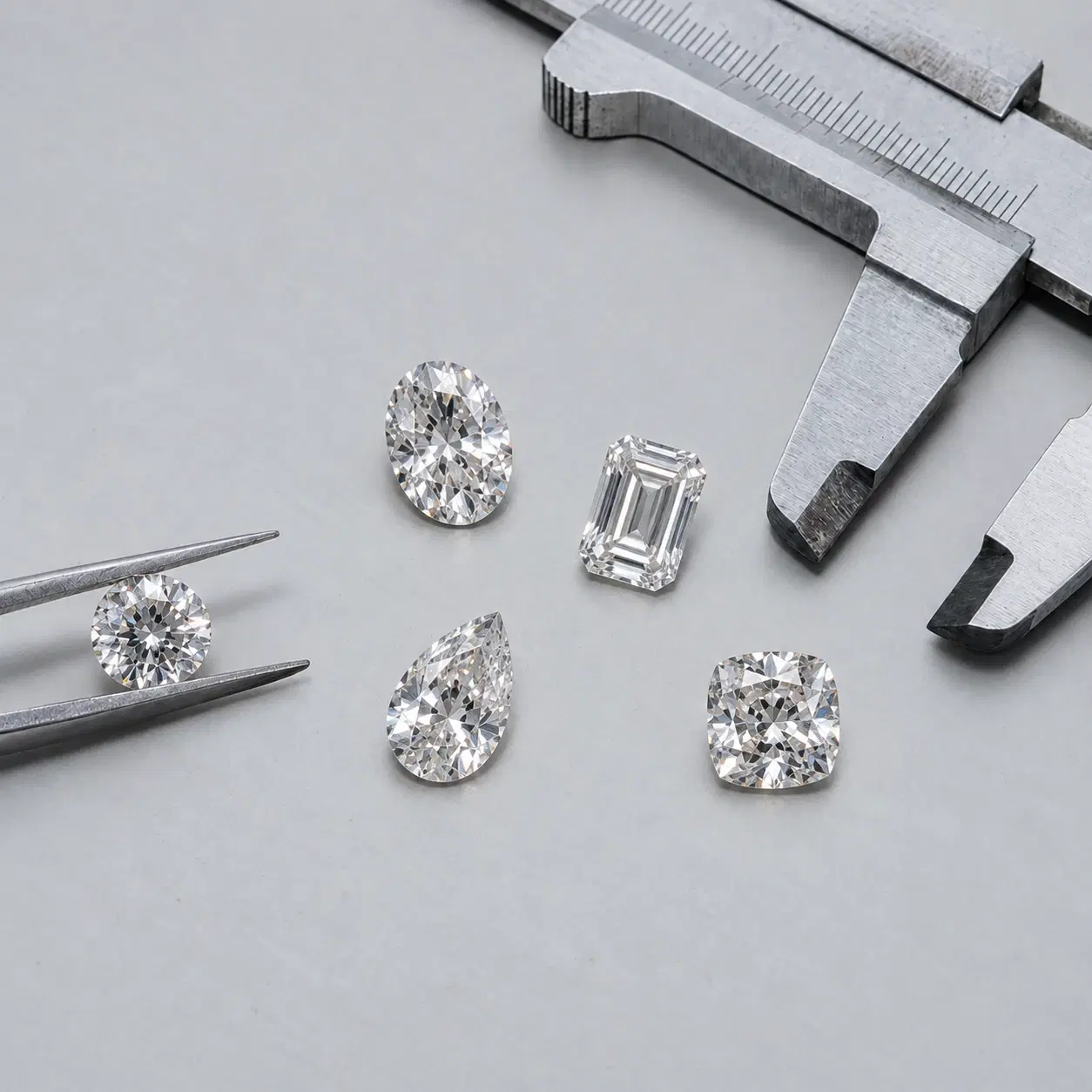
A 1.00-carat G/VS2 round diamond and a 1.00-carat D/VS1 round diamond do not represent the same specification. Likewise, a two-carat oval, round and emerald-cut diamond should not automatically be expected to carry the same price simply because their weights are similar.
For that reason, this guide does not publish a third-party market price chart or use another company's advertised prices as a substitute for Uniglo pricing.
For a useful comparison, request current Uniglo quotations for diamonds with reasonably similar specifications and keep the following information beside each price:
| Pricing factor | What to compare |
|---|---|
| Exact carat weight | Use the stone’s actual weight rather than only a broad “1 carat” or “2 carat” category |
| Shape | Compare like-for-like shapes where possible |
| Colour | Keep the colour grade or grade range reasonably consistent |
| Clarity | Compare the recorded clarity grade and relevant characteristics |
| Cut and finish | Review applicable cut information, proportions, polish and symmetry |
| Measurements | Compare the stone’s actual length, width and depth |
| Laboratory report | Confirm the issuing laboratory and report details |
| Price basis | Establish whether the quotation is per carat or for the whole stone |
| Included costs | Confirm taxes, delivery, setting or other charges separately |
This approach makes it easier to understand why one natural diamond costs more than another without relying on an outside commercial price chart.
For current Uniglo options, browse the natural diamond inventory or request a quotation for the specification you are considering.
How much does a 1 carat natural diamond cost?
A one-carat budget needs a more specific brief than weight alone. Start with your preferred shape, then compare a small selection with documented colour, clarity and cutting information. Decide whether the budget covers the loose stone or the complete jewellery piece.
There can also be a price difference around the one-carat threshold. GIA identifies 1.00 carat as a desirable milestone and explains that a 0.99-carat stone can look very similar while carrying a different price. The comparison still depends on the individual diamonds. GIA’s guidance on carat thresholds.
If the exact weight is flexible, ask to compare available stones just below and above one carat. Review their millimetre measurements and appearance together. A saving is useful when the alternative still meets your preferences for the finished piece.
Keep changes in specifications visible. If one quotation describes a one-carat G/VS2 round and another describes a one-carat I/SI1 cushion, the price difference combines several factors. It cannot show what changing clarity alone would save.
For a current amount, use the specification of the actual Uniglo diamond rather than applying a general one-carat market figure.
How much does a 2 carat natural diamond cost?
Doubling a one-carat quotation is not a reliable way to budget for a two-carat natural diamond. Larger diamonds of comparable colour, clarity and cut are rarer, which can increase the price as weight rises. GIA’s explanation of weight, rarity and price.
Request two-carat quotations directly. Keep the shape and intended quality range consistent, and compare both the whole-stone amount and the price per carat. Ask the seller to explain substantial differences between options and provide images or videos of the actual stones.
For a ring, establish how much of the budget remains for the setting and any additional diamonds. A two-carat centre stone and a ring advertised as two carats in total can involve different stone sizes. Ask for the centre-stone weight separately from the combined weight of all diamonds.
If you are considering a larger centre stone, our three-carat natural diamond price guide addresses that weight more specifically.
Natural diamond price per carat: how the calculation works
The basic calculation is:
Whole-stone price = price per carat × actual carat weight.
For example, suppose a hypothetical 1.20-carat diamond is quoted at €4,000 per carat. Its stone price is €4,800, before any charges excluded from that quotation. The €4,000 figure is an illustrative input, not a market estimate or Uniglo offer.
You can also work backwards. Divide the whole-stone amount by the carat weight to calculate the price per carat. Use amounts with the same inclusions when comparing the result: a tax-inclusive price per carat and a tax-exclusive figure are different bases.
This calculation helps organise quotations. It does not establish equivalent quality. A lower price per carat may accompany differences in shape, cutting, colour, clarity or other characteristics that need examination.
Why natural diamonds with similar descriptions have different prices
Cutting and the individual stone’s appearance
Cutting influences how a diamond interacts with light. A GIA cut grade encompasses a range of proportion combinations, so two round diamonds with the same cut grade can still differ in their proportions and appearance. GIA’s diamond cut guidance.
When a seller attributes a premium to better cutting, ask for the information supporting that description. Review the relevant report assessment, proportions and imagery of the actual stone. Compare videos under similar lighting and consider which appearance you prefer.
A shape label also needs context. Compare round diamonds with rounds when investigating a price difference within that category. If you prefer an oval, pear or emerald shape, build a separate shortlist for that shape instead of applying a round-diamond benchmark directly.
Colour and clarity differences
Colour distinctions can affect natural diamond prices even when they are subtle. Laboratories assess colour under controlled conditions using reference stones; photographs taken in different lighting do not reproduce that comparison. GIA’s explanation of diamond colour.
Clarity grades also summarise different combinations of characteristics. Their size, position, nature, number and visibility matter to the assessment. Two diamonds in the same clarity category can have different inclusions and blemishes. GIA’s clarity guidance.
Ask what a proposed change in colour or clarity would mean for the individual stone you are considering. Compare the actual appearance and the revised price before deciding whether the higher grade is worth the difference to you. Our diamond 4Cs guide explains the grading foundations.
Fluorescence and treatment information
Fluorescence can contribute to pricing differences. GIA notes that some higher-colour diamonds with very strong fluorescence sell for less than comparable stones without fluorescence, even when their appearance is largely unaffected. This does not establish a standard discount for every fluorescent diamond. GIA’s fluorescence guidance.
If fluorescence helps explain a lower quotation, review the diamond’s transparency and appearance in different lighting. Our diamond fluorescence guide covers that assessment in more detail.
Treatment status matters too. A natural diamond may have undergone a process to change its colour or clarity. Ask what has been disclosed and what the laboratory report records before comparing its price with an untreated stone. GIA’s diamond treatment guidance.
The report and the seller’s offer
Establish which laboratory assessed each diamond and read the document behind the listing. GIA’s natural Diamond Grading Report records quality characteristics and proportions; its overall cut grade applies to standard round brilliants in the D-to-Z colour range. GIA’s sample natural diamond reports.
A seller’s description such as “ideal” or “premium” therefore needs an explanation, particularly when comparing different shapes or laboratories. Ask who assigned the term and what it covers. Our diamond certificates guide introduces the documents used in diamond buying.
If you are comparing multiple current quotations, make sure the diamonds and included services are genuinely comparable. Confirm availability, inspection, payment conditions and delivery before interpreting a price difference. A matching report number can help identify the stone, but it does not establish identical purchase terms.
What should a natural diamond quotation include?
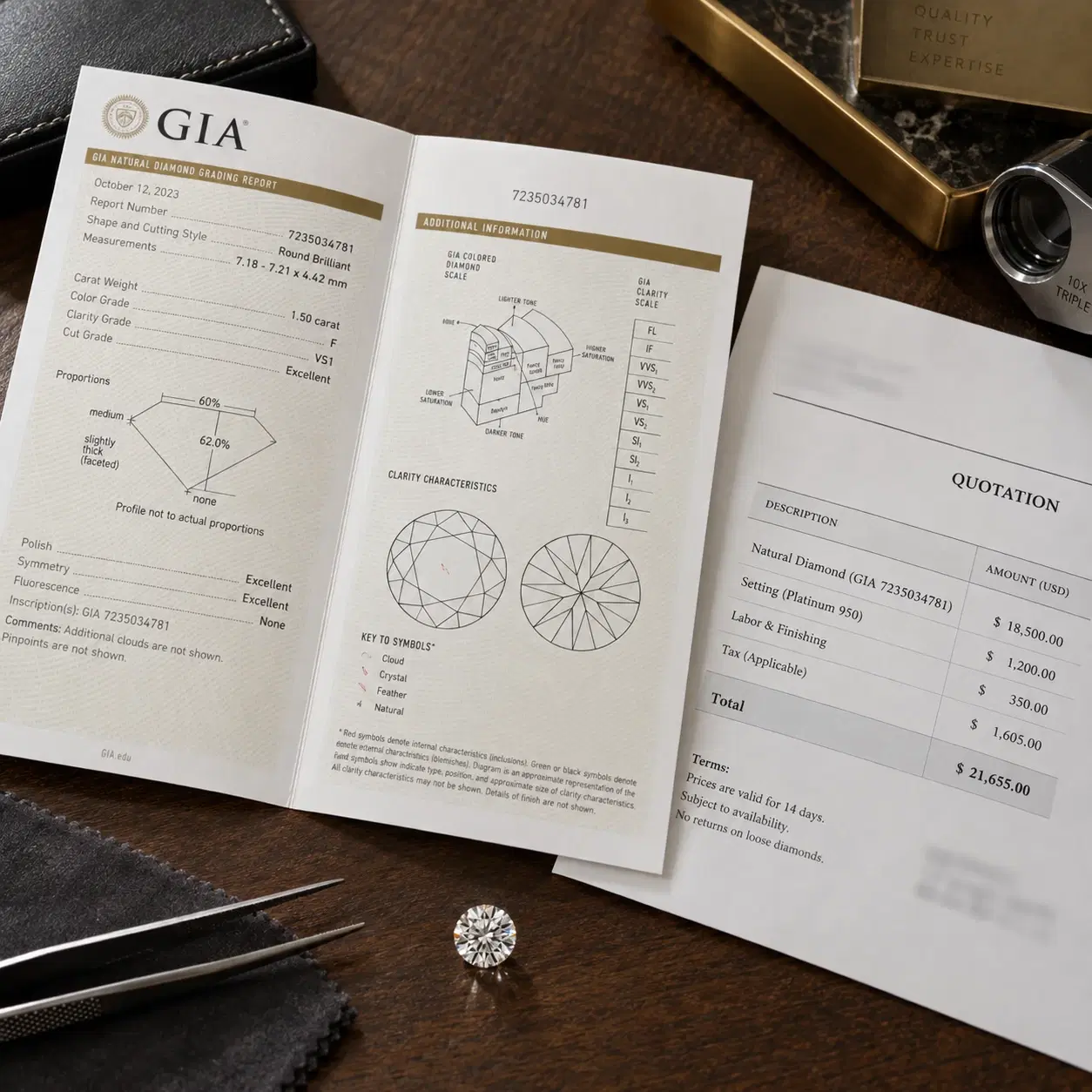
A useful quotation connects the price to an identifiable diamond. Ask for the stock or report reference, exact carat weight, shape, assessed characteristics and quotation date. Keep the report and any individual-stone imagery with that quotation so you can review the offer together.
The amount should have a clear basis. Confirm the currency, whether it is per carat or for the whole diamond, and whether applicable taxes are included. Ask how long the quotation remains valid and whether the price depends on a particular payment method.
Delivery also belongs in the comparison. Establish the amount payable for delivery to your destination, what insurance is included and whether any import charges would be payable separately. If one of these amounts remains unknown, your total purchase cost remains incomplete.
For finished jewellery, request a breakdown identifying the centre diamond, metal, setting work and additional stones. Confirm whether services such as sizing or engraving are included when they form part of your order.
Finally, read the inspection, return and aftercare terms alongside the price. Where an upgrade or buyback arrangement is available, assess its written conditions separately. Ask what restrictions, deductions or future spending requirements apply.
A worked comparison of two diamond quotations
Consider this hypothetical comparison for the same individual loose diamond. The amounts below are invented to demonstrate the calculation.
| Quotation item | Offer A | Offer B |
|---|---|---|
| Whole-stone price, including applicable taxes | €4,800 | €4,900 |
| Insured delivery to the agreed destination | €80 | Included |
| Other payable charges | None in this example | None in this example |
| Total payable | €4,880 | €4,900 |
The initial difference between the stone prices is €100. Once delivery is included, the difference is €20. You can then compare the remaining service and purchase terms to understand the complete offers.
If the quotations describe different diamonds, first review the differences between the stones. Equal carat weights and matching headline grades do not make this a comparison of the same product.
The figures above are purely mathematical illustrations. They are not current Uniglo diamond prices.
Comparing natural diamond prices in euros, pounds and dollars
Keep the original currency visible when collecting prices. A quotation expressed in dollars and another expressed in euros may differ in their tax treatment, delivery destination and payment basis as well as currency.
For a practical comparison, ask for a quotation in the currency you expect to pay. If conversion is required, record the exchange rate and date used and check any conversion charges applied by the payment provider. A converted research figure is only a comparison aid; the payable amount comes from the agreed transaction terms.
Buyers comparing quotations from different locations should use the same destination and purchase brief for each enquiry. A seller’s location or a “wholesale” label does not establish the lowest complete price for a particular diamond.
How to work within your natural diamond budget
Start with the amount you want to spend on the finished purchase. Set aside the expected setting and delivery costs, then use the remaining amount to discuss suitable loose stones.
Ask for a small selection showing clear alternatives. For example, one option might keep your preferred dimensions while changing colour or clarity; another might retain the requested grades at a slightly different weight. Comparing those choices shows what each adjustment achieves within your budget.
Make one preference change at a time where possible. If shape, weight, colour and clarity all change together, it becomes difficult to understand which compromise produced the saving. Examine the individual stones before deciding that the lowest quotation provides the best fit.
If you are considering both diamond origins, review our lab grown diamond price guide alongside comparable natural-diamond quotations. Keep each stone’s origin explicit throughout the comparison.
Frequently asked questions
Is there one standard price for a 1 carat natural diamond?
No. One-carat natural diamonds can differ in shape, colour, clarity, cut, measurements, fluorescence, treatment status and other characteristics. Current pricing should therefore be attached to an identifiable diamond rather than one general carat figure.
Why can a two-carat natural diamond cost more than twice a one-carat diamond?
The price per carat can increase with weight because larger diamonds of comparable quality are rarer. A two-carat budget therefore needs quotations for two-carat stones. GIA’s guidance on carat weight and value.
Is price per carat the same as the total price?
No. Multiply the price per carat by the diamond’s weight to calculate its stone price. Then account for any taxes, setting costs, delivery or other charges excluded from the original amount.
Does a higher clarity grade always justify a higher budget?
Decide after comparing the individual stones. Ask what the grade difference means for visible appearance and whether the higher-graded option delivers something you value. A grade is useful information, but your purchase decision also includes the price and intended jewellery piece.
Does the quoted diamond price include the ring setting?
Check the quotation. A loose-stone price normally identifies the diamond component, while a finished-ring quotation should explain the setting and other included elements. Request a breakdown if the description is unclear.
How can I get a current natural diamond price from Uniglo?
Send the stock reference of a diamond you are considering, or describe your preferred shape, weight, quality range and budget. Include your delivery destination and whether you want a loose stone or a finished jewellery quotation.
Request a natural diamond quotation
Explore our natural diamond inventory or contact Uniglo Diamonds with your requirements.
Ask for a current quotation linked to the individual stone’s specifications and documentation. Confirm the whole-stone amount, currency and included charges so you can compare the complete offer with your budget.