IGI Certified Lab-Grown Diamonds: How to Read Your Report
An IGI-certified lab-grown diamond is a laboratory-grown diamond examined and graded by the International Gemological Institute. Its report identifies its laboratory-grown origin and records assessed characteristics. Buyers often call this document an “IGI certificate”, although IGI describes it as a laboratory report. IGI’s laboratory-grown diamond report explains the service.
The report becomes most useful when you can connect its information to the diamond you are considering. What do the measurements tell you? Is an Excellent symmetry grade also an Excellent cut grade? Does an online report match prove that the stone in front of you is the same diamond?
This guide explains how to read those details, recognise the limits of the document and ask more precise questions before choosing a stone.
Start with the diamond’s identity and the report type
Check the description before comparing grades. The report should identify the diamond as laboratory-grown. The IGI name alone does not establish origin: IGI examines natural diamonds, laboratory-grown diamonds and other gemstones.
IGI describes a screening process that distinguishes natural, laboratory-grown and simulant material. Its grading workflow also uses identification numbers to conceal owner information from graders. These procedures support identification and assessment; they do not mean that every graded diamond receives the highest grades. IGI’s grading process
Next, establish what was examined. A report for an individual loose diamond and a report for a completed ring have different scopes. If you are choosing a centre stone, ask which document describes that particular diamond and whether it was assessed before or after mounting.
What to check on an IGI lab-grown diamond report
Begin with the identifying details, then read the grading results and supporting information together. IGI’s report-reading guide describes the main fields and notes that reports may include proportion diagrams and clarity plots.
| Report detail | What to check |
|---|---|
| Report number and date | Match these with the document supplied for the stone. |
| Description | Confirm laboratory-grown origin. |
| Shape and cutting style | Check that the wording corresponds to the offered diamond. |
| Measurements | Compare the millimetre dimensions with the listing. |
| Carat weight | Confirm the weight of the individual diamond. |
| Colour and clarity | Read the actual grades, including any ranges or qualifications. |
| Cut, polish and symmetry | Identify which separate assessments are recorded. |
| Comments and inscriptions | Read the complete entries and investigate unexplained differences. |
Do not rely on a cropped screenshot containing only colour, clarity and carat weight. Request the complete document so that qualifications, comments and identification details remain visible.
Read carat weight alongside the measurements
Carat measures weight: one carat equals 0.2 grams. It does not specify a diamond’s visible diameter or length. Two diamonds with the same weight can have different dimensions and appear different in size. IGI’s carat-weight guide
When comparing stones, place their millimetre measurements beside their carat weights. For an elongated shape, look at both length and width. A longer stone is not necessarily wider, and an impressive length alone may not describe the appearance you want.
For example, an illustrative oval measuring 10.00 × 7.00 mm has a length-to-width ratio of approximately 1.43. That calculation describes its outline; it does not establish its cut quality.
Also distinguish an individual diamond’s weight from a jewellery listing’s total diamond weight. Ask for the centre-stone weight separately when a ring includes surrounding diamonds. This prevents you from comparing a complete ring’s combined weight with another listing’s single centre stone.
Understand what the colour grade describes
For diamonds in the normal colour range, IGI uses the D–Z scale. D–F belongs to the colourless category, while G–J is near-colourless. Fancy-colour diamonds use a different assessment framework. IGI evaluates normal-range colour under controlled conditions, using comparison stones. IGI’s colour guide
The grade and a photograph answer different questions. A report records the laboratory assessment; a photograph shows the diamond under particular lighting, camera settings and surroundings. IGI notes that shape, cut, mounting and lighting can affect perceived colour.
When comparing shortlisted diamonds, request images or videos taken under similar conditions. If the setting metal is already chosen, discuss how each stone looks in that context.
There is no need to select a colour grade solely because it is the highest available. Decide whether the difference matters to your eyes, your design and your budget.
Interpret clarity beyond the letters
IGI assesses clarity at 10× magnification, considering characteristics such as their size, position, nature and visibility. Its scale includes Internally Flawless, VVS, VS, SI and Included categories. A grade describes the assessment under magnification; it is not a photograph of what you will see during everyday wear. IGI’s clarity guide
Ask where the relevant characteristics are located and whether they are noticeable without magnification. A seller’s “eye-clean” description should come with an explanation of the viewing conditions, including distance, lighting and whether the stone was examined face-up.
If the report includes a clarity plot, use it to guide those questions. Ask the seller to point out the corresponding areas in a magnified video. This makes the discussion more useful than asking whether a clarity grade is simply “good”.
Keep the viewing scale in mind, too. An inclusion that looks prominent in an enlarged image should also be assessed at a realistic viewing size. Conversely, a distant photograph may not provide enough detail to answer your questions.
Separate cut grade, polish and symmetry
These fields describe related but different aspects of craftsmanship. Polish concerns the finish of the facet surfaces. Symmetry concerns the alignment and arrangement of the diamond’s features. Neither field, by itself, establishes an overall cut grade. IGI’s terminology glossary
For a round brilliant, read the actual cut grade recorded on the report, then examine the supporting proportions and finish grades. If a retailer uses an additional description such as “premium”, ask how it relates to the laboratory’s assessment.
IGI also offers cut grading for fancy-shaped diamonds. It is optional, so an overall cut grade will not necessarily appear on every fancy-shape report. IGI’s grading process
Its fancy-shape method combines finish assessment, proportion checks, shape-specific craftsmanship requirements and light-return assessment. The scale runs from Excellent to Poor. Proportions alone are insufficient, and IGI distinguishes its fancy-shape light-return assessment from a full assessment of fire and scintillation. IGI’s cut-grading methodology
Consequently, an oval with Excellent polish and Excellent symmetry should not automatically be described as having an IGI Excellent overall cut grade. Check whether that separate grade is actually present.
Use the report to narrow your shortlist, then compare the stones in motion. Ask for a slow video that lets you examine the centre, edges and changing pattern of bright and dark areas.
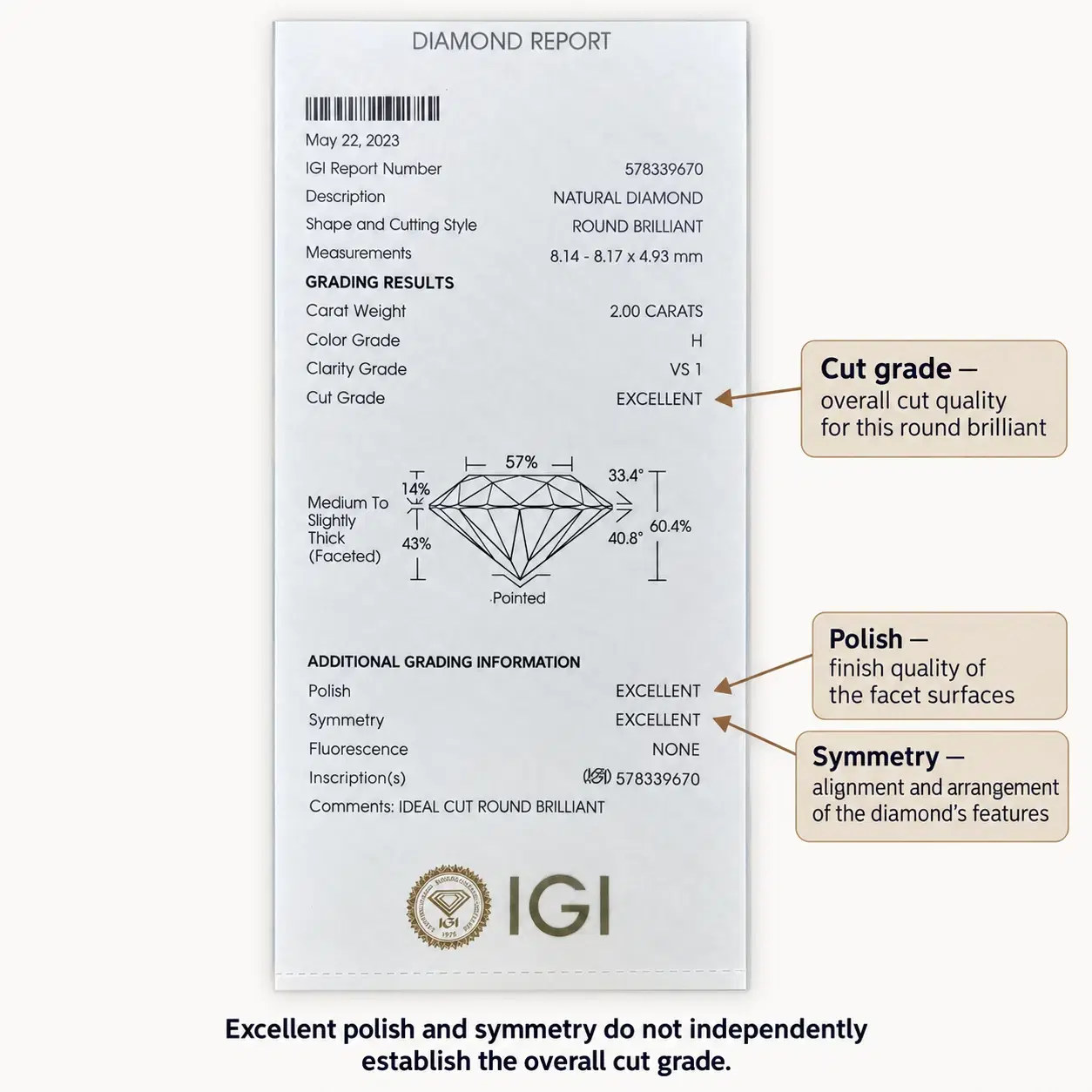
Illustrative sample. Check the actual diamond and its laboratory document.
Put proportions and fluorescence in context
A proportions diagram can help you understand how the diamond’s weight is distributed. Table size, depth and other recorded measurements provide additional context, but a single percentage should not become a substitute for assessing the entire stone.
When a seller recommends a diamond because of its proportions, ask them to explain the recommendation using the report and the actual video. This connects the numbers to something you can evaluate.
Fluorescence describes a diamond’s reaction to ultraviolet light. It is a separate characteristic from colour and clarity. IGI’s explanation of fluorescence assessment
If fluorescence is relevant to your shortlist, ask to see the diamond under appropriate viewing conditions. Avoid drawing conclusions about overall beauty from that field alone, or assuming that a fluorescence entry answers every question about transparency and appearance.
Read growth-method and treatment comments carefully
A report may contain information about the growth process or subsequent treatment. IGI states that the growth process and presence of treatments can be included in the comments section upon request. This information should therefore be checked on the particular document rather than assumed to appear on every report. IGI’s laboratory-grown reporting service
Growth-method information describes how the diamond was created. Treatment information addresses a separate question about processing. Read the complete wording instead of interpreting a short abbreviation in isolation.
If the seller makes a specific claim about growth method or the absence of treatment, ask what documentation supports it. A blank comments section is not sufficient evidence for an “untreated” claim.
You can ask: “Does the report explicitly support this description, or is there additional documentation I should review?” This keeps the discussion tied to the individual stone.
Verify the report, then match it to the diamond
Verification involves checking both the document and its connection to the stone being offered. Looking up a report number checks an online record; it does not physically examine a diamond.
Check the online record
Open IGI’s official report-verification page and enter the report number yourself. Compare the result with the complete report supplied by the seller.
Check the description, shape, measurements, carat weight, colour, clarity and any relevant comments. Compare these details with the listing as well. If a listing rounds a measurement or uses a different description, ask for clarification before treating the records as a match.
Keep a copy of the report alongside the listing and order details. This gives you a consistent set of references when discussing the purchase.
Check the physical diamond
IGI’s Laserscribe service places identifying characters on a diamond’s girdle, its outer edge. A report-number inscription helps connect the stone to its documentation. IGI’s inscription service
Ask a jeweller or gemmologist to examine the inscription under magnification and compare it with the report’s inscription entry. They can also compare accessible measurements and other identifying features.
If the diamond is mounted and the inscription cannot be seen clearly, ask what can be checked without disturbing the setting. Do not assume that an unsuccessful viewing attempt proves the inscription is absent.
Resolve discrepancies before proceeding
If a number, measurement or description does not agree, request a clear explanation and the correct documentation. An unsuccessful online lookup should also be resolved with the seller or IGI.
Pause the purchase while a material mismatch remains unresolved. A convincing photograph of a report should not replace a consistent connection between the document, the listing and the stone.
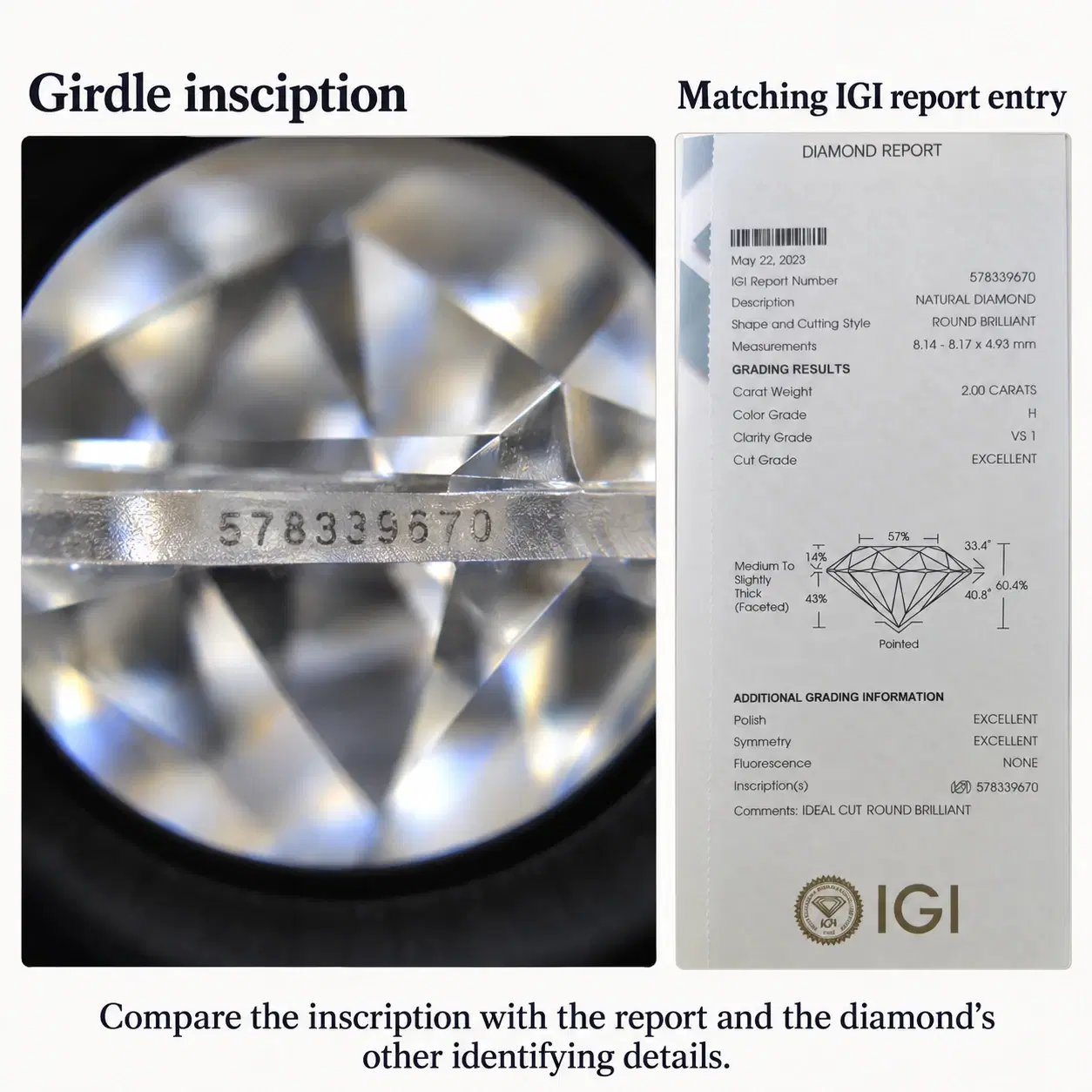
Illustrative sample. Check the actual diamond and its laboratory document.
Understand the limits of a finished-jewellery report
IGI also issues reports for finished jewellery. These describe the article and its gemstones, with assessments made within the limits of the mounting.
IGI explains that where grading is performed as the mounting permits, colour and clarity may be expressed as ranges, and cut may be estimated. Where a stone was graded before mounting, the report can state that and use the corresponding grading information. IGI’s jewellery-report guidance
A range such as D–E should therefore be read as a range. It should not automatically become “D colour” in a product description.
For a ring with several diamonds, establish which entries apply to the centre stone and which describe accompanying stones. Ask whether the centre has its own loose-diamond report and whether the jewellery document refers to it.
This distinction is especially useful when comparing a loose stone with an already completed ring. Before comparing specifications, make sure you understand how each set of grades was obtained.
Use the report to make a more informed shortlist
Consider an illustrative listing for a 2.00 ct oval with F colour, VS1 clarity and measurements of 10.00 × 7.00 × 4.40 mm. These are example figures, not an offer of Uniglo stock.
The weight tells you its mass. The measurements describe its dimensions. The colour and clarity grades give you laboratory assessments. You would still need to check whether an overall cut grade is recorded, review any comments, verify the report and examine the diamond’s appearance.
Now imagine a second listing with the same carat weight, colour and clarity. You should still compare the dimensions, available cut information, images and documentation before deciding that the two stones are equivalent.
A useful shortlist keeps each diamond’s report, video and quotation together. When something is missing, write down the unanswered question rather than filling the gap with an assumption. This makes it easier to compare the actual options.
What an IGI report does not establish
A grading report does not set the diamond’s selling price or promise a future resale amount. An appraisal is a separate type of document that addresses value for a stated purpose. IGI distinguishes its appraisal services from its grading reports. IGI’s appraisal information
Likewise, laboratory-grown origin does not by itself document a producer’s energy use or substantiate a specific environmental claim. If those factors matter to your purchase, request supporting evidence for the claim being made. IGI’s educational guidance discusses the need for separate sustainability credentials. IGI’s lab-grown diamond guidance
Treat the report as one part of the purchase documentation. The quotation, sales terms, physical inspection and any additional claims each need their own supporting information.
Choosing an IGI-reported diamond with Uniglo
When enquiring about a diamond, share your preferred shape, approximate carat range, budget and any report requirements. Ask for the complete IGI report for the specific stone, its current availability and images or video that help answer your remaining questions.
You can explore the lab-grown diamond inventory or use our loose lab-grown diamond guide when planning a custom piece.
Jewellers and trade buyers can visit our IGI-certified lab-grown diamond wholesale page for enquiries about commercial sourcing.
Frequently asked questions
Are IGI-certified lab-grown diamonds real diamonds?
Yes. Laboratory-grown diamonds are diamonds, while moissanite and cubic zirconia are different materials. The report’s description should identify which material and origin were established. IGI’s explanation of laboratory-grown diamonds
Does IGI only grade lab-grown diamonds?
No. IGI also provides reports for natural diamonds and other gemstones. Always read the description on the individual report rather than using the laboratory’s name to infer origin. See IGI’s report services.
Can I check a report if I have lost the paper copy?
Use the report number to look for the digital record through IGI’s verification service. If you do not have the number, ask the seller for the original documentation or ask a jeweller to examine an accessible inscription.
What should I do if the report and listing disagree?
Ask the seller to identify the correct details and provide a consistent listing, report and quotation for the same stone. Do not choose whichever version offers the more favourable grade. Resolve the difference before ordering.
How much does an IGI lab-grown diamond report cost?
Request a current quotation from IGI for the service you need, specifying the stone or jewellery item and requested report. When buying an already graded diamond, ask the seller whether its quotation includes the report and whether any additional service is being charged separately.
Should I choose an IGI report or a GIA report?
Compare the actual documents available for the diamonds you are considering. Establish what each report assesses, how its results are expressed and whether the information answers your questions. Our GIA lab-grown diamond report guide explains that laboratory’s reporting separately.