Lab Grown Diamonds vs Cubic Zirconia
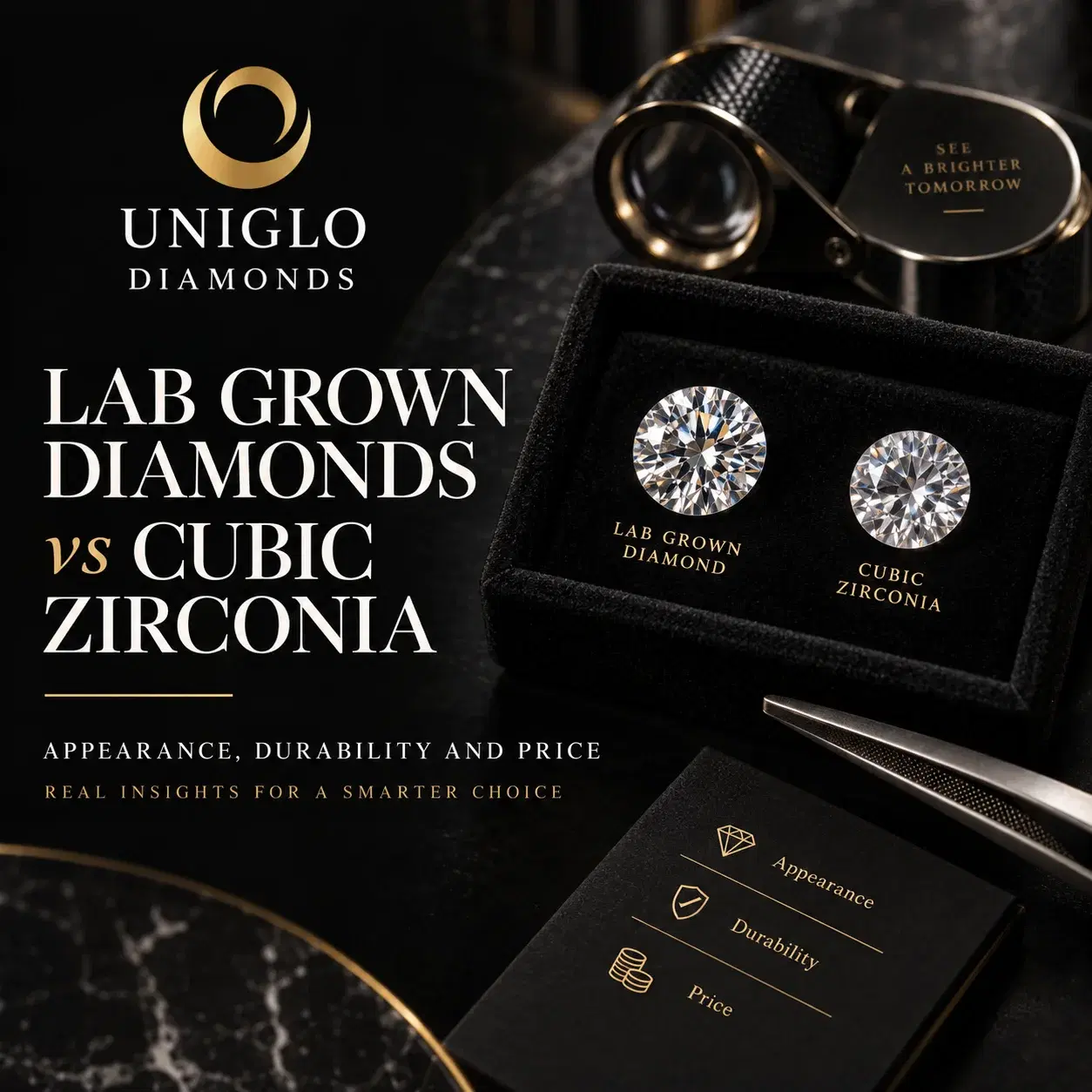
A laboratory-grown diamond is diamond, while cubic zirconia is a different synthetic material used as a diamond simulant. They can both be colourless, transparent and faceted for jewellery, but their chemical composition, optical behaviour, hardness, density, documentation and price are different.
Laboratory-grown diamonds have the carbon crystal structure of diamond and nearly the same chemical, optical and physical properties as natural diamonds. Their laboratory origin describes how they were produced. Cubic zirconia, commonly abbreviated to CZ, is stabilised cubic zirconium oxide. It may be manufactured in a laboratory, but that does not make it a laboratory-grown diamond.
GIA classifies cubic zirconia as a diamond simulant and explains that simulants are unrelated to diamond at the atomic level. GIA separately describes laboratory-grown diamonds as having diamond’s crystal structure of tightly bonded carbon atoms. GIA’s guide to simulants and laboratory-grown diamonds.
The right choice depends on what you expect the jewellery to be. Decide whether owning a diamond matters, how frequently the piece will be worn, how you want it to look over time and what information should support the purchase.
Lab grown diamond vs cubic zirconia at a glance
| Comparison | Laboratory-grown diamond | Cubic zirconia |
|---|---|---|
| Material identity | Diamond, composed primarily of carbon | Synthetic cubic zirconium oxide |
| Relationship to natural diamond | Same crystal structure and nearly the same chemical, optical and physical properties | Different material that can imitate the appearance of diamond |
| Common role in jewellery | Centre stone, accent stone or diamond jewellery material | Diamond simulant or gemstone material in its own right |
| Mohs hardness | 10 | Approximately 8–8.5 |
| Density | Lower than cubic zirconia | Higher than diamond, so equal dimensions do not produce equal weights |
| Light effects | Brightness, fire and scintillation depend on diamond material and cutting | Can show noticeable coloured fire; appearance also depends on cutting and condition |
| Size comparison | Reported in actual carat weight and millimetre measurements | Check actual weight, millimetres and any seller-defined equivalent-size description |
| Documentation | A laboratory report can confirm laboratory-grown diamond identity and assessed characteristics | A seller card or identification document must clearly state cubic zirconia and its purpose |
| Buying priority | Owning a diamond with documented characteristics | Obtaining a diamond-like visual effect at a lower purchase price |
These differences are material facts rather than quality rankings. A well-made cubic zirconia piece can satisfy a buyer who knowingly wants CZ, while it would be unsuitable for someone whose requirement specifically states diamond.
Cubic zirconia is not a type of diamond
The phrase “lab created” can describe many different manufactured materials. It does not identify the gemstone by itself.
A laboratory-grown diamond is produced through a process such as high pressure, high temperature growth or chemical vapour deposition. The resulting crystal is diamond. Advanced gemmological testing can distinguish its growth origin from that of a natural diamond, while confirming that the material is diamond. GIA’s explanation of laboratory-grown diamonds.
Cubic zirconia is manufactured from a different compound. GIA’s research describes colourless CZ as a diamond imitation and records physical and optical properties that enable it to be separated from diamond. GIA’s research on cubic zirconia.
The word zirconia can also cause confusion with zircon, which is a separate natural mineral. A listing should state cubic zirconia or CZ rather than relying on vague wording such as “zircon”, “American diamond”, “created stone” or “diamond alternative”.
Before paying, ask the seller to put the gemstone identity on the quotation or invoice. A product advertised as laboratory-grown diamond should not contain cubic zirconia unless CZ accent stones are separately and clearly disclosed.
For the wider explanation of diamond identity and origin, read are lab grown diamonds real?.
Appearance: both can sparkle, but they do not behave identically
Diamond appearance includes brightness, fire and scintillation. Brightness concerns reflected white light, fire describes flashes of colour and scintillation includes the flashes and changing pattern of light and dark seen as the diamond moves. Facet arrangement, proportions, polish and symmetry influence the result. GIA’s diamond cut guidance.
Cubic zirconia also reflects and disperses light. Its optical properties can produce a bright appearance with noticeable coloured flashes. GIA’s technical research records a higher dispersion range for cubic zirconia than for diamond, while also documenting differences in refractive index and other identifying properties. GIA’s cubic zirconia study.
That does not mean every CZ will show more attractive fire or that every diamond will look the same. Cutting quality, stone condition, lighting and surface cleanliness affect both materials.
Compare actual pieces under consistent conditions:
- View them in soft indoor light as well as focused jewellery lighting.
- Move each piece slowly and observe white reflections, coloured flashes and contrast.
- Compare them at the distance from which the jewellery will normally be seen.
- Check whether fingerprints, oil or dust are affecting one stone more than the other.
- Use magnified images to examine workmanship, then return to a realistic viewing scale.
A heavily edited video or a single bright spotlight can exaggerate sparkle. The useful comparison is how the individual stone looks in the environments where it will be worn.
Cut descriptions do not transfer automatically between materials
Diamond quality terminology has a defined context. A laboratory report may assess a diamond’s shape, cutting style, measurements, polish, symmetry and, where the service applies, overall cut quality.
A cubic zirconia listing may use familiar expressions such as “ideal cut”, “D colour”, “VVS” or “five-star quality”. Establish who created those descriptions and what standards they represent. A seller’s CZ quality category is not a GIA or IGI diamond grade.
The shape name can still be useful. Round, oval, cushion, radiant, pear and emerald describe recognisable outlines, but two stones carrying the same shape name may have different facet arrangements and proportions.
Compare the actual dimensions, outline and workmanship. Look for balanced symmetry, secure setting, consistent facet junctions and a finish that suits the intended jewellery piece.
Durability and regular wear
Diamond is the hardest gemstone on the Mohs scale, with a hardness of 10. Cubic zirconia is commonly reported around 8–8.5. GIA’s cubic zirconia research records a hardness range of approximately 8.0–8.5. GIA’s technical data for cubic zirconia.
Hardness measures resistance to scratching. It does not mean that diamond cannot chip, break or become loose in a damaged setting. Toughness, cleavage, stone shape and the construction of the complete piece also affect durability.
The hardness difference matters over time. Cubic zirconia is more susceptible to surface scratching and abrasion than diamond. Wear can soften facet edges and reduce the crispness of the polish, particularly in jewellery exposed to frequent contact.
A laboratory-grown diamond is more resistant to scratching, but it can still collect oil, soap and cosmetic residue. A dirty diamond may look dull even when its surface is undamaged. Cleaning restores the visible surface when residue is the cause; it does not repair chips or scratches.
For either material, inspect the setting as well as the stone. Loose prongs, worn metal and impact damage can create problems regardless of gemstone hardness. GIA advises checking jewellery for loose stones and avoiding methods that may damage the gemstone or setting. GIA’s diamond care guidance.
Does cubic zirconia become cloudy?
Cubic zirconia is often described as becoming cloudy, but several different changes may be grouped under that word.
Oil, lotion, soap and dust can form a film on the surface. This residue may be removable with cleaning appropriate to the stone and jewellery construction. Scratches and abrasion are different: they physically affect the polish and cannot be removed by ordinary washing.
Inspect the stone when it is clean and dry. If dullness remains, ask a jeweller whether the problem is surface wear, damage, a loose setting or residue in areas that are difficult to reach.
A laboratory-grown diamond can also look less bright when dirty. Diamond attracts grease readily, so surface contamination can interfere with light entering and leaving the stone. Neither material should be judged before the piece has been safely cleaned.
Measurements: compare millimetres rather than carat labels
Carat is a unit of weight. One metric carat equals 200 milligrams, and the figure does not directly state a stone’s face-up length or width. GIA’s explanation of carat weight.
Material density creates an additional issue when comparing diamond and cubic zirconia. GIA’s technical data shows that cubic zirconia has a substantially higher specific gravity than diamond. A CZ and a diamond cut to the same millimetre dimensions will therefore not have the same actual carat weight. GIA’s cubic zirconia properties.
For example, an 8 mm round cubic zirconia and an 8 mm round diamond share the stated diameter. They do not automatically share depth, facet design or weight. Calling both “two carat” without explaining the measurement basis can create a misleading comparison.
When reviewing a listing, separate these fields:
| Size field | What it tells you |
|---|---|
| Actual carat weight | The measured weight of that stone |
| Length × width × depth | Its recorded external dimensions in millimetres |
| Diameter | The measured span used for a round stone, often stated as minimum and maximum values on diamond reports |
| Equivalent weight | A seller’s approximation of how the visible size compares with another material; confirm the definition |
| Total carat weight | The combined weight of multiple stones, which is different from the weight of one centre stone |
Use millimetres to compare visible dimensions across materials. Use actual carat weight only as the weight of the material being described.
Our diamond size chart explains how measurements and carat weight work together for diamonds.
Documentation and gemstone identification
A laboratory-grown diamond report can confirm that the examined stone is diamond of laboratory origin and document the characteristics included in that service. IGI states that its laboratory-grown diamond reports provide origin and quality information and that its laboratory screens stones to separate natural, laboratory-grown and simulant materials. IGI’s laboratory-grown diamond report guidance.
GIA also explains that professional laboratories use advanced gemmological and spectroscopic techniques to distinguish natural diamonds, laboratory-grown diamonds and simulants. GIA’s identification guidance.
A card supplied with cubic zirconia may describe the product, brand, warranty or seller’s quality category. It should not be presented as though it were a diamond grading report. Read the issuer, material description and purpose of every document.
For a laboratory-grown diamond purchase, check:
- the issuing laboratory and report service;
- the origin statement;
- the report number and verification method;
- shape, measurements and carat weight;
- the quality information covered by the service;
- comments about growth or treatment where provided;
- whether any inscription corresponds with the document.
For a cubic zirconia purchase, confirm that the invoice accurately states CZ, the dimensions or actual weight, the metal and the applicable product terms.
Our diamond certificates guide explains how identification reports, grading reports, appraisals and seller documents differ.
Can a diamond tester distinguish cubic zirconia?
Some screening instruments use thermal or electrical properties to separate materials. Cubic zirconia and diamond have different responses, but a consumer tester result should not be treated as a complete gemstone identification.
The instrument’s design, calibration, stone size, setting, contact point, temperature and operator technique can affect testing. A tester may also be designed to answer only a narrow question, such as whether a material behaves like diamond under one measurement.
Do not rely on scratch tests, fog tests, newspaper tests or attempts to judge weight by hand. These methods can be inconclusive, damage jewellery or create false confidence.
When identity matters, use appropriate documentation and professional examination. GIA notes that advanced testing can confidently separate diamond materials and simulants. GIA’s gemstone identification overview.
Price: compare the whole purchase
Cubic zirconia is generally offered at a much lower price than laboratory-grown diamond. That broad difference reflects the materials and their markets, but it does not tell you whether two finished pieces are comparable.
Start by matching the intended use and visible dimensions. Then compare the metal, setting construction, stone count, workmanship, documentation, warranty and purchase terms.
A CZ ring in plated silver and a laboratory-grown diamond ring in gold contain differences in gemstone, metal and construction. The price gap cannot be attributed to the centre stone alone.
For a clear quotation, request:
| Quotation detail | Question to resolve |
|---|---|
| Gemstone identity | Does the invoice state laboratory-grown diamond or cubic zirconia? |
| Stone basis | Is the amount for a loose stone or finished jewellery? |
| Metal | What metal and fineness are included? |
| Additional stones | Are accents diamonds, CZ or another material? |
| Documentation | What report, identification or warranty accompanies the item? |
| Charges | Are applicable taxes, delivery, fitting and other charges included? |
| After-sales terms | What return, repair and warranty conditions apply? |
Avoid treating a laboratory-grown diamond as an investment promise or using a cubic zirconia’s lower price as evidence of poor workmanship. Compare what each offer contains and choose according to your material requirement and budget.
Our lab-grown diamond price guide explains how to bring diamond quotations to a consistent basis.
Which is suitable for an engagement ring?
A laboratory-grown diamond may suit an engagement ring when the wearer wants diamond, values diamond’s hardness and expects a grading or identification report appropriate to the purchase. Compare individual diamonds for appearance, dimensions, quality information and price.
Cubic zirconia may suit a temporary ring, travel ring, fashion design or engagement ring where the wearer knowingly prefers CZ and accepts its different wear characteristics. The material should be disclosed clearly, particularly when the ring is a gift.
The recipient’s expectation is central. A CZ ring cannot satisfy a brief that specifically requires diamond simply because the two can look similar in a photograph. Likewise, a buyer who only wants a particular visual style may decide that diamond documentation is unnecessary for that purchase.
After choosing the material, assess the setting. The stone must fit securely, vulnerable areas should be protected and the metal should suit the expected pattern of wear.
Care and maintenance
Follow the care instructions for the complete piece rather than using one routine for every gemstone and metal.
For both materials, remove jewellery before activities that expose it to strong impact, abrasive dirt or harsh chemicals. Store pieces separately so that harder stones and metal edges do not scratch softer materials.
Use a mild cleaning method only when it is suitable for the gemstone, metal, treatments and setting. Do not use an ultrasonic or steam cleaner merely because the centre stone could tolerate it; other stones, adhesives or damaged settings may not.
Arrange a professional inspection if the stone moves, a prong catches on fabric or the piece has received a hard impact. Cleaning cannot correct structural damage.
Which material should you choose?
Choose a laboratory-grown diamond when owning a diamond is part of the requirement, you want diamond’s material properties and you value independent documentation of the particular stone.
Choose cubic zirconia when you knowingly want a different synthetic material, prefer its available price options and are comfortable with its lower scratch resistance and different documentation.
Use this sequence to make the decision:
- Confirm whether the brief requires diamond or simply a colourless faceted stone.
- Compare actual appearance in similar lighting.
- Match visible dimensions in millimetres rather than relying on carat labels.
- Consider how often and in what conditions the jewellery will be worn.
- Read the material description and supporting documents.
- Compare the complete setting, metal and payable price.
- Ensure the invoice accurately identifies every gemstone material.
If laboratory-grown diamond suits your priorities, our loose lab-grown diamond guide covers the next stage of selecting an individual stone.
Frequently asked questions
Is cubic zirconia a lab grown diamond?
No. Cubic zirconia is stabilised cubic zirconium oxide. A laboratory-grown diamond has diamond’s carbon crystal structure. Both may be manufactured, but they are different materials.
Is a lab grown diamond real diamond?
Yes. Laboratory-grown identifies its production origin. The material has the crystal structure and nearly the same chemical, optical and physical properties as natural diamond. GIA’s laboratory-grown diamond guidance.
Is cubic zirconia glass?
No. Cubic zirconia is a synthetic crystalline material. Glass is another material that can also be used as a diamond simulant.
Which sparkles more, cubic zirconia or lab grown diamond?
They produce different light effects. CZ can show noticeable coloured fire, while a diamond’s brightness, fire and scintillation depend strongly on its cutting. Compare the actual stones under consistent lighting instead of using sparkle as a material-identification test.
Does cubic zirconia scratch more easily than diamond?
Yes. Diamond has a Mohs hardness of 10, while GIA’s cubic zirconia research records approximately 8–8.5. CZ is therefore more susceptible to scratching and abrasion.
Why can the same millimetre size have a different carat weight?
Carat measures weight, and the materials have different densities. Cubic zirconia is denser than diamond, so stones with equal external dimensions will not have equal actual weights.
Can cubic zirconia pass a diamond tester?
A suitable instrument can help separate materials, but a single consumer tester does not provide a complete identification. Use professional examination and appropriate documentation when gemstone identity matters.
Does cubic zirconia come with a diamond certificate?
It should not be represented as a graded diamond. A document for CZ should identify cubic zirconia and explain whether it is an identification, product description or warranty. A laboratory-grown diamond report serves a different purpose.
Which lasts longer in regularly worn jewellery?
Laboratory-grown diamond has greater resistance to scratching. The life of either piece also depends on impacts, setting construction, metal wear, care and maintenance.
Is cubic zirconia suitable for an engagement ring?
It can be chosen if the wearer knowingly wants CZ and accepts its material and wear characteristics. If diamond is an essential requirement, choose a documented natural or laboratory-grown diamond instead.
Discuss laboratory-grown diamond options with Uniglo
If laboratory-grown diamond is the right material for your purchase, contact Uniglo Diamonds with your preferred shape, dimensions, carat range, budget and intended jewellery piece.
Ask to review the individual diamond’s documentation and a current quotation showing what is included. Where you are comparing the diamond with another gemstone material, use millimetre dimensions and the complete jewellery specifications to keep the comparison accurate.