GIA Lab-Grown Diamond Reports: Premium, Standard and Verification
GIA provides laboratory services for lab-grown diamonds, but the information you receive depends on the document accompanying the stone. A current quality assessment, an older grading report and a coloured-diamond report can answer different questions.
When a seller describes a stone as a GIA certified lab-grown diamond, ask for the complete document. Check its title, identifying number, date and stated scope before comparing the diamond with another offer.
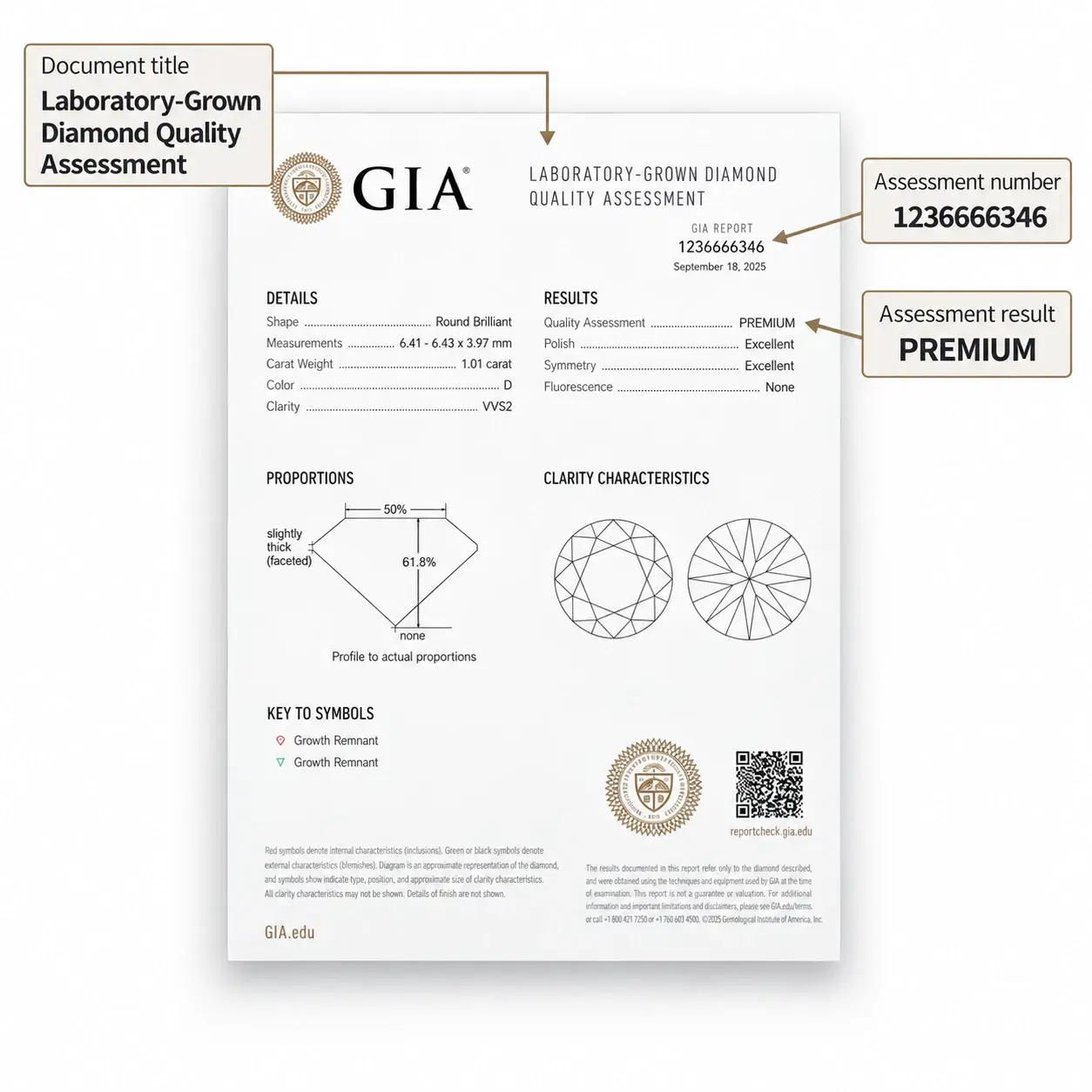
GIA’s current Laboratory-Grown Diamond Quality Assessment uses Premium and Standard categories for eligible loose, colourless to near-colourless laboratory-grown diamonds weighing at least 0.15 carats. These categories provide an overall assessment rather than the same presentation of individual grades found on some earlier documents. GIA laboratory-grown diamond services.
Understanding that difference helps you ask better questions, recognise unsupported listing details and establish what still needs checking before purchase.
What Does “GIA Certified Lab-Grown Diamond” Mean?
“GIA certified” is a familiar phrase in diamond listings. For a buyer, however, the useful information lies in the specific GIA report or assessment associated with the individual stone.
Begin by asking what the seller is offering: a diamond with an existing document, a diamond that will be submitted for assessment, or a general sourcing service. These are different situations. If documentation is still pending, establish what will be supplied and when you can review it.
Also distinguish the laboratory document from the seller’s own specification sheet. Both may contain useful information, but they should not be presented as interchangeable. A seller may provide dimensions, photographs or other details beyond the document’s contents; ask how those details were established.
The practical aim is to connect three things clearly: the diamond being offered, its laboratory documentation and the specifications recorded in your purchase agreement.
GIA Premium and Standard: How the Categories Work
GIA introduced its revised assessment service on 1 October 2025. Premium requires every applicable Premium criterion; Standard covers qualifying combinations meeting the minimum requirements without satisfying all Premium criteria.
| Factor | Premium | Minimum for Standard |
|---|---|---|
| Colour | D | D–J |
| Clarity | VVS or higher | VS or higher |
| Polish | Excellent | Very Good or higher |
| Symmetry | Excellent | Very Good or higher for round brilliants; Good or higher for fancy shapes |
| Cut grade—round brilliant only | Excellent | Very Good or higher |
A stone below the minimum requirements receives no quality classification under this service. These are assessment thresholds, not a rule that every qualifying diamond suits every buyer. GIA’s published assessment criteria.
Consider two illustrative applications of those criteria. A round brilliant with D colour, VVS clarity and Excellent cut, polish and symmetry meets the Premium thresholds. Changing only its colour to E places it within Standard, assuming the remaining requirements are met.
Consequently, Standard does not identify one exact colour-and-clarity combination. Ask for supporting evidence when a listing provides more specific grades than its document.
Illustrative sample. Check the actual diamond and its laboratory document.
Why Older GIA Reports Can Look Different
GIA has changed its laboratory-grown diamond services over time. An older document may therefore contain information that is absent from a newer format, or present results differently.
There were also differences between older report types. In January 2023, GIA explained that its revised laboratory-grown Dossier retained 4Cs specifications but omitted growth-method and post-growth-treatment information. Its fuller laboratory-grown report continued to include those details and a plotted clarity diagram. This is historical information about those services, not a description of the current assessment. GIA’s 2023 report announcement.
For buyers, the lesson is to read the report title as carefully as the laboratory name. Do not assume that two documents issued in the same period contain identical information.
A different layout alone is not evidence that a document is false. Equally, an older document should not be relabelled Premium or Standard through a seller’s interpretation. Verify the record and ask whether the diamond has been recut, repolished or otherwise changed since examination.
Where its history is unclear, obtain professional advice about whether further examination is appropriate.
How to Read a GIA Lab-Grown Diamond Assessment
Read the document in a consistent order so that its headline result does not distract from identifying details or limitations.
Start with the document title, date and number
The title identifies the service. The date provides context for its format, while the identifying number connects your enquiries to a specific laboratory record.
Ask for the complete document rather than a cropped image showing only the result. Keep its number with the seller’s diamond reference so that a later stock substitution cannot be mistaken for the stone you originally reviewed.
If several diamonds are being considered, maintain a separate record for each. Similar filenames, screenshots and product references can otherwise make comparisons confusing.
Check shape, cutting style and carat weight
GIA’s published current sample includes the stone’s shape and cutting style, weight, identifying number, inscription information, result and a proportions diagram. Use those entries to check the offer you received. GIA’s assessment sample.
A laboratory’s cutting-style description may be more technical than the familiar shape name used in a listing. Ask the seller to explain the relationship if it is unclear.
Carat measures weight: one metric carat equals 0.2 grams. It does not directly specify the diamond’s length or width. GIA’s explanation of diamond weight.
For example, a document for a 1.50-carat centre stone should not be confused with a ring advertised as 2.00 carats total weight. Ask the seller to separate the centre-stone weight from any surrounding diamonds.
Request the measurements needed for your purchase
If millimetre dimensions are absent from the document supplied, request them separately. For an existing setting, your jeweller needs the actual measurements and an assessment of fit; the carat figure alone is insufficient.
Confirm which measurements belong to the stone in the report. A size guide or an approximate dimension for that shape is not a substitute for the individual diamond’s recorded specifications.
This is particularly useful when comparing offers with similar weights but different outlines. Establish the dimensions first, then judge whether those proportions suit your intended design.
Read the proportions diagram in context
A proportions diagram is a reference for the information displayed. It is not a photograph of the diamond or a complete demonstration of its appearance.
GIA explains that proportions affect how a diamond handles light. Nevertheless, reviewing one percentage in isolation does not show the whole visual result. GIA diamond quality factors.
Ask for a clear video or an in-person view when appearance matters to your decision. Treat the document, physical specifications and visual evidence as complementary information.
Read every scope statement and comment
The wording around an assessment matters. GIA’s current published sample states that laboratory-grown origin was disclosed and that no additional testing was performed. It should therefore not be represented as evidence of a separate origin-identification test.
If you need independent confirmation of origin, growth method or treatment, ask which service and document provide that information. Do not infer an unreported result from a blank field. GIA’s sample and scope statement.
How to Verify the Document and Match It to the Diamond
Verification involves checking the laboratory record and establishing that the physical stone corresponds to it. Completing one task does not automatically complete the other.
Check the record directly with GIA
Open GIA Report Check and enter the identifying number. GIA describes this service as a way to compare report information with its database. GIA guidance on report authenticity.
Compare the available record with the document supplied. Pay attention to the document type, number and recorded characteristics. Where the result differs from the seller’s information, request an explanation before proceeding.
If the record cannot be retrieved, first check the number for typing errors. Ask the seller for a clearer copy and seek assistance from GIA if necessary. An unsuccessful lookup needs investigation; it does not establish the cause by itself.
Arrange a physical match
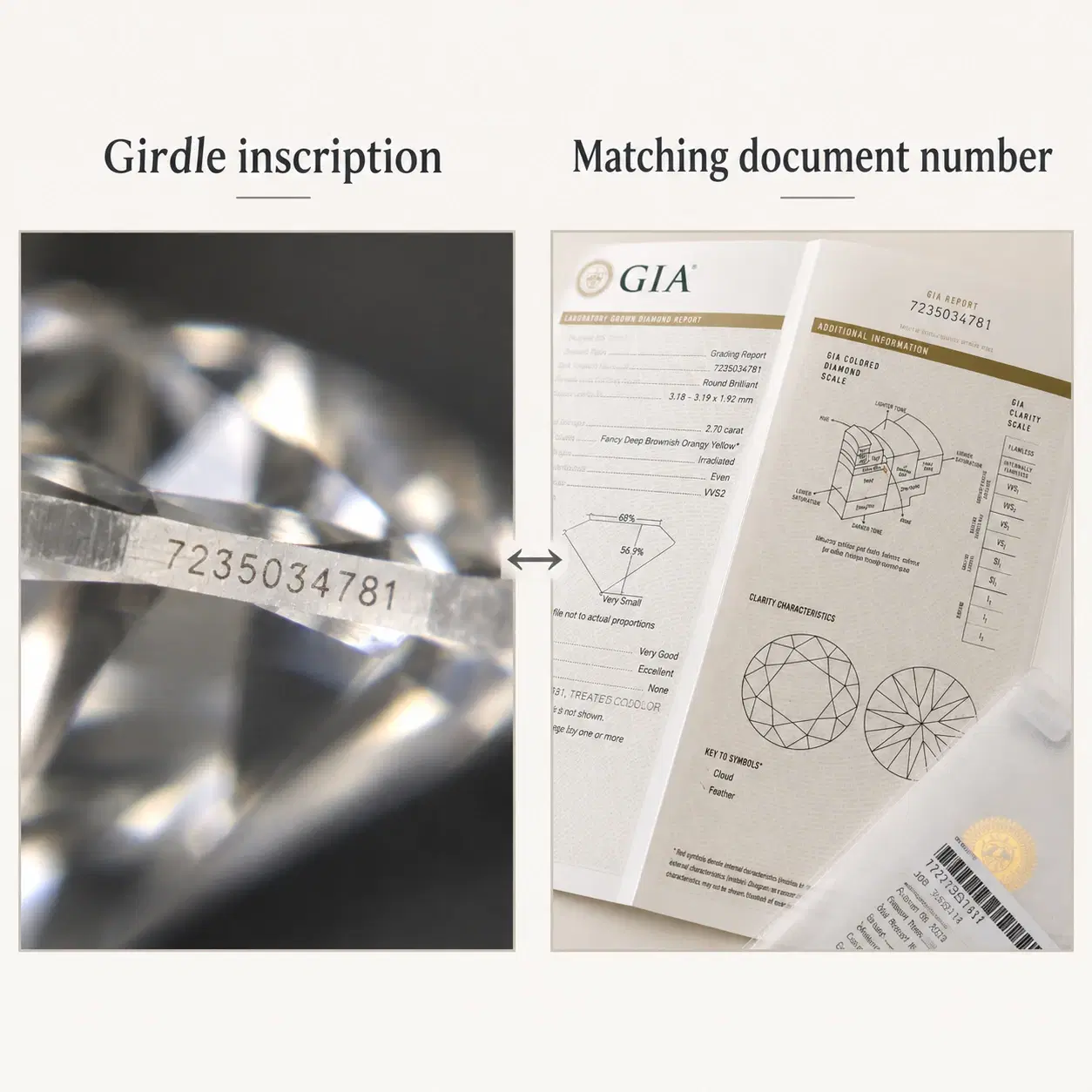
Ask a qualified professional to compare the diamond with its documentation, including any recorded inscription and the relevant physical characteristics.
This matters especially when you have only seen photographs online. A genuine document can be photographed independently of the stone being offered, so the document image alone cannot establish the identity of the diamond delivered.
Where the diamond is already mounted, ask what can be checked reliably in its present setting. Do not assume an inaccessible inscription or difficult measurement can be verified from an ordinary product photograph.
Resolve discrepancies before accepting the stone
If the number, weight, shape or another recorded detail does not match, establish whether the issue is a listing error, an incorrect attachment or a different stone.
For a simple listing error, request a corrected specification and written confirmation. If the seller proposes a replacement diamond, review that replacement’s own documentation and appearance before agreeing.
Keep the final document, agreed specifications and invoice together. This creates a clear record of the stone you selected and the information on which the purchase was based.
Illustrative sample. Check the actual diamond and its laboratory document.
What If the Listing Contains Details Missing from the Assessment?
A listing can legitimately contain additional information, but its source should be clear.
For instance, suppose the seller advertises an exact clarity grade while the accompanying document presents an overall category. Ask what supports the more specific statement: another laboratory report, a separate examination or the seller’s assessment.
The same principle applies to measurements, treatment claims and appearance descriptions. Request the evidence relevant to your decision rather than assuming every statement comes from GIA.
If two laboratory documents are supplied, establish that they refer to the same stone. Compare dates and identifying information, and ask whether any work took place between examinations. Where their findings differ materially, obtain an explanation rather than choosing whichever result is more favourable.
For your own comparison, distinguish documented laboratory results from seller-supplied information and your visual preferences. That makes it easier to identify a missing fact before it becomes a purchasing problem.
GIA Reports for Coloured Lab-Grown Diamonds
GIA lists separate services for laboratory-grown coloured diamonds. Its full coloured-diamond report includes a quality assessment, a plotted clarity diagram, and assessments of growth type and post-growth treatment. Its colour-identification report focuses on colour and colour distribution, alongside growth and treatment assessments. GIA’s coloured lab-grown diamond services.
Check which document accompanies the stone. Do not assume that a colour-identification report provides the same clarity information as the fuller service.
When a seller uses a colour description in the product title, compare it with the laboratory wording. Ask for any difference to be explained, particularly where a marketing name could be mistaken for a laboratory description.
Questions to Settle Before Purchase
Before committing to a diamond, establish that you have enough information for the decision you are making. The laboratory document may answer some questions while leaving others to the seller or your jeweller.
Ask whether the stone shown remains available, which document accompanies it, and whether the photographs or video show that individual diamond. If the stone will be set before delivery, establish when you can review its documentation and how its identity will be recorded.
Agree how substitutions or discrepancies will be handled. Your written order should identify the selected stone and its accompanying document, rather than referring only to a broad description such as “GIA lab-grown diamond”.
For the wider selection process, visit our loose lab-grown diamond guide.
Frequently Asked Questions
Does every lab-grown diamond have a GIA report?
No. Ask which laboratory documentation accompanies the individual stone. A website displaying a laboratory logo or discussing GIA does not establish that every diamond offered has a GIA document.
Can a diamond already set in a ring receive the current assessment?
GIA lists the current quality assessment for loose stones. Ask about the appropriate service and preparation before submitting a mounted diamond. Have a qualified jeweller advise on any removal from its setting. GIA service eligibility.
Does a missing growth-method entry mean the diamond was not tested?
An absent entry does not establish what examination occurred. Report formats differ: some older services deliberately omitted growth-method information. Check the particular document’s scope and ask the laboratory about any additional information you require.
Should I reject a diamond because its document is older?
Consider the verified record and the diamond’s history. A format change alone does not show that the stone has changed. If it has been recut, repolished or damaged, ask whether the existing document still adequately describes its present condition.
Is a GIA assessment the same as an insurance valuation?
Do not use the assessment result as a monetary figure. Ask your insurer which documents it requires and whether a separate valuation is needed. Keep the laboratory document available as supporting information.
Can I compare a GIA document directly with an IGI report?
Compare the actual fields and the scope of each document. Do not assume differently presented results have an automatic one-to-one correspondence. Our IGI lab-grown diamond report guide covers how to approach that laboratory’s documentation.
What if the seller cannot provide the document before payment?
Ask when it will be available and what opportunity you will have to review it. If the purchase depends on particular documented results, establish those requirements and the applicable terms before committing.
Discuss Your Diamond and Documentation Requirements
When contacting Uniglo Diamonds, include the diamond reference, preferred shape, carat weight and any specific laboratory-document requirements. Request current availability, the accompanying document and the individual stone’s supporting specifications.
If you already have a report, explain which detail you need clarified. A precise question about the document, the listing or the physical stone makes the enquiry more useful.