GIA Diamond Report Comments Explained
GIA diamond report comments provide additional information about the diamond, including characteristics omitted from the plot and certain treatment disclosures. Read them alongside the clarity grade, the diagram where provided and the individual stone. GIA describes the Comments field as a place for identifying information that is not otherwise represented on the report. GIA’s guide to understanding its Diamond Grading Report.
A comment mentioning clouds can describe additional features that have not been drawn. A different sentence can explicitly state that clouds are the basis of the clarity grade. Those statements deserve different follow-up questions.
This guide focuses on comments encountered on natural diamond reports. For the complete document walkthrough, including grades, proportions and verification, read our GIA natural diamond report guide.
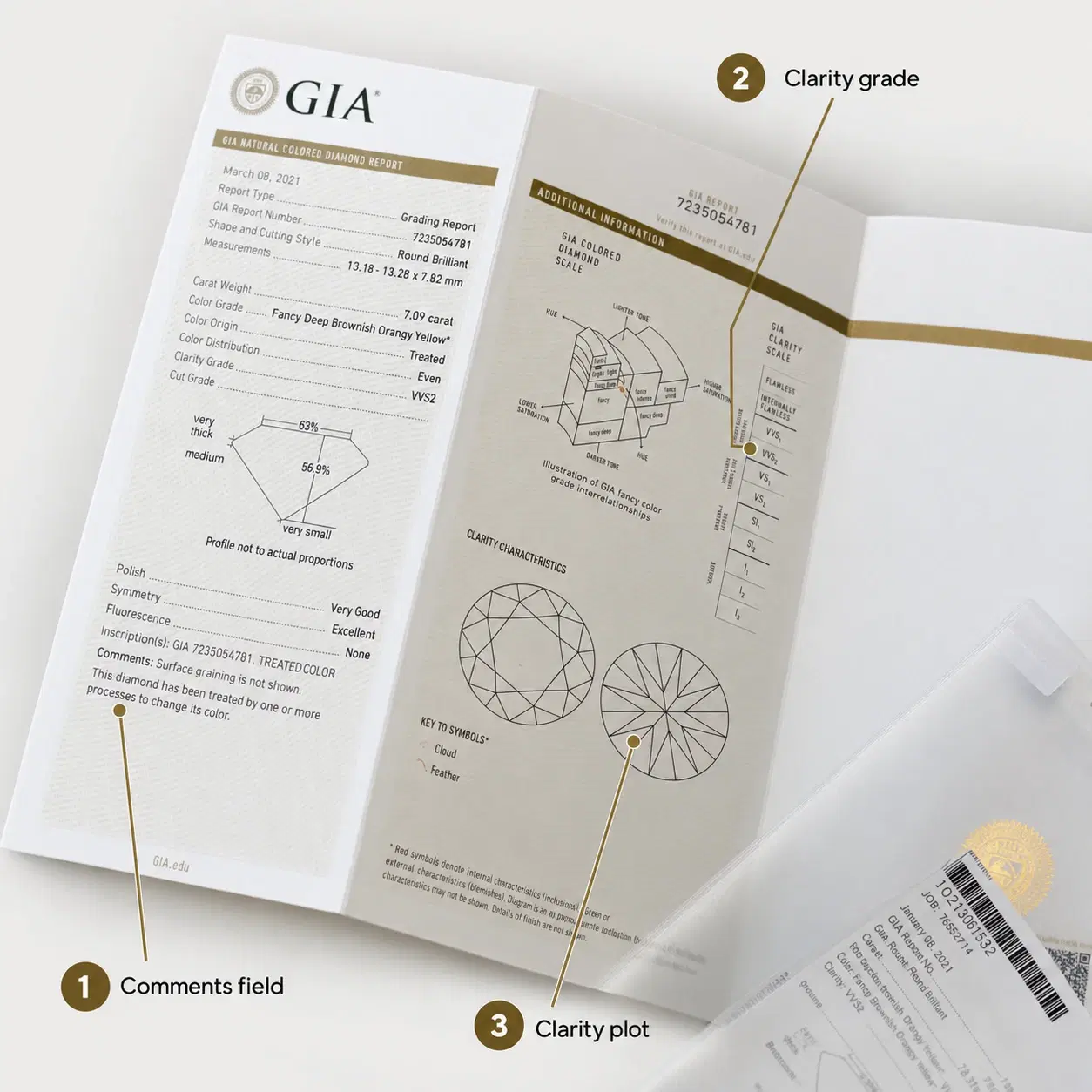
Read the comment with the grade and plot
A clarity plot uses symbols to record the nature, approximate size and position of characteristics. It is a diagram rather than a photograph. The accompanying comments can supply information that the drawing does not communicate. GIA’s explanation of report fields and plotting.
Start by reading the complete sentence. Establish which characteristic it names and whether it says that the feature determines the grade. Then look at the clarity grade and the key to symbols.
GIA assesses clarity using factors including the size, number, location, nature and visibility of characteristics under 10× magnification. Counting the marks on a diagram cannot reproduce that assessment. GIA’s diamond clarity guidance.
For buying purposes, there is another question: how does the diamond look when you view it? Ask for the actual stone or suitable imagery, and discuss any feature that matters to your choice.
Example 1: additional clouds and unplotted pinpoints
A published copy of GIA report 1225349994, dated 18 April 2016, records a 1.80-carat round brilliant with VS2 clarity. Its comments include:
Additional clouds are not shown. Pinpoints are not shown.
The plot’s key lists clouds, feathers and a needle. The comment therefore adds information to an existing diagram: some clouds are represented, while further clouds and the pinpoints are omitted.
The useful distinction is between a feature being present and being drawn. An unplotted characteristic has still been observed. The comment is not saying that the diamond contains only the marks visible on its diagram.
A pinpoint is a minute crystal that appears as a dot under 10× magnification. A cloud consists of grouped pinpoints whose combined appearance can be hazy under examination. GIA’s definitions of diamond inclusions.
The sentence alone does not establish the diamond’s overall transparency in ordinary viewing. Ask whether the clouds have a visible effect when the clean stone is examined, and request a comparison under similar lighting if you are choosing between diamonds.
This report is a wording example. Its dated copy does not establish the stone’s present condition or availability.
Example 2: clouds that determine the clarity grade
A published copy of GIA report 2215194753, dated 9 October 2020, records a 1.00-carat round brilliant with SI1 clarity. One comment states:
Clarity grade is based on clouds that are not shown.
Here the sentence expressly connects the clouds with the assigned clarity grade. The plot’s key identifies twinning wisps and an indented natural; the clouds are explained in the comment.
The comment explains why the grade was assigned. Looking only at the plotted marks would miss that explanation.
A useful question is: “How do the clouds affect this diamond’s transparency when viewed from above?” Ask the seller or examining gemmologist to explain the observation and provide a clear view of the individual stone.
If a video leaves you uncertain, arrange an appropriate inspection before committing. A written comment cannot show the extent to which a particular appearance will be noticeable or acceptable to you.
Avoid treating every reference to clouds as equivalent. Compare the complete wording, the assessed grade and the physical appearance together.
Example 3: additional twinning wisps
The same October 2020 report also states:
Additional twinning wisps are not shown.
Its diagram already includes twinning wisps, so this note records further examples beyond those illustrated. GIA report 2215194753.
Twinning wisps are combinations of features such as pinpoints, clouds or crystals associated with twinning and distortion within the diamond’s crystal structure. GIA’s inclusion glossary.
For the buyer, the next step is to ask where these characteristics occur and how visible they are. If a seller supplies a magnified photograph, ask them to identify the relevant features and explain the image’s scale.
Keep that explanation connected to the individual report. A general statement that twinning wisps are always harmless, or always unacceptable, gives you little help in assessing the stone being offered.
Internal graining: presence and effect on clarity
Internal graining can appear as lines, curves or other features associated with irregularities in crystal growth. Its appearance may be whitish, coloured or reflective. GIA’s explanation of internal graining.
GIA’s 2006 research on graining and clarity grading documents this wording:
The clarity grade is based on internal graining that is not shown
The wording identifies graining as the basis of the clarity assessment even though it is absent from the diagram. The research also discusses a different comment:
Transparent internal graining is present.
That second description was used for a transparent feature that generally did not affect the clarity grade. GIA’s research also shows that graining’s visibility can change with viewing angle and movement. GIA’s study of internal graining and clarity grading.
Read the statement about its effect, as well as the word “graining”. Ask whether the feature influences transparency, where it can be seen and how it appears when the diamond moves.
The paper documents changes in reporting practice over time. When reviewing an older report, use its exact wording and ask the laboratory to clarify an unfamiliar description. Do not assume that every historical phrase corresponds to the same present-day reporting convention.
Surface graining and polish notes
Another comment in the October 2020 report reads:
Surface graining is not shown.
This records an observed surface characteristic that has not been drawn. GIA report 2215194753.
GIA describes surface graining as a feature arising from irregularities in crystal structure that appears at the diamond’s surface. It separately defines polish lines as fine grooves and ridges left by polishing. These terms describe different features. GIA’s guide to diamond blemishes.
When a report refers to minor polish details that are not drawn, read that description alongside the polish and clarity grades. Ask which surface features are being described if the distinction is unclear.
An Internally Flawless clarity grade can coexist with surface blemishes: GIA distinguishes it from Flawless, which requires the absence of both inclusions and blemishes visible under its grading conditions. GIA’s clarity scale.
The practical question is whether the recorded surface feature matters to your purchase. Ask to see it under appropriate magnification and then assess the diamond at a normal viewing distance.
Treatment comments require a separate buying discussion
A treatment disclosure explains something about the diamond’s processing history. GIA’s report guide states that detected treatments such as laser drilling can be described in Comments. It also explains that an asterisk beside the colour grade on the illustrated D-to-Z report indicates detected colour treatment. GIA’s report interpretation guide.
If wording refers to HPHT processing to change colour, read it as a treatment statement in the context of the diamond’s identified origin. HPHT equipment can be used under different conditions to treat an existing diamond or to grow a laboratory-grown diamond. GIA’s treatment guidance.
Ask for written confirmation of the disclosed process and any relevant care requirements. State explicitly if your buying brief requires untreated colour and clarity.
A GIA report can accompany a diamond with a stable treatment. GIA explains that it issues reports for eligible diamonds with treatments such as HPHT processing or laser drilling, while excluding fracture-filled and coated diamonds from grading reports. GIA’s policy for treated diamonds.
For the processes, disclosure and care considerations in detail, read our natural diamond treatments guide.
Turn a report comment into a useful question
A seller’s explanation should address the characteristic named in your report. The following questions help move the discussion from terminology to evidence about the actual diamond.
| What you are reading | What to ask next |
|---|---|
| A note about characteristics omitted from the diagram | Which features are unplotted, and how visible are they in this stone? |
| A statement explaining the basis of the clarity grade | How does that characteristic affect the diamond when viewed from above? |
| A surface graining or polish note | Where is the feature, and can you show it under magnification and at normal viewing distance? |
| A treatment disclosure | Which treatment was identified, and what written disclosure and care information accompany the purchase? |
| Wording that differs from the seller’s description | Can you reconcile the listing with the complete laboratory report before I decide? |
Keep the report number, the seller’s explanation and the imagery together. This is particularly useful if you are considering several diamonds with similar headline grades.
If the seller attributes a price difference to a comment, ask what that means for the individual stone. Establish whether the explanation concerns appearance, treatment status or another documented characteristic. Then compare the complete quotations. Our natural diamond price guide covers that comparison in more detail.
Frequently asked questions
Does a report with no comments mean the diamond is flawless?
No. Read the stated clarity grade. The number of comments is not a clarity scale, and a short or empty Comments field does not override the laboratory’s grade. GIA’s Flawless and Internally Flawless categories have specific definitions based on examination under 10× magnification. GIA’s clarity guidance.
Why does my GIA report have no clarity plot?
Check the report format. A GIA Diamond Dossier does not include the plotted clarity diagram provided with a Diamond Grading Report. The absence of a plot therefore does not establish the absence of inclusions. GIA’s comparison of natural diamond report formats.
What does “natural” mean in the key to symbols?
In that context, a natural is a remnant of the rough diamond’s original surface left on the polished stone. It is a named surface characteristic. Read the report’s origin and treatment information separately when establishing what diamond is being offered. GIA’s definition of a natural.
Does a matching report number prove the stone matches the report?
A report number lets you retrieve the associated record through GIA Report Check. Matching the physical diamond requires examination of its identifying characteristics. GIA has documented cases involving copied inscriptions on different stones, so the inscription should be considered with the other evidence. GIA’s research on counterfeit inscriptions.
Discuss a natural diamond report
To discuss a natural diamond requirement, contact Uniglo Diamonds with your preferred shape, size and budget.
If you have a report to review, include its number and the complete comment you want explained. Ask how the wording relates to the particular diamond’s appearance, documentation and suitability for your intended jewellery piece.