GIA Certified Natural Diamonds: Understanding the Report
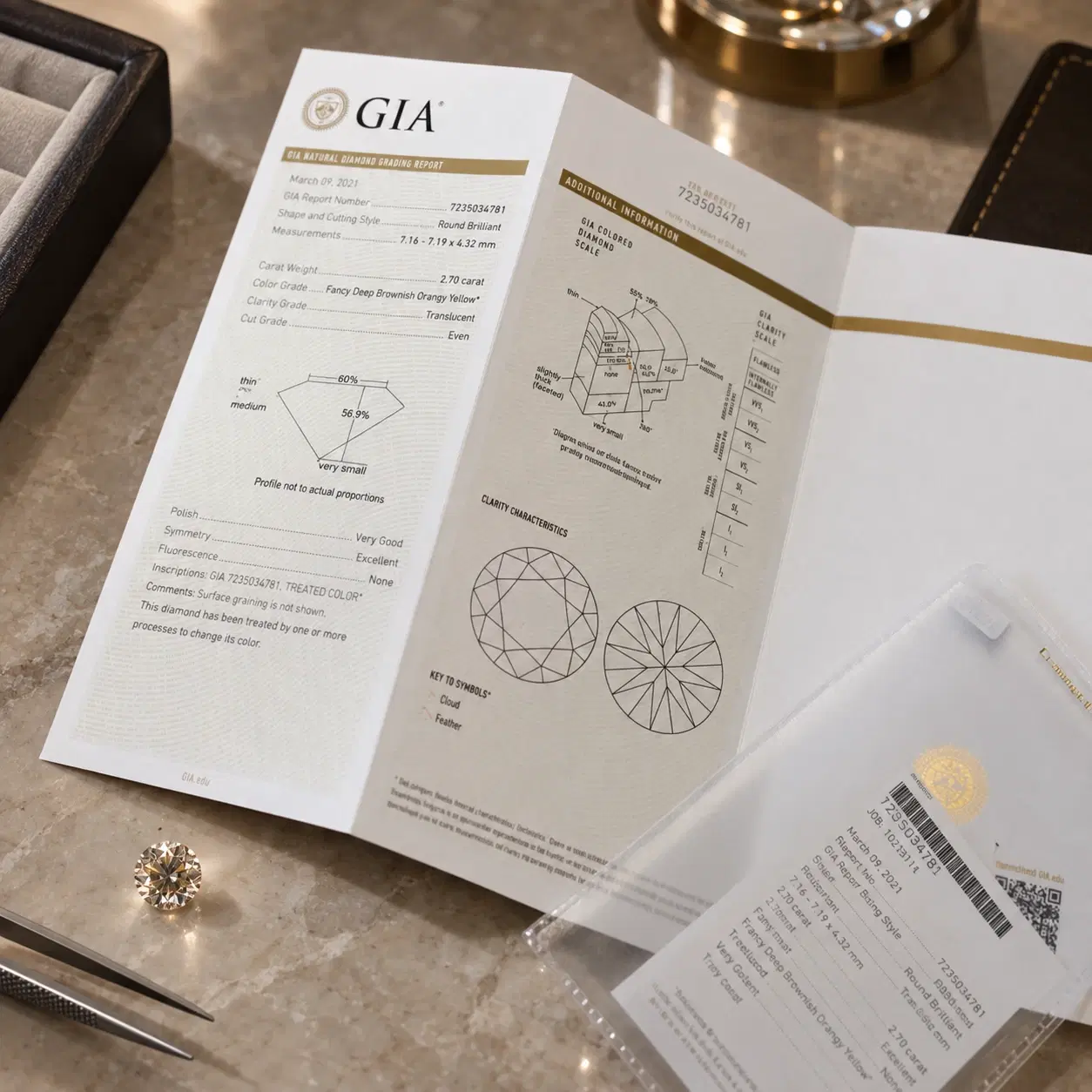
“GIA certified natural diamonds” usually means natural diamonds accompanied by GIA grading reports. GIA assesses diamonds and reports its findings; it does not certify diamonds or their monetary value. Understanding that distinction helps you use the document properly when buying. GIA’s explanation of GIA-graded diamonds.
A report gives you information to compare, including the diamond’s weight, measurements and assessed characteristics. Your purchase also involves checking that the document matches GIA’s records, establishing that it belongs to the stone being offered and reviewing the actual diamond.
This guide takes you through those steps. For the wider buying process, start with our natural diamond buying guide.
What does “GIA certified” mean when buying a natural diamond?
GIA stands for the Gemological Institute of America. Its grading reports provide an independent assessment of a diamond’s characteristics. A diamond having a GIA report does not automatically mean it has the highest colour, clarity or cut grades: you need to read the results. GIA’s guide to its grading terminology.
Ask for the complete document for the individual stone. A listing that says only “GIA”, or a photograph of a sample report, leaves the actual assessment unconfirmed.
It also helps to distinguish laboratory documentation from a seller’s invoice, warranty or valuation. Our diamond certificates guide introduces the different documents you may encounter.
Identify which GIA report you are reading
GIA offers several natural diamond report formats. Three you may encounter are the Diamond Grading Report, Diamond Dossier and Diamond Origin Report.
| Report | Main information and format | What to recognise when buying |
|---|---|---|
| Diamond Grading Report | Quality assessment with a plotted clarity diagram; available for loose natural diamonds in the D-to-Z colour range weighing at least 0.15 carats | The plot helps describe the stone’s clarity characteristics |
| Diamond Dossier | Quality assessment with the GIA report number laser inscription included; available for eligible stones weighing 0.15–1.99 carats | This format does not include a plotted clarity diagram |
| Diamond Origin Report | Quality assessment, clarity plot and geographic origin information for eligible diamonds submitted for analysis as rough | This service adds origin information beyond the standard grading report |
These distinctions follow GIA’s natural diamond services and its report comparison.
The walkthrough below focuses on natural diamonds in the D-to-Z colour range. Check the named service when reviewing a coloured-diamond or laboratory-grown document, because its scope and terminology may differ.
How to read a GIA natural diamond report
Start with the report number and date
The report number identifies the GIA record. The date records when GIA examined the diamond. Keep both with the seller’s listing and quotation so you can track which stone is being discussed. GIA’s report-reading guide.
If a seller replaces your shortlisted diamond with another option, request its own report before comparing the offer.
Read shape, measurements and carat weight together
Shape and cutting style describe the outline and facet arrangement. Round diamond measurements record minimum diameter, maximum diameter and depth; fancy-shape measurements record length, width and depth. These dimensions are given in millimetres. GIA’s explanation of report fields.
Carat measures weight, with one metric carat equal to 200 milligrams. Two diamonds of equal weight can have different visible dimensions. GIA’s carat weight guidance.
For example, when comparing two one-carat ovals, read their length and width alongside their photographs. Decide which outline you prefer and ask your jeweller whether the actual measurements suit the intended setting.
Understand the colour grade
For diamonds graded on GIA’s D-to-Z scale, D represents the colourless end and Z the light-colour end. Grading takes place under controlled conditions using reference diamonds. GIA’s colour grading guidance.
Use the grade to organise your shortlist, then compare the stones under similar lighting. Photographs taken against different backgrounds can make a comparison difficult. If two options differ by one colour grade, ask to see whether that difference matters to your preference in the intended jewellery.
Interpret clarity alongside the individual stone
GIA assesses clarity at 10× magnification, considering the characteristics’ size, number, location, nature and relief. Its scale contains 11 grades, running from Flawless to Included. Many features assessed during grading are difficult to see without magnification. GIA’s clarity guidance.
A clarity label such as VS1 or SI1 is a starting point. Ask where the relevant features are and whether they are visible at normal viewing distance. If the seller describes the diamond as “eye-clean”, ask what viewing conditions that description assumes.
A highly magnified video helps locate features, but also look at the diamond at a realistic viewing scale. Our diamond 4Cs guide explains the quality categories more broadly.
Separate cut grade from polish and symmetry
GIA’s standard overall cut grade applies to standard round brilliant diamonds in the D-to-Z colour range. It runs from Excellent to Poor. Polish concerns the finished surfaces, while symmetry concerns the precision of the outline and facet arrangement. GIA’s cut grading guidance.
Read these entries separately. An oval report showing Excellent polish and Excellent symmetry does not thereby give the oval an overall GIA Excellent cut grade. If a listing advertises an additional cut label, ask who assigned it and what it measures.
Where a proportions diagram is provided, use it to locate the diamond’s recorded proportions. Consider the figures together with the applicable assessment and the actual appearance. GIA explains that multiple proportion combinations can fall within a cut grade, leaving room for differences in preference. GIA’s explanation of proportions and cut.
Check fluorescence without assuming it settles quality
Fluorescence describes a diamond’s response to ultraviolet light. GIA records its strength using descriptions from None to Very Strong. This entry alone does not establish that a diamond looks cloudy: GIA’s research distinguishes fluorescence from the light-scattering defects responsible for haziness. GIA’s fluorescence guidance.
When fluorescence is part of your comparison, ask to see the actual stones in suitable, comparable lighting. Our diamond fluorescence guide explains the buying considerations.
Read the clarity plot, key and comments
Where provided, the plotted diagram maps identifying clarity characteristics, with a key explaining the symbols. Comments record additional information that may not appear elsewhere on the report. GIA’s guide to the plot and comments.
Use the plot to discuss particular features with the seller. Counting symbols is a poor substitute for understanding their significance in the actual stone.
Read treatment information carefully. Natural origin and treatment status describe different things: a natural diamond may have undergone a treatment. GIA records known treatments and issues grading reports for certain stable treatments; it does not issue grading reports for fracture-filled or coated diamonds. GIA’s treatment guidance.
If any wording is unclear, ask for an explanation tied to the complete report before proceeding.
How to verify a GIA report online
Open GIA Report Check directly
Open GIA Report Check yourself and enter the report number. The service compares report information with GIA’s archived record.
Compare the record, document and listing
Compare the number, date, shape, weight, measurements, grades and comments with the supplied document and listing. Download the report where available; supporting material depends on the service and report date. GIA Report Check information.
If details differ, ask the seller to resolve the discrepancy and put the correct report reference on the quotation.
Resolve missing results
If no result appears, recheck the number and contact GIA or the seller. A failed lookup alone does not establish the cause. Once the records agree, arrange a physical match.
How to match the report to the diamond
Ask a qualified gemmologist or appropriate laboratory to compare the stone with its documentation. Relevant evidence includes measurements, observable identifying characteristics and any recorded inscription. Where a clarity plot is available, it can support that comparison.
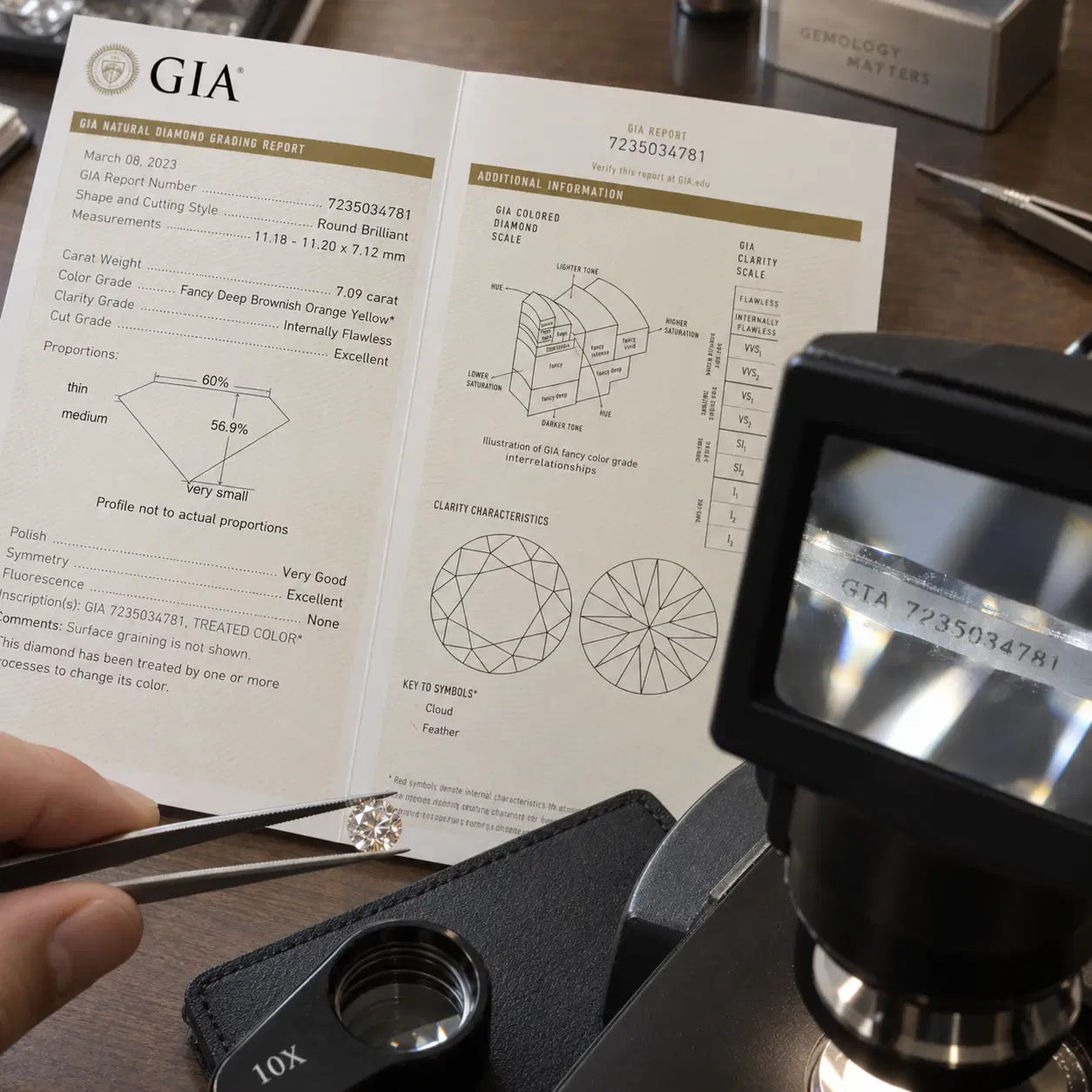
A GIA report number may be laser inscribed on the diamond’s girdle, the narrow edge around the stone. Inscription is included with some services and optional with others, so it should be checked against the particular report format. GIA’s comparison of report features.
A matching inscription is useful evidence, but it does not establish identity on its own. GIA has documented natural and laboratory-grown diamonds carrying counterfeit inscriptions that referred to other stones. In those cases, laboratory examination identified the differences. GIA’s research on counterfeit inscriptions.
For an online purchase, ask how the seller matches the offered stone to its report and what independent inspection arrangements are available. If identity or origin remains uncertain, request laboratory verification.
Consider the report date and the diamond’s current condition
A report describes the diamond examined at the recorded time. When buying a previously owned stone or one with an older report, ask whether it has subsequently been damaged, repolished, recut or treated.
The practical question is whether its current condition and characteristics still agree with the documentation. GIA offers follow-up services to verify, re-evaluate or update previous results. Ask which service is appropriate if a fresh examination is needed. GIA’s natural diamond follow-up services.
An older date alone is insufficient to judge the purchase. Consider the stone’s history, current examination and the available records together.
Use the report when comparing quotations
Once you have established which diamond the report describes, use it to compare the seller’s offer with your requirements.
Consider two hypothetical round diamonds both listed as G colour, VS2 clarity and Excellent cut. Review the exact weights, measurements, proportions and individual imagery. Ask each seller to explain any feature they say supports a higher price.
Then compare the commercial offer: total payable amount, currency, applicable taxes, delivery, inspection arrangements and purchase terms. Keep the report number on the quotation so those terms refer to the stone you selected.
GIA does not provide monetary appraisals. Its grading information can support an appraiser’s assessment, but the report itself supplies neither a selling price nor a resale valuation. GIA’s explanation of grading and appraisals.
Our natural diamond price guide covers quotation comparisons and price inclusions in more detail.
Frequently asked questions
Does GIA Report Check prove the diamond in front of me is natural?
The online check confirms whether supplied report information agrees with GIA’s database. Establishing that the physical stone is the diamond described requires a separate match. Where origin is uncertain, seek appropriate laboratory examination. GIA Report Check, GIA’s inscription research.
Why does my GIA report have no clarity plot?
Some formats, including the Diamond Dossier, omit the plotted clarity diagram. Check the named service before treating a missing plot as a problem. GIA’s report comparison.
Should every GIA-graded natural diamond have a laser inscription?
No. The inclusion of an inscription depends on the service and any additional inscription work requested. Review the report’s inscription entry and have the stone checked accordingly. GIA’s report features.
Why is there no overall cut grade on a GIA oval diamond report?
GIA’s standard overall cut grade applies to standard round brilliant diamonds in the D-to-Z colour range. An oval’s polish and symmetry results are separate assessments. GIA’s cut grading guidance.
Does a GIA grading report identify the country where a diamond was mined?
A standard Diamond Grading Report does not provide geographic origin. GIA’s separate Diamond Origin Report includes this information for eligible diamonds examined through its rough-to-polished process. GIA’s natural diamond report services.
Can GIA issue a Diamond Grading Report while the diamond is set in a ring?
This service requires a loose diamond. GIA explains that a setting can affect assessment of colour and clarity and prevent accurate determination of carat weight. Discuss any necessary removal and resubmission with a jeweller. GIA’s explanation of loose-diamond grading.
Discuss a natural diamond with Uniglo Diamonds
To discuss a natural diamond requirement, contact Uniglo Diamonds with your preferred shape, approximate carat weight, budget and delivery destination. Specify that you would like to consider stones accompanied by GIA natural diamond reports.
If you already have a particular stone in mind, include its report number or full report. Ask for the individual diamond’s specifications, imagery and a current quotation so you can consider its documented characteristics and purchase terms together.