Lab-Grown Diamond Prices: Cost per Carat, 1–4 Carat Comparison and Buying Costs
Understanding lab-grown diamond prices starts with understanding exactly which diamond is being priced. Carat weight matters, but it is only one part of the calculation. Shape, cut, colour, clarity, measurements, certification and current availability can all change the quotation for two diamonds that appear similar at first glance.
There is also an important difference between the price of a loose diamond, the total price of a finished engagement ring and a wholesale quotation for multiple stones. These should not be compared as though they represent the same purchase.
At Uniglo Diamonds, current pricing is connected to the actual diamond being offered. Buyers can search the certified diamond inventory by shape, carat, colour, clarity, finish, cut, symmetry, polish, fluorescence and grading laboratory. Prices and price per carat are available through the inventory account, while buyers can also request a quotation directly from Uniglo for a specific requirement.
Current Uniglo lab-grown diamond pricing by carat
A fixed table giving one price for every 1-carat, 2-carat, 3-carat or 4-carat lab-grown diamond would create the wrong impression. Uniglo's inventory contains diamonds with different specifications, and the current price needs to be connected to the actual available stone.
For this reason, this guide does not assign an artificial fixed price to each carat category.
| Carat weight | Current Uniglo pricing | What should be compared | Recommended action |
|---|---|---|---|
| 1 carat | Current stone-specific price required | Shape, exact weight, colour, clarity, cut, dimensions and certificate | Check Uniglo inventory or request a current quotation |
| 2 carat | Current stone-specific price required | Shape, exact weight, colour, clarity, proportions, measurements and certificate | Compare available Uniglo stones with matching specifications |
| 3 carat | Current stone-specific price required | Quality becomes increasingly important alongside dimensions and visual appearance | Use the Uniglo 3-carat guide, then request pricing for the actual stone |
| 4 carat | Current stone-specific price required | Compare cut, colour, clarity, shape, proportions and setting compatibility | Use the Uniglo 4-carat guide, then request pricing for the actual stone |
This approach is more useful than giving a single number because a 2.00 ct round diamond with one combination of colour, clarity and cut should not automatically be treated as equivalent to another 2.00 ct diamond carrying different grades or proportions.
It also keeps the price information connected to Uniglo's own inventory instead of using another retailer's advertised prices as a benchmark.
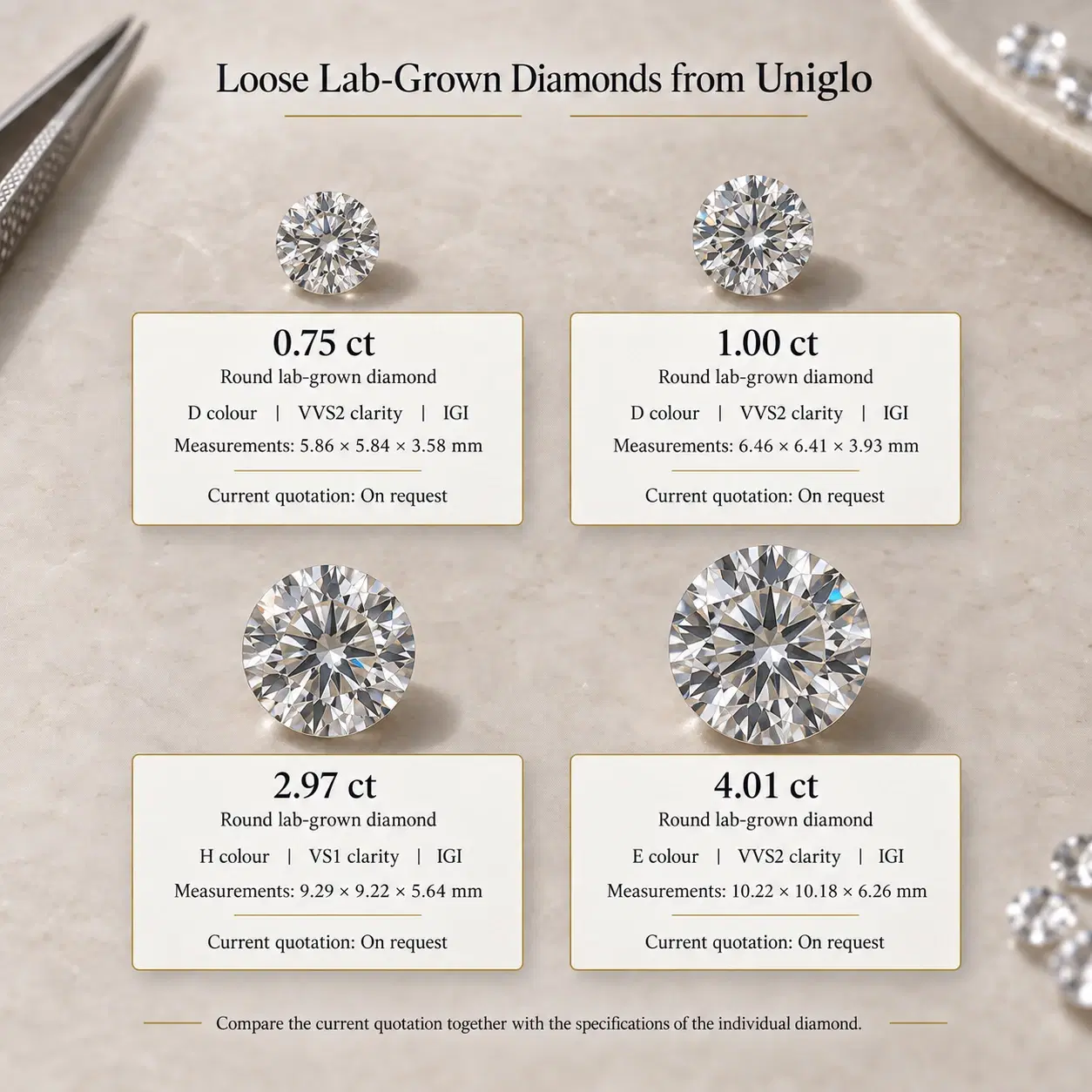
Illustrative example. Specifications and prices shown are not a current quotation.
Why Uniglo does not need a fixed generic diamond price chart
Lab-grown diamond inventory changes. A fixed number attached to a broad carat category can therefore become misleading quickly.
A buyer searching for a 2-carat round diamond may be considering an F/VS1 stone, while another buyer may prefer G/VS2, D/VVS1 or a different shape entirely. Even if both diamonds weigh approximately 2 carats, they are not automatically comparable purchases.
A more useful price comparison starts by controlling the specification. Choose the shape and approximate carat weight first, then narrow the colour, clarity, cut and grading requirements. Once those characteristics are reasonably close, compare current Uniglo quotations.
This makes the page useful both for consumers and trade buyers without presenting an external retailer's price as though it represented the Uniglo offer.
How to calculate lab-grown diamond price per carat
Price per carat expresses the price of the loose diamond relative to its actual weight.
Price per carat = current loose-diamond price ÷ exact carat weight
For example, if Uniglo provides a quotation for a 2.03 ct diamond, the quotation should be divided by 2.03, not rounded down to 2.00 for the calculation.
This figure is useful when comparing diamonds with genuinely similar specifications. It becomes much less useful when the diamonds differ significantly in shape, colour, clarity, cut quality, certification or proportions.
A lower price per carat does not automatically mean better value. One stone may have a different colour grade, less desirable proportions, lower clarity or a different visual appearance. Conversely, paying a higher price per carat does not itself prove that one stone is better.
The calculation should therefore be treated as one comparison tool rather than a quality grade.
Carat weight and visible diamond size are not the same thing
Carat is a measure of weight, not face-up diameter or surface coverage. One carat equals 0.2 grams, but two diamonds weighing the same amount can have different measurements.
This becomes important when comparing price.
Two round diamonds near the same weight can have slightly different diameters. Elongated shapes such as oval, pear or marquise diamonds can also differ substantially in length and width while remaining within a similar carat range.
A buyer should therefore compare the reported millimetre measurements together with the carat weight rather than assuming that the heavier diamond will always look substantially larger.
The Uniglo inventory includes measurement filters as part of the search process, making it possible to compare more than just the headline carat figure.
What changes the price of a lab-grown diamond?
Carat weight is an important price factor, but it does not operate alone. A useful Uniglo quotation should be interpreted together with the characteristics of the individual diamond.
Cut and visual performance
Cut affects how effectively a diamond handles light and therefore has a major influence on its visible brilliance.
For round diamonds, buyers can compare the recorded cut information together with polish, symmetry, table, depth and other proportions. Fancy shapes require additional visual assessment because two diamonds with similar measurements and grading information can still present differently.
If two Uniglo stones have different prices, the comparison should therefore go further than simply asking which has the higher carat weight. Examine the complete specifications and, where available, photographs or video of the actual diamonds.
Colour and clarity
Colour and clarity also influence pricing.
Colourless grades generally represent a different price category from diamonds with more visible colour, while higher clarity grades can also command different prices from lower grades.
However, the highest numerical or alphabetical grade is not automatically necessary for every buyer.
A diamond intended for a ring, pendant, earrings or another piece of jewellery should be assessed in the context of how it will actually look when worn. The objective is to understand what additional price is purchasing rather than simply selecting the highest available grade.
Uniglo's own certification guides can be used when interpreting the grading information supplied with a diamond.
Shape and measurements
Round, oval, emerald, cushion, radiant, pear, marquise, princess and other shapes should generally be compared within their own category before judging price differences.
Two diamonds with identical carat weights but different shapes can have different face-up dimensions, proportions and cutting requirements.
This is particularly important when a buyer is choosing primarily for visible size. A shape that spreads its weight differently may produce a different visual footprint without changing the carat figure.
Certification
Certification makes meaningful comparison easier because the grading report records the characteristics of the individual diamond.
The report should be checked alongside the quotation rather than being treated as a separate marketing badge. Carat weight, measurements, colour, clarity, polish, symmetry and other recorded characteristics help explain why two stones may not carry the same price.
Uniglo's inventory allows buyers to search diamonds by grading laboratory, including recognised certification options.
Availability and matching
Availability also affects a sourcing decision.
A single loose diamond is different from a matched pair for earrings, and both are different from a group of consistently matched stones for a bracelet or jewellery collection.
Finding multiple diamonds that need to match closely in dimensions, colour, clarity and appearance can require additional selection. A trade buyer should therefore make clear whether the enquiry concerns one centre stone, a pair, a parcel or repeat supply.
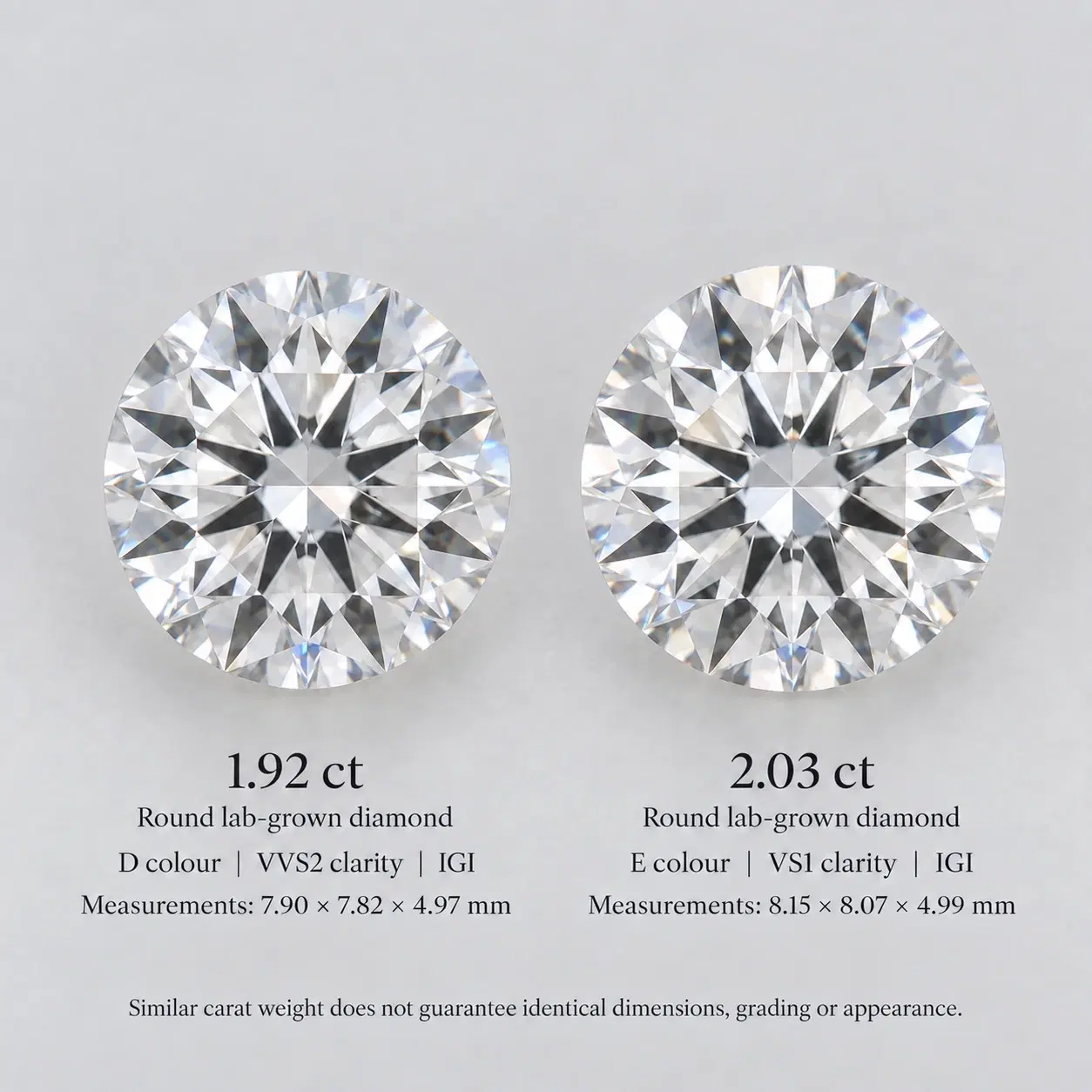
Illustrative example. Specifications and prices shown are not a current quotation.
1-carat lab-grown diamond prices
A 1-carat lab-grown diamond is a useful starting point for buyers comparing loose stones for engagement rings, pendants, earrings and other jewellery.
There should not be one universal Uniglo price printed beside “1 carat” because the specification can change significantly within that category.
A buyer might be comparing round and oval stones, different colour and clarity grades, different certificates and diamonds that have noticeably different millimetre measurements despite sitting within a similar weight range.
For the most accurate comparison, filter Uniglo's inventory around the preferred 1-carat range and establish the other requirements before comparing the available price.
If budget is the priority, consider whether the highest colour or clarity grade will create a visible difference in the intended jewellery. If visual performance is the priority, give appropriate attention to cut and the actual appearance of the stone rather than carat weight alone.
2-carat lab-grown diamond prices
At approximately 2 carats, differences in individual diamonds become more important because the larger stone makes colour, clarity, proportions and face-up dimensions easier to assess.
The current Uniglo price should therefore be requested for the specific stone rather than estimated by multiplying the cost of a 1-carat diamond.
Diamond pricing does not follow a simple rule where doubling the weight automatically doubles the price.
When comparing available 2-carat Uniglo diamonds, keep shape, colour, clarity, cut, measurements and certification as consistent as possible. That produces a much more meaningful price comparison than comparing two stones simply because both are described as approximately 2 carats.
3-carat lab-grown diamond prices
A 3-carat lab-grown diamond moves into a category where the individual characteristics of the stone become increasingly visible.
Uniglo already has a dedicated guide for buyers researching this size:
That page can provide further background about the category, while the final buying decision should use the current price attached to the actual available diamond.
For a shortlisted 3-carat stone, compare its exact measurements, shape, colour, clarity, cut information and certificate before judging whether the quotation represents the right option for the purchase.
This prevents an older guide figure or a broad market estimate from being mistaken for today's price of a specific Uniglo diamond.
4-carat lab-grown diamond prices
The same principle becomes even more important around 4 carats.
Uniglo's dedicated guide provides additional information about selecting diamonds in this larger category:
For the actual transaction, however, request the current quotation against a specific available stone.
At this size, the relationship between weight and visible dimensions should be examined carefully. Shape, colour, clarity, proportions and visual performance can create substantial differences between diamonds carrying a similar carat description.
A setting should also be selected around the actual dimensions of the stone rather than assuming that every 4-carat diamond will fit the same mounting.
Loose-diamond price versus completed ring price
A loose-diamond quotation and a completed ring quotation should never be treated as the same price.
The loose stone is only one component of a finished piece of jewellery. The complete cost may also include the setting, metal, additional diamonds, custom manufacturing or other agreed work.
A useful budgeting formula is:
Total jewellery cost = centre diamond + setting + accompanying stones + separately charged manufacturing or custom work + applicable taxes and delivery
Only include each cost once. If a service is already included within the setting or jewellery quotation, it should not be added again.
If a buyer has a fixed total budget, it can be more useful to tell Uniglo the complete budget at the beginning. The available amount can then be considered across both the centre diamond and the intended design rather than selecting a stone that leaves insufficient budget for the finished jewellery.
Currency, taxes and delivery can change the final payable amount
When comparing quotations, check the currency and what has already been included.
The displayed or quoted diamond price may not be the only amount relevant to an international purchase. Delivery destination, applicable taxes and other transaction-specific costs should be confirmed before treating two quotations as equivalent.
This is another reason a fixed generic price chart can be misleading. The number most useful to a buyer is the current price for the actual diamond together with a clear statement of what the final quotation covers.
For international enquiries, provide the destination when requesting pricing from Uniglo so that the quotation can be interpreted correctly.
Are lab-grown diamond prices changing?
Lab-grown diamond prices can change as manufacturing, availability and demand change. Different carat weights, shapes and quality combinations also do not necessarily move in exactly the same way.
For this reason, this page should not use a third-party market statistic to predict what a Uniglo diamond will cost next.
Uniglo's current inventory and quotations provide the relevant buying reference.
If a quotation is being used for a future purchase, ask how long it remains valid. A price attached to a particular stone today should not automatically be assumed to remain the same indefinitely if inventory or market conditions change.
The objective of this guide is therefore not to forecast a future lab-grown diamond price. It is to help buyers understand the variables behind the price they receive from Uniglo.
Wholesale lab-grown diamond pricing
Wholesale pricing requires a different comparison from a consumer purchasing one centre stone.
A trade enquiry may involve quantity, grade ranges, repeated supply, matched stones, melee diamonds or parcels. The quotation therefore depends on much more than the headline carat weight of one diamond.
A jeweller or retailer should provide Uniglo with the required shape, size or carat range, colour range, clarity range, certification preference, quantities and delivery requirements. This allows the quotation to reflect the actual sourcing brief.
A wholesale price per carat should also be interpreted together with the specification of the goods being supplied. A parcel price cannot automatically be compared with the price of one individually selected and certified centre stone.
How to compare two Uniglo lab-grown diamond quotations
Start with diamonds that are sufficiently similar to make the comparison meaningful.
For example, if the purpose is to compare two round diamonds around 2 carats, try to keep the colour, clarity, certification and cut requirements close. Then inspect the actual weight, measurements, proportions and visual appearance alongside the quotation.
If one diamond costs more, identify what is different before concluding that it is expensive. If one costs less, identify what has changed before concluding that it represents better value.
The question should not simply be:
“Which diamond is cheaper?”
A more useful question is:
“What specifications, appearance and services am I receiving for this price?”
That approach makes the quotation easier to interpret and reduces the risk of choosing a stone based on price alone.
Request a current lab-grown diamond quotation from Uniglo
The most accurate way to establish the price of a lab-grown diamond from Uniglo is to specify the diamond you need and request the current available options.
Provide the preferred shape, approximate carat weight, colour or colour range, clarity range, certification preference, purpose and destination. If you are flexible about one specification in order to improve price or visible size, state that as well.
For a jewellery project, explain whether the enquiry concerns a loose stone or the complete finished item. For trade sourcing, include the quantities and whether matching or repeat supply is required.
The Uniglo inventory can then be used to review available diamonds and current prices rather than substituting a competitor's listing or a general market average.
CTA: View Current Diamond InventoryInternal destination: /inventory
CTA: Request a Current Uniglo PriceInternal destination: /contact-us
Frequently asked questions
How much does a 1-carat lab-grown diamond cost at Uniglo?
There is no single fixed price for every 1-carat lab-grown diamond. The current cost depends on the individual stone's shape, exact weight, colour, clarity, cut, measurements, certification and availability. Check the Uniglo inventory or request a quotation for the specification you need.
How much does a 2-carat lab-grown diamond cost?
A current price should be taken from an available Uniglo stone rather than calculated by doubling a 1-carat price. Two-carat diamonds can vary in shape, colour, clarity, cut, measurements and certification, all of which affect the quotation.
How much does a 3-carat lab-grown diamond cost?
Uniglo has a dedicated 3-carat lab-grown diamond price guide for buyers researching the category, but the actual purchase price should be confirmed against the specific available diamond. Use the guide for background and the Uniglo inventory or quotation for current pricing.
How much does a 4-carat lab-grown diamond cost?
Uniglo also has a dedicated guide covering 4-carat lab-grown diamonds. Because quality and dimensions become especially important at this size, request the current price for the exact stone rather than relying on one universal 4-carat figure.
Does a 2-carat lab-grown diamond cost twice as much as a 1-carat diamond?
Not necessarily. Diamond prices do not increase according to a simple multiplication rule. The two stones may also differ in colour, clarity, cut, dimensions, shape, certification and current availability.
What is lab-grown diamond price per carat?
Price per carat is the loose diamond price divided by its exact carat weight. It is useful when comparing diamonds with similar specifications but should not be treated as a complete measure of quality or value.
Why can two lab-grown diamonds with the same carat weight have different prices?
Carat weight is only one specification. Colour, clarity, cut, shape, proportions, measurements, certification, matching requirements and availability can all differ between two diamonds of the same weight.
Does a lab-grown diamond price include the ring setting?
Only when the quotation specifically includes the setting or finished jewellery. A loose-diamond price should not automatically be treated as the total cost of the completed ring.
Is the cheapest lab-grown diamond the best value?
Not necessarily. Compare the complete specification and appearance of the stone. A lower price may correspond to different colour, clarity, cut, measurements or other characteristics.
Are Uniglo diamond prices available online?
Uniglo's inventory allows buyers to search diamonds using detailed specification filters. Price and price-per-carat information are available through inventory access, while buyers can also contact Uniglo directly for current pricing based on their requirements.
Should I use an old online price chart when buying a lab-grown diamond?
An old price chart can provide background but should not replace current inventory pricing. The relevant buying figure is the present quotation for the individual diamond you are considering.
Are wholesale lab-grown diamond prices the same as single-stone prices?
No. Wholesale enquiries can involve quantities, grade ranges, matched stones, parcels, melee diamonds and repeat supply. The correct comparison depends on the specification and commercial requirements of the order.
Can I request a price without knowing the exact diamond specification?
Yes. Start with the shape, approximate carat range, budget and intended use. Uniglo can then identify suitable options, after which the colour, clarity, cut, measurements and certification can be compared.
Where can I check current Uniglo lab-grown diamond prices?
Use the Uniglo Diamond Inventory at /inventory or submit the required specifications through /contact-us to request current pricing.
Final takeaway
There is no useful universal price for “a 1-carat lab-grown diamond” or “a 3-carat lab-grown diamond” without describing the stone behind that number.
The strongest comparison keeps the carat weight, shape, colour, clarity, cut, measurements and certification visible alongside the current price.
For Uniglo buyers, that means using Uniglo's actual inventory and current quotations as the pricing source, rather than using another retailer's advertised stone or an external market average as a substitute for what Uniglo can supply today.