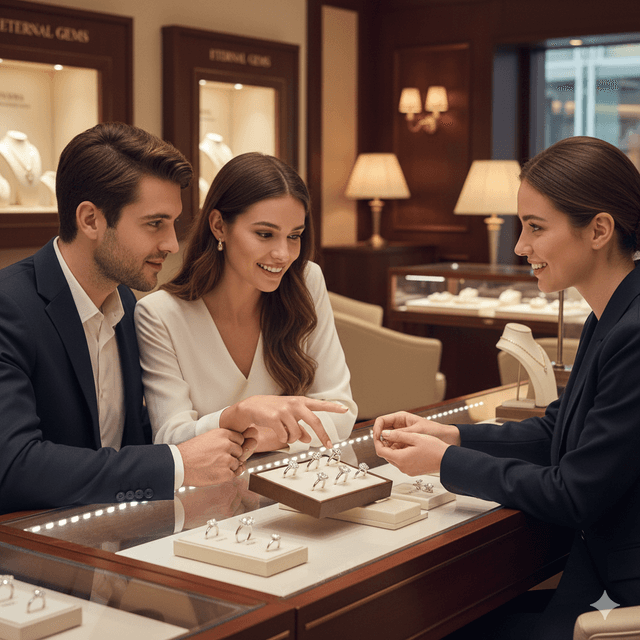
Lab Grown Diamonds vs Natural Diamonds
Lab grown diamonds and natural diamonds are both diamonds. They share the same carbon crystal structure and have nearly the same chemical, optical and physical properties. Their different growth histories can be identified through specialist laboratory testing. GIA’s explanation of laboratory-grown and natural diamonds.
For a buyer, the comparison involves several separate decisions. How important is natural origin? What appearance do you want? How much do you want to spend? What documentation accompanies the stone, and what are your expectations if you later sell or exchange it?
Understanding these questions helps you compare the diamonds themselves and decide which origin suits your priorities.
Lab grown and natural diamonds at a glance
| What you are comparing | Lab grown diamonds | Natural diamonds |
|---|---|---|
| Origin | Produced in controlled facilities using processes such as CVD or HPHT | Formed through natural geological processes |
| Material | Diamond | Diamond |
| Appearance | Depends on the individual stone and its cutting | Depends on the individual stone and its cutting |
| Typical upfront price | Generally lower for comparable specifications | Generally higher for comparable specifications |
| Durability | Highly scratch-resistant; can still chip or fracture | Highly scratch-resistant; can still chip or fracture |
| Documentation | Should clearly identify laboratory-grown origin; report formats vary | Should identify natural origin; geographic provenance requires appropriate supporting information |
| Future sale | Confirm buyer acceptance and obtain an actual offer | Obtain an actual offer rather than assuming recovery of the purchase price |
| Sourcing claims | Assess evidence about production and the supply chain | Assess evidence about extraction and the supply chain |
The material and appearance comparison follows GIA’s diamond-origin guidance. The distinction between scratch resistance and resistance to damage is explained in GIA’s diamond care guide.
Origin: what makes the two categories different?
Natural diamonds form under geological conditions involving high temperature and pressure. Many formed more than a billion years ago. That age describes their geological history; it should not be confused with a claim that every diamond took billions of years to grow. GIA’s natural diamond overview.
Laboratory-grown diamonds are produced using technology. CVD and HPHT are two principal growth methods, each creating diamond under controlled conditions. The finished material is subsequently cut and polished for its intended use. GIA’s laboratory-grown diamond guidance.
Natural origin may be an essential part of what someone wants to own. Another buyer may be comfortable with laboratory production and place more weight on the finished stone and its purchase price. Establishing that preference early makes the remaining comparisons more useful.
For a broader introduction to terminology and production, visit our lab grown diamond education guide.
Appearance: does one origin look better?
An origin label does not tell you how attractive a particular diamond will look.
Cutting determines how the facets interact with light. Proportions, polish and symmetry contribute to the finished appearance, including brightness, coloured flashes and the changing pattern of sparkle as the stone moves. GIA’s explanation of diamond cut.
Compare diamonds under similar lighting and viewing conditions. A carefully lit promotional video of one stone and a static photograph of another give you different amounts of information. Ask to see comparable views, including the diamond moving through different angles.
The same principle applies to size. A carat figure alone does not describe the whole appearance. Review the shape, measurements and proportions of the actual stones you are considering.
The practical question is whether you prefer one particular diamond over another after reviewing its details and appearance. Natural origin does not automatically produce better cutting, and laboratory-grown origin does not guarantee an attractive finished stone.
Our Diamond 4Cs guide explains the quality factors used when assessing individual diamonds.
Price: compare equivalent purchases
Laboratory-grown diamonds generally occupy a lower price point than natural diamonds with comparable characteristics. GIA’s overview of laboratory-grown diamonds.
To understand what that difference means for your purchase, compare clearly described stones. A comparison becomes less useful when one option has a different shape, substantially different measurements, different quality information or an additional setting included in its price.
Start with the diamond you would be happy to wear or use in your jewellery design. Then compare what that specification costs in each origin category. This shows whether natural origin fits comfortably within your budget and what alternatives the same budget provides.
Ask for the quotation date, currency and included charges. If you are comparing finished jewellery, establish how much of the total relates to the diamond, setting and any additional work.
For more detail, read our lab grown diamond price guide. The reasons behind the price difference are covered separately in why lab grown diamonds cost less.
Reports: the laboratory name is only the starting point
Both natural and laboratory-grown diamonds can receive independent laboratory documentation. Read the report type and its results carefully, because different services present information differently.
For example, GIA’s Diamond Grading Report provides a full 4Cs assessment for eligible natural diamonds. Its Diamond Origin Report is a separate service that can include geographic origin for qualifying stones submitted through the required process. Confirming natural origin and documenting a country of origin are different assessments. GIA’s natural diamond report services.
IGI’s laboratory-grown diamond reports document identity and relevant quality characteristics. GIA’s current assessment for eligible colourless to near-colourless laboratory-grown diamonds uses Premium and Standard categories, with separate services for laboratory-grown coloured diamonds. IGI laboratory-grown diamond reports, GIA laboratory-grown diamond services.
Consequently, two diamonds described simply as “certified” are not necessarily comparable in quality. Check what each document actually states, verify its identifying number through the laboratory and review the accompanying stone information.
Our IGI report guide and GIA report guide explain these documents in greater detail.
Durability: how do they compare in jewellery?
Both origins offer diamond’s high resistance to scratching. However, resistance to scratching and resistance to breaking are different properties. A diamond can chip or fracture when struck, particularly around vulnerable points or edges. GIA’s diamond durability guidance.
For a finished piece of jewellery, consider the stone’s condition, its proportions and the setting that protects it. Secure construction and appropriate care remain relevant whichever origin you choose.
There is therefore little value in choosing between the two categories on the assumption that a laboratory-grown diamond is inherently unsuitable for regular jewellery use. Assess the actual diamond and the complete piece.
Resale: separate future offers from today’s purchase price
Your purchase price, a future cash offer and a retailer’s exchange credit are different figures. A grading report records gemmological information; it is not itself an appraisal. IGI’s explanation of grading reports and appraisals.
If resale matters to your decision, investigate the likely selling route before purchasing. For a laboratory-grown diamond, confirm whether the prospective buyer accepts that category. For a natural diamond, ask for an assessment of the specific stone rather than relying on a general statement about rarity.
Request clarity about deductions, condition requirements and any documentation needed. If a seller advertises buyback or upgrade terms, establish whether the offer involves cash or credit and whether another purchase is required.
Treat natural origin as a characteristic you may value personally. It does not establish what a future buyer will offer. Equally, a lower initial price for a laboratory-grown diamond does not tell you its eventual resale outcome.
Ethics and sustainability: compare the supporting evidence
A useful sourcing comparison asks about the businesses and processes behind the diamond.
The Responsible Jewellery Council’s Laboratory Grown Material Standard addresses human rights, working conditions, environmental practices, product disclosure and supply-chain due diligence. These requirements show the range of information relevant to responsible laboratory-grown production. RJC’s laboratory-grown materials standard.
When comparing either origin, ask what evidence supports the seller’s specific claims. For an environmental comparison, establish which production stages are included, what is being measured and whether the information relates to the supplier or stones under consideration.
A broad label such as “sustainable” gives you less information than a clearly explained claim with supporting records. Keep sourcing evidence alongside the diamond’s quality documentation when evaluating your options.
Which should you choose?
A laboratory-grown diamond may suit you if you are comfortable with its production origin and want to explore more options within your available budget. Consider how much you value the individual stone’s appearance and whether its documentation and purchase terms meet your needs.
A natural diamond may suit you if geological origin is an essential part of the purchase. Decide what you are comfortable spending for that preference, then select an individual stone whose appearance and quality you also appreciate.
For a gift, discuss origin preferences with the recipient where possible. A choice that seems practical to the buyer may carry a different meaning for the person who will wear it.
Once you have settled the origin question, move on to comparing actual stones. Our loose lab grown diamond buying guide explains the next stage for buyers considering an unset laboratory-grown diamond.
Frequently asked questions
Do natural diamonds sparkle more than lab grown diamonds?
Natural origin does not guarantee greater sparkle. A diamond’s interaction with light depends heavily on its cutting and proportions, so compare the finished stones rather than expecting one origin to look better automatically. GIA’s diamond cut guide.
Can you reliably identify the origin by looking at a diamond?
Casual observation does not reliably establish origin. Gemmological laboratories use specialist equipment and diagnostic characteristics to distinguish natural diamonds, laboratory-grown diamonds and simulants. IGI’s explanation of origin identification.
Are lab grown diamonds as suitable for jewellery as natural diamonds?
Both can be used in jewellery. Assess the individual stone and its setting, remembering that diamond’s high scratch resistance does not prevent all chipping or fracture damage. GIA’s diamond care guidance.
Does a certificate mean two diamonds have the same quality?
No. The document identifies the characteristics covered by that laboratory service. Compare its actual results and format; the word “certified” is not a quality grade. IGI laboratory-grown diamond report information.
Should resale expectations decide the purchase?
If resale is important to you, investigate current buyer acceptance and written terms before purchasing. Separate those findings from your preferences about appearance and origin. A grading report does not provide a guaranteed future selling price.
Which origin is better for a meaningful jewellery gift?
The recipient’s preferences should guide that decision. Some people attach particular meaning to natural origin; others are comfortable with laboratory-grown diamonds. Discuss that preference alongside the jewellery design and budget.
Compare your options with Uniglo Diamonds
If you are deciding between natural and laboratory-grown diamonds, contact Uniglo Diamonds with your preferred shape, approximate size, budget and origin preferences. Ask for the details and documentation of the specific options being discussed so you can make a considered comparison.