Diamond Size Chart in Millimetres and Carats
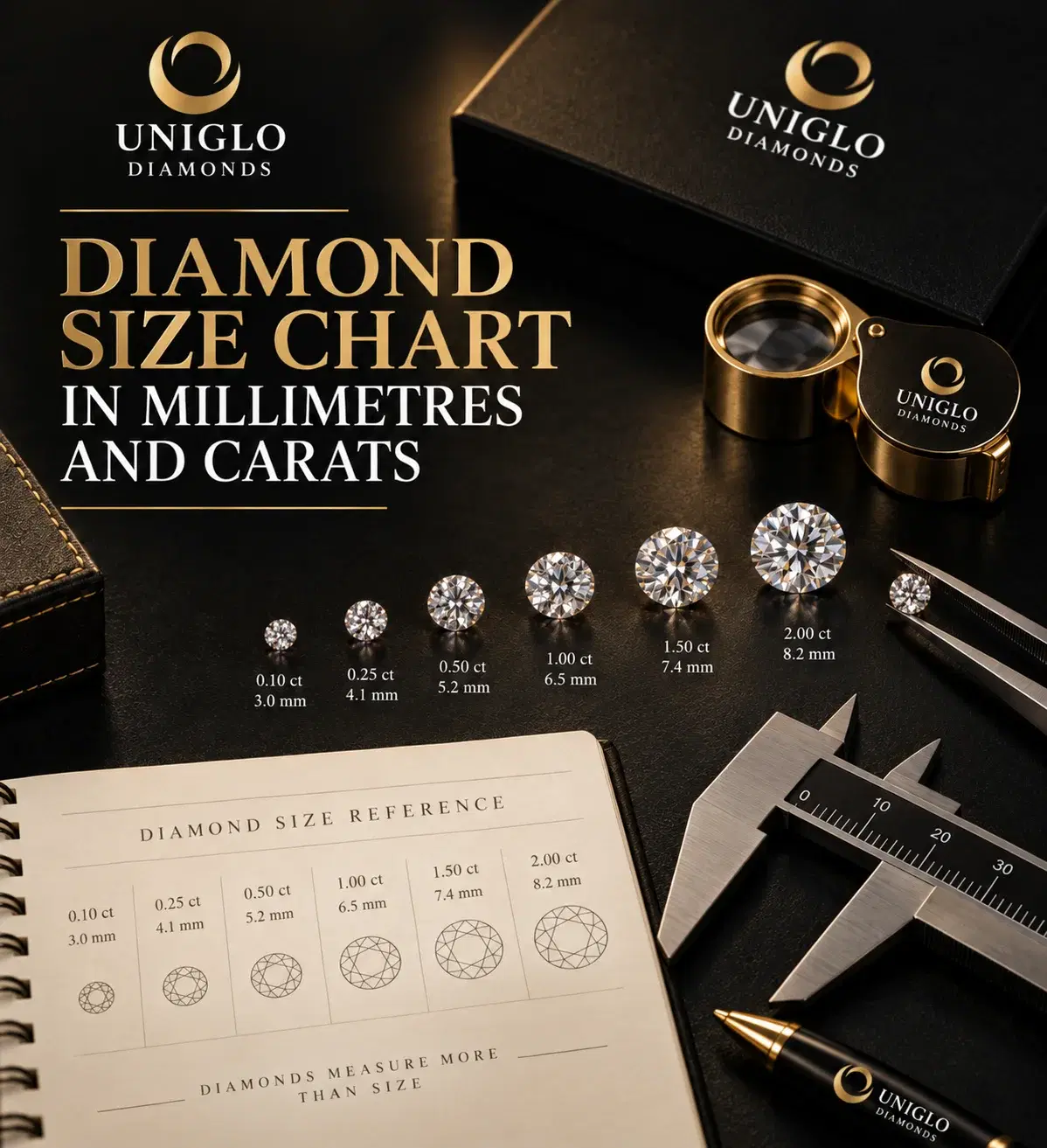
A diamond size chart helps you compare carat weight with a diamond’s approximate dimensions in millimetres. As a practical reference point, a one-carat round diamond is about 6.5 mm across, while a two-carat round diamond is about 8.2 mm.
However, carat is a measurement of weight rather than visible diameter. Diamonds with the same carat weight can therefore have different measurements depending on their shape, proportions and depth.
The charts below cover both natural and lab-grown diamonds. Use them to understand approximately how different carat weights may translate into face-up dimensions, then check the actual measurements recorded for the individual diamond before making a selection.
For a broader introduction to weight, cut, colour and clarity, see Uniglo’s Diamond 4Cs guide.
Round Diamond Size Chart
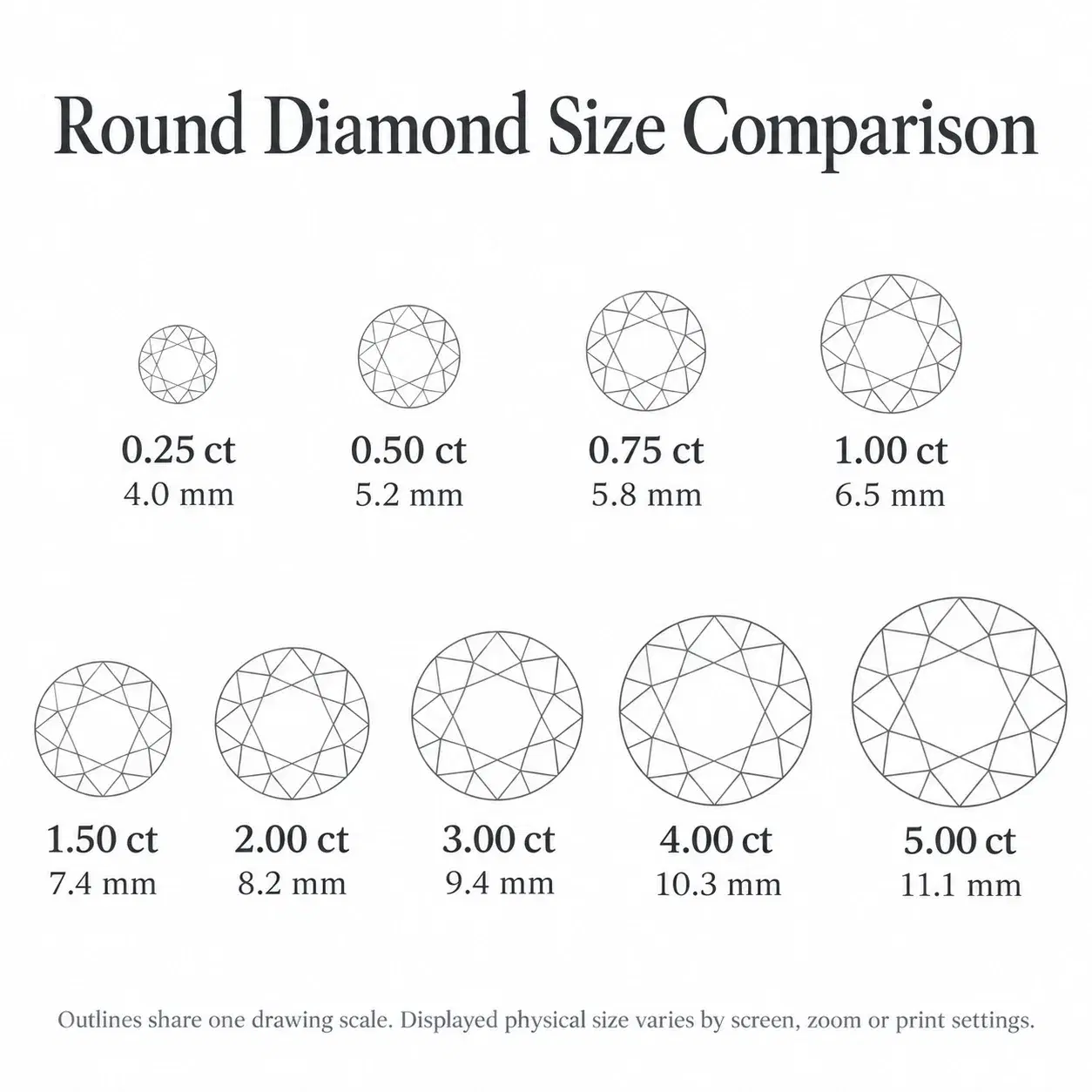
For a round diamond, diameter describes the width of the stone when viewed from above. The measurements below are approximate reference sizes rounded to one decimal place.
| Carat weight | Approximate diameter |
|---|---|
| 0.25 ct | 4.0 mm |
| 0.50 ct | 5.2 mm |
| 0.75 ct | 5.8 mm |
| 1.00 ct | 6.5 mm |
| 1.50 ct | 7.4 mm |
| 2.00 ct | 8.2 mm |
| 3.00 ct | 9.4 mm |
| 4.00 ct | 10.3 mm |
| 5.00 ct | 11.1 mm |
These measurements should be treated as reference points rather than fixed dimensional standards.
A diamond being larger or smaller than one of these approximate values does not by itself establish whether the diamond has better or worse cut quality. Its depth, proportions, symmetry and overall cutting also need to be considered.
Fancy-Shape Diamond Size Chart
Oval, emerald, pear, marquise, radiant and other fancy-shape diamonds generally require at least two face-up measurements: length and width.
This means that describing a fancy-shaped diamond simply as “8 mm” does not provide enough information to understand its outline.
The table below provides approximate examples around one and two carats.
| Diamond shape | Approximate example at 1 ct: length × width | Approximate example at 2 ct: length × width |
|---|---|---|
| Oval | 8.4 × 5.7 mm | 10.6 × 7.2 mm |
| Emerald | 7.0 × 5.0 mm | 8.5 × 6.5 mm |
| Pear | 9.2 × 5.6 mm | 11.6 × 7.1 mm |
| Marquise | 10.5 × 5.1 mm | 13.2 × 6.5 mm |
| Cushion, square example | 5.5 × 5.5 mm | 7.0 × 7.0 mm |
| Radiant, rectangular example | 6.7 × 5.3 mm | 8.5 × 6.6 mm |
| Princess, square example | 5.5 × 5.5 mm | 7.0 × 7.0 mm |
| Asscher, square example | 5.8 × 5.8 mm | 7.3 × 7.3 mm |
These dimensions are illustrative rather than an exact carat-to-millimetre conversion.
Two diamonds with the same nominal shape and carat weight can have different measurements. This is particularly important with shapes such as cushions, radiants and ovals, where length-to-width ratios and cutting styles can differ considerably.
An elongated cushion, for example, should not automatically be compared with the measurements of a square cushion simply because both diamonds have the same carat weight.
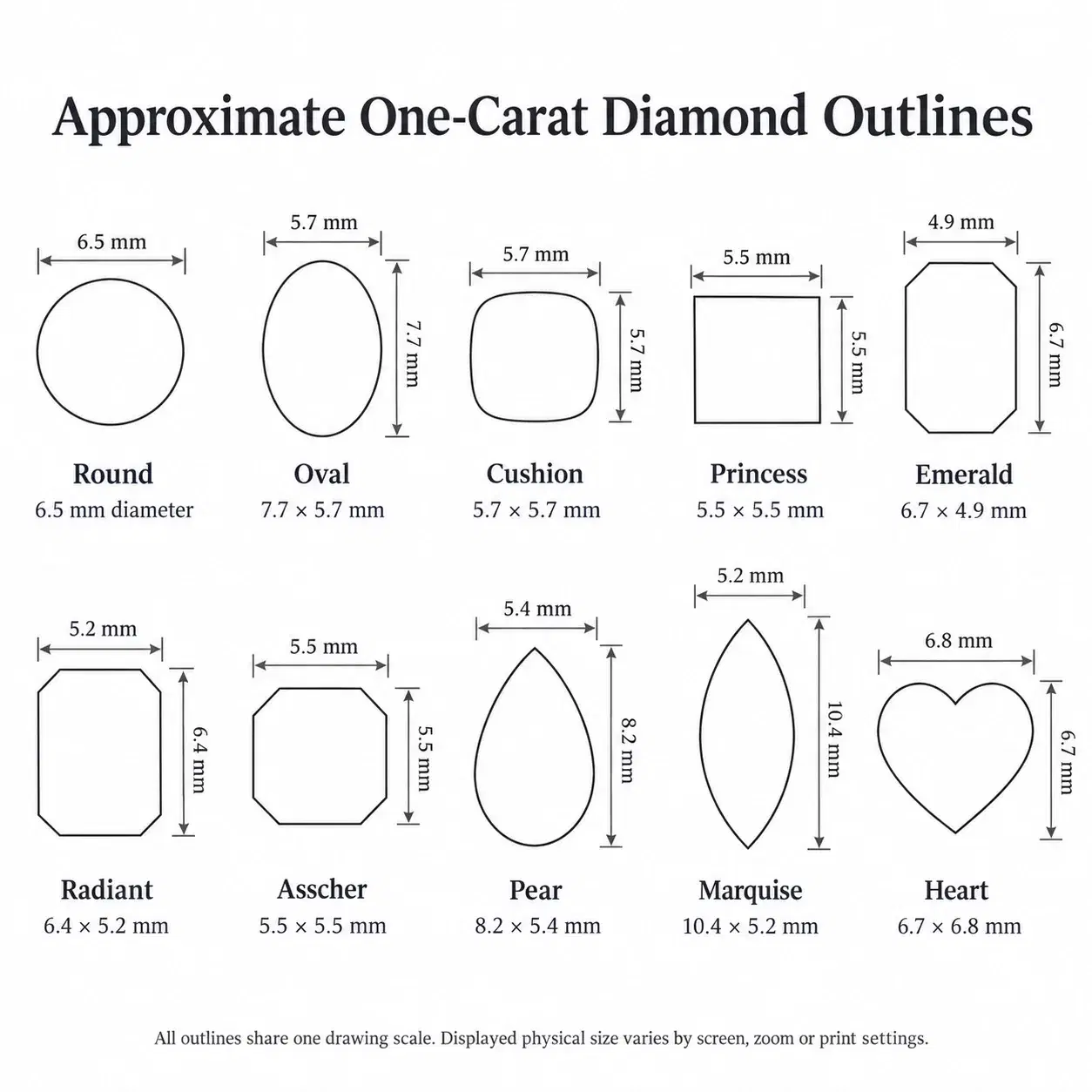
A longer diamond is also not necessarily larger in every direction. A marquise may be substantially longer than a round diamond while remaining much narrower across its centre.
For this reason, compare length and width together rather than focusing only on the longest measurement.
You can learn more about how these outlines differ in Uniglo’s Diamond Shapes guide.
What Is the Difference Between Carats and Millimetres?
Carats measure weight. Millimetres measure physical dimensions.
One metric carat equals 200 milligrams, or 0.2 grams, and a carat is divided into 100 points. A 0.50-carat diamond therefore weighs 100 milligrams and may also be referred to as a fifty-point diamond.
GIA explains diamond carat weight as one of the four principal characteristics used when describing a diamond.
When examining diamond dimensions, the measurements you are likely to encounter include:
- Diameter: the distance across a round diamond.
- Length: usually the longest face-up dimension of a fancy-shaped diamond.
- Width: the shorter face-up dimension.
- Depth: the distance from the top of the diamond to its bottom.
The view from above is often described as the face-up view.
Face-up measurements are particularly useful when you want to understand approximately how much visual space a diamond may occupy in a ring. Depth gives additional information about how the diamond’s weight is distributed below the girdle.
For more information on how carat relates to the other major grading characteristics, see The Diamond 4Cs.
How to Read Diamond Measurements on a Grading Report
A grading report provides the actual dimensions of the diamond rather than relying on a general size chart.
For a round diamond, GIA reports measurements as:
minimum diameter – maximum diameter × depth
For fancy shapes, measurements are generally presented as:
length × width × depth
These measurements are expressed in millimetres.
You can review GIA’s guide to understanding diamond grading reports for more information about the fields appearing on a report.
Consider these illustrative examples:
| Example | Measurements | How to read them |
|---|---|---|
| Round diamond | 6.42–6.48 × 3.98 mm | Diameter varies from 6.42 to 6.48 mm; depth is 3.98 mm. |
| Oval diamond | 8.40 × 5.70 × 3.55 mm | Length is 8.40 mm, width is 5.70 mm and depth is 3.55 mm. |
For the round diamond, the average diameter is 6.45 mm. That average can be useful when comparing stones, although the complete reported measurement should still be retained.
For the oval, 8.40 mm represents the longest dimension. Comparing that number alone with the round diamond’s 6.45 mm diameter would be misleading because the oval is considerably narrower across its width.
For more detail on reading certification information, use Uniglo’s GIA Certified Natural Diamonds guide or IGI Certified Lab-Grown Diamonds guide.
Can You Convert Millimetres Into a Carat Range?
A diamond size chart can help you identify a general carat range worth exploring, but millimetre measurements should not be used as a substitute for the diamond’s recorded carat weight.
Using the round reference figures above:
| Approximate diameter span | Carat bracket represented by the chart |
|---|---|
| 5.2–6.5 mm | 0.50–1.00 ct |
| 6.5–7.4 mm | 1.00–1.50 ct |
| 8.2–9.4 mm | 2.00–3.00 ct |
These are simply brackets created from the approximate examples in the size chart. They are not minimum or maximum measurement requirements for diamonds of those weights.
The limitation becomes even more important with fancy shapes.
For example, knowing that a diamond measures 8 × 6 mm does not tell you its depth, exact outline, cutting style or actual weight. Two diamonds with similar face-up measurements can therefore have different carat weights.
Whenever possible, use the diamond’s recorded carat weight together with its complete measurements rather than attempting to calculate its weight from length and width alone.
For mounted jewellery, also establish whether the stated weight comes from the original diamond documentation or whether it has subsequently been estimated.
Why Is a Two-Carat Diamond Not Twice as Wide as a One-Carat Diamond?
A two-carat diamond has twice the weight of a one-carat diamond, but that does not mean it has twice the diameter.
A diamond is a three-dimensional object. Additional weight is distributed through its width, length and depth rather than being added only to the visible face-up diameter.
Using the round reference measurements in this chart:
1.00 ct ≈ 6.5 mm
2.00 ct ≈ 8.2 mm
The diameter increases by approximately 1.7 mm, which is about 26% relative to the smaller reference diameter.
This example illustrates why carat weight and visible diameter should not be treated as interchangeable measurements.
When visually comparing diamonds, make sure photographs or diagrams are displayed at the same scale. Separate product images often enlarge each diamond to fill the available frame, which can make very different carat weights appear similar.
How Length-to-Width Ratio Changes a Diamond’s Appearance
Length-to-width ratio is calculated by dividing the diamond’s length by its width.
For example:
9.00 mm ÷ 6.00 mm = 1.50
An oval measuring 9.00 × 6.00 mm therefore has a length-to-width ratio of 1.50.
Another oval measuring 8.40 × 6.00 mm has a ratio of 1.40.
Although both diamonds have the same width, the first has a more elongated outline.
Length-to-width ratio describes shape rather than overall size. Diamonds with very different carat weights can share exactly the same ratio.
For example:
6 × 4 mm = 1.50 ratio
9 × 6 mm = 1.50 ratio
The second diamond is substantially larger, but both have the same proportional outline.
For this reason, use the ratio together with actual measurements and carat weight.
A buyer looking for an elongated oval could therefore give a supplier a more precise request such as:
“Approximately 9 mm long with a length-to-width ratio around 1.45–1.50.”
That provides considerably more information than simply asking for “a large oval diamond”.
Uniglo’s Diamond Shapes guide can also help you compare the visual characteristics of different outlines.
Do Natural and Lab-Grown Diamonds Use the Same Size Chart?
Yes. The same carat and millimetre measurement principles apply to natural and laboratory-grown diamonds.
A millimetre represents the same physical distance regardless of diamond origin, while a carat represents the same unit of weight.
GIA explains that laboratory-grown diamonds have essentially the same chemical composition and crystal structure as natural diamonds while differing in their origin. You can read more in GIA’s explanation of natural diamonds, laboratory-grown diamonds and simulants.
You therefore do not need a separate carat-to-millimetre system simply because the diamond is laboratory grown.
Two one-carat diamonds can still have different dimensions because of differences in shape and proportions, but the measurement system itself does not change.
When comparing available stones, review the actual measurements alongside the origin information.
Browse Uniglo’s natural diamonds and lab-grown diamonds using the same measurement principles.
Diamond Size vs Face-Up Appearance
Carat weight tells you how much the diamond weighs, but the face-up dimensions influence how large the diamond appears when viewed from above.
This distinction becomes particularly useful when comparing diamonds with similar carat weights.
A stone that carries more of its weight in its depth may present differently from another stone whose dimensions distribute more of the weight across its visible outline.
However, a larger face-up measurement should not automatically be treated as evidence that the stone is better.
The diamond still needs to be assessed for its proportions, appearance and cutting characteristics.
This is why a diamond size chart should primarily be used as a comparison and shopping-reference tool, rather than as a grading system.
Compare Diamond Size With Shape
Shape has a major influence on how carat weight translates into visible measurements.
A round diamond tends to be discussed mainly in terms of diameter, whereas an oval, pear, marquise, emerald or radiant diamond needs both length and width to properly describe its face-up outline.
This creates situations where two diamonds of equal weight may look noticeably different when placed next to one another.
An elongated shape can appear longer on the finger, while a wider or squarer shape may occupy more visual space across the finger.
Neither effect changes the actual carat weight.
Before deciding that one diamond “looks larger”, consider exactly which dimension is creating that impression.
Use Uniglo’s Diamond Shapes guide alongside this size chart when comparing outlines.
Check Dimensions Alongside Diamond Cut
Size is only one part of diamond selection.
A diamond’s proportions and cutting influence the way light interacts with the stone. This means that a size chart cannot tell you whether a diamond will have strong brilliance, fire or scintillation.
GIA’s diamond cut guidance explains why diamond cut involves the relationship between multiple proportions and characteristics rather than a single measurement.
When comparing diamonds, bring together:
the carat weight, face-up measurements, depth, grading information and a clear view of the individual diamond.
If information in a listing differs from the accompanying grading report, clarify the discrepancy before making a selection.
For additional context, use Uniglo’s Diamond 4Cs guide.
Diamond Measurements and Setting Fit
If you already have a jewellery setting, do not assume that a diamond described simply as “one carat” will automatically fit.
Settings are constructed around physical dimensions, not just carat weight.
A jeweller may need to evaluate:
the stone’s length, width, depth, girdle position, shape and the construction of the setting itself.
This becomes particularly important when replacing a diamond or fitting a fancy-shaped diamond into an existing setting.
Provide the complete measurements of the proposed diamond rather than only its weight.
For earrings, multi-stone rings and other jewellery containing several diamonds, also check whether the advertised carat figure refers to one individual diamond or total carat weight across all stones.
When visual matching matters, request measurements for the individual stones rather than relying exclusively on the combined carat figure.
Frequently Asked Questions
How many millimetres is a one-carat diamond?
A one-carat round diamond is approximately 6.5 mm across in this reference chart. Fancy-shaped diamonds have different length and width measurements, so the individual diamond’s grading report or specifications should be used for its actual dimensions.
How big is a two-carat round diamond?
A two-carat round diamond is approximately 8.2 mm in diameter according to the rounded reference chart. Actual measurements can differ according to the individual diamond’s proportions.
Is an 8 mm diamond always two carats?
No.
You need to know the diamond’s shape, complete measurements and recorded weight.
An 8 mm diameter on a round diamond and an 8 mm length on an oval or emerald diamond describe very different outlines. One measurement alone cannot establish carat weight.
Can two diamonds have the same carat weight but different sizes?
Yes.
Carat measures weight, so equal carat weight does not require equal external dimensions. Shape, depth and proportions can result in different face-up measurements.
Can two one-carat diamonds look different in size?
Yes.
Even when both diamonds weigh exactly one carat, differences in shape and proportions can make their face-up dimensions noticeably different.
Compare the complete measurements rather than assuming equal carat weight means identical visible size.
Are diamond size diagrams actual size on my phone?
Not necessarily.
The diagrams can preserve a consistent scale relative to one another, but their physical display size changes according to device size, browser zoom, responsive page layout and display settings.
Use the printed millimetre measurements rather than measuring the screen image with a ruler.
Does a larger millimetre measurement mean a better diamond?
No.
A larger measurement establishes a dimensional difference. Diamond quality and suitability also depend on characteristics such as cut, colour, clarity, proportions, appearance, documentation and the requirements of the jewellery.
Does lab-grown diamond size work differently from natural diamond size?
No.
Natural and lab-grown diamonds use the same carat weight and millimetre measurement systems.
Origin should be recorded separately from size.
Should I compare carat or millimetres when buying a diamond?
Ideally, compare both.
Carat tells you the diamond’s weight, while millimetres tell you its actual external dimensions. Looking at both gives you a much more useful understanding of how the individual diamond may appear.
Find a Diamond in Your Preferred Size
If you already know the approximate diamond size you want, contact Uniglo Diamonds with your preferred:
diamond shape, approximate millimetre dimensions, carat range, budget and preference for natural or lab-grown origin.
If the diamond is intended for an existing setting, include the setting requirements as well.
When reviewing available options, compare the individual diamonds’ measurements, grading documentation and images rather than making the decision from carat weight alone.
You can also explore Uniglo’s natural diamonds or lab-grown diamonds before requesting suitable options.