Natural Diamond Treatments: What Buyers Should Check
A natural diamond can be treated after it forms. “Natural” describes its geological origin; it does not automatically mean that its colour or clarity is untreated. Before buying, establish the treatment status, read the relevant laboratory information and understand any effect on care or the purchase decision. GIA’s explanation of diamond treatments.
Treatment information belongs alongside the diamond’s appearance, dimensions and grades. It helps you understand what is being offered and whether the stone meets your requirements.
The useful questions are specific: what treatment has been identified, where is it documented, and what does it mean for this particular diamond?
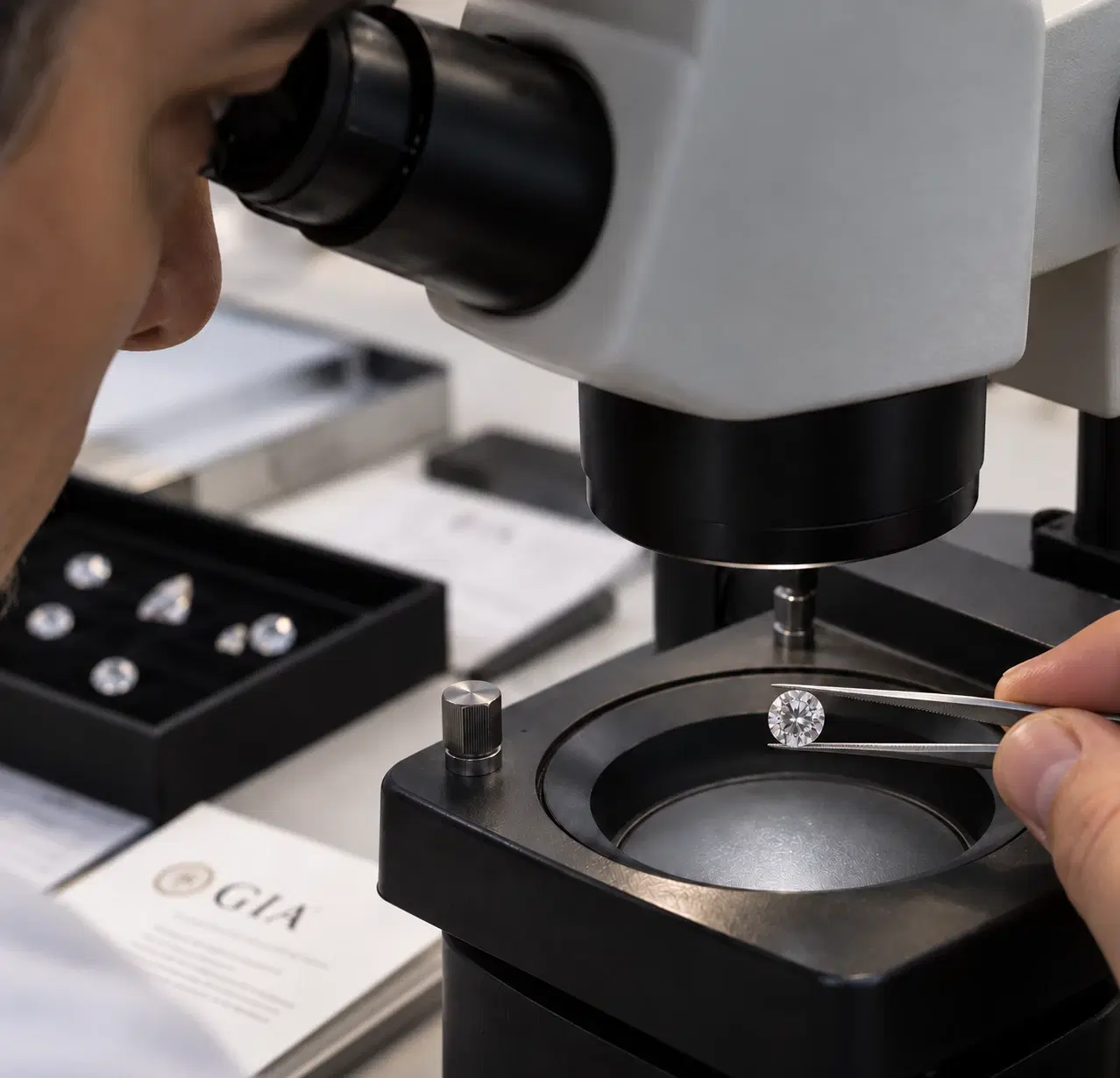
Natural origin and treatment status describe different things
A diamond may have formed in the earth and subsequently undergone a process intended to change its appearance. Treatment does not change that geological history. A report can therefore identify a natural diamond while also recording treatment.
Ordinary cutting and polishing are part of preparing a diamond for jewellery. Gemmological treatment terminology generally concerns additional processes intended to alter characteristics such as colour or clarity. GIA’s introduction to gem treatments.
This distinction matters when reading a listing. “Natural diamond”, “natural colour” and “untreated diamond” communicate different claims. Ask the seller to explain exactly which claim applies and what supports it.
For a broader introduction to natural diamonds and the buying process, visit our natural diamond buying guide.
The main natural diamond treatments buyers may encounter
HPHT colour treatment
High-pressure, high-temperature treatment, usually shortened to HPHT, can change a diamond’s colour. Depending on the starting material, it may reduce a brown tint or produce another colour. GIA describes the result as stable under normal jewellery handling conditions. GIA’s explanation of HPHT treatment.
HPHT can describe diamond growth or subsequent colour treatment. Read the report’s origin identification separately to establish which applies. GIA’s explanation of HPHT uses.
If a listing says only “HPHT diamond”, request the complete origin and treatment description before comparing it with other stones.
Irradiation and annealing
Artificial irradiation changes a diamond’s colour through exposure to radiation. It may be followed by annealing, a controlled heating process that further modifies the colour. Some resulting colours can be affected by the heat used during jewellery repairs. GIA’s explanation of irradiation.
For a coloured natural diamond, ask whether the colour is natural or treatment-induced. The visible shade alone is an inadequate basis for that decision.
Also request care information for the identified treatment. If the stone is later set, resized or repaired, give that information to the jeweller before work begins.
Laser drilling
Laser drilling can create a small channel through which a dark inclusion can be reached and lightened chemically. It is a clarity treatment intended to make the inclusion less noticeable. SGL’s explanation of laser drilling.
The drilling leaves a feature that needs to be considered when assessing the stone. Ask the seller to show you its location and explain the laboratory’s description. Also establish whether filling was used after drilling, because that introduces another treatment to assess.
A statement such as “clarity enhanced” is too broad to answer these questions. Ask for the method to be named.
Fracture filling
Fracture filling introduces a glass-like material into surface-reaching fractures to reduce their visibility. The fracture remains present, even when it becomes less apparent. GIA’s explanation of fracture filling.
The filling has its own care requirements. Cleaning or repair procedures can damage it, and the treatment is not considered permanent. SGL’s discussion of fracture-filled diamonds.
Ask what material or process was used, what care instructions apply and what any treatment-related warranty actually covers. A promise to restore the filling should explain the conditions, costs and arrangements involved.
Surface coatings
A coating places an additional layer on part or all of a diamond’s surface to alter its apparent colour. Coatings can scratch or wear away, so the appearance depends partly on the continued condition of that layer. GIA’s explanation of surface coatings.
Ask whether the colour you are seeing depends on a coating and what handling restrictions apply. If your brief requires untreated colour, make that requirement explicit before selecting a stone.
What treatment information should be disclosed?
Request a written description that identifies the diamond as natural and states any known treatment. Broad phrases such as “enhanced”, “improved” or “processed” should be explained in terms you can use to evaluate the purchase.
The description should connect the treatment to the individual stone. Keep its stock reference or report number attached to the quotation and ask for the agreed disclosure to appear on the sales documentation.
If more than one process has been used, ask for each known process to be recorded. An answer about colour alone leaves your question about clarity unresolved.
Where the seller describes the diamond as untreated, ask what that statement covers and which laboratory assessment supports it. If you require no colour or clarity treatment, state both requirements in your enquiry.
This also helps when buying a gift. The recipient should receive the relevant treatment and care information with the diamond or jewellery, particularly if someone else will arrange future servicing.
Read the laboratory’s treatment wording in context
Start with the report issuer and service. Different reports provide different information, and a short product listing may omit details present in the full document.
For coloured natural diamonds, GIA’s services distinguish natural colour from treated colour. Its Colored Diamond Identification and Origin Report concerns the origin of the colour; this should not be confused with a statement identifying the country where a diamond was mined. GIA’s coloured diamond report services.
The following wording and report features deserve attention. Their location and presentation depend on the laboratory and report format.
| Wording or feature | What it tells you | What to check next |
|---|---|---|
| Colour origin described as natural | The assessment concerns the origin of the diamond’s colour | Read the remaining information for clarity treatment and other relevant disclosures |
| Colour origin described as treated | The colour has been attributed to treatment | Ask which process is identified and what care guidance applies |
| HPHT processing identified | A high-pressure, high-temperature process is recorded | Read the diamond’s origin identification separately |
| Laser drill hole recorded | A feature associated with clarity treatment has been identified | Ask to see its location and clarify whether additional filling is present |
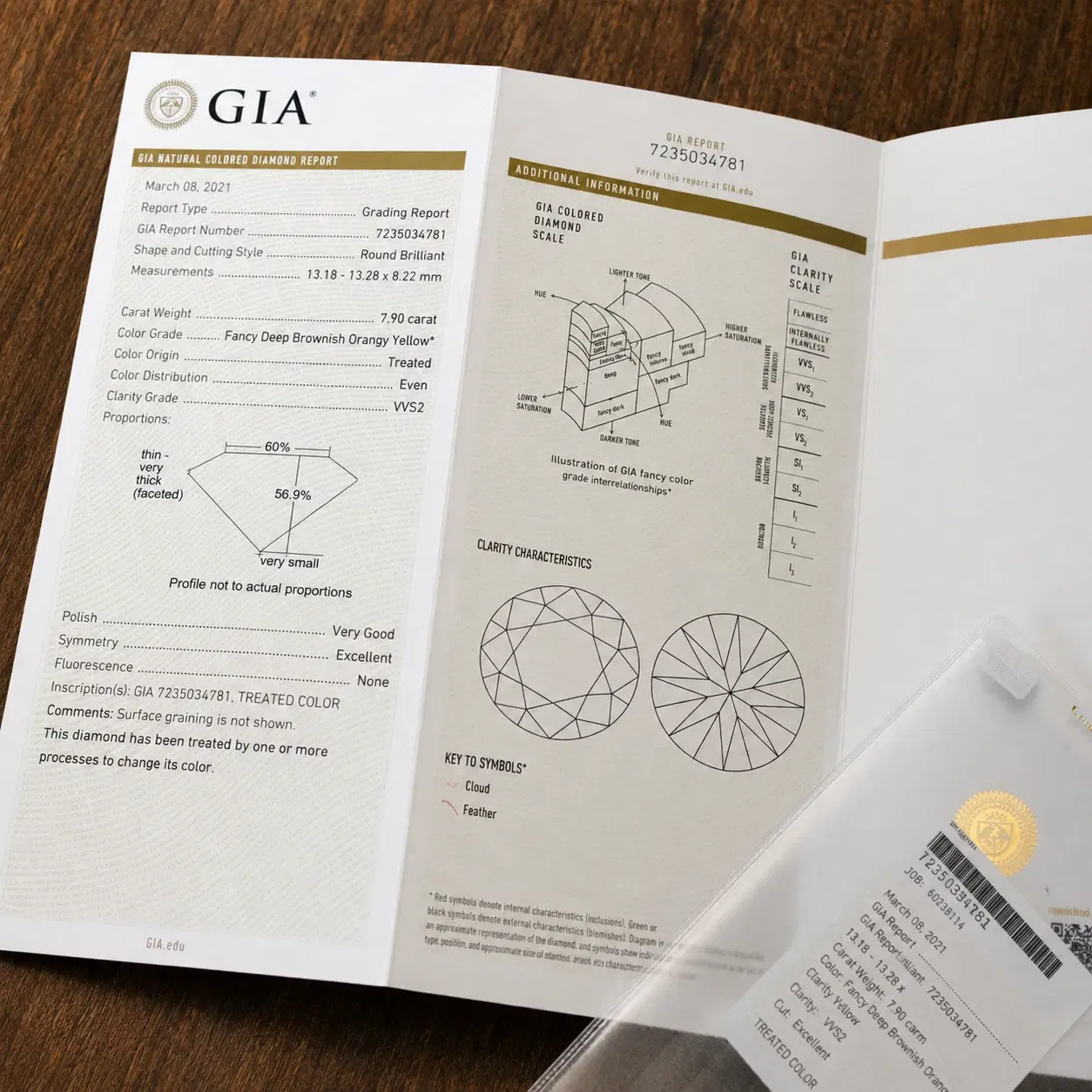
| TREATED COLOR inscription | A treatment disclosure appears on the diamond’s girdle | Match the inscription and the physical stone to the relevant report |
GIA explains how laser drilling is recorded and describes its reporting approach to treated diamonds. Its laboratory research also documents the TREATED COLOR inscription on colour-treated natural diamonds. GIA’s treatment reporting guidance, GIA’s inscription research.
IGI states that permanent treatments are noted in the comments section of its natural diamond reports and that it does not issue full grading reports for diamonds with non-permanent treatments. Check the policy and wording of the laboratory that issued your document. IGI’s natural diamond report guidance.
Does a GIA report mean the diamond is untreated?
GIA can issue grading reports for certain stable treatments, including HPHT processing, irradiation, annealing and laser drilling. It does not issue grading reports for fracture-filled or coated diamonds. Having a GIA report therefore does not, by itself, establish untreated status. GIA’s policy on treated diamonds.
If someone offers a fracture-filled diamond with a GIA grading report, ask how the document relates to the stone’s current condition. Establish whether the report predates the filling and obtain an explanation of any discrepancy.
For any older report, ask whether treatment or other work has occurred since the examination. An archived document should be considered alongside the diamond being offered today.
Use GIA Report Check to compare the supplied information with GIA’s records, then arrange an appropriate physical match. Our GIA natural diamond report guide covers the wider verification process.
Compare price using the treatment status
When comparing offers, record treatment status alongside the shape, carat weight, dimensions, grades and laboratory information. If that information is missing from one quotation, resolve it before deciding whether the offers are comparable.
For example, imagine two hypothetical listings described as blue natural diamonds of similar size. One report identifies natural colour; the other identifies treated colour. Their descriptions now reveal a difference that matters to the purchasing brief.
The buyer seeking naturally occurring blue colour would need to consider that distinction before comparing prices. A buyer open to treated colour would still need to assess the specific stone, its documentation and the complete offer.
Ask for current quotations for clearly described options. A claimed treatment-related discount needs an explanation of the comparison behind it; the percentage alone cannot determine whether the purchase suits you.
Our natural diamond price guide explains how to compare stone specifications and quotation inclusions.
Ask for care instructions before buying
The care discussion should identify the treatment, the diamond’s condition and the jewellery construction. Ask which cleaning methods are suitable and whether any procedures should be left to a professional.
Diamond’s hardness describes scratch resistance. It does not mean that the stone, a treatment material or its setting is immune to damage. GIA distinguishes hardness from toughness and stability when explaining diamond care. GIA’s diamond care guidance.
Keep the treatment information available for future jewellers. Before resizing, resetting or repair, tell the person carrying out the work what is known about the diamond and provide the accompanying documents.
If you are offered a treatment warranty, read what it covers. Clarify whether it concerns the appearance of the treatment, repeat treatment, accidental damage or another service, and who pays any associated costs.
If treatment status is uncertain, obtain suitable professional advice before using steam, an ultrasonic cleaner or other intensive cleaning methods.
Deciding whether a treated natural diamond suits you
Start with your own requirement. If owning an untreated natural diamond is essential, put that in writing and ask for supporting information before purchase.
If you are open to a treated diamond, consider whether you understand the treatment, like the actual appearance and can accommodate the care requirements. Review the documentation and purchase terms with the same attention you give to the stone.
You should be able to explain what you are buying without relying on a vague reassurance such as “it is still natural”. A clear description should tell you both the diamond’s origin and its known treatment status.
Resolve unanswered questions before paying, especially where the seller’s wording and the laboratory information appear inconsistent.
Frequently asked questions
Is a treated natural diamond still a real diamond?
Yes. A natural diamond can undergo treatment after formation. Its natural origin and subsequent treatment should both be accurately described. GIA’s diamond treatment guidance.
Does natural colour mean there has been no clarity treatment?
A colour-origin assessment answers a question about colour. Read the other report information and ask separately about clarity treatment before interpreting it as an overall untreated statement. GIA’s coloured diamond report services.
Is a laser inscription the same as laser drilling?
No. An inscription places identifying characters on the girdle, while laser drilling is a process used to reach an inclusion inside the diamond. IGI’s explanation of laser inscription, SGL’s explanation of laser drilling.
Can I identify every treatment from a photograph?
A photograph cannot establish the complete treatment status. Treatment detection can require specialised laboratory examination. Use the individual stone’s documentation and request further assessment where information remains uncertain. SGL’s discussion of treatment identification.
Discuss natural diamond treatment information with Uniglo
To discuss a natural diamond requirement, contact Uniglo Diamonds with your preferred shape, size and budget, and state whether you require untreated colour and clarity.
If you are considering a particular stone, include its reference or report number. Ask to review the available treatment information, supporting documents and relevant care considerations before making your decision.