
Why Does a Diamond Look Cloudy? A Buyer’s Inspection Guide
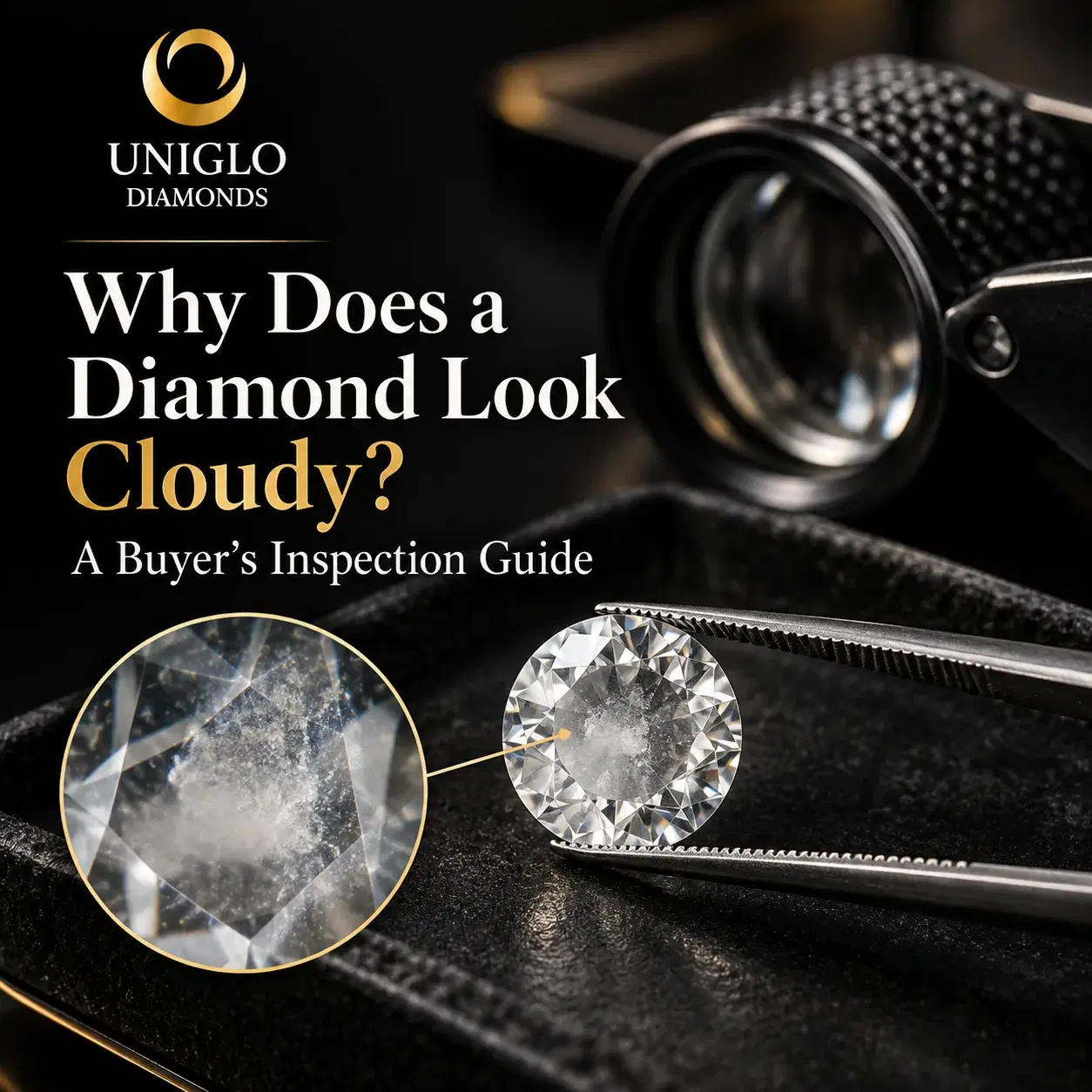
A diamond can look cloudy because of surface residue, internal inclusions or light-scattering defects. Poor lighting and an unclear video can also make a transparent stone look dull. Start with a suitable cleaning, then inspect the actual diamond under more than one light source. A clarity grade or fluorescence description alone cannot identify the cause of what you are seeing.
For a buyer, the useful question is: Does the freshly cleaned diamond still show a persistent haze, and has the cause been examined? This guide explains how to gather that evidence before choosing a loose diamond or investigating a ring that has lost its usual appearance.
What does a cloudy diamond look like?
Buyers use “cloudy,” “milky” and “hazy” to describe an appearance that seems veiled or lacking definition. Those words describe an observation, rather than a single diagnosis.
Look at what is actually unclear. Does the surface appear smeared? Is there a pale patch inside one part of the stone? Do bright and dark facet reflections look washed out across a wider area? Or is the whole video out of focus, including the holder?
Write down the observation before assigning a cause. “The centre looks veiled after cleaning in two lighting conditions” gives a jeweller much more to investigate than “It does not sparkle enough.”
Cloudy appearance: possible causes and useful checks
| What you observe | Possible explanation | Next useful check |
|---|---|---|
| Smears or a film, especially on a worn ring | Surface oil and accumulated dirt | Clean appropriately; compare before and after under the same light |
| A persistent pale patch inside a clean diamond | A localised group of inclusions | Ask a gemologist to locate and assess the feature |
| A wider milky veil that remains after cleaning | Internal light scattering | Request an assessment of transparency, rather than relying on the grade alone |
| Dark areas that change as the diamond moves | Facet reflections, lighting or cut-related appearance | View a slow rotation in another lighting environment |
| A change between indoor light and daylight | A lighting-dependent appearance; fluorescence may be relevant | Compare the same clean stone in both settings and discuss the result |
| Soft detail throughout the entire recording | Focus, exposure or video quality | Request a new, sharply focused recording |
These are starting points for inspection. Several can occur together, and a photograph alone may not distinguish them.
Start by checking the surface
Oil from handling and dirt can reduce a diamond’s brilliance. The underside is particularly easy to overlook when the stone is mounted. GIA’s guidance on keeping diamonds sparkling explains how surface oils affect appearance and recommends gentle cleaning for suitable jewellery.
For an untreated diamond in a sound setting, mild dish soap, water and a soft brush may be appropriate. Fragile jewellery, other gemstones and treatments can change the cleaning requirements. If the item’s condition or treatment history is uncertain, ask a jeweller to inspect and clean it first.
The buying comparison should begin with a freshly cleaned stone. Ask the seller when the diamond was cleaned and whether the underside was accessible. For an existing ring, photograph it before and after cleaning in the same position, with the same camera and light.
If the appearance improves substantially, record that improvement. If a veil remains, move to an examination rather than repeating progressively harsher cleaning. GIA’s diamond care guide advises against abrasive cleansers and home ultrasonic or steam cleaning; professional equipment requires checks for loose stones.
For routine care, see Uniglo’s guide to cleaning diamond jewellery at home.
Can inclusions make a diamond cloudy?
Some can. A cloud is a group of very small inclusions. IGI’s glossary describes these grouped features as having a cloudy appearance. A small localised cloud and a feature spread through much of the stone are different inspection situations.
The word “cloud” on a report therefore needs context. Ask where the feature is, how extensive it is, and whether the cleaned stone shows an observable effect in ordinary viewing conditions. Finding a cloud under magnification does not, by itself, establish that the entire diamond looks milky to a buyer.
Other characteristics can affect transparency too. GIA’s inclusion guide explains that internal graining can involve whitish or reflective features associated with irregular crystal growth. Avoid treating every persistent haze as one identical type of inclusion.
A useful request is: “Please show the area under magnification, then show the same diamond face-up at normal viewing distance.” This connects the technical description to the appearance you are buying.
Does strong fluorescence make a diamond cloudy?
Strong fluorescence alone is not a reliable reason to label a diamond cloudy. In its 2021 study of blue fluorescence and diamond appearance, GIA found that fluorescence alone did not noticeably reduce transparency in the tested diamonds without light-scattering defects. Strong fluorescence could increase apparent haze where those defects were already present, and some tested stones showed minor contrast loss.
The practical response is to examine the actual diamond in relevant lighting. Neither “Strong” nor “None” on a report should replace that inspection. GIA’s consumer explanation of fluorescence likewise recommends viewing the stone in person, including daylight-equivalent conditions.
Ask for an ordinary indoor view and a daylight or professionally controlled daylight-equivalent view of the same clean stone. A dramatic UV-lamp clip demonstrates a reaction under that lamp; it does not answer how the diamond will look during everyday wear.
For the broader topic, read Uniglo’s diamond fluorescence guide.
Cloudy, dull and grey: describe the difference
A diamond that looks dark in one position is not necessarily internally hazy. Change the angle slowly and observe whether the dark area moves or becomes bright. Then repeat the view under another light source. Describe the behaviour rather than assigning a transparency problem from one frame.
Cut quality influences brightness, fire and scintillation. IGI’s clarity discussion explains why a higher clarity grade does not automatically mean more sparkle, while noting that transparency also matters. Uniglo’s diamond cut versus clarity guide covers that buying trade-off in more detail.
A grey or brown impression raises a separate question about colour and the viewing environment. Tell the seller whether you see a tint, a washed-out pattern, a dark reflection or a persistent veil. “Grey” and “cloudy” should not be used interchangeably in your request for an assessment.
Video can blur these distinctions. When the stone, tweezers and background are all soft, ask for a better recording before making a decision. When highlights are almost entirely white, request a view with less exposure so that facet detail remains visible.
What should you check on the diamond report?
Begin with identity: the issuing laboratory, report number, measurements and any inscription information. Ask the seller how the stone shown in the video has been matched to that report. Uniglo’s diamond certificate guide explains the main report fields.
Next, review the clarity information and any comments. GIA explains clarity grading in terms of the size, nature, position, relief and number of characteristics assessed at 10× magnification. Some obvious inclusions in the Included grades can affect transparency and brilliance.
If a report mentions clouds, graining or features not represented on a diagram, ask for an explanation specific to that stone. A diagram is an aid to understanding characteristics; it is not a photograph of everyday appearance. Do not invent a visible result from a comment without an inspection.
Keep the report and viewing evidence together. If a video seems inconsistent with the description, request a new view and an examination before deciding. A report issued before wear also needs to be considered alongside the item’s current condition.
A six-step inspection for buyers
This is a practical comparison procedure, rather than a laboratory grading method. Its purpose is to make the seller’s evidence clear enough for you to assess.
1. Identify the exact stone
Request the report and a recording of the diamond being offered. Confirm whether it is loose or mounted. Save the report number with the video so that similarly sized options cannot be confused later.
If comparing several diamonds, label each one consistently in every image. A seller’s verbal description becomes much easier to follow when “Diamond A” always refers to the same report.
2. Establish a clean starting point
Ask for suitable cleaning before the comparison and confirmation of what could be accessed. For a mounted diamond, ask whether the setting prevented inspection or cleaning of any part of the stone.
Avoid comparing one freshly cleaned loose diamond with another filmed in an older, worn ring. Request comparable conditions, or clearly record the limitations.
3. Request a steady face-up view
Ask for a short pause face-up, followed by a slow rotation. The recording should retain enough detail to show bright and dark reflections rather than just flashes. Request both a normal-distance view and a closer view.
The normal-distance view answers an appearance question. The close view helps locate what concerns you. Keep both; an enlarged frame alone can exaggerate the importance of a tiny feature.
4. Repeat in a second lighting environment
Use an ordinary indoor setting and daylight or a disclosed daylight-equivalent setup. Keep the stone clean between views. Ask the seller to identify the lighting rather than simply calling it “natural.”
Note whether the concern persists, changes location with rotation, or appears only in one environment. This record helps a professional investigate the cause without assuming that every change is fluorescence-related.
5. Compare like with like
Where possible, request two clean diamonds of similar shape and size in the same frame, at similar angles. Separate clips with different exposure, distance or lighting make a subtle comparison harder.
Pause on a view where both stones are in focus. Ask the seller to address the particular region or appearance you noticed. A side-by-side comparison can support a buying decision, but it does not independently diagnose an internal defect.
6. Obtain an explanation before committing
If haze persists, ask a qualified gemologist to examine the stone and explain the findings. Clarify whether the concern is surface-related, internal, an aspect of its cut appearance or a limitation of the media.
For an important purchase, an independent inspection can resolve uncertainty. Arrange the timing while the applicable inspection or return period remains open. For jewellers, agree the appearance requirement before setting or accepting a batch.
What to ask the seller
Send a request that identifies the evidence you need:
Please provide a freshly cleaned face-up video of this exact diamond, linked to its report number, with a steady view and slow rotation in ordinary indoor light and daylight or disclosed daylight-equivalent lighting. Please explain whether you observe any persistent milkiness or haze after cleaning, where it appears, and whether a gemologist has examined the cause. If possible, show a similar clean diamond alongside it under the same conditions. Please also confirm the inspection and return arrangements before setting or purchase.
For trade orders, add the intended use: centre stone, matched pair or melee parcel. If consistency across multiple stones matters, specify that alongside the requirement to examine individual stones. Do not accept a generic “eye-clean” description as the entire response to a transparency concern.
Can a cloudy diamond be fixed?
The answer depends on the cause. Surface residue can often be removed through suitable cleaning. An internal inclusion is inside the diamond; washing its surface will not remove it. Ask for a diagnosis before considering any proposed remedy.
Damage requires a different assessment. GIA’s care and cleaning guide documents a diamond with a cloudy surface after fire exposure that required recutting, with a reduction in size. That is a specialist repair example, rather than a model for everyday cleaning.
Do not buy a diamond on an unsupported promise that persistent internal milkiness will disappear after mounting, washing or polishing. Ask what change is proposed, who will assess it, and what effect it could have on the stone and its documentation.
If you want a transparent-looking diamond and the seller cannot explain a persistent veil, compare another stone before committing. If you prefer a deliberately milky appearance, establish what category of diamond you are buying. GIA’s research on Fancy white diamonds describes a distinct opalescent appearance; Fancy white is different from “white” used casually for colourless diamonds.
Choose with a clear view of the actual diamond
Bring together the report, cleaned-stone views and any professional findings before making your decision. If those pieces do not agree, resolve the difference while you can still inspect and compare alternatives.
When enquiring with Uniglo, share the report number, your intended jewellery design and the lighting conditions in which you noticed the concern. Contact Uniglo Diamonds to discuss your requirements and request available information for the stone you are considering.
Frequently asked questions
More Topics




