
What Is an Eye-Clean Diamond? A Viewing Checklist
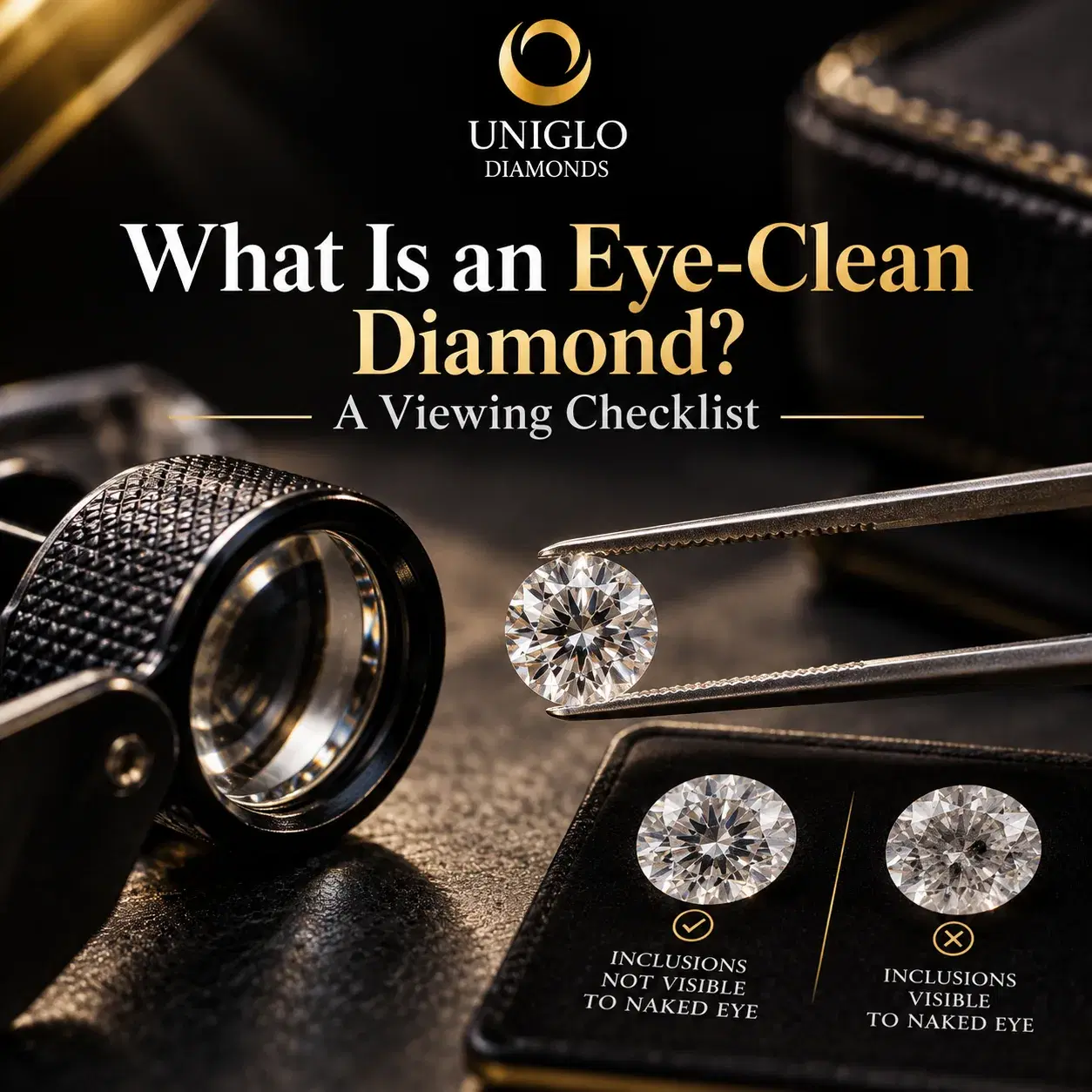
An eye-clean diamond has no inclusions visible without magnification under the viewing conditions being described. “Eye-clean” is an appearance term, not a laboratory clarity grade. To make the description useful, agree on the viewing distance, lighting and directions, then inspect the individual stone or request a written assessment tied to its report number.
A diamond can look marked in a magnified video yet appear clean when viewed normally. Another can look convincing in a small promotional image but reveal a feature when examined in person. Neither situation is resolved by the words “eye-clean” alone.
This guide gives you a practical way to check the claim, compare evidence and explain your own requirements. It focuses on unaided-eye viewing rather than ranking every clarity grade or identifying every type of inclusion. For the wider quality framework, see Uniglo’s diamond 4Cs guide.
What does eye-clean mean when buying a diamond?
GIA’s clarity buying guidance describes eye-clean as an industry term concerning inclusions that cannot be seen with the naked eye. GIA does not use it as a clarity grade. A laboratory report and an eye-clean assessment therefore answer different questions.
IGI’s explanation discusses a trade-consensus definition using face-up viewing, daylight-equivalent or fluorescent lighting, approximately 15–30 cm distance and 20/20 vision. That is a reference definition, not a universal guarantee for every observer or every angle.
For a purchase, ask what the seller means by the term. Does it cover the view from above only? Was the diamond examined loose or mounted? At what distance, and by whom? “Eye-clean from the top at 30 cm” is a more useful statement than “very clean”.
Your acceptance criteria can be more demanding than the seller’s. If you want a diamond that remains visually clean when inspected from the side or closer up, include that in the brief before asking for candidates. Describe the additional requirement rather than assuming the label already covers it.
Eye-clean versus a laboratory clarity grade
A clarity grade is based on an examination of the diamond’s characteristics under controlled conditions. GIA’s clarity explanation describes assessment at 10× magnification and consideration of factors including size, number, position, nature and contrast. Eye-clean concerns visibility without that magnification under the stated conditions.
| Description | What it establishes | What still needs checking |
|---|---|---|
| Laboratory clarity grade | The laboratory’s reported clarity assessment | Your visual preference and the complete stone |
| Seller’s eye-clean statement | An appearance assessment under the seller’s stated conditions | Whether those conditions match your requirements |
| Magnified photograph or video | Detail visible in that recording | Unaided-eye visibility in person |
| Your viewing notes | What you observed in that examination | Separate report, condition and treatment questions |
An eye-clean appearance does not change the grade printed on the report. Equally, a higher grade is not automatically a visible improvement for your particular purchase. Keep the report information and the viewing assessment in separate columns when comparing options.
GIA’s laboratory process uses systematic examination and additional review. Your checklist helps you make an appearance decision; it does not reproduce that process or allow you to regrade a diamond at home.
A practical eye-clean diamond viewing checklist
The following is this guide’s suggested shopping procedure, not a laboratory grading protocol. Its purpose is to make your observations repeatable and communicate them clearly to the seller. Use it for the actual diamond you are considering, rather than a representative photograph of another stone.
1. Confirm the diamond and the viewing conditions
Match the stock reference and report number with the candidate being shown. Record whether the diamond is loose or mounted and ask the seller to distinguish an actual-stone image from an illustrative one. If the available material cannot be tied to the candidate, request clarification before assessing its appearance.
Set your viewing criteria at the beginning. A practical starting point for this checklist is face-up viewing at approximately 30 cm, followed by any closer or side-view check that matters to you. This is a chosen reference distance for comparison, not a newly defined industry standard. Use the same agreed distance for each candidate.
2. Start with a clean, safely handled stone
Ask the jeweller to present the diamond with clean surfaces and use an appropriate holder for a loose stone. An unresolved mark needs identification before it becomes the reason for accepting or rejecting a candidate. Request a fresh view if fingerprints, dust or an unclear surface make the examination difficult.
If you are viewing a ring you already own, use cleaning advice suitable for that item and its condition. GIA’s care guidance advises against harsher home methods such as ultrasonic and steam cleaning. For a purchase inspection, asking the professional to prepare the stone is usually more straightforward than experimenting with cleaning yourself.
3. View face-up without a loupe or screen enlargement
Look down through the top of the diamond at the agreed distance. Begin without consulting an enlarged inclusion image so that your first note reflects what you notice naturally. Write either what you see or “no inclusion noticed in this view”; avoid turning an observation into a laboratory conclusion.
Use your usual viewing setup, recording whether you wore your normal prescription glasses if relevant. Do not introduce a loupe or phone zoom during this first check. If you subsequently examine the stone much closer, label that as a separate observation rather than silently changing the conditions halfway through the comparison.
4. Check more than one lighting environment
Start in reasonably even, diffused lighting, then compare a second environment relevant to ordinary wear. Ask the seller to show the stone away from the display’s strongest spotlight as well. The aim is to understand your own response across useful conditions, rather than select whichever view is most flattering.
GIA’s diamond-viewing advice distinguishes diffused, spot and combined lighting because they reveal different aspects of appearance. Bright flashes and the pattern seen in softer light are not interchangeable evidence.
Record the lighting plainly: “diffused desk light” or “shop display lighting”, for example. Avoid claiming a controlled daylight standard unless the examiner actually used and documented one. A specific description is easier to reproduce than “good lighting”.
5. Move the stone and inspect the directions you requested
Rotate or tilt the diamond slowly with the seller’s assistance. Observe the top view first, then inspect the side if that is part of your requirements. Note whether a feature draws your attention consistently or only in one position. A single appealing still frame cannot represent every direction you might see in wear.
Keep the scope of the assessment explicit. A side-view observation does not automatically contradict a statement limited to face-up viewing. It may, however, make that candidate unsuitable for your preferred setting or personal criteria. Resolve the difference through a precise description of what you want.
6. Review magnified evidence afterwards
Now compare the stone with its magnified recording and report. Ask the seller to identify any significant characteristic and show its location in the full diamond. This detailed examination helps you understand the candidate rather than relying on a memorised clarity label.
Then return to the original viewing conditions and record whether you can locate the feature without magnification after learning where it is. Keep this observation separate from your first impression. Both may matter to your satisfaction, but they answer different questions: whether you noticed it spontaneously and whether you can find it deliberately.
Do not estimate “10×” by how large the diamond looks on your monitor. A loupe’s optical magnification, a camera recording and a resized image displayed on a screen are different presentation systems. If the recording’s magnification is unknown, call it a magnified recording rather than inventing a number.
7. Write down the result before making a decision
Record the report number, distance, lighting, viewing direction and any visible feature. Include whether the observation was made before or after reviewing the magnified evidence. For a remote purchase, distinguish a seller’s assessment from an examination you performed yourself.
Finish with an action: the candidate meets your agreed visual requirements; further evidence is needed; or it does not meet those requirements. “Unconfirmed” is a valid outcome. A blank field or a dash in an online listing is missing information, not an affirmative eye-clean assessment.
How to check an eye-clean claim when buying online
Ask for a written assessment tied to the actual stock reference and laboratory report number. Request a clear, slow video that shows the top and any additional views you need, plus a magnified recording for identifying the reported characteristics. The two recordings have different purposes.
A small image on your phone cannot establish how the physical diamond will look at the same distance from your eyes. Screen size, image enlargement, focus and compression all change the presentation. Shrinking a recording until the diamond appears a certain size is not a reliable substitute for examining the stone itself.
If you cannot inspect before payment, clarify the inspection arrangements and applicable return terms. Ask when the inspection period begins, whether mounting or custom work affects it and what process applies if the diamond does not meet the agreed description. Record the seller’s actual terms rather than assuming a standard policy.
If the supplied evidence remains incomplete, leave the result unconfirmed. There is no useful percentage certainty to assign merely because the seller has provided more frames or a sharper image. The missing answer may be a direct observation under your requested conditions.
Questions to send the seller
The following request gives the seller a clear brief. Adjust the distance and additional directions to match your own requirements; do not present the wording as an official laboratory certification.
“Please assess diamond [stock reference], report [number], without magnification, face-up at approximately 30 cm in diffused lighting. State whether any inclusion is visible under those conditions, who examined it and whether it was loose or mounted. Please also describe visibility from the side and at any closer distance we agree. Provide an actual-stone video, identify the significant clarity characteristics in a magnified view and confirm whether transparency, condition or setting suitability needs further review.”
Add your intended setting, origin requirement and inspection arrangements to that message. If the seller uses another definition, ask them to explain the difference. A qualified answer can be conditional or provisional; the useful requirement is that it describes the examination honestly.
Use Uniglo’s diamond certificates guide to keep the report details attached to your candidate. An eye-clean note belongs alongside the laboratory document, not in place of it.
Are VS2 and SI diamonds eye-clean?
There is no single clarity label that replaces checking whether a candidate meets your viewing requirements. IGI’s eye-clean discussion identifies step cuts and larger round brilliants as situations requiring particular case-by-case attention at VS2. Keep the shape, dimensions and actual evidence in the assessment.
IGI’s clarity education also explains that some SI1 and SI2 diamonds can appear clean to the unaided eye. That is a possibility to investigate, not a promise that every stone in either grade will suit you.
Ask for the same viewing evidence across the shortlist instead of changing the test to favour one grade. If you have decided that the documented grade itself matters to you, state that separately. A preference for a higher report grade and a requirement for eye-clean appearance can coexist without being the same requirement.
Why diamond shape and visible size matter
The same clarity grade can accompany different visual experiences. GIA’s clarity guidance explains that the open facets of an emerald cut can make inclusions more readily visible than a brilliant cut’s smaller facets, and reflections can repeat a characteristic’s appearance. Shape therefore belongs in the discussion of your viewing evidence.
For a cutting-style comparison, see Uniglo’s emerald versus radiant diamond guide. Use it to understand the difference, then inspect the actual candidates rather than prescribing one minimum clarity for every stone of a shape.
Record dimensions as well as carat weight. Uniglo’s diamond size chart provides measurement context. When comparing recordings, ask for consistent framing rather than treating identical on-screen sizes as proof that two physical diamonds are equally large.
Eye-clean does not settle transparency, condition or treatment
Not noticing an individual inclusion does not establish the entire quality of the diamond. Request separate answers about transparency and condition, especially if a report or magnified examination raises an unresolved feature. Avoid allowing one reassuring appearance label to stand in for every assessment.
IGI’s guidance on feathers explains why the extent and position of a break, together with setting considerations, can matter. A setter should assess the actual stone before placing pressure near a relevant feature; obscuring it visually with a prong is not an assessment of its suitability.
Treatments are another separate question. GIA’s treatment guidance describes methods that can alter the appearance of clarity characteristics. Ask for the applicable disclosure and care information instead of inferring untreated status from an eye-clean claim.
For the broader balance between appearance and specifications, use Uniglo’s diamond cut versus clarity guide. Your shortlist should bring those factors together after the viewing questions have been answered.
A simple way to compare two candidates
The hypothetical examples below show how the quality of the assessment changes the next step. They are not real Uniglo stock, laboratory findings or promised outcomes.
| Record | Candidate A | Candidate B |
|---|---|---|
| Eye-clean description | “Yes” with no conditions | Face-up observation recorded at the agreed distance and lighting |
| Actual-stone identity | Video reference needs matching | Video and report matched to the candidate |
| Additional directions | No side-view answer | Side-view result stated separately |
| Your own inspection | Not yet performed | Not yet performed |
| Next step | Request the missing details | Review the assessment against your criteria and inspection arrangements |
Candidate B has more useful documentation; the table does not prove it is the better diamond. Candidate A might meet your requirements once examined, while B might fail a criterion you have not yet specified. The purpose of the record is to make the next action clear.
If both eventually meet your visual brief, compare the complete specifications and current quotations. Eye-clean is not a fixed price category, and a shared appearance description does not make two diamonds identical in grade or value.
To discuss candidates, contact Uniglo Diamonds with your preferred shape, budget, origin, setting and viewing criteria. Ask for the evidence relevant to those requirements and keep each response attached to the individual stone.
Frequently asked questions
More Topics




