
What Are Melee Diamonds? A Buying Guide for Jewellers
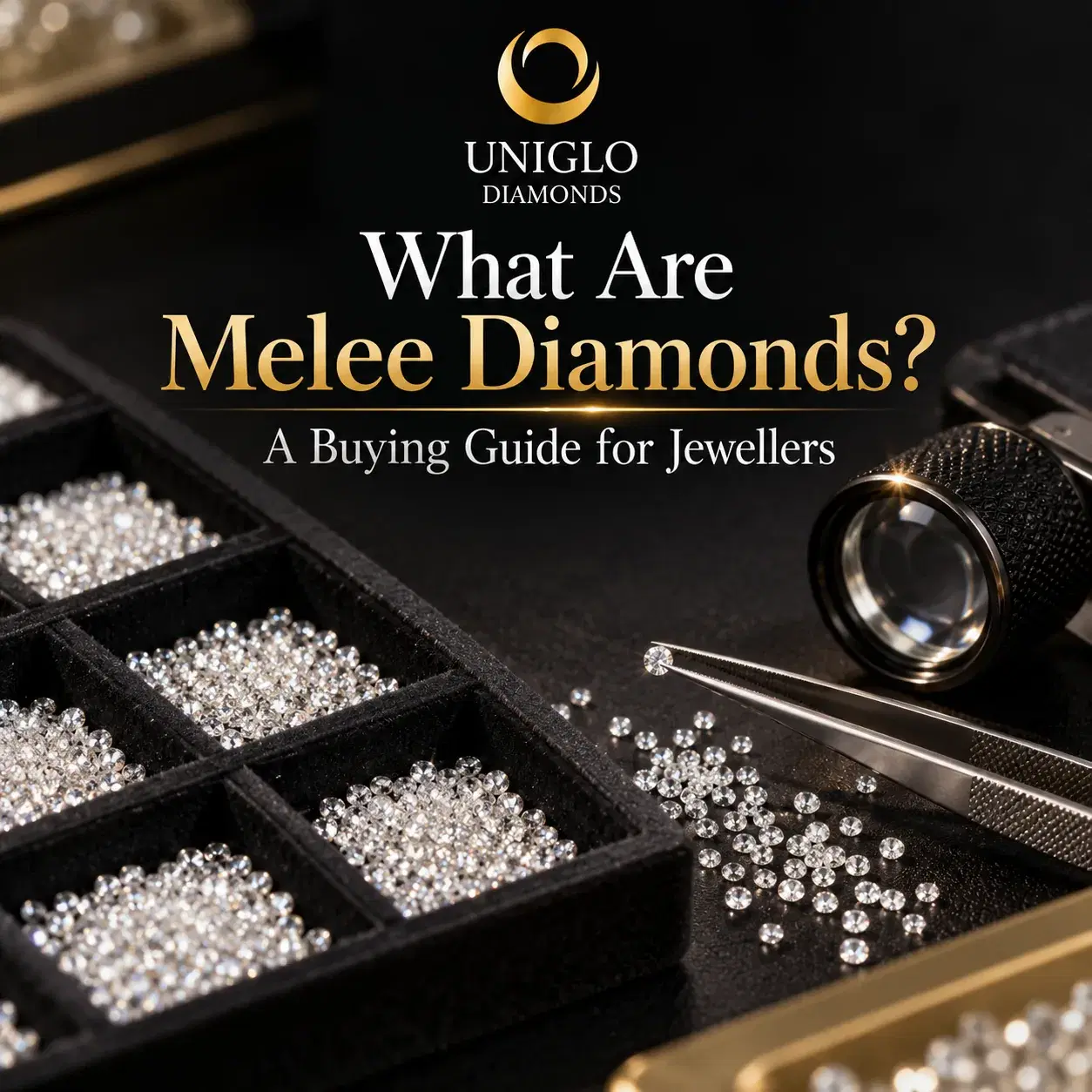
Melee diamonds are small diamonds used as accents in jewellery, often around a centre stone or along a band. GIA defines melee as diamonds weighing less than 0.20 carat each, although trade size ranges vary. Jewellers commonly buy them in parcels, specifying dimensions, cut style, colour, clarity and natural or laboratory-grown origin.
For a jeweller, buying melee is also a matching exercise. A parcel needs to suit the design, fit the intended settings and produce a consistent appearance across the finished piece. A low quotation is only useful when the stones meet those requirements and their description is supported by appropriate documentation.
This guide explains how to assess a melee diamond parcel, compare suppliers’ descriptions and prepare an enquiry that gives you usable answers before placing an order.
What does “melee” mean in the diamond trade?
Melee describes a size category and a role in jewellery; it is not a colour grade, clarity grade or statement of origin. A melee diamond can be natural or laboratory-grown, and its quality must be described separately. The word is pronounced “meh-lee”.
GIA’s explanation of melee gives the less-than-one-fifth-carat definition while acknowledging variation between trade segments and countries. A supplier may therefore list some larger accent stones within a melee collection. Before ordering, establish the actual dimensions and individual weight instead of relying on the category name.
Melee should also be distinguished from diamond simulants. Cubic zirconia and moissanite can resemble diamonds, but they are different materials. A parcel described simply as “small white stones” does not give a jeweller enough information to purchase it as diamond melee.
Where do jewellers use melee diamonds?
Small diamonds can form a halo, create pavé surfaces, accent a ring’s shoulders or run along a wedding band. They also appear in earrings, pendants, bracelets and decorative jewellery details. In each application, the design determines the matching requirement: a uniform row calls for consistency, while a graduated design deliberately uses different sizes.
Consider a halo around a centre stone. The surrounding diamonds need to work together visually, rather than look like unrelated stones placed in a circle. For a graduated arrangement, identify each required size group separately so the supplier understands which differences are intentional. Do not describe a graduated order as one uniform parcel.
Repair work requires another approach. The replacement must match the remaining diamonds and suit an existing seat. Record the original cut style and appearance, then have the setter establish the physical requirements before requesting a stone. Matching the approximate weight alone may not produce a suitable replacement.
Single-cut and full-cut melee diamonds
Round melee is available in different faceting styles. GIA’s melee guide describes single-cut diamonds with 17 or 18 facets and full-cut round brilliants with 57 or 58 facets, depending on whether a culet is present. Confirm which style a quotation covers.
For new work, choose the style with the jewellery designer and setter. For repairs, inspect the existing stones before assuming that a modern round brilliant will match. A difference in faceting can affect the appearance even when the replacement has similar dimensions.
“Full cut” identifies a faceting arrangement; it does not establish excellent workmanship, an independent cut grade or consistent appearance throughout a parcel. Ask how any additional cut description was assessed and whether it represents a supplier’s classification or laboratory grading. A label such as “excellent” needs that context to be useful.
Natural and lab-grown melee: what should you order?
Natural and laboratory-grown melee are both diamonds, but their origins differ. GIA distinguishes laboratory-grown diamonds from simulants: laboratory-grown diamonds share diamond’s crystal structure and have essentially the same chemical, physical and optical properties as natural diamonds. Simulants are other materials.
Choose the origin according to the customer’s agreed specification and describe it clearly in the order. If a commission calls for natural diamonds, request natural melee explicitly. If the customer has selected laboratory-grown diamonds, record that requirement with the same care. For a piece combining both origins, retain an accurate breakdown for the finished jewellery description.
Appearance alone cannot reliably establish origin. GIA’s identification guidance explains that traditional observations and instruments cannot reliably separate natural from laboratory-grown diamonds; advanced testing is required. A photograph, loupe inspection or an unspecified “diamond test” should not be treated as proof of natural origin.
How to judge the quality of a melee parcel
Colour matching and the finished appearance
A parcel description may specify a colour range rather than one grade. Ask what that range means, who assigned it and how closely the stones are matched within it. Two quotations using similar broad wording may describe different levels of selection.
For a uniform design, review the proposed stones together under consistent lighting and, where possible, alongside the centre stone or existing jewellery. Treat this as an appearance assessment, separate from formal colour grading. Decide what is acceptable for the particular commission and record that requirement before ordering a larger quantity.
Clarity and condition
GIA’s clarity guidance assesses inclusions and blemishes using factors including their size, number, nature, location and visibility. A supplier’s “eye-clean” description does not replace a defined clarity specification or disclose every condition issue.
Ask whether the stated clarity is a minimum, an average or a range across the parcel. During inspection, look for conspicuous inclusions and condition concerns such as chips or damaged girdles, and have a qualified person assess stones that raise questions. A stone can look acceptable from above while still warranting closer inspection before setting.
Cut appearance and consistency
Review the parcel as a group and examine individual stones that appear different. For example, a diamond that looks noticeably darker or less lively than its neighbours deserves closer attention. Cleaning, orientation and lighting can affect the comparison, so keep the viewing conditions consistent before making a decision.
Agree the acceptance standard with the supplier. A representative image can start the discussion, but it does not establish every stone’s appearance or dimensions. Ask whether the sample, photograph or video shows the actual lot being quoted and what inspection arrangements apply to the purchase.
What does “calibrated melee” mean?
Calibration concerns the physical size specification. It does not establish natural origin, colour, clarity or an individual grading report. For round stones, request the diameter range; for fancy shapes, confirm the relevant length, width and other dimensions required by the setter.
Ask how the parcel’s stated size range was established and what tolerance applies. A nominal diameter, a sieve category and a measured range are related descriptions, but they should not be assumed to mean exactly the same thing. Match the supplier’s specification to the design before approving the stones.
For measurement terminology, consult Uniglo’s melee diamond size chart. In a buying enquiry, the practical requirement is to give the supplier the dimensions your setter needs and obtain confirmation that the available parcel meets them.
Are melee diamonds individually certified?
Melee parcels commonly come without individual grading reports for every stone. GIA explains that the cost and practicality of grading hundreds of very small diamonds can make individual reports uneconomic. That does not remove the need for an accurate description and appropriate origin assurance.
Separate three questions: who assigned the quality description, how the stones were size sorted, and what identification or screening was performed. A supplier’s parcel grade, a calibration specification and an origin-screening result provide different information. None should automatically be presented as the other.
If a quotation says “certified melee”, request the actual document and establish what it covers. Does it refer to a specific lot, an origin-screening service or individually identified stones? Uniglo’s diamond certificates guide provides broader context on laboratory documents; the evidence for your particular parcel should still be checked separately.
What does melee screening establish?
GIA’s Melee Analysis Service separates qualifying natural diamonds from laboratory-grown diamonds, simulants and potentially HPHT-treated natural diamonds. It also offers colour sorting for round melee. Its published eligibility criteria include dimensions, colour range and minimum submission quantity, so suitability must be confirmed for the specific parcel.
When a supplier states that a lot has been screened, ask which service or instrument was used, whether the entire lot was covered, what results were recorded and how the tested lot is identified. Retain the supporting information with the purchase record. A screening statement should be specific enough to connect the evidence to the stones you receive.
Screening should not be described as individual 4Cs grading unless the documentation actually supports that claim. It also does not replace the jeweller’s checks for dimensions, condition and matching appearance. Those checks answer separate questions about whether the parcel suits the intended work.
How are melee diamonds priced?
Compare current quotations for the same origin, shape, cut style, dimensions, quality range and quantity. A price difference is difficult to interpret when one parcel is more tightly matched or includes different documentation. Ask the suppliers to quote against the same written specification before comparing their totals.
Where a quotation is expressed per carat, the basic stone cost is price per carat multiplied by the parcel’s actual total carat weight. Request any screening, selection, shipping or other charges separately, together with the quotation’s currency and validity period. If the design requires a fixed piece count, confirm that count as well as weight.
The cheapest lot may not be the least expensive option for a particular job if additional matching, returns or replacement work is required. Treat this as a purchasing decision based on the quoted terms and your inspection, rather than assuming a higher or lower price proves quality.
What should a jeweller include in a melee enquiry?
Use a written specification that connects the design requirements with the purchasing quantity. The following fields help a supplier provide a quotation you can compare and act on.
| Enquiry detail | What to confirm |
|---|---|
| Origin | Natural or laboratory-grown diamonds |
| Shape and cut style | For example, round full cut or round single cut |
| Dimensions | Required measurements and acceptable tolerance |
| Colour | Required range and matching expectations |
| Clarity and condition | Minimum or range, with agreed rejection criteria |
| Quantity | Required piece count and any agreed spare stones |
| Weight | Actual total weight and whether individual weight is an average |
| Documentation | Grading basis, screening scope and lot identification |
| Commercial terms | Price basis, currency, additional charges and quote validity |
| Delivery and inspection | Availability, required date and agreed inspection or return terms |
For example: “Please quote 80 round full-cut natural diamonds for a wedding-band order. Our setter will provide the required diameter range and tolerance. Please confirm the colour and clarity range, matching standard, screening documentation, actual piece count, total weight and delivery terms.” Add the confirmed dimensions before requesting the final quotation.
For replacement work, include the available information about the existing jewellery and ask what further measurements are needed. Avoid ordering a replacement solely from a customer’s estimated weight or a photograph without a reliable scale.
Receiving a parcel and planning repeat orders
On receipt, reconcile the supplier’s lot reference, origin declaration, quantity and weight with the order. Keep each lot identifiable during inspection and setting. If differences appear, document them and contact the supplier within the agreed inspection period before accepting or using the disputed stones.
For repeat orders, retain the complete specification rather than only the previous invoice total. Ask whether a matching lot remains available and how any new lot compares with the original. The same broad trade description may still require a fresh assessment for a uniform finished piece.
If spare stones are appropriate for the commission, agree their quantity and retain them with the job reference. There is no single spare allowance suitable for every design; decide it with the setter and customer as part of the order.
Sourcing melee diamonds from Uniglo
Uniglo’s melee diamond collection lists natural and laboratory-grown parcels with specifications for enquiry. Use the listings to identify relevant lots, then confirm the details needed for your design, including measurements, quantity, matching expectations and supporting documentation.
For a quotation, contact Uniglo Diamonds with your written specification and required date. Request confirmation of the available lot and its terms before committing to a production schedule.
Frequently asked questions
More Topics




