
Visiting Uniglo Diamonds in Antwerp: What to Expect at Your Appointment
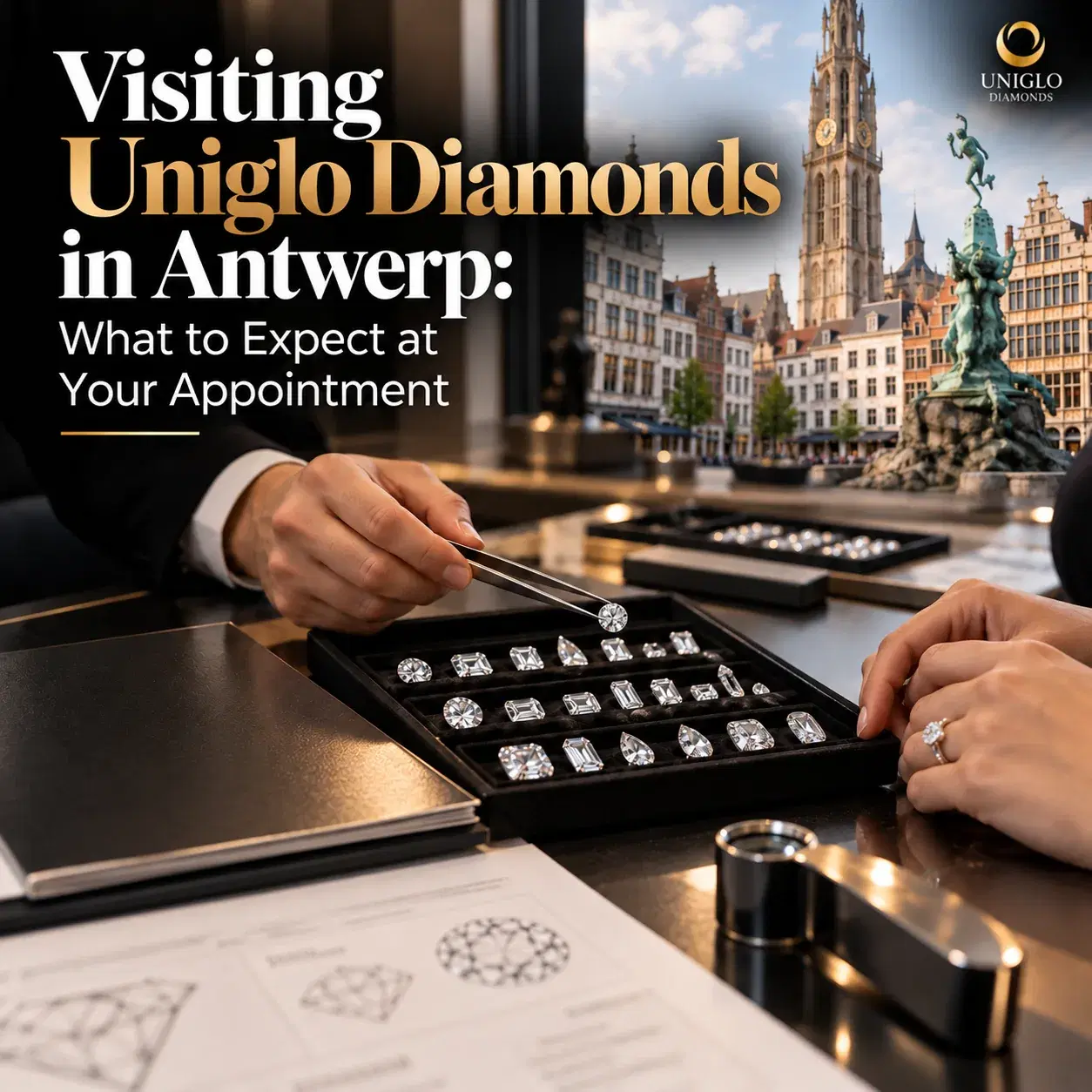
To arrange a diamond appointment in Antwerp with Uniglo Diamonds, contact the team with your requirements, preferred date and any stones you want to view. Confirm the appointment and the availability of your shortlist before travelling. The office is at Hoveniersstraat 30, Suite 662/Bus 250, 2018 Antwerp, Belgium.
An in-person viewing gives you an opportunity to compare the diamonds you are considering and ask questions about their documents, appearance and current quotations. Preparing a focused shortlist helps you use that opportunity well, whether you are selecting a centre stone, looking for a pair or discussing a trade requirement.
Request a diamond appointment in Antwerp. Include your budget, preferred origin and shape, plus any diamond references you have already selected.
Booking your visit: contact and location
| Detail | Uniglo Diamonds visit information |
|---|---|
| Address | Hoveniersstraat 30, Suite 662/Bus 250, 2018 Antwerp, Belgium |
| suraj@uniglodiamonds.com | |
| Telephone | +32 3 500 91 07 |
| Published weekday hours | Monday–Friday, 10:00–18:00 |
| Weekend visits | Listed as by appointment; confirm the exact date with the team |
| Booking route | Contact the team through the contact page, email or telephone |
Use the Uniglo contact page to request your visit and check current contact details. Sending an enquiry is the first step; wait for confirmation of your date, time and viewing arrangements before making travel plans.
Ask for the entrance instructions and anything you need to bring. If you have a limited window in Antwerp, mention it in your first enquiry. For a weekend or holiday visit, confirm availability specifically rather than relying on weekday opening hours.
Start with what you want the appointment to help you decide
A useful visit begins with a clear question. You may want to choose between two shapes, inspect a particular diamond before buying, compare natural and lab-grown options, or find stones that fit a jewellery design.
Describe the intended use as well as the specification. “An oval centre stone for an engagement ring” gives a different brief from “a matched pair for studs” or “calibrated diamonds for a production order.” Explain which decision is most important so your enquiry can focus on relevant options.
For an engagement ring or another commissioned piece, include any measurements supplied by your setter. If you already own a mounting, send its specifications or clear images and explain that the diamond will need a fit assessment. Viewing a diamond does not itself establish compatibility with an existing ring.
Tell the team whether you are enquiring as a private buyer or for a business. For a business requirement, include the quantities, size ranges and documentation needs. Ask what arrangements apply to the particular purchase you have in mind.
What to send before your diamond appointment
| Information | What to include |
|---|---|
| Purpose | Ring centre, earrings, pendant, other jewellery or trade order |
| Origin | Natural, lab-grown or a request to discuss the difference |
| Shape | Preferred outline and any alternatives you want to compare |
| Size | Carat range and relevant millimetre requirements |
| Budget | Currency, approximate range and what it needs to cover |
| Shortlist | Diamond references or report numbers from relevant listings |
| Timing | Preferred visit dates and any deadline for the finished purchase |
You do not need to settle every preference before enquiring. If shape or origin is undecided, say which alternatives interest you and what you want to learn from the comparison. A clearly stated uncertainty is more useful than an overly broad request to see everything.
For the budget, distinguish the loose diamond from the complete jewellery project. If the amount also needs to cover a mounting, setting work or delivery, explain that. Ask for the current quotation in your preferred currency and which charges it includes.
If you are visiting with someone whose preference matters, include that in the booking request. Ask the team to confirm the practical arrangements for your party rather than assuming a particular appointment format.
Prepare a shortlist before you view diamonds in Antwerp
Start with Uniglo’s natural loose diamond inventory or lab-grown loose diamond inventory. Save the reference for each stone that interests you, together with its report and any available imagery.
A small shortlist is easier to compare than a long collection of similar-looking listings. As a preparation suggestion, choose two to four relevant candidates and write down why each is on the list. This is not a limit on Uniglo’s appointment service or a promise that a particular number will be presented.
Make the comparison deliberate. You might choose stones with similar dimensions but different documented characteristics, or two shapes within the same budget. If all the variables change at once, it becomes harder to understand what you prefer.
Use Uniglo’s diamond shapes guide if you need help identifying outlines. For origin, the lab-grown vs natural diamonds guide provides background before you request options.
Send the references before your appointment. Uniglo’s published viewing guidance asks buyers to arrange an appointment, share their shortlist and confirm which stones can be made available. A diamond appearing in an online search should not be treated as confirmation that it will be physically present for your visit.
What to confirm before travelling
Confirm the date, start time and expected length with the team. Ask whether the selected stones are available for that meeting and whether any alternatives will be discussed. If a particular diamond is essential to your trip, identify it explicitly.
Ask whether a viewing fee, deposit or other appointment condition applies. The published contact information does not specify those details. Obtain the answer for your visit instead of assuming that all appointment formats have the same terms.
If you need assistance in a particular language or have an access requirement, mention it before booking. Ask for confirmation of what can be arranged. Do the same for a weekend, holiday or tightly scheduled visit.
If your shortlist changes, send the updated references ahead of time. Keep the appointment confirmation and contact details accessible on the day so you can notify the team if your arrival plans change.
Comparing the actual diamonds during your visit
Use the appointment to answer the questions that photographs could not settle. Look at the outline, visible dimensions, colour appearance and light pattern of each available stone. Explain what you notice and ask for help interpreting any feature you do not understand.
Begin at an ordinary viewing distance, then request a closer examination where appropriate. A magnified view is useful for locating a feature, but it can make a small inclusion or facet detail dominate the comparison. Return to normal viewing before deciding how much it matters to you.
Keep the comparisons consistent. Ask whether shortlisted stones can be viewed under matching conditions and whether more than one lighting environment is available. GIA explains the importance of comparing diamond appearance under different lighting in its quality diamond buying guide.
Notice what happens as the stone tilts rather than selecting it from one attractive angle. Decide which outline and changing pattern you enjoy. Record the reference immediately so your favourite diamond remains connected with its correct report and quotation.
These are suggested viewing checks, not a description of a fixed Uniglo presentation routine. Confirm any specific equipment, demonstration or comparison you want when booking.
Read the report alongside the stone
Ask to review the report for each diamond you are considering. Check its laboratory, number, description, weight, dimensions and comments. Report formats differ, so ask about anything that is missing or unfamiliar rather than assuming every document uses the same fields.
IGI’s report-reading guidance explains the information in its natural diamond reports. Uniglo’s diamond certificates guide provides a broader introduction to laboratory documentation.
For a GIA report, GIA Report Check lets you confirm that the document’s information matches the archived record. Matching the physical diamond to the report is a separate task; ask how that is established for the stone presented.
If the report records an inscription, ask whether it can be viewed and how it is used in identification. An inscription is one item of evidence rather than a complete identity test by itself. If identity or treatment information is unclear, request clarification before proceeding.
Check visible size, colour and inclusions
Carat is a weight measurement rather than a direct measure of visible size, as GIA’s carat-weight guidance explains. Compare the actual dimensions and outline, especially if you are choosing between shapes or buying for a particular mounting.
For colour, look at the actual stone under the available comparison conditions and describe whether you enjoy its appearance. A higher grade on paper does not tell you how much a particular difference will matter to your own preference or design.
For inclusions, request an explanation of any feature you can see. Ask where it sits, how it appears at ordinary distance and whether it raises a condition or setting concern. Have technical concerns assessed by an appropriately qualified person rather than diagnosing them yourself from a close-up.
If a setting metal or design is already chosen, discuss it during the comparison. Ask what additional fit checks or approvals will be needed before the diamond is mounted. Keep the appointment’s diamond decision connected to the intended finished jewellery.
Comparing pairs or trade requirements
For a pair, inspect the diamonds together. Discuss dimensions, outline and appearance alongside their individual documents. Two stones with similar headline grades still need to be considered as a pair for the design you intend to make.
For a parcel or production enquiry, provide the intended use, quantities and relevant calibration requirements before the visit. Ask whether you will review individual stones, a representative selection or the proposed parcel, and what that examination establishes.
Record the specification and quotation for the actual group being discussed. Avoid transferring your impression of one sample to an entire order without knowing the basis of the offer. Clarify any size or quality ranges and what documentation accompanies supply.
An appointment request should describe these needs explicitly. The viewing arrangements for a single centre stone and a business order may differ, so ask the team to confirm the format that suits your enquiry.
Understand the quotation and next step
Before deciding, request a current quotation tied to the correct diamond reference or group specification. Confirm the currency, included charges and the period for which the offer or availability is valid, if one is stated.
Discuss the applicable payment, collection or delivery arrangements and purchase terms. If you are considering a mounting or custom work, ask for a separate explanation of what is offered, what needs approval and the expected schedule. Do not assume viewing a loose diamond includes an immediate setting service.
If you need more time to decide, ask whether a reservation can be arranged and what its terms would be. If no candidate suits you, explain what you would change in the next shortlist: outline, dimensions, appearance, origin or budget.
Take away the reference numbers, relevant documents and agreed next step. A useful appointment leaves you knowing which diamond you prefer, what remains unresolved and what the complete offer includes.
Request your Uniglo Diamonds appointment
To begin, use the appointment contact page and share your preferred visit dates, purchase purpose and shortlist. If you have not selected stones yet, describe the alternatives you want to compare and the budget you are working within.
Confirm the meeting and viewing availability before travelling. With those arrangements in place, you can focus your visit on the actual diamonds and the questions that matter to your purchase.
Frequently asked questions
More Topics




