
Single-Cut vs Full-Cut Melee Diamonds
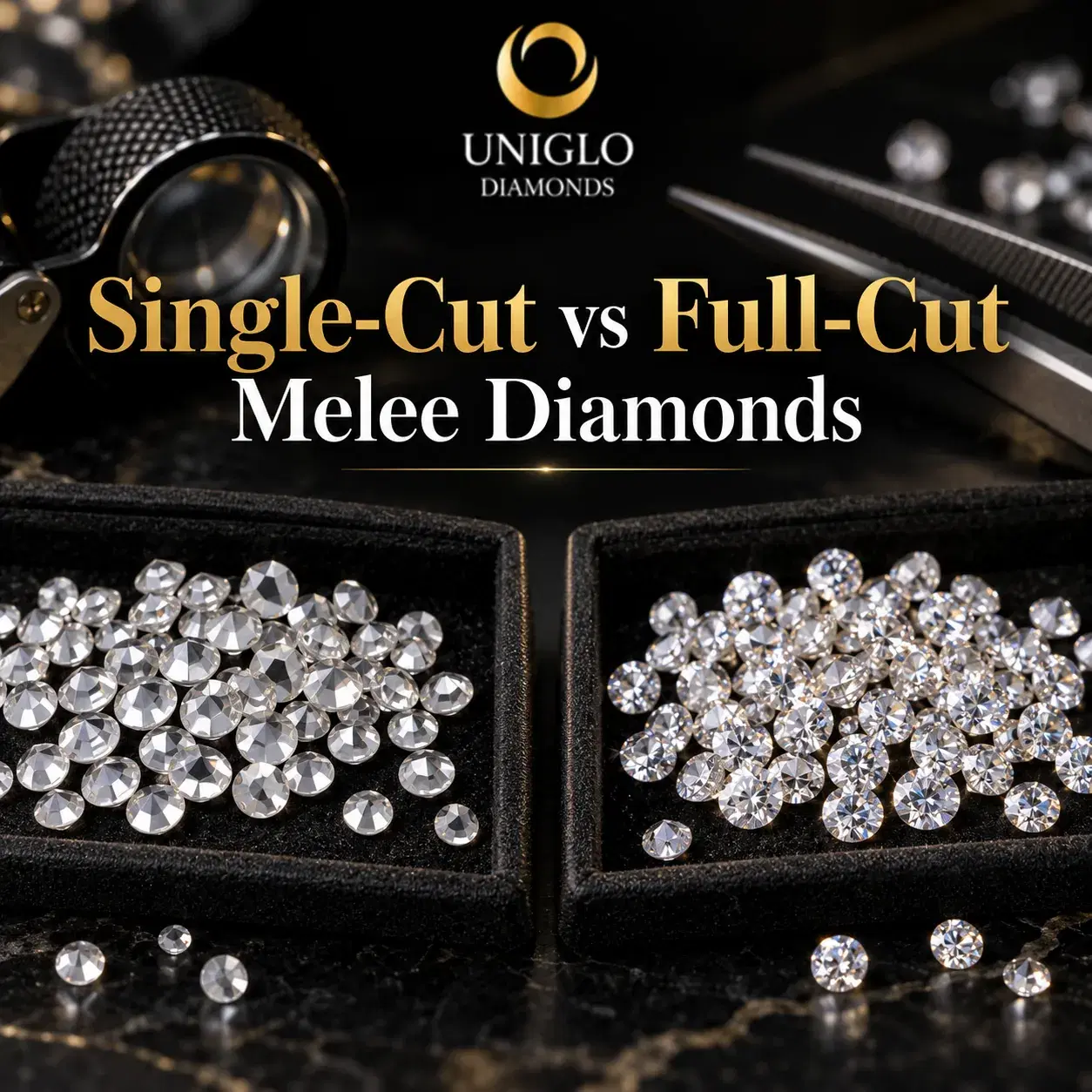
Single-cut diamonds have 17 or 18 facets; standard full-cut round brilliants have 57 or 58. The difference changes the faceting pattern and can change the appearance of small accent stones. When choosing single-cut vs full-cut diamonds for melee, consider the intended look, matching requirements and actual parcel quality—not facet count alone.
For a new design, compare the two styles at the diameter and viewing scale you intend to use. For a repair, establish the cutting style of the existing diamonds before requesting a replacement. A correctly sized stone can still look different from its neighbours if its facet arrangement does not match.
This guide compares conventional round single cuts with standard round-brilliant full-cut melee. It explains the facet difference, how to assess appearance and which details to include in a jeweller’s enquiry.
What are single-cut melee diamonds?
A single-cut diamond has a round outline and a relatively simple facet arrangement. GIA describes the single cut as one table facet, eight crown facets and eight pavilion facets, with an optional culet. That gives 17 facets without a culet or 18 with one.
The crown is the upper part above the girdle, and the pavilion is the lower part. The table is the large top facet. The culet, where present, is a small facet at the bottom of the pavilion; it accounts for the one-facet variation in the total.
“Single cut” identifies the arrangement, not the quality of the material or workmanship. Colour, clarity, dimensions, condition and origin still need to be described separately. A parcel label should give enough information to assess those requirements alongside the cut style.
What are full-cut melee diamonds?
Full-cut round melee uses the standard round-brilliant arrangement, with more facets than the conventional single cut. GIA’s explanation of the round brilliant identifies one table, 32 crown facets and 24 pavilion facets, plus an optional culet. The total is 57 or 58.
The additional crown and pavilion facets create a different pattern of reflections. Full-cut melee is therefore a faceting-style description. It does not mean a larger individual stone, a heavier parcel, or a higher colour or clarity grade.
If a supplier uses “round brilliant” or “RBC”, confirm that the proposed goods have the conventional full-cut arrangement required by the order. Where terminology is unclear or a different faceting variant is offered, ask for an explicit description rather than approving the lot from an abbreviation alone.
Single cut vs full cut: the practical differences
| Feature | Conventional single cut | Standard full-cut round brilliant |
|---|---|---|
| Outline | Round | Round |
| Table | One facet | One facet |
| Crown, excluding the table | Eight facets | 32 facets |
| Pavilion, excluding any culet | Eight facets | 24 facets |
| Total facets | 17 or 18 | 57 or 58 |
| Appearance decision | Compare the actual stones at the intended scale | Compare the actual stones at the intended scale |
| Repair decision | Match when this is the existing style | Match when this is the existing style |
| Quality guarantee from the name | None | None |
Melee refers to small accent diamonds; the single-cut and full-cut labels describe how those stones are faceted. GIA’s design guidance defines melee below 0.20 ct while noting variation between trade segments and countries. The cut comparison remains a separate question from the supplier’s size-category terminology.
Do full-cut diamonds sparkle more?
GIA’s discussion of diamond appearance explains that cutting style, number of facets and cut quality affect sparkle. It notes that a standard round brilliant can appear more sparkling than a single cut because it has more reflective surfaces. That is useful context, but it does not select the best parcel for every design.
Compare the type and distribution of flashes in the proposed stones. Look at them moving in ordinary viewing conditions, then at the scale of the finished jewellery. Magnified footage is useful for identifying the style, while a less magnified view helps assess how the overall effect will look to the wearer.
At small sizes, do not assume that an enlarged comparison predicts how obvious the distinction will be in daily wear. Ask the supplier or setter to show suitable examples at your intended diameter. Decide whether the observed difference matters to the particular design.
Is full-cut melee automatically higher quality?
No. Facet arrangement and cut quality are related but separate descriptions. IGI’s cut guidance discusses proportions, precision and finish as factors affecting appearance. Adding facets is not a substitute for assessing those qualities in the actual goods.
“Full cut” should not be read as “Excellent cut”. GIA’s cut-grading guidance limits its overall cut grade to D-to-Z standard round brilliants. A single-cut diamond is not that standard arrangement, and a full-cut description alone does not establish that an individual stone has received a GIA cut grade.
If a parcel quotation includes another description such as “Excellent” or “Very Good”, ask who assigned it and what it covers. A supplier’s classification should be distinguished from an independent grading result. Clarify the acceptance requirements rather than treating familiar wording as proof of a particular laboratory assessment.
Does single cut mean antique, or full cut mean modern?
A facet arrangement alone does not date a diamond or establish its provenance. If you are buying for an antique repair, identify the existing stones instead of assigning a cutting style from the jewellery’s age. If age or provenance matters to the purchase, request supporting information separately.
Similarly, do not treat every older-looking round diamond as a single cut. The actual facet pattern must be identified. Uniglo’s old-cut diamonds page provides a starting point for enquiries about older cutting styles; the requirements for a particular melee replacement still need to be established from the piece.
Matching a missing melee diamond
Begin with an inspection of the remaining stones and the setting. The jeweller should establish the cutting style, required dimensions, colour appearance and condition requirements. An approximate point weight or a photograph without a reliable scale is insufficient for a precise replacement order.
For a single-cut row, compare the proposed single-cut replacement with its neighbours. For a full-cut row, do the corresponding full-cut comparison. The aim is a suitable match in the actual piece, not an automatic upgrade to the style with more facets.
Check fit independently of appearance. A stone can have the requested cut style but unsuitable dimensions or depth for the seat. Conversely, a stone can fit the seat while introducing a different reflection pattern. Have the setter confirm both aspects before approving the replacement.
Choosing a cut style for a new design
For new work, establish the intended appearance with the designer and customer. Request representative samples of the proposed single-cut and full-cut parcels at comparable dimensions, origin and quality. Explain which differences you are trying to assess rather than requesting two unrelated samples labelled only by cut.
Compare the stones loose first, then review an appropriate sample setting or comparable finished work where available. Keep the viewing conditions consistent. A difference between an enlarged single stone and a completed row may reflect the presentation as much as the cutting style.
Once a style is approved, include it in the production specification and repeat-order records. A later substitution should be assessed against the approved appearance, not accepted because its name sounds equivalent. For projects requiring manufacturing input, Uniglo’s diamond manufacturing page provides service context; confirm the requirements and available options for the particular job.
Can you mix single-cut and full-cut melee?
The design may deliberately use different styles, but mixing them should be an explicit decision. For a uniform row or halo, assess whether the combination creates an appearance difference you or the customer find distracting. Do not assume that similar colour and dimensions will conceal a change in faceting.
For a repair, discuss any proposed substitution before ordering or setting it. If a matching stone cannot be found, the jeweller can explain the available options and their effect on the piece. The customer should approve the approach rather than discover a difference after completion.
Keep different lots identified during production when the job requires a consistent style. A shared weight or broad trade description is not enough to establish that two parcels have the same facet arrangement and appearance.
How to compare parcels in photographs and videos
Request images of the actual lots or clearly identified samples from them. A sharp close-up can help discuss the facet arrangement, but identifying a cut style may require examination by a qualified person. A low-resolution product thumbnail is not reliable evidence of every stone’s faceting.
For the appearance comparison, ask for footage made at the same scale, under the same lighting and with similar movement. Include a less magnified view as well as the close-up. The first helps assess the overall jewellery effect; the second helps discuss workmanship and individual differences.
Watch the parcel as a group. If a stone appears different from the rest, ask whether the lot is mixed, whether its orientation explains the difference or whether further inspection is needed. Describe what you observed without assigning a technical diagnosis from a compressed clip.
Size, colour and clarity still need to be specified
Cut style does not replace calibration. Request the millimetre range and acceptable tolerance for the setting, together with the required number of stones. If a sieve label is used, obtain the corresponding dimensions rather than assuming the label supplies the entire size specification.
Uniglo’s melee diamond size chart provides broader measurement context. For this comparison, avoid assuming that single cuts and full cuts of the same nominal diameter must have identical individual weights. Confirm the proposed parcel’s measurements, count and actual weight.
Record the colour and clarity requirements separately, including whether the supplier’s descriptions represent ranges or minimum standards. Ask how consistently the stones are matched within the proposed lot. These checks apply whichever facet arrangement you choose.
Does the cut style establish natural or lab-grown origin?
No. Single cut and full cut describe faceting, not how the diamond formed. Specify natural or laboratory-grown origin independently and request the relevant supporting information for the lot. Appearance and facet count should not be treated as an origin test.
GIA’s Melee Analysis Service separates qualifying natural diamonds from laboratory-grown diamonds, simulants and potentially HPHT-treated natural diamonds. Confirm whether the particular parcel, including its size and cutting style, is eligible for the proposed service rather than assuming all melee is covered.
Screening and individual grading answer different questions. Uniglo’s diamond certificates guide explains broader report terminology; for a melee order, ask what documentation is actually available and which stones or lot it covers.
Is single-cut melee cheaper than full-cut melee?
Do not use facet count alone to predict the quotation. Request current prices for comparable dimensions, origin, colour, clarity, condition, quantity and selection requirements. A different specification may explain a price difference that would otherwise be attributed to cutting style.
Confirm whether the offer is per carat, per stone or for a complete parcel. For a per-carat quotation, the basic stone cost is the quoted rate multiplied by the actual parcel weight. Obtain any additional selection, documentation or delivery charges separately.
Compare the cost of the goods that satisfy the design, not merely the lowest quoted rate. For a repair, a cheaper stone that does not match is not an equivalent alternative. For new work, an agreed appearance sample can help connect the quotation to what the customer approved.
What should a jeweller put in the order?
The order should make the required facet arrangement explicit and connect it to the lot, dimensions and approval evidence. This compact specification can be added to a supplier enquiry.
| Order detail | What to confirm |
|---|---|
| Cutting style | Conventional round single cut or standard full-cut round brilliant |
| Intended use | New work, repeat production or a replacement matching an existing row |
| Size and fit | Required millimetre range, tolerance and any depth requirement |
| Quality and origin | Colour and clarity specification, condition criteria, natural or laboratory-grown origin |
| Quantity and price | Piece count, actual parcel weight, quote basis and additional charges |
| Lot and approval | Parcel reference, actual sample or imagery, and agreed substitution terms |
An enquiry could read: “Please quote single-cut round natural melee to match the existing stones in this repair. The setter will confirm the diameter range and fit requirements. Please provide the available colour and clarity specification, lot reference, quantity, actual weight and comparison imagery.” Add the confirmed measurements before requesting the final offer.
For new full-cut work, replace the cutting-style requirement and state whether the comparison is against an approved sample. Retain that approval with the order so future deliveries can be reviewed against the same requirements.
Requesting the required style from Uniglo
Use Uniglo’s melee diamond collection to identify relevant listed parcels, then ask the team to confirm the cutting style and specifications of the proposed lot. A general collection listing should not be treated as confirmation that both styles are currently available in every size or quality.
Contact Uniglo Diamonds with your required cut style, measurements, origin, quantity and intended use. For a repair, include clear information about the existing stones and ask what further inspection or measurements are needed before a suitable replacement can be proposed.
Frequently asked questions
More Topics




