
SI1 vs SI2 Diamonds: Appearance, Inclusions and Value
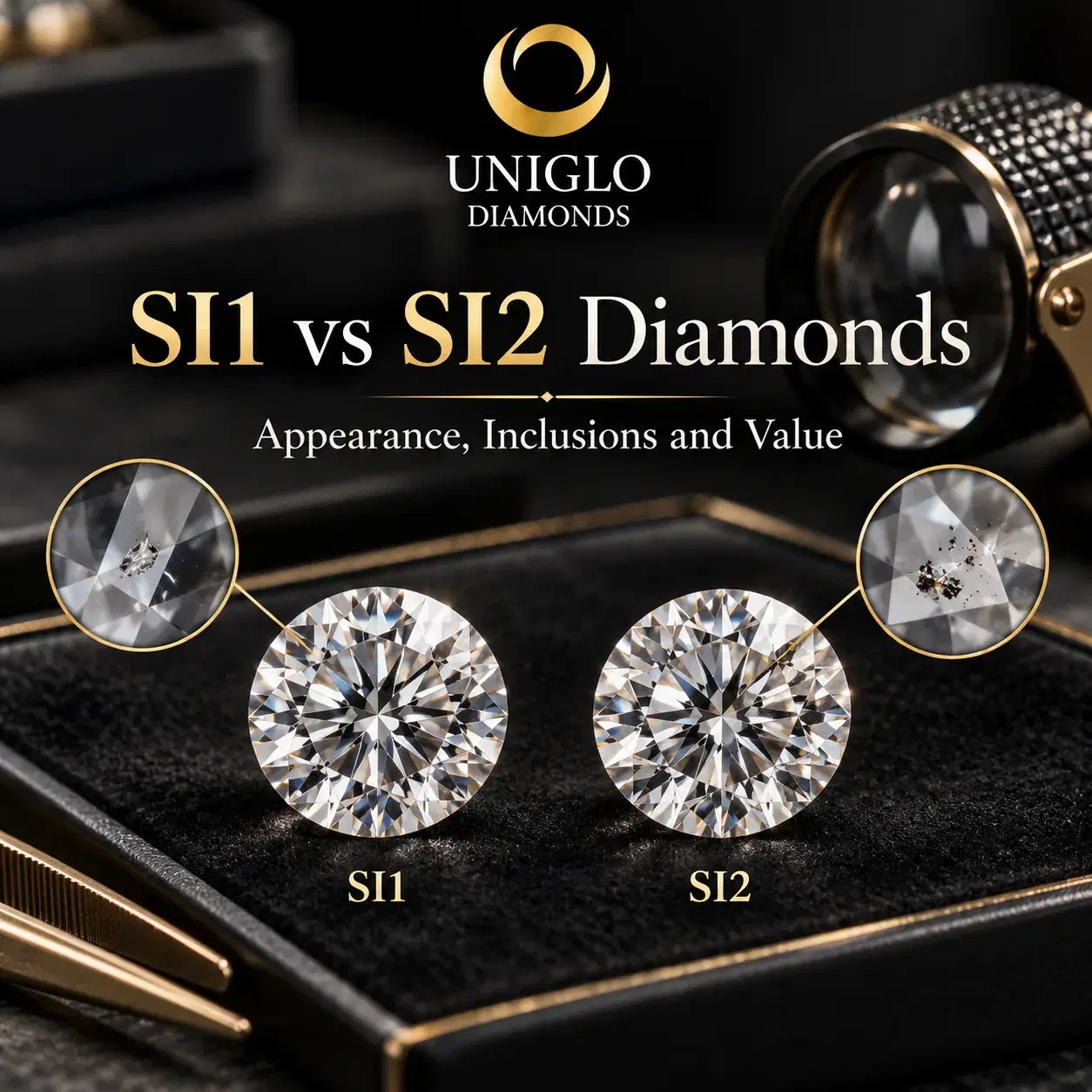
SI1 and SI2 mean Slightly Included 1 and Slightly Included 2. Both describe diamonds with inclusions noticeable to a skilled grader at 10× magnification, with SI1 ranking above SI2 on the clarity scale. SI1 inclusions are generally less readily apparent under grading conditions, but neither grade guarantees an eye-clean appearance. Compare the actual stones for visibility, transparency, condition and price.
An SI2 diamond can be suitable for a buyer who finds its appearance attractive and accepts its characteristics. An SI1 diamond can still have an inclusion the buyer notices. The useful comparison is therefore between specific diamonds with supporting reports and imagery, rather than between two labels in isolation.
This guide explains the difference between SI1 and SI2, how inclusion type and position affect the buying decision, and how to assess whether a lower clarity grade offers value for your particular purchase.
What is the difference between SI1 and SI2?
GIA’s clarity guidance places both grades in the Slightly Included category. Clarity assessment considers several characteristics, including their size, number, nature, location and relief. It is not simply a count of visible dots.
SI1 is one step above SI2, and SI2 is one step above I1. The distinction describes the assessed clarity characteristics under grading conditions; it does not prescribe one identical appearance for every stone within the grade.
For example, one diamond might have a readily identifiable crystal, while another has a different combination of smaller characteristics. Their assessment depends on the whole set of grading factors. When comparing candidates, ask what sets each stone’s grade and how those characteristics appear in ordinary viewing.
SI1 vs SI2 diamonds at a glance
| Buying consideration | SI1 | SI2 |
|---|---|---|
| Position on the clarity scale | Higher of the two grades | Lower of the two grades |
| Inclusions under 10× | Noticeable; generally less readily apparent than SI2 | Noticeable; generally more readily apparent than SI1 |
| Unaided-eye appearance | Must be checked for the individual stone | Must be checked for the individual stone |
| Eye-clean guarantee | The grade provides no guarantee | The grade provides no guarantee |
| Transparency and condition | Require separate inspection | Require separate inspection |
| Sparkle | The clarity label alone does not determine it | The clarity label alone does not determine it |
| Price comparison | Compare current, otherwise similar stones | Compare current, otherwise similar stones |
Use the table as a starting point, not a prediction of how two shortlisted diamonds will look. Their shape, size, cutting, inclusion characteristics and viewing conditions remain part of the decision.
Can SI1 and SI2 diamonds be eye-clean?
Both grades can include diamonds that a particular observer finds eye-clean. However, some stones have visible characteristics that the same observer would notice without magnification. IGI’s discussion of eye-clean diamonds explains that eyesight, distance, viewing direction and lighting affect that judgment.
Ask what a supplier means by “eye-clean”. Does the statement cover the face-up view only, or also views through the side? At what distance and under which lighting was the diamond examined? A shared understanding of those conditions is more useful than accepting an undefined promise.
If a clean face-up appearance is important, begin by inspecting the stone without magnification at a comfortable viewing distance. Then use magnified images to locate characteristics and repeat the ordinary-distance check. Decide whether any feature remains distracting to you, rather than treating the existence of an enlarged inclusion as an automatic rejection.
Conversely, a low-resolution image that shows no inclusion is not proof of an eye-clean diamond. The recording may lack the detail needed to reveal it. Request clearer evidence or an appropriate viewing arrangement when the available material cannot answer your question.
Inclusion type and location matter
The inclusion description helps identify what needs closer inspection. GIA’s illustrated clarity reference distinguishes characteristics such as crystals, pinpoints, clouds and feathers. The name alone does not establish how visible or significant a particular example will be.
| Characteristic | What it describes | What to ask when buying |
|---|---|---|
| Crystal | A mineral crystal enclosed in the diamond | Where is it, how conspicuous is it, and is it visible in the intended view? |
| Pinpoint | A very small crystal inclusion | Is it isolated or part of a group that needs closer assessment? |
| Cloud | A group of closely spaced pinpoints | Does the actual stone show any relevant loss of transparency? |
| Feather | A break within the gemstone | Does its size, position or surface connection raise a condition or durability concern? |
A conspicuous inclusion near the central face-up area may be more relevant to your appearance preference than one that is difficult to notice elsewhere. But an edge location should not automatically be considered an advantage: condition and setting suitability need their own assessment.
Ask the supplier to show the principal characteristics in the actual stone. A marked photograph can help connect a report description with the video, although it should be identified as an annotation rather than an independent laboratory assessment.
Transparency: look beyond individual spots
An inspection should consider the overall material appearance as well as recognizable inclusions. IGI’s clarity discussion highlights transparency when considering SI diamonds and cautions buyers to be aware of clouds and haze. A higher clarity label should not replace that observation.
Compare clean stones under consistent lighting and camera conditions. If one appears hazy or lacks definition, ask the supplier or a qualified gemologist to assess the cause. Surface dirt, focus, exposure and compression can also affect video appearance, so footage alone may leave the question unresolved.
Do not assume that every cloud makes a diamond visibly cloudy or that a stone without an obvious dark inclusion must be transparent. The relevant question is how the particular characteristics affect the actual stone. A report comment is a reason to seek an explanation where needed, rather than a diagnosis based on a phrase alone.
Does SI2 have less sparkle than SI1?
Clarity and cut describe different aspects of a diamond. Brightness, fire and the pattern of flashes depend substantially on cutting and light interaction. Transparency can also matter. Moving from SI2 to SI1 therefore does not establish a predictable increase in sparkle.
When comparing candidates, examine both the visible characteristics and the optical appearance. If one stone looks livelier in a video, first check whether the lighting, scale and movement are comparable. Do not attribute the difference to clarity without supporting evidence.
Uniglo’s guide to diamond cut versus clarity explains that broader buying trade-off. For an SI1 versus SI2 shortlist, keep your appearance requirements clear and assess the actual cut information and imagery alongside the clarity report.
Does shape change the SI1 vs SI2 decision?
GIA’s quality-diamond buying guide notes that inclusions can be more noticeable in step cuts than in brilliant cuts. Their larger, less fragmented reflections can provide a different view into the stone. This makes shape and cutting style relevant to the inspection.
For an emerald or Asscher cut, spend time examining the broad face-up areas and views through the stone. For a round or other brilliant cut, inspect the principal inclusion as the diamond moves rather than assuming the reflection pattern will always conceal it.
Size is also part of the comparison. A satisfactory appearance in one diamond does not establish that another stone of the same grade, shape or larger dimensions will look the same. Judge the candidate you are purchasing and use Uniglo’s diamond shapes guide for shape terminology when requesting alternatives.
Durability and setting: are SI diamonds safe to wear?
The grade alone does not provide a complete condition assessment. GIA’s clarity guidance on durability explains that certain inclusions, including some near the girdle or extending to the surface, can make a diamond more vulnerable to damage. Their nature and position require qualified evaluation.
An SI2 grade does not automatically make a diamond unsuitable for jewellery, and an SI1 grade does not make it immune to damage. If a feather, chip, cavity or other feature raises concern, ask a qualified gemologist and the setter to assess the stone before production or purchase.
Covering an inclusion with a prong is an appearance choice, not proof that the underlying feature is harmless. Discuss the proposed orientation and setting with the setter. Do not assume that concealing a characteristic resolves a condition issue or makes setting pressure irrelevant.
How to read the report and its comments
Confirm the laboratory, report number, clarity grade and identity of the stock item. Where a plotting diagram is included, use it to locate the characteristics that warrant inspection. GIA explains its clarity plots as maps supporting the grade and helping identify the stone.
Read the comments as well as the plot. Some widespread or faint characteristics may be described in comments without being plotted. A sparse-looking diagram therefore should not be treated as proof that the stone has few characteristics or will meet your appearance preference.
The diagram is not a photograph of how the inclusion will look in daily wear. Equally, some report formats do not include a plotting diagram; absence of a plot is not evidence of absence of inclusions. Ask for imagery and an explanation of the principal characteristics when the document alone leaves uncertainty.
Review treatment disclosures and any information relevant to the particular stone. Uniglo’s diamond certificates guide provides broader document context, but the report and supplied diamond still need to be connected through appropriate identity checks.
Comparing SI1 and SI2 in videos
Request footage of the actual stock item, clearly linked to its reference. Begin with a face-up view, then look at gentle movement and relevant side views. Ask for both ordinary-distance footage and a closer view that helps identify the characteristics under discussion.
For a direct comparison, request the SI1 and SI2 candidates under similar lighting, backgrounds, magnification and movement. Otherwise, differences in recording conditions can be mistaken for differences between the diamonds. A supplier can also annotate an inclusion’s location so you know which part to examine.
Your inspection notes can be simple: “The central crystal remains noticeable face-up” or “I cannot resolve the cloud-related question from this clip.” Distinguish what you observed from what still requires a professional explanation. Video is a useful shortlisting tool, but it cannot settle every transparency or durability question.
SI1 vs SI2 diamond prices and value
Higher clarity generally carries a price premium when other relevant factors are comparable, but there is no fixed saving that applies to every SI2 purchase. Use dated quotations for the same origin, similar shape, weight, colour and cut quality, with differences in condition and documentation made clear.
For two quotations, the percentage saving against the SI1 option is (SI1 price − SI2 price) ÷ SI1 price × 100. That calculation measures the quoted difference; it does not establish that the SI2 stone is better value. A price reduction may be unhelpful if you dislike a visible inclusion or cannot resolve a condition concern.
Consider two hypothetical shortlists. In the first, both stones meet your appearance and condition requirements, and the SI2 quotation is lower. It may be a sensible option within the agreed specification. In the second, the SI2 has a characteristic you keep noticing and the SI1 does not; the extra spend may be worthwhile to you. These are decision examples, not market price observations.
For broader pricing context, use Uniglo’s natural diamond prices guide. Compare the actual candidates’ total costs and purchase terms rather than applying a generic discount percentage to the clarity labels.
Natural and lab-grown diamonds: check the grading document
Confirm origin separately from clarity. If a laboratory-grown diamond is advertised as SI1 or SI2, ask which laboratory or supplier assigned that description and obtain the corresponding document. Do not assume that every laboratory currently uses the same reporting format for natural and laboratory-grown stones.
GIA’s current laboratory-grown services use a Premium or Standard overall quality assessment for eligible colourless to near-colourless laboratory-grown diamonds. This is different from the familiar individual natural-diamond clarity labels. Check the report type and date when comparing descriptions.
Compare natural stones with natural alternatives and laboratory-grown stones with laboratory-grown alternatives when judging price differences attributable to clarity. Uniglo’s lab-grown diamond prices guide addresses the broader pricing context for that origin.
When should you choose SI1, and when should you consider SI2?
Choose an SI1 candidate when its specific appearance, condition and documentation meet your requirements and the quotation fits your budget. Its higher position on the clarity scale may help narrow a search, but inspection remains necessary.
Consider an SI2 candidate when its characteristics are acceptable to you, transparency and condition questions have been resolved, and the overall purchase terms make sense. If the visible inclusion distracts you or the evidence is insufficient, request another candidate rather than relying on the lower price to settle the decision.
For a jeweller buying to a customer’s specification, obtain approval for any proposed clarity substitution. A diamond that looks satisfactory to the buyer handling the order may not meet the end customer’s contractual requirement. Record the agreed stone reference, grade and any accepted appearance characteristics.
Contact Uniglo Diamonds with your required origin, shape, size, colour, clarity range and budget. Include whether an eye-clean face-up appearance is a priority and ask what reports, imagery and viewing arrangements are available for the proposed stones.
Frequently asked questions
More Topics




