Surprise Her or Let Her Choose? A Decision Guide for Mother’s Day Jewellery
Quick answer: jewellery can be a successful surprise when you already know the recipient’s usual metal colour, design style, jewellery category and any relevant size. If you know her taste but not the exact piece, give her a guided choice between two or three genuinely suitable options. If the gift involves a high budget, an uncertain fit, a bespoke design or personal family symbolism, reveal a confirmed design appointment and create the piece together.
The occasion can remain a surprise even when the final jewel is not.
That is the idea behind this guide. It does not ask whether surprise is romantic and choice is practical. It asks which parts of the gift are safe to decide for her, and which parts should remain hers.
The three routes at a glance
| Route | What is revealed on Mother’s Day? | Best when | Main risk to control |
|---|---|---|---|
| Complete surprise | The finished jewel | Her style, metal preference, category, fit and diamond preference are already well evidenced | Mistaking confidence for knowledge |
| Guided surprise | Two or three preselected, purchasable options | You know the direction, but she should decide the exact design, proportion or fit | Presenting three variations that are not truly comparable |
| Gift now, design together later | A confirmed consultation, design brief or — only when appropriate — a documented loose diamond | The budget is significant, the fit is uncertain, the design is bespoke or the symbolism belongs to the family | Promising a design, price or completion date before it is agreed |
None of the routes is more thoughtful by default. Thoughtfulness is shown by how well the route protects her preferences, comfort and ability to use the gift.
Why a dramatic reveal is not the only measure of a good gift
Gift-givers and recipients do not always evaluate the same present in the same way. Three research findings are especially useful when jewellery is expensive, personal or difficult to alter.
First, a requested gift can feel more thoughtful than the giver expects. Across five experiments, researchers Francesca Gino and Francis Flynn observed that people receiving a present valued an explicitly requested choice more highly than an unsolicited one. Givers underestimated that advantage because they tended to see an unrequested selection as the stronger signal of care. The research does not say every requested gift wins or every surprise fails. It does challenge the assumption that asking destroys meaning.
For jewellery, “requested” need not mean sending a product link. It may be as simple as knowing that she wants small yellow-gold hoops, prefers laboratory-grown diamonds, dislikes heart motifs or has been waiting to redesign an inherited stone.
Second, the person wearing the gift may give practicality more weight. A separate research programme examined the difference between an exciting gift and a feasible one. The published paper reports that recipients weighted feasibility more strongly than givers did; Yale’s account of the work describes eight classroom studies and one field study involving friends.
In jewellery, feasibility means details that disappear in the box-opening moment but determine whether the piece is worn:
- A fastening she can operate without help.
- A necklace length that works with her clothes.
- Earrings that fit her piercing status and weight preference.
- A ring made for the correct finger and hand.
- A bracelet that passes over the hand or closes at the right circumference.
- A design compatible with work, caregiving, sport and daily routines.
The visual impact of the reveal lasts minutes. Wearability is tested for years.
Third, a higher price is not a reliable shortcut to appreciation. Across three studies, Flynn and Adams found that gift-givers expected more expensive gifts to produce more appreciation, while recipients did not report the same relationship between price and appreciation. This is not an argument for buying cheaply — price may reflect diamond specifications, metal, construction, skilled work or rarity. It is a reason not to use budget alone as proof that the finished surprise must be right.
For a significant purchase, spend the decision effort as carefully as the money. A guided shortlist or design appointment can preserve more value than a costly finished jewel chosen on weak evidence.
Route 1: choose a complete surprise
A complete surprise means the recipient first sees the finished jewel on Mother’s Day. This route works when the unknown is the gift itself — not her underlying preferences.
You should be able to answer yes to each relevant question:
- Category: does she regularly wear this kind of jewellery?
- Metal: do you know the colour she actually chooses — yellow, white, rose or deliberately mixed?
- Scale: do you know whether she prefers discreet, medium-scale or statement designs?
- Fit: is no fitted size required, or do you have reliable size evidence for the exact body location?
- Practicality: does the fastening, weight, profile and movement suit how she lives?
- Diamond: if diamonds are involved, do you know whether origin, shape, grading report or total size matters to her?
- Terms: have you checked the selected item’s return, exchange, resizing, engraving and delivery conditions before changing it?
One observation is not enough for a high-stakes decision. A white-coloured ring does not prove that all her jewellery should be white metal. An unworn bracelet does not prove that she needs another bracelet. An old ring does not supply the size of a different finger.
Use recent wear, more than one favourite piece, photographs and — where appropriate — a discreet question to someone she trusts. GIA similarly recommends looking at the recipient’s style and existing jewellery, sharing photographs with the jeweller and asking a close friend or family member when more evidence is needed.
Necklaces and earrings often fit this route best
Necklaces and earrings avoid ring sizing, which makes them comparatively easier surprise categories. They are not automatically risk-free.
For earrings, confirm:
- Her ears are pierced.
- She wears studs, hoops or drops rather than merely owning them.
- She is comfortable with the proposed size and weight.
- The fastening resembles one she uses successfully.
- Any known metal sensitivity has been discussed with the jeweller.
For necklaces, confirm:
- The length of a necklace she wears frequently, measured end to end.
- Whether she wears a single piece or layers several lengths.
- The pendant scale she chooses.
- Whether the chain and clasp suit her routine.
- Whether an extender is part of the finished length.
GIA’s surprise-gift guidance also identifies necklaces and earrings as easier alternatives to rings, while reminding buyers to confirm pierced ears.
A complete surprise is weaker for rings and fitted bracelets
A ring is not only a design choice. It must fit the correct finger on the correct hand, and the selected construction must allow any later resizing. Eternity settings, engraving and custom work can create additional limits. A fitted bracelet needs circumference and fastening evidence; a slip-on bangle also has to pass over the hand.
If the size is estimated, the design is difficult to alter or personalisation removes a return route, move to guided choice or design together. The box-opening moment does not justify making the recipient absorb the fit risk. The size-safe surprise jewellery guide sets out that decision in detail.
To preserve the emotion without overselling certainty, write a short note explaining why the piece reminded you of her. Do not include a speech about how long she must keep it, how much it cost or why it is “exactly her” before she has tried it. Give her room to respond honestly.
If the item is eligible for exchange or resizing, keep every required tag, document and packaging component intact until she has checked the fit and comfort. Do not engrave first merely to make the gift feel more personal.
Route 2: create a guided surprise
A guided surprise keeps the occasion and the thought secret while giving the recipient control over the final choice. You present two or three options that have already passed your evidence checks.
This is often the most balanced route. It works when you know her general direction but the final distinction belongs on her body: stud diameter, pendant scale, chain length, diamond shape, ring profile, bracelet fit or metal tone.
A shortlist should remove noise, not move the entire showroom into a message. Each option must satisfy the same non-negotiables:
- Correct jewellery category.
- Compatible metal preference.
- Suitable daily-wear level.
- Agreed diamond origin, if known.
- Realistic availability and timing.
- Transparent price and policy information.
- A documented route for fit or alteration where needed.
Then vary one or two meaningful features.
| Poor shortlist | Useful shortlist |
|---|---|
| A ring, necklace and bracelet at unrelated prices | Three necklaces in her usual metal and a similar budget, with different pendant proportions |
| Three pieces chosen only because they are in stock | Three pieces that match her observed scale and routine, all confirmed for the required date |
| A low, middle and very high price designed to steer her | A transparent range you are genuinely comfortable paying |
| Three almost identical product photographs | Options whose differences can be explained in one sentence each |
Do not hide the budget and ask her to guess what is acceptable. State a comfortable range or confirm that every option shown is genuinely available to choose. This prevents the most expensive option from feeling forbidden and the least expensive option from feeling expected.
Guided choice works especially well for:
- Earrings: when she wears the category but should choose stud size, hoop diameter, drop length or fastening.
- Necklaces: when her metal and style are known but she should compare pendant scale or chain position.
- Rings: when she knows the intended finger and can have it measured before the final order.
- Fitted bracelets: when comfort depends on trying a length or clasp.
- Significant budgets: when both of you should see what changing diamond size, origin, report, metal or design does to the price.
- Very specific taste: when she enjoys control over proportions but appreciates you doing the first round of research.
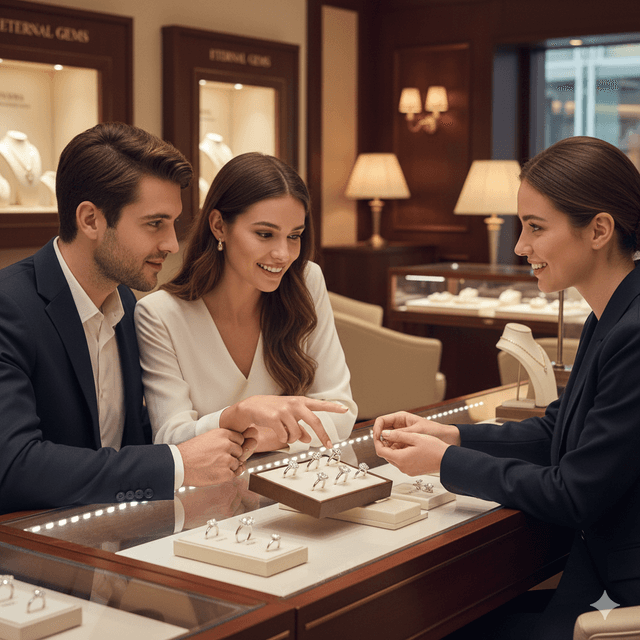
There are three ways to stage the guided reveal. The private edit places three printed or tablet-ready options in the gift box, each with one sentence explaining why it made the shortlist. The appointment edit reserves a confirmed time and asks the specialist to have the selected options ready to compare — do not call an enquiry a booking; obtain confirmation first. The sample edit compares physical samples, if the jeweller approves it and the commercial terms are clear, without engraving or altering them before her decision.
Avoid turning the appointment into a test of whether she agrees with your favourite. If only one answer is emotionally acceptable, it was not a real choice.
Route 3: give the moment now and design together later
This route makes the future piece the shared project. On Mother’s Day, present a confirmed consultation, a concise design brief or, in a narrower set of cases, a properly documented loose diamond that will become part of the final jewel.
It is the strongest route when meaning has to be translated into design rather than attached after the fact.
A family jewel may involve:
- One diamond per child or grandchild.
- One central diamond representing the family.
- Initials, names, dates or handwriting.
- A birthstone or colour system.
- Space for future additions.
- An inherited stone that may be reset.
- A ring, pendant or bracelet chosen for different wearing habits.
Each idea contains choices that affect appearance, durability, cost, future alteration and emotional meaning. If the recipient is the person whose family story is being represented, she should normally help decide how that story is encoded.
Uniglo’s current bespoke page describes a process involving conversation and design approval and gives a typical completion range of two to four weeks, depending on complexity. Treat that as published general guidance, not a promise for a particular Mother’s Day project. Obtain a written estimate after the design, materials and approval stages are known.
The Mother’s Day box can contain a personally written card explaining the design idea, a confirmed appointment date, time, place and contact, a one-page brief with known preferences and open questions, two or three visual directions labelled as starting points rather than approved designs, a photograph of an inherited jewel only if its owner has agreed to the redesign discussion, and a budget range you are comfortable discussing together.
Do not present an unconfirmed appointment as though the jeweller has reserved time. Do not print a fixed delivery date before Uniglo has approved the design and schedule. Do not describe a card as a voucher or store credit unless Uniglo has formally issued it with written terms.
Should you present a loose diamond first?
A loose diamond can make sense when the recipient already wants to co-design the setting and you know her preferences on natural or laboratory-grown origin, shape, size direction and documentation. Before buying, confirm in writing:
- Whether the exact stone will be reserved.
- Its origin and any treatment.
- Its weight and report details, where applicable.
- Whether it can be exchanged if the design changes.
- How it will be stored, insured and transferred.
- Whether the final design budget includes or excludes the setting and making costs.
Belgian pre-purchase rules require important diamond information — including origin as natural or synthetic, number, weight, treatment status and treatment type where applicable — to be supplied before the consumer is bound by an in-store sale. The FPS Economy guidance also says those core product characteristics must be communicated clearly for distance sales.
If you do not know which diamond story she values, reveal the design consultation without preselecting the stone. A loose diamond is still a major choice; it is not a neutral placeholder. The guide comparing natural and laboratory-grown diamond gifts sets out the trade-offs.
Personalisation also changes the risk. Under EU distance-purchase rules, consumers generally have a 14-day withdrawal period, but goods made to order or clearly personalised can be excluded. Separate statutory remedies still apply when goods are faulty or not as described, but a change of mind is not the same issue.
Uniglo’s published bespoke guidance says custom and personalised jewellery — including engraved or eternity bands — is not eligible for its stated ready-to-wear return route. Policies can change and the selected design may have additional terms. Ask for the exact cancellation, approval, return, resizing, remake and warranty conditions before authorising sketches, engraving or production.
Designing together is not the cautious version of a gift. For bespoke work, it is often the part that makes the gift truly personal.
Which route fits the person and the jewellery?
Use this matrix as a starting recommendation, then apply the five-question quiz below.
| Situation | Strongest starting route | Why | Move to another route when… |
|---|---|---|---|
| Necklace | Complete surprise or guided surprise | It avoids ring sizing, and a familiar length can be measured | Her preferred length, pendant scale, clasp or layering position is unknown |
| Earrings | Complete surprise or guided surprise | No ring size is required | Piercing status, weight tolerance, fastening or style is uncertain |
| Ring | Guided surprise | The intended finger can be measured and the profile tried | It is custom, difficult to resize, engraved or strongly symbolic; then design together |
| Fitted bracelet or bangle | Guided surprise | Fit, movement and fastening can be checked before purchase | Exact circumference or passage over the hand is unknown; then design together or choose a non-fitted category |
| Significant budget | Guided surprise | She can compare what design, diamond and material choices change | The piece is bespoke or the meaning is still open; then design together |
| Bespoke design | Design together | Approval is part of the product, and personalisation can limit change-of-mind returns | She has already approved a complete specification and genuinely wants the final execution kept secret |
| New mother | Guided surprise or design together | It avoids assumptions about fit, routine and whether she wants a child-symbolic jewel | She has explicitly requested a particular size-safe piece and its practical details are known; then a complete surprise may work |
| Grandmother or family-symbolic piece | Design together | Names, dates, stone order and future additions are personal decisions | She has already stated the exact symbolism and format she wants |
| Very specific taste | Guided surprise or design together | Precision is part of the pleasure for someone who notices proportions and details | You have an exact current request, measurements and terms; then the execution can be the surprise |
A note about jewellery for a new mother
Do not assume the gift must represent the baby. She may want a jewel that marks motherhood, a practical everyday piece, a celebratory statement design or something unrelated to parenting.
Ask — or learn indirectly — whether she wants symbolism at all. If fit, comfort or routine has changed, do not use an old ring or bracelet measurement without confirmation. If she is caring for a baby, consider how easily a long chain, large hoop or projecting setting fits her current routine, but do not turn caregiving into a permanent verdict on her style. Guided choice lets her decide what feels wearable now.
A note about grandmothers and legacy pieces
Do not use age as a proxy for taste or dexterity. Look at what she wears and ask about any clasp, weight or comfort preferences. For a family jewel, verify every name, spelling, date and birthstone choice with the people involved before engraving.
If an inherited jewel may be altered, establish ownership and obtain the owner’s informed agreement before stones are removed or metal is changed. Photograph and document the piece before any work. Sentiment does not replace consent.
“One stone per child” sounds simple until another child or grandchild arrives. Before production, ask whether the design can accept another stone without being remade, whether the current stones must be reset to keep the composition balanced, whether there is space for another name or date, whether one central stone or abstract motif would avoid fixing the family at today’s size, and who should decide the order of names or stones. Future flexibility may matter more than squeezing every symbol into the first version.
Five-question quiz: surprise, shortlist or design together?
Choose one answer — A, B or C — for each question. Answer from evidence, not optimism.
1. How precisely do you know her jewellery taste?
- A: I can name her usual metal, category, scale and at least two pieces she wears repeatedly.
- B: I know the general direction, but she would notice differences in shape, proportion or detail.
- C: Her taste is unclear, very specific or the idea has not yet become a design.
2. How secure is the fit and comfort information?
- A: The piece is size-neutral, or I have current and reliable evidence for every relevant measurement and fastening.
- B: I know the category, but she should compare length, diameter, profile, weight or fit.
- C: The exact size is unknown, likely to need custom work or central to the design.
3. How much decision risk does the purchase carry?
- A: The spend is comfortable, the item is unaltered and I have checked its exact return or resizing terms.
- B: The budget is significant enough that she should compare a few fully priced options.
- C: The piece will be bespoke, engraved, made to order, use an inherited stone or have restricted cancellation or return options.
4. Who should determine the meaning?
- A: The meaning is the act of giving; the jewel does not need names, dates or a family code.
- B: I have two or three possible motifs and want her to choose the one that feels right.
- C: The symbolism involves her children, grandchildren, handwriting, heirloom or story and should be defined with her.
5. How does she usually prefer to make personal purchases?
- A: She enjoys well-judged surprises and has happily worn similar gifts from me.
- B: She likes someone else to edit the options but wants the final say.
- C: She enjoys the design process, asks precise questions or dislikes other people deciding her jewellery.
Score the result: mostly A answers point to a complete surprise; mostly B answers to a guided surprise; mostly C answers to gift now and design together later. If the result is tied, choose the route that gives her more control: C before B, and B before A.
Two safety overrides apply. If fit is uncertain and the exact design is not clearly alterable, do not use a complete surprise. If personalisation or bespoke production limits cancellation, returns or resizing, do not authorise it without her approval unless she has already requested that exact specification.
This quiz is an editorial decision aid, not a validated psychological test. Its purpose is to expose unknowns before they become expensive surprises.
Worked examples
Example 1 — familiar studs, no size problem. Her recent photographs show small white-metal studs on ordinary days. Her ears are pierced, she uses the same fastening comfortably, prefers laboratory-grown diamonds and has asked for “slightly more sparkle.” The selected earrings are unengraved, available for the required date and covered by confirmed written terms. Route: complete surprise. The observations agree, and the remaining choice is narrow.
Example 2 — known necklace style, uncertain proportion. She wears yellow-coloured fine chains and often layers two necklaces. You know the available space between them but cannot tell whether she would prefer a single diamond, an initial or a wider family motif. Route: guided surprise. Present three compatible designs at the correct length and within one comfortable budget range.
Example 3 — family ring for a grandmother. The family wants one diamond for each grandchild, but no one has agreed the order, the family may grow, her correct ring size is unknown and the proposed engraving would be permanent. Route: design together. Reveal the idea and confirmed appointment, then let her settle the symbolism, format and fit.
Copy-and-send personal gift shortlist brief
Complete only what you genuinely know. Write “unknown” instead of guessing.
- Preferred route: complete surprise, guided shortlist, design together or unsure.
- Relationship to recipient.
- Required date.
- Collection, delivery or appointment location.
- Budget range, including VAT.
- Jewellery category: necklace, earrings, ring, bracelet or unsure.
- Metal colour she wears: yellow, white, rose, mixed or unclear.
- Design scale: discreet, medium, statement, varies or unclear.
- Two or three pieces she wears often.
- Categories or motifs she avoids.
- Piercing, clasp, weight or comfort information.
- Known necklace, bracelet or ring measurement and how it was obtained.
- Natural or laboratory-grown diamond preference: natural, laboratory-grown, wants to compare or unknown.
- Diamond shape or report preference, if known.
- Daily routine considerations.
- Personalisation or family symbolism under consideration.
- Must the design allow future additions: yes, no or unsure.
- Return, resizing or exchange questions.
- Three features that matter most.
- What should remain a surprise.
A ready-to-send message might read: “Please help me prepare a personal Mother’s Day jewellery shortlist. I prefer a complete surprise, a guided shortlist or a design-together route, can spend a stated range including VAT, and need the gift for a stated date and location. She usually wears a given category, metal and scale; my clearest observations are two or three examples. I still need guidance on fit, design, diamond or symbolism. Please propose no more than three options and compare their wearability, specifications, price, availability and current return or alteration terms. If photographs would help, please confirm the approved way to share them.”
Do not send identity documents, grading-report numbers, receipts, addresses visible in photographs or images of valuables stored in the home. Uniglo’s current contact form does not display a file-upload field, so send the written brief first and ask for the approved image-sharing method.
Request a personal gift shortlist
A useful shortlist is small enough to compare and specific enough to act on. Ask Uniglo’s Antwerp team for no more than three options, each with:
- The reason it fits the brief.
- Exact metal and diamond description.
- Dimensions or relevant fit information.
- VAT-inclusive price.
- Current physical availability or production status.
- Collection or delivery timing.
- Return, resizing, engraving and personalisation terms.
- The next step if none of the three is right.
For a design-together gift, request a confirmed consultation and written explanation of what happens before any paid or non-refundable production stage. Uniglo’s public contact page currently lists weekday hours of 10:00–18:00, but an enquiry is not an appointment and holiday availability can differ. Obtain confirmation for the exact date and format.
You can also complete the 10-minute jewellery-box audit, use the size-safe surprise jewellery guide or compare natural and laboratory-grown diamond gifts before requesting the shortlist.
Frequently Asked Questions
More Topics