
Rose-Cut vs Brilliant-Cut Diamonds
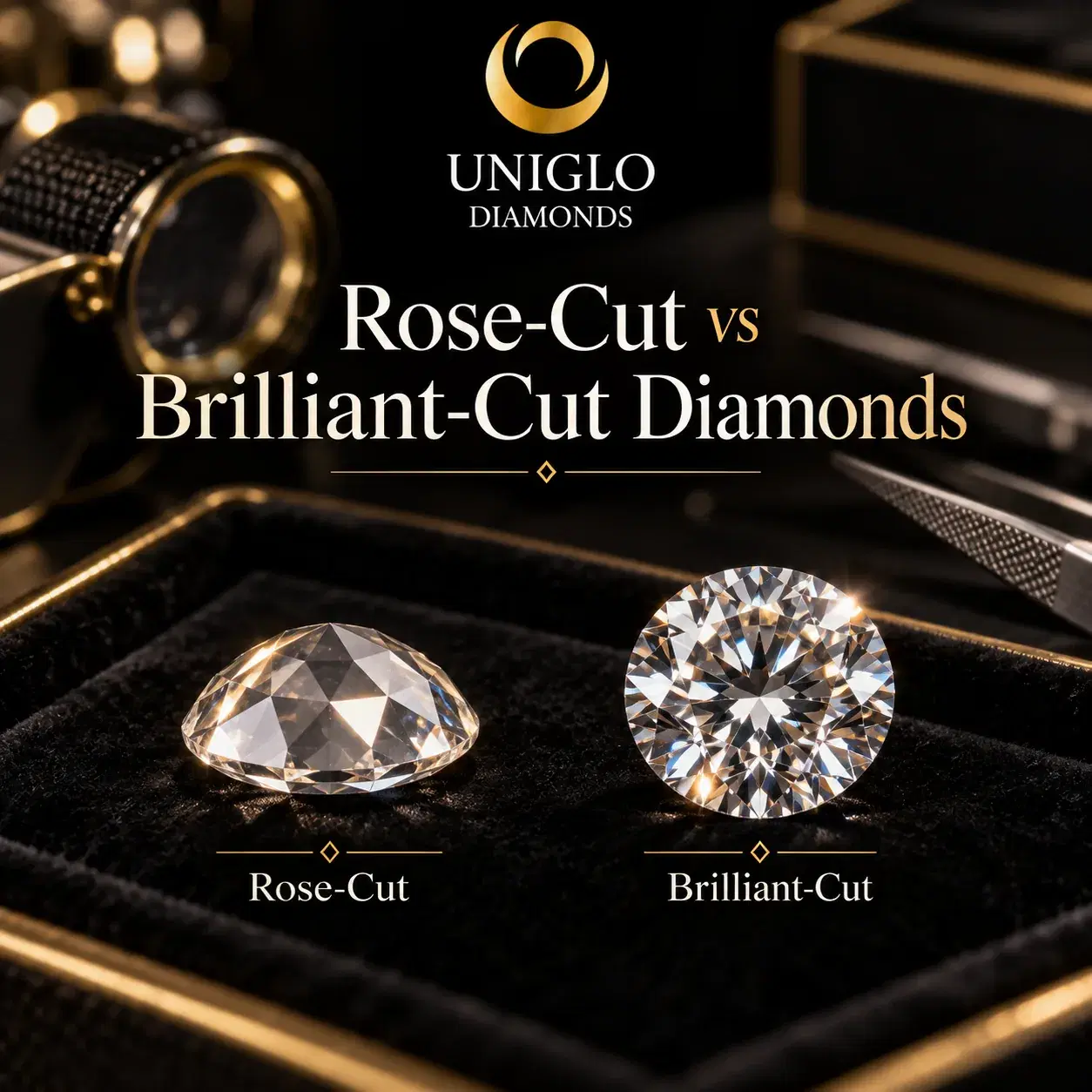
A traditional rose-cut diamond has a flat base and a domed, faceted top. A modern brilliant-cut diamond has a crown and pavilion arranged to return light towards the viewer. Rose cuts generally offer a softer gleam, while well-cut brilliants produce stronger sparkle. Choose by the actual stone’s appearance, dimensions and condition, rather than the cutting name alone.
The decision starts with what you want to see when you look at the jewellery. Do you prefer a delicate, relatively transparent appearance, or a brighter display of moving flashes? Then consider how that preference works with your intended setting, daily wear and budget.
Rose cut vs brilliant cut: comparison table
| Feature | Traditional rose cut | Modern brilliant cut |
|---|---|---|
| Structure | Faceted dome over a flat base | Crown above the girdle and pavilion below |
| Top surface | Facets rise towards an apex; usually no table | Usually a flat table surrounded by crown facets |
| Typical visual effect | Subtle gleam and reflections | Stronger brightness and sparkle when well cut |
| Face-up size | Can have a larger outline for its weight | Depends on shape and proportions |
| Setting consideration | Inspect the background and proposed backing | Allow space for the pavilion and suitable support |
| Facet count | Varies; many familiar examples have 12 or 24 | Standard round brilliant: 57, or 58 with a culet facet |
| Shape | Cutting style should be distinguished from outline | Includes round and various fancy shapes |
| Buying priority | Appearance in the intended mounting | Actual light performance, proportions and finish |
The rose-cut comparison here concerns the familiar flat-backed style. Ask for a side view if a seller uses a specialist variation or an unfamiliar trade description. A product name is less informative than clear images and accurate specifications of the offered stone.
What is a rose-cut diamond?
The rose cut is a historic cutting style with facets rising over a domed top. Its name refers to the resemblance to a rosebud. GIA describes rose cuts as having a flat bottom and a crown reaching an apex, with the style originating in diamond cutting during the 1500s. See GIA’s definitions of gem cutting styles.
That history helps explain the design, but it does not date an individual stone. A newly made piece can use an antique-inspired appearance. If your goal is genuine antique jewellery, make historical evidence part of your buying requirements from the beginning.
Examine the dome straight on and from the side. Decide whether you like the height, the arrangement of the visible facets and the outline. An attractive description such as “romantic” cannot answer those questions for you.
Rose cut describes the cutting style rather than the colour of the diamond or its setting metal. It should not be confused with a pink diamond or jewellery made in rose gold. Ask for the colour and metal specifications separately when reviewing a listing.
What is a brilliant-cut diamond?
Brilliant cutting uses a facet arrangement intended to produce brilliance. The modern round brilliant is the most familiar example, but brilliant-style diamonds also include shapes such as oval, pear, marquise and heart. IGI’s glossary explains this distinction.
A standard round brilliant has 57 facets, or 58 when a culet facet is present. That count belongs to the standard round arrangement; it should not be applied automatically to every brilliant-style shape.
The outline and the cutting style answer different questions. “Round” describes the perimeter, while “brilliant” describes the faceting. Use Uniglo’s diamond shapes guide to compare outlines, then inspect the specific diamond’s cutting description and images.
For a straightforward comparison with a rose cut, start with a modern round brilliant of a similar visible size. Comparing a large rose-cut oval with a much smaller round stone can mix up your preference for size, shape and sparkle.
Why does a brilliant cut usually sparkle more?
A brilliant diamond’s pavilion provides facets below the girdle that help return light through the crown. A traditional rose cut lacks that pavilion, so its visual effect is different. GIA’s antique diamond cuts guide describes the rose cut’s quieter shimmer and surface gleam.
You can still enjoy reflections and flashes from a rose cut. The point is to buy it for the appearance you actually see, rather than expect it to perform like a modern round brilliant. Similarly, the word “brilliant” does not guarantee excellent performance in every stone carrying that description.
GIA distinguishes brightness, fire and scintillation: reflected white light, coloured flashes, and the sparkle and changing light-dark pattern seen with movement. Its diamond cut guide explains these terms.
Use those distinctions when describing your preference. “I like the softer reflections but want fewer distracting marks” is a useful request for a rose cut. “I want strong brightness in ordinary indoor light” gives a clear starting point for a brilliant-cut comparison.
Can you see through a rose-cut diamond?
Some rose cuts have a relatively see-through appearance. Inspect how much of the background is visible through the actual stone, and whether you enjoy that effect. Do not assume that every rose cut will look equally transparent.
Ask for a view over a neutral background and another in the intended setting or a suitable setting preview. Notice whether you see the background, an underlying surface or a distracting central area. Have the supplier explain anything you cannot identify confidently from the image.
Transparency is not a reliable diamond identification test. GIA explains why the familiar newspaper test is misleading and why home tests cannot conclusively establish a gemstone’s identity. See GIA’s guidance on telling whether a diamond is real.
Keep appearance and identification separate. You can decide whether you like a transparent look yourself; identifying the material and its origin requires appropriate examination and documentation.
Which looks bigger at the same carat weight?
Rose cuts can face up larger than other cuts at the same carat weight because of their flat-backed construction. GIA discusses this tendency in its diamond engagement ring shapes guide. It is a useful consideration, rather than a promise about every pair of diamonds.
Carat weight measures mass. Compare the actual millimetre dimensions alongside the weight: diameter measurements for a round outline, or length and width for an elongated shape. Include depth when discussing the mounting with your jeweller.
Do not rely on a fixed claim that a rose cut always looks twice as large. Ask for matching-scale images or place the stones beside each other. Enlarged product photographs can make quite different physical sizes look similar on screen.
For buyers who prioritise finger coverage, compare outlines and dimensions first. For buyers who prioritise sparkle, compare appearance under matching light first. A larger silhouette and stronger light return are different benefits, and your preference determines which matters more.
Colour and clarity: what should you inspect?
Start with the colour appearance you enjoy, then consider the report information. View the diamond against a neutral background before looking at it in the proposed metal. If different stones are photographed in different surroundings, request a more consistent comparison.
For a rose cut, inspect the large visible facet areas and any features you find distracting. For a brilliant cut, inspect whether the changing pattern remains appealing through a slow tilt. In both cases, look at normal wearing size as well as under magnification.
There is no universal clarity grade that makes every rose cut or brilliant cut visually acceptable. Ask the supplier to identify visible inclusions, explain their location and provide suitable images. Have a qualified professional assess any feature that raises a condition concern.
An enlarged inclusion photograph and an ordinary-distance view serve different purposes. Keep both: one helps locate a feature, while the other helps you judge its everyday visibility. Avoid accepting “eye-clean” without understanding how that claim was assessed.
Settings can change the buying decision
A rose cut’s flat base can allow a relatively low setting, but the finished height depends on the dome and mounting design. Ask for the actual proposed height rather than assuming every rose-cut ring will sit close to the finger.
Discuss what will be visible behind the stone, how it will be supported and whether it can be inspected and cleaned in the finished piece. If a backing is proposed, ask to see a representative preview and have its construction explained. Do not choose the setting from a top-view photograph alone.
GIA notes that historical rose cuts were sometimes used in closed-backed, foil-lined mountings. An existing antique mount therefore deserves an assessment of its construction and condition before cleaning or alteration. Tell the jeweller if preserving the original assembly is important to you.
For a brilliant cut, review how the pavilion fits into the design and whether the ring’s height suits daily activities. Request a side profile and, where possible, try a ring with a comparable profile before approving a custom setting.
Neither style provides an automatic guarantee of comfort or protection. The best mounting is one designed around the particular stone, the wearer’s routine and a professional assessment of its condition.
Are rose-cut diamonds cheaper than brilliant-cut diamonds?
Compare dated quotations for specific stones. A cutting-style label alone does not establish a fair price, and it is unsafe to assume that every rose cut costs less than every brilliant cut.
Decide what you are comparing: the same carat weight, a similar visible size, or a complete piece with a similar design. Each comparison answers a different question. Record the origin, dimensions, documented quality, condition and any supported historical claims for both offers.
Request separate details for the stone, setting and included services where available. Confirm what the quotation includes, such as a report, taxes, delivery or setting work. Read the inspection and return terms before paying.
If historical provenance is central to one offer, examine the evidence rather than comparing it only by price per carat. If your goal is visual appearance, compare the finished look and documents of the actual alternatives within your budget.
Reports, origin and antique claims
Ask for laboratory documentation appropriate to the offered diamond. IGI describes its diamond reports as documenting relevant gemological characteristics and screening origin, with permanent treatments noted. Read the actual report and match it to the stone being offered.
A report’s shape or cutting-style description is not the same thing as an overall cut-quality grade. GIA’s standard round-brilliant cut grading framework does not apply to rose cuts. If a rose-cut listing says “Excellent cut,” ask who assigned that description and what it measures.
Report formats and grading systems differ by laboratory and service. Uniglo’s diamond certificates guide provides background, but your buying decision should use the document for the specific stone rather than a generic sample report.
For an antique claim, ask what is being dated: the diamond’s cutting, the mounting or the assembled jewellery. GIA states that its diamond grading report does not establish when a diamond was cut. Request the available provenance and the basis for any age attribution separately.
For natural versus lab-grown origin, consult Uniglo’s lab-grown vs natural diamonds guide. Require clear disclosure for any stone offered. A historic-looking style or gentle sparkle cannot establish its origin.
Condition and everyday wear
Diamond hardness does not make a stone immune to chipping. GIA’s diamond chipping guide highlights the importance of vulnerable areas, existing damage and suitable protection.
Have a qualified jeweller or gemologist check the stone’s edges and any surface-reaching features. Ask what can and cannot be examined while it is mounted. Request a written condition description if you are buying older jewellery or planning a reset.
For daily wear, discuss your routine with the jeweller before choosing the mounting. A flat base or a modern facet pattern alone cannot tell you how well the finished piece will tolerate accidental knocks. Review the whole design and its condition.
For care, obtain instructions specific to the stone and mounting. If a piece has an antique closed back, foil or uncertain construction, have it assessed before using a cleaning method intended for a simple modern ring.
How to compare rose cut and brilliant cut in videos
Request clean stones filmed with the same camera distance, background and lighting. Include a stationary face-up view, a slow tilt and a side profile. These are practical comparison requests, rather than a substitute for laboratory examination.
Start with ordinary indoor light and diffuse daylight, then review a separate spotlight clip. Look at the outline, reflections, visible features and overall appearance in each environment. Judge at approximately normal wearing size as well as at the enlarged screen view.
GIA explains that lighting changes diamond appearance in its quality diamond buying guide. A dramatic showroom clip should therefore be one part of the evidence.
For a rose cut, pay particular attention to the effect of the background. For a brilliant cut, inspect the changing bright and dark pattern. If the two videos use noticeably different conditions, ask for matching footage before drawing conclusions.
Which diamond should you choose?
Choose a rose cut if you enjoy its delicate appearance, visible facet geometry and potential for a relatively low design. Choose a well-cut brilliant if stronger sparkle is your priority. Confirm either preference by looking at actual stones in ordinary light.
Uniglo’s round lab-grown diamonds provide a modern round comparison. This collection link does not establish rose-cut availability or antique inventory. Review individual listings and ask for current specifications before shortlisting.
To discuss your requirements, contact Uniglo Diamonds with your preferred outline, visible dimensions, origin, budget and intended setting. Say whether you want an original antique or a newly made piece with a historic appearance. Request available options, matching videos and documentation for any stone offered.
Frequently asked questions
More Topics




