
Replacing Your Engagement Ring’s Centre Diamond: What to Confirm Before Buying
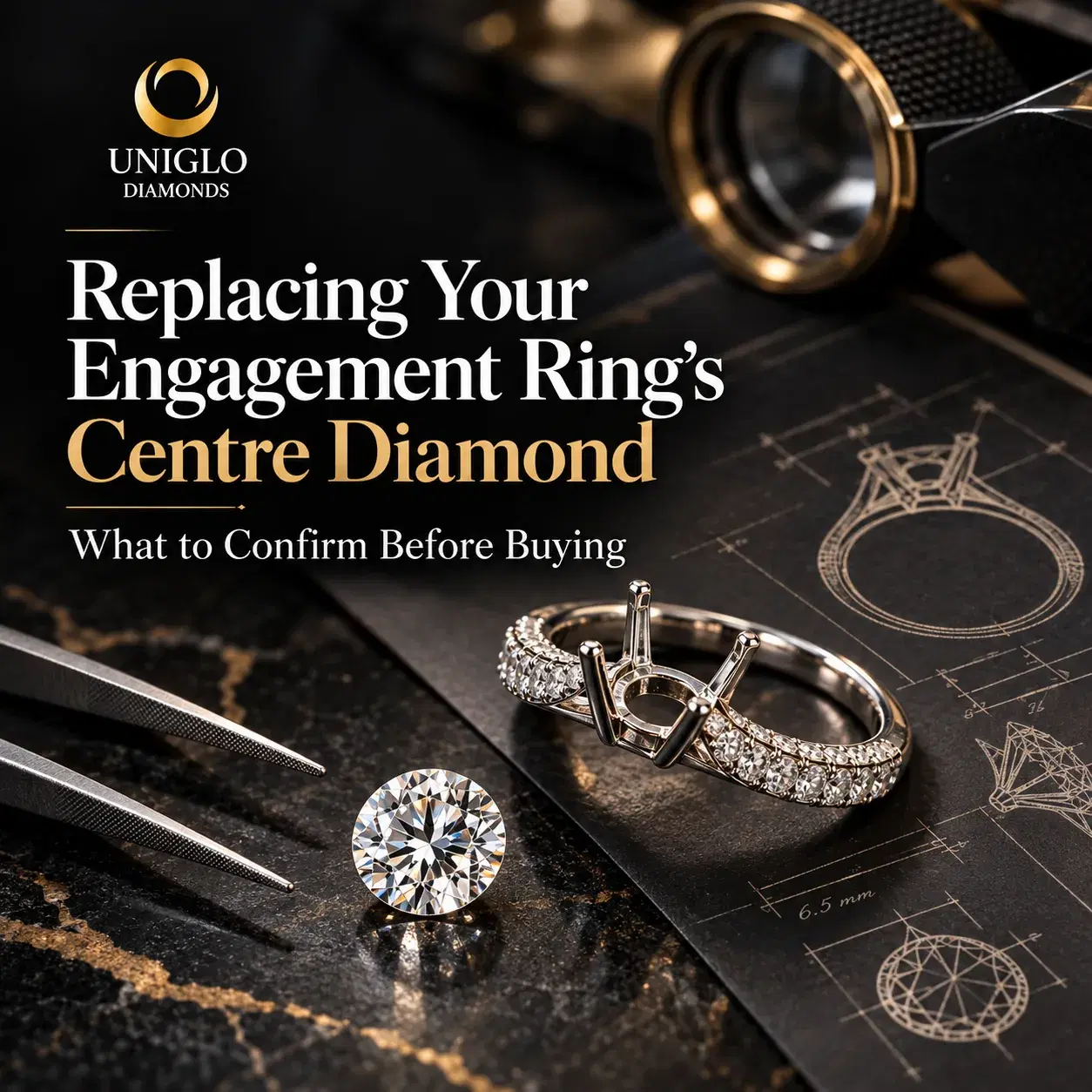
You may be able to replace your engagement ring’s centre diamond while keeping part or all of the original ring. The setting jeweller needs to inspect the ring and assess the replacement stone’s shape, millimetre measurements, profile and condition before confirming how it can be fitted. Buying a diamond with a higher carat weight does not establish that it will work in your existing setting.
Start with the ring assessment, then ask for suitable replacement diamonds. This order gives the stone supplier a practical brief and lets you compare the complete project cost. Whether your aim is a larger-looking centre stone, a different shape or replacing a lost diamond, the purchase and setting work need to be planned together.
Decide what you want to preserve and what you want to change
An engagement ring diamond upgrade can mean several things. You might want greater visible size, a different outline, a change in colour or clarity, or a replacement for a missing stone. Explain the result you want in everyday terms before narrowing the search to laboratory grades. Also tell the jeweller which parts of the ring carry sentimental value.
“Keep my original ring” needs clarification. Do you want to preserve the band, the engraving, the surrounding diamonds, the centre-stone holder or all of them? A proposal that retains the band but replaces the head—the part holding the centre diamond—may suit one owner and feel like too much change to another. Have the jeweller identify exactly which components would remain.
If your main concern is that the current diamond looks dull, first ask for cleaning and inspection. GIA’s engagement ring upgrade guide includes a professional check and cleaning as a way to refresh an existing ring. That assessment can help you distinguish a maintenance issue from a change you actually want to make.
Have the existing ring inspected before shopping for the replacement
Take the ring to the jeweller who would carry out the setting work. Include any original report, purchase documents, design drawing and details of previous repairs that you have. Photographs can support an initial discussion, but ask what the jeweller needs to inspect in person before giving a firm answer about compatibility.
Request an assessment of the centre setting, prongs or bezel, the supporting structure, the band and any surrounding stones. Ask whether the ring is suitable for the proposed work and which repairs would be necessary even if you kept the original diamond. This separates the cost of maintaining the ring from the additional cost of changing its centre stone.
If the diamond has been lost, have the jeweller investigate the setting before fitting another stone. A replacement needs a secure mounting; the cause of the loss may need attention first. GIA explains that damaged prongs can leave a diamond insecure and increase its exposure to damage in its diamond protection guidance.
Also ask whether the jeweller accepts a replacement diamond purchased from another supplier. Some projects may require the setter to examine the loose stone before accepting it. Obtain that answer before paying for a diamond, and keep any preliminary advice clearly separate from final acceptance after inspection.
Confirm which setting route is workable
There are three useful possibilities to discuss: using the existing centre setting, replacing the centre-stone holder while retaining the band, or making a new setting. The right route depends on the actual ring and diamond. A photograph, carat-size chart or supplier recommendation cannot settle the construction decision on its own.
| Proposed route | What the jeweller should confirm | What to establish before buying |
|---|---|---|
| Retain the existing centre setting | Its condition and suitability for the specific candidate stone | Required dimensions, permitted work and final loose-stone inspection |
| Replace the head and retain the band | Whether the new holder can be fitted appropriately to the remaining ring | New design, stone requirements, components retained and complete work quotation |
| Make a new setting | Why this is the recommended route and what can be reused | Design approval, exact stone requirements and disposition of the original ring |
GIA describes a peg setting as one example where a jeweller can replace the centre-stone holder to accommodate a larger or differently shaped diamond while retaining the rest of the ring. This illustrates a possible construction approach, not a promise that your ring has that structure or can be altered in the same way. GIA’s explanation of peg-setting upgrades.
Ask for the proposed work in writing. If a new head changes the stone’s height, the prong arrangement or the ring’s outline, request a drawing or other design explanation before approving it. Make sure “reuse the setting” does not conceal a different understanding of which parts will be replaced.
Use millimetre measurements rather than carat weight to discuss fit
Carat weight describes mass. The setter needs the diamond’s physical dimensions and shape to assess its fit. Obtain the candidate stone’s length, width and depth in millimetres, together with the report and actual-stone imagery. IGI’s report-reading guide identifies measurements, shape, cutting style and quality assessments among the information documented on a diamond report.
For a round diamond, share the reported diameter measurements and depth. For an oval, emerald cut, pear or other elongated shape, share length, width and depth, and discuss the intended orientation. Our diamond shapes guide can help you describe the outline you prefer, while the setting jeweller decides what the ring can accommodate.
The stone’s profile also matters to the proposed mounting. Ask the setter to review the girdle, pavilion and culet area rather than relying only on the top-view outline. A diamond that looks like an appropriate width in a photograph may still need a different holder or design once its complete profile is considered.
There is no universal millimetre allowance that makes every replacement suitable. Do not assume that a stone slightly larger than the original can be fitted by spreading the existing prongs. Ask the jeweller to specify the acceptable candidate requirements and explain any necessary work. Final suitability should be confirmed for the actual loose stone, not just a nominal size category.
Can you put a bigger diamond in the same ring?
Possibly, but first establish what “bigger” means to you. You might want a higher carat weight, a wider face-up appearance or more presence in the finished design. These are related preferences, but they are not interchangeable. Compare the candidates’ measurements and imagery, then ask the jeweller how each would affect the ring.
Discuss the setting’s height and how the finished ring will feel during wear. A proposed larger centre diamond should also be considered alongside the band, side stones and wedding ring. Bring the wedding band to the assessment if you normally wear the two together, and ask the jeweller to show how the proposed design would sit beside it.
Keep secure stone retention in the design brief. GIA explains that prongs serve the essential function of holding the diamond and warns against making them insufficient simply to expose more of the stone. Its guide to setting choices and apparent diamond size is useful background for that discussion.
If preserving the current mounting is your highest priority, ask for diamonds that meet the jeweller’s requirements. If visible size is the priority, ask what setting changes would be needed for your preferred candidate. Comparing both routes can reveal whether the larger stone still makes sense once the complete work is included.
Changing shape, colour or diamond origin
Replacing a round centre diamond with an oval, pear or emerald cut should be discussed as a change in design. The setter needs to review the new outline, dimensions, orientation and protection of the stone. A matching carat weight does not make two different shapes interchangeable in an existing holder.
A halo or fitted arrangement of side stones deserves particular attention. Ask whether the new centre diamond can work with those surrounding elements and which parts would need alteration. The decision should be based on the actual ring, not an assumption that every halo can be enlarged or every side-stone arrangement retained.
Compare colour and appearance beside the existing accent diamonds where possible. A centre diamond chosen in isolation may create a different overall look once placed alongside the other stones and metal. Tell the jeweller whether you prefer a close visual match or are comfortable with contrast, and ask to review the proposed combination.
If you are considering switching between natural and laboratory-grown origin, make that choice explicit to both the supplier and setter. Our natural versus lab-grown diamond guide explains the broader distinction. Either shortlist still needs its own documented stone measurements and setting assessment; origin alone cannot confirm fit.
Check the replacement diamond’s report and condition
Request the actual report for the shortlisted stone, with its stock reference, origin designation and relevant comments. Review shape, measurements, grades and any disclosed treatments rather than relying on a short sales description. Our diamond certificates guide explains the role of laboratory documentation.
Ask how the supplier matches the offered diamond to that documentation and how the setter will record its identity at intake. A report number is useful information, but the receiving jeweller should also examine the actual stone. Keep the purchase description, report and handover record together so each party is working from the same candidate.
Have the setter inspect the girdle, points, corners and any relevant condition features before accepting the work. GIA notes that very thin girdle areas and exposed points or corners can be vulnerable to chipping, and discusses protective setting choices. This is a reason for individual assessment, rather than a blanket instruction to reject a particular shape.
Your original diamond’s documents can help describe the starting point, but ask how any mounted assessment is qualified. GIA explains why its Diamond Grading Report requires a loose diamond: a mounting can affect assessment and prevent exact weighing. IGI likewise explains the limits of assessments made as a mounting permits. Do not treat an estimated mounted measurement or grade as an exact loose-stone result.
Coordinate the supplier and setting jeweller before payment
The practical sequence is to inspect the ring, agree the setting route, obtain a replacement-stone brief, shortlist diamonds and have the setter review the candidates. Once a preferred stone is identified, align its purchase terms with the setter’s availability and inspection process. This helps prevent a delivery arriving while the receiving jeweller is unable to assess it.
| Information to coordinate | What to confirm |
|---|---|
| Existing ring | Inspection findings, repairs and parts to retain |
| Candidate diamond | Stock reference, report, dimensions, imagery and condition assessment |
| Setting work | Jeweller acceptance, proposed design, quotation and required inspection |
| Purchase timing | Quote validity, availability, delivery and inspection period |
| Authorisation | Who confirms acceptance and when setting work may begin |
| Original stone | Removal record, return instructions or a separately agreed next use |
Ask when any return or inspection period begins and whether setting or alteration affects it. Do not authorise the stone to be set while you are still deciding whether to keep it. Confirm the supplier’s terms and the jeweller’s schedule directly rather than assuming the two periods will align.
For delivery or handover, agree who receives the stone and records its condition. Ask who is responsible for it during transit, storage and setting, and which arrangements apply if it is damaged or lost. If you have jewellery insurance, ask the insurer about the proposed work and any documentation changes required; coverage should be confirmed for your circumstances.
Budget for the complete engagement ring diamond upgrade
Request separate descriptions of the replacement diamond and the setting work, then establish the complete payable amount. Depending on the project, the work quotation may involve removal, repairs, a replacement head, a new mounting or finishing. Ask which elements apply to your ring rather than relying on a general reset price.
Include applicable taxes, delivery and any other quoted charges. If the original diamond is being considered for trade-in, request a separate written offer and its conditions. Do not deduct an assumed value from the upgrade budget before an offer has been confirmed and accepted.
There is also no standard completion time that applies to every replacement. Ask the supplier and setter for their respective dates, then allow for receiving inspection and any unresolved design decisions. If the finished ring is needed for an anniversary or other occasion, share the deadline before purchase and have the jeweller confirm what can be committed to.
Decide what happens to the original diamond
You may want to keep the original diamond loose, have it made into another piece or consider a separate sale. Give the jeweller clear instructions before removal, and ask for the stone and any replaced components to be identified on the handover record. An instruction to replace the centre diamond should not be treated as permission to dispose of the original.
If you want another piece made, discuss that project separately. Confirm its design, costs and required inspection rather than assuming removal includes a pendant or other finished item. Keeping the two commissions clear also makes it easier to understand the total spending.
For a proposed trade-in or sale, distinguish credit towards another purchase from cash. Confirm eligibility, deductions and payment or credit terms. The sentimental significance of the original diamond may also affect your decision, so settle its destination before the replacement work starts.
What to confirm when collecting the finished ring
Review the completed ring with the jeweller and compare it with the approved design and work description. Ask the jeweller to demonstrate the checks made on the stone’s seating, retention and finished condition. Confirm that the documentation identifies the replacement diamond and accurately describes the work performed.
Check comfort and the ring’s relationship with your wedding band if applicable. Ask about inspections, maintenance and any relevant care instructions for the new design. GIA’s engagement ring protection guide provides background on checking a ring’s setting and condition during wear.
Collect the original stone and replaced parts according to the agreed instructions. Retain the replacement purchase documents, laboratory report, setting invoice and intake or collection records. Ask the appropriate provider whether any existing warranty or insurance documentation needs updating following the work.
Enquire about a replacement centre diamond with Uniglo
Contact Uniglo Diamonds with your existing centre stone’s details, photographs of the ring, your preferred change and the requirements supplied by your setting jeweller. Include the desired origin and shape, acceptable dimensions, budget, delivery destination and timing. State whether the budget covers the diamond alone or the complete replacement project.
You can explore our natural loose diamonds or lab-grown loose diamonds to identify candidates for enquiry. Ask for a focused shortlist with current quotations, reports, measurements and actual-stone imagery that you can share with your setter.
For example: “I want to replace the centre diamond while preserving my engagement ring’s band. My jeweller has inspected the ring and will confirm the setting route after reviewing a candidate. Please suggest replacement stones within the attached dimension requirements and budget, with reports, imagery and complete quotation terms.” If the ring has not yet been assessed, say so in the enquiry so the proposed shortlist can remain provisional.
Frequently asked questions
More Topics




