
Replacing a Missing Diamond: How to Find the Right Match
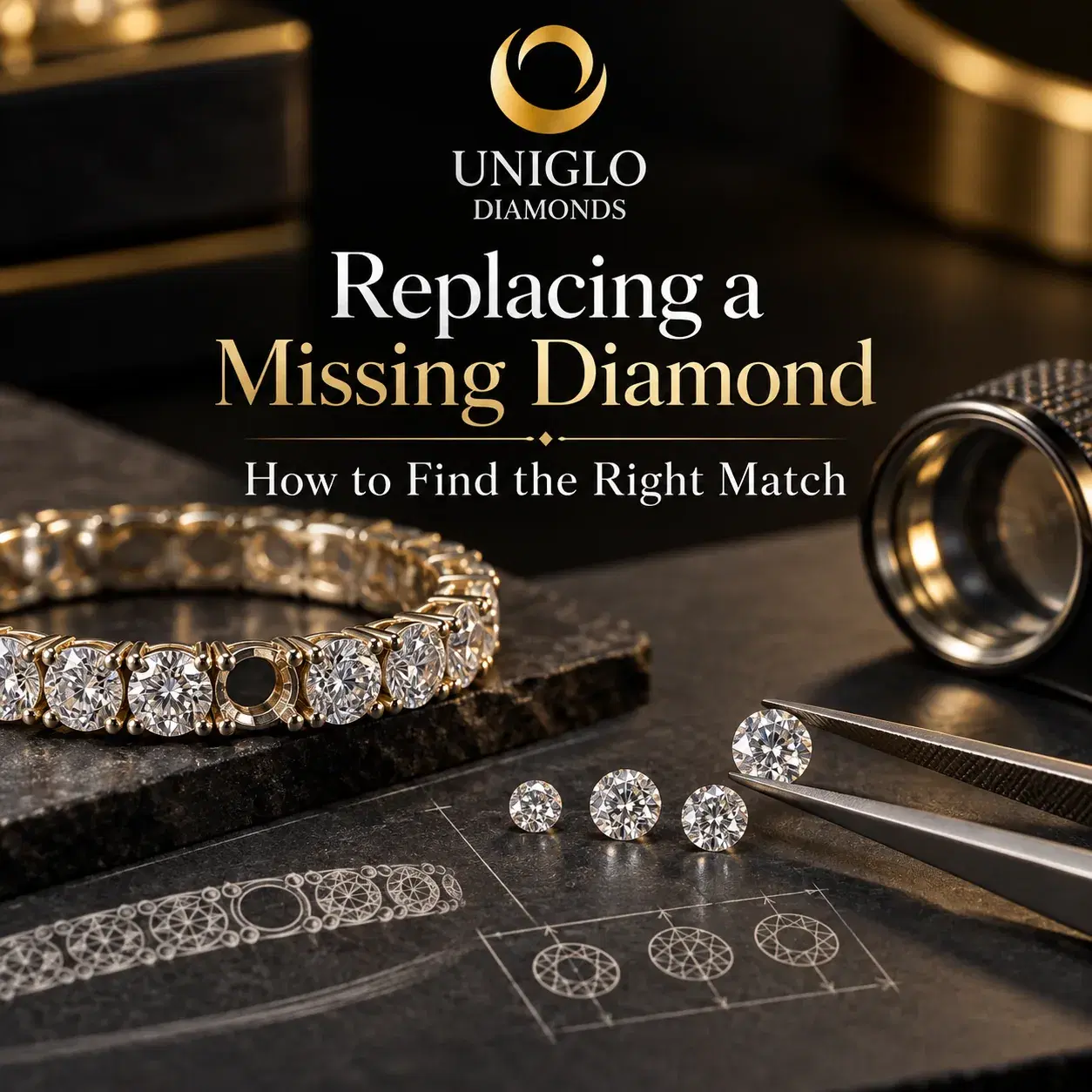
Finding a replacement diamond starts with the jewellery it will join. The supplier needs the required measurements, shape, cutting style and appearance of the remaining stones, while the setting jeweller needs to confirm that the candidate can be fitted securely. A diamond with a similar carat weight or the same headline grades is not automatically the right match.
The aim is to restore the piece’s appearance without leaving the replacement noticeably different from its neighbours. Whether a stone is missing from a ring, tennis bracelet, pendant or earring, begin with an inspection and a clear sourcing brief. The existing jewellery provides the reference for that brief; the empty space alone cannot supply every detail.
Have the jewellery checked before ordering a stone
Ask a setting jeweller to inspect the piece and identify the work required. The missing diamond may be only part of the repair: the jeweller also needs to assess the metal that held it, nearby settings and the condition of the remaining stones. Request an explanation of any necessary repairs before asking a supplier to choose the replacement.
Set the jewellery aside until the jeweller has assessed it, particularly if another stone appears loose or the setting is damaged. GIA explains that bent or broken prongs can leave diamonds insecure and more exposed to damage in its guide to preventing diamond chipping. Do not try to close prongs or test the fit of a loose replacement yourself.
If you find the original diamond, keep it safely and ask the jeweller to examine it before assuming it can be reused. If it remains missing, the jeweller can establish which surviving stone or part of the design should guide the search. Confirm that the jeweller accepts a stone obtained from a separate supplier and ask what must be checked before setting work begins.
Define the match: physical fit and visual consistency
A replacement has two connected requirements. It must suit the intended mounting, and it should create the appearance you want beside the remaining diamonds. A candidate may satisfy one requirement while failing the other, so agree how both will be assessed before purchasing.
Physical compatibility involves the actual shape, dimensions and profile of the stone together with the proposed repair. Visual matching involves its outline, apparent size, colour, cutting style and appearance in the finished piece. Documented origin is another requirement to state separately: a visually similar stone does not establish that it is natural or laboratory-grown.
Ask which features are essential and where a small variation can be considered. A close visual match in a line of small diamonds is a different request from adding a deliberately contrasting stone. For a restoration, explain that you want the missing position to blend with the existing design rather than requesting the highest grades available within a budget.
The information a replacement-diamond supplier needs
Send a brief prepared with the setting jeweller wherever possible. Identify the piece, the missing position and the surviving stones that should be used as references. Keep measured information separate from estimates or information taken from old documents, so the supplier understands which requirements are firm.
| Brief detail | What to provide |
|---|---|
| Jewellery item | Ring, bracelet, necklace, pendant or earring; design and repair reference if available |
| Missing position | A labelled photograph showing exactly where the stone belongs |
| Quantity | Number of missing stones, with each position identified separately |
| Shape and cutting style | The required outline and facet arrangement, confirmed by the jeweller |
| Dimensions | Required millimetre measurements and acceptable variation supplied by the setter |
| Existing appearance | Relevant neighbouring or counterpart stones, viewed after suitable cleaning |
| Origin | Natural or laboratory-grown; state when this is not yet established |
| Documents | Relevant reports, invoices, design records and any qualified mounted assessment |
| Proposed work | Repairs or setting changes identified by the jeweller |
| Commercial requirements | Budget, destination, deadline and inspection arrangements |
If several stones are missing, label them separately rather than assuming every position needs the same diamond. A design may have different sizes or outlines in different locations. State whether the request is for individual replacements, a matched pair or several coordinated stones.
For jewellers arranging laboratory-grown replacement sourcing, our diamond sourcing guide for jewellers provides a broader framework for specifying goods and checking a delivery. A one-stone repair should still have a clear reference and an agreed acceptance process.
Get the required millimetre measurements from the setter
Use physical measurements to describe the replacement rather than relying solely on carat weight. For a round stone, the setter may need its diameter range and depth; for an elongated or other fancy shape, length, width and depth need consideration. The jeweller should identify which measurements and profile requirements matter to the particular mounting.
Do not order from the visible width of the empty opening alone. Have the setter assess the stone seat, the remaining metal and the proposed repair, then specify a suitable candidate. The dimensions of a neighbouring diamond can help form the brief, but that stone should be used as the reference only if the jeweller confirms it belongs to the same size and design position.
For a tapered baguette, ask whether the search needs separate measurements for the wider and narrower ends as well as length and depth. For other distinctive outlines, supply a drawing, relevant photographs or measurements requested by the setter. A shape name such as “baguette” or “pear” may leave important details unresolved. Our diamond shapes guide can help identify the broad outline before the technical brief is prepared.
There is no universal tolerance that makes every replacement suitable. The setter should establish the permitted variation for the actual job and inspect the chosen stone before fitting it. A seller’s size label or a general millimetre-to-carat chart is a starting point for enquiry, not a fit confirmation.
Match cutting style as well as shape
Two small diamonds can have a round outline while using different facet arrangements. GIA describes single-cut melee as having 17 or 18 facets and full-cut round-brilliant melee as having 57 or 58, depending on the presence of a culet. Its melee diamond guide explains these cutting styles.
For a missing accent diamond, ask the jeweller to identify the cutting style of the relevant remaining stones. Ordering a generic round diamond leaves that requirement unresolved. Have the candidate compared with the jewellery before deciding that its shape and size make it an acceptable replacement.
The same principle applies to a step-cut or distinctive older design: identify the intended facet arrangement rather than substituting a stone solely because the outline looks similar. If the jeweller cannot determine the cutting style from the available photographs, record it as unconfirmed and arrange examination. Photographs should support the search without being treated as a laboratory assessment.
Compare colour and appearance beside the existing diamonds
Use the remaining jewellery as the visual reference. Ask for comparison under consistent conditions, with the piece suitably cleaned by the jeweller if appropriate. Describe whether the candidate appears different in colour, brightness or outline rather than making a decision from isolated sales photographs taken under unrelated lighting.
GIA’s guide to selecting diamond side stones discusses coordinating colour, cut, clarity and proportions to achieve a consistent design. For replacement work, those considerations help define what to compare; they do not create a fixed grade difference that guarantees a match for every piece.
An apparently higher-grade replacement is not automatically the better restoration choice. Ask how it looks beside the reference stones and whether it meets the condition and quality requirements of the repair. If one candidate looks noticeably different, the supplier needs that feedback to refine the selection.
Treat assessments of mounted stones with their stated qualifications. IGI explains that jewellery grades may be limited by the mounting and that colour and clarity can be expressed as ranges when grading is performed as the mounting permits. IGI’s jewellery report guidance. Do not convert a qualified range for the piece into an exact grade for every remaining diamond.
Confirm natural or laboratory-grown origin
Tell the supplier which origin the replacement should have. Check the original paperwork, but establish whether it identifies the particular missing stone, the surrounding diamonds or only the centre diamond. If the evidence does not resolve that question, ask the jeweller how the origin requirement can be established before ordering.
Appearance alone is insufficient to settle origin. GIA’s research explains the challenges of identifying very small diamonds and the role of suitable screening and further testing where needed. Its laboratory-grown diamond identification update distinguishes a screening result from conclusive identification.
Ask what documentation or screening evidence supports the replacement’s described origin. Do not assume that every small accent stone has its own individual grading report or that parcel evidence provides a separate grade for each diamond. Have the supplier explain what its evidence covers. Our diamond certificates guide and natural versus lab-grown diamond guide provide supporting background.
Different jewellery needs different matching references
A missing diamond in a halo, pavé ring or eternity band
Mark the missing position and have the jeweller identify the appropriate neighbouring stones for comparison. Ask whether the design uses one repeated size or changes sizes across the setting. For more than one gap, make a position-by-position list so the supplier knows how many distinct requirements are involved.
The setting work belongs in the assessment too. GIA describes pavé as a bead-setting arrangement and channel setting as stones laid in a grooved row in its side-stone setting guide. These are different constructions, so ask the jeweller what repairs and acceptance checks apply to your piece rather than treating every small-stone replacement as the same job.
A missing diamond in a tennis bracelet or necklace
Use the relevant section of the piece as the reference and confirm whether the design has uniform or graduating stones. Ask the jeweller to review the neighbouring settings and any component affected by the loss. The intended result is an acceptable match in the finished sequence, not merely a replacement with the same weight description.
Supply photographs of the whole item as well as the gap. This lets the supplier understand the layout and which stones the setter has selected as references. If multiple positions differ, retain those distinctions in the sourcing brief and delivery record.
A missing side stone or one stone from an earring pair
For a three-stone ring, the surviving side stone can help guide the search, but ask whether the replacement needs a particular orientation or complementary outline. Request comparison in the intended layout. A loose candidate viewed alone cannot demonstrate how the two sides will balance in the completed ring.
For earrings, provide the surviving stone’s dimensions, report where available, imagery and setting information. GIA advises buyers to consider the 4Cs together when selecting diamond stud earrings. If the entire earring is missing, clarify that recreating the jewellery also involves its mounting and fittings; a matching loose diamond addresses only the stone component.
Use photographs and documents without overstating their accuracy
Send one photograph of the whole piece, a close view of the missing position and a view showing the reference stones. Keep the images clear and unfiltered. If a scale is included, describe it as a visual aid; the required measurements should still come from the jeweller’s assessment.
Original reports, invoices and design records can narrow the search. Check their scope carefully. A centre-diamond report does not necessarily describe the small stones around it, while an invoice giving only total carat weight does not identify the dimensions of the missing diamond. Dividing the total weight by the number of stones can give an average, but it cannot prove that every position had the same stone weight or size.
Where information is missing, say so directly. “Origin not yet confirmed” or “dimensions awaiting setter assessment” gives the supplier a more useful starting point than an unsupported precise specification. An initial shortlist based on incomplete evidence should remain provisional until the relevant checks are completed.
Review the candidate and complete repair cost before setting
Have the setter assess the delivered loose stone for physical suitability and condition, then compare it with the chosen reference stones. Agree who confirms acceptance and when setting work may begin. Keep the candidate identifiable with the supplier’s reference and available documentation throughout that process.
Ask for the replacement-stone quotation and repair quotation separately, then confirm the complete payable amount. Identify taxes, delivery and other excluded charges rather than assuming the stone price is the whole cost. A small replacement diamond does not establish the amount or complexity of the jewellery repair.
Confirm availability, inspection arrangements and the applicable return terms before paying. Ask whether setting the stone affects its eligibility for return and coordinate the jeweller’s inspection with that period. If the candidate is unsuitable, contact the supplier within the agreed terms before authorising alteration or fitting.
At collection, compare the completed piece with the approved repair description. Ask the jeweller to confirm the stone’s seating and retention, and review the visual result together. Keep the source details and repair invoice for future reference, particularly where the replacement’s origin or specifications have been documented.
Send Uniglo a replacement-diamond sourcing enquiry
Contact Uniglo Diamonds with photographs of the jewellery, the labelled missing position and the requirements supplied by your setting jeweller. Include quantity, shape, cutting style, required dimensions, appearance references, origin, budget, destination and timing. State which details are measured and which still need confirmation.
For example: “One small diamond is missing from my ring. My jeweller has identified the required size and cutting style and will compare any candidate with the neighbouring stones before setting. Please let me know whether you can source a replacement within the attached requirements and provide its origin information, complete quotation and inspection terms.” This gives the supplier a defined task without assuming stock or an exact match is already available.
Our natural loose-diamond inventory and lab-grown loose-diamond inventory can support enquiries for relevant individually listed stones. For a small accent, unusual outline or other requirement not identifiable in the public inventory, send the technical brief and ask about sourcing suitability and any order conditions.
Frequently asked questions
More Topics




