
Reordering Melee Diamonds: How to Keep the Next Batch Consistent
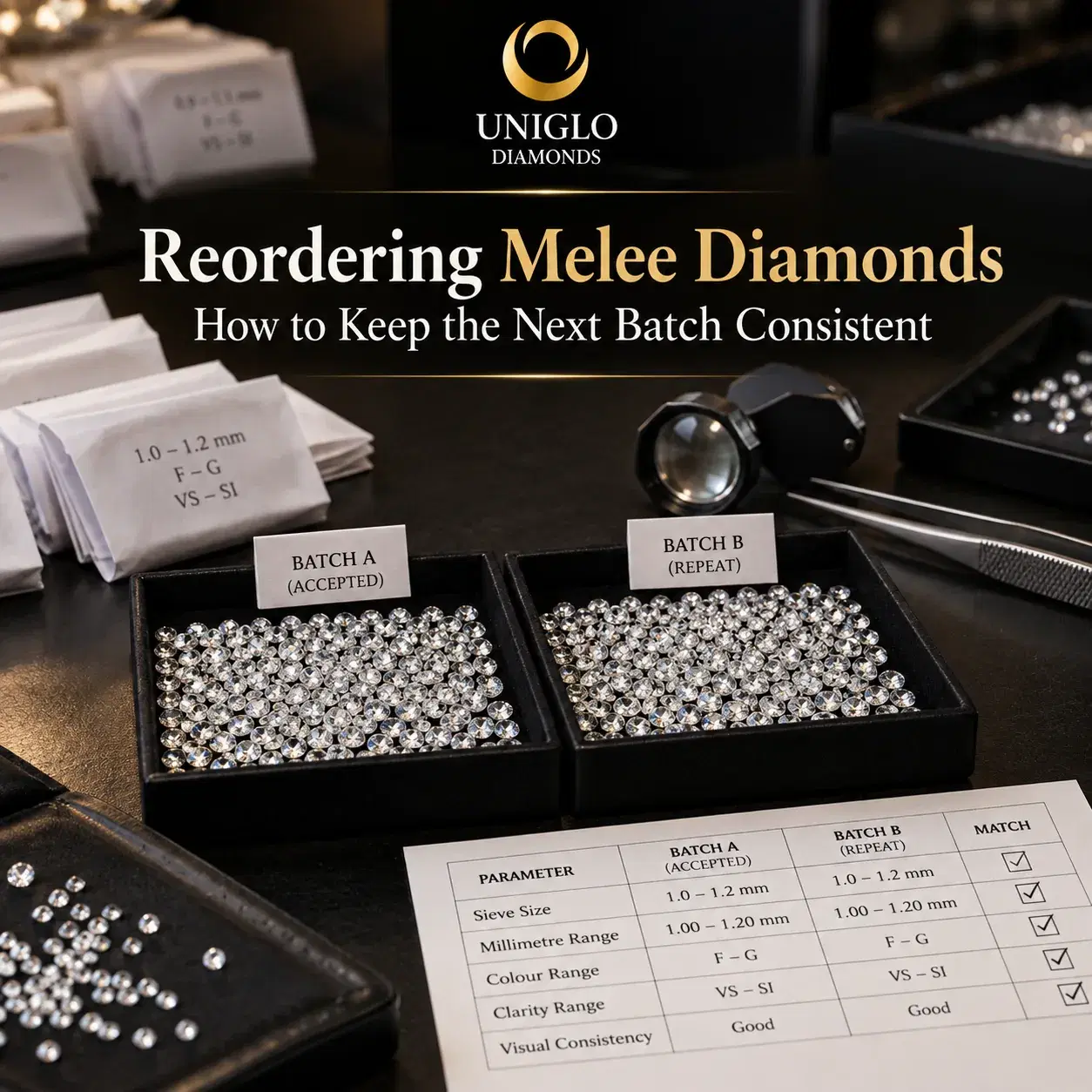
To reorder melee diamonds consistently, document the goods your workshop accepted and turn that record into a measurable repeat specification. Include the origin, shape, cutting style, dimensional limits, appearance criteria and supporting evidence. Use the earlier parcel reference to identify the starting point, then obtain a fresh offer and assess the new delivery before mixing it with accepted stock.
“Send the same again” leaves too much unresolved. The supplier needs to know which features must remain consistent, how the stones will be used and what variation your workshop can accept. An earlier successful order is a useful reference; it does not establish the contents, availability or purchase terms of the next batch.
Document the accepted stones, not only the original order
Keep the purchase brief, quotation and receipt record, but also record the final acceptance decision. The goods ordered and the goods released for production may differ after inspection, sorting or an agreed replacement. The accepted selection is the relevant starting point for a repeat requirement.
Identify any rejected or returned stones, substitutions and changes agreed during the first order. If the workshop accepted only a selected portion of a broader parcel, state that clearly. Reordering the original commercial grade range without those additional criteria may not reproduce the selection that worked in production.
Record who accepted the dimensional fit, who assessed matching and what documentation was reviewed. One person may perform several tasks, but the scope of each decision should remain clear. Acceptance of appearance does not automatically confirm origin, dimensions or suitability for a particular setting.
Associate the record with the jewellery design and its revision. A batch may have been satisfactory for one mounting while being inappropriate for a later design change. Before repeating the order, check whether the setting requirements still apply rather than allowing an old purchase description to become the permanent specification.
Build a reusable accepted-batch record
A useful record lets another purchaser or setter understand what was approved without relying on the memory of the person who handled the goods. Keep references consistent across the supplier documents, workshop packets and production records.
| Record field | What to retain |
|---|---|
| Supplier and purchase | Supplier identity, order, quotation and invoice references |
| Received goods | Delivery date, parcel or lot reference, received count and weight |
| Accepted selection | Quantity and weight released for use, with any qualifications |
| Origin evidence | Natural or laboratory-grown designation and documents reviewed |
| Shape and cutting style | Required outline, facet arrangement and relevant finish descriptions |
| Dimensional requirement | Approved measurement limits, units and method of checking |
| Observed measurements | Inspection results and whether they cover every stone or a sample |
| Matching assessment | Appearance criteria, comparison conditions and reference material |
| Exceptions | Rejections, substitutions and agreed deviations from the original brief |
| Production use | Design revision, job allocation, setter feedback and remaining stock |
| Approval | Named decision-maker, date and scope of acceptance |
Keep the requested limits separate from the observed results. For example, a measurement record describing a sample should not be presented as the maximum and minimum of the entire delivery. Record what was actually checked and any limitations of that examination.
Do not silently turn supplier shorthand into more precise claims. A parcel description may use a colour or clarity range rather than individual grades. Retain the original wording alongside your agreed interpretation and acceptance criteria. Our diamond certificates guide provides background on interpreting supporting documentation.
Preserve a reference that can support comparison
Where practical, discuss retaining an identifiable reference selection from the accepted goods. Agree its quantity, ownership and storage, and record what the selection represents. A few reference stones can support comparison, but they do not prove the characteristics of every stone in the original batch.
If a reference is supplied to the supplier, identify it separately and agree its return or other disposition. Keep the approved dimensional and appearance requirements in writing as well. A request to match a physical sample should explain which features matter rather than leaving the supplier to infer the full specification.
Photographs and video are useful supplementary records when their conditions are documented. Use consistent lighting, background and scale for later comparisons, and retain the unedited originals. Images should not replace measured dimensions, appropriate origin evidence or inspection of the next goods.
If no loose reference remains, use the accepted-batch record and relevant production feedback. Finished jewellery can help describe the intended appearance, but its mounting may limit comparison and measurement. Tell the supplier which evidence is available rather than presenting a mounted stone or photograph as a complete loose-parcel specification.
Specify dimensional consistency in millimetres
Define the repeat requirements around the mounting, with limits approved by the setter. For rounds, identify the required diameter range and any relevant depth criteria. For fancy shapes, specify the required length, width, depth and outline details. Our diamond shapes guide supports shape descriptions, while the workshop determines the fit requirements.
Keep nominal size, permitted limits and measurement results distinct. A nominal label does not confirm that all stones fall within the usable range. If a sieve designation is part of the order, ask for its meaning in millimetres and the supplier’s interpretation before relying on it for repeat production.
GIA’s guidance on designing with melee explains the importance of size consistency where uniformity is intended and connects stone selection with jewellery engineering. That supports specifying fit carefully; it does not provide a universal reorder tolerance for every setting.
If the next proposal changes the dimensional range, have the setter assess it before ordering. Do not describe a broader range as “the same” because its average is similar to the previous delivery. Record any approved change as a new revision, with the jobs or designs to which it applies.
Define the appearance you want to repeat
State whether matching is needed within one jewellery piece, between old and new stock, or across a wider collection. These are different comparison tasks. A new parcel may look internally consistent yet differ from the accepted stones it will sit beside.
Retain the required colour and clarity range, cutting style and any agreed appearance conditions. Explain the visible differences that prompted rejection during the previous order, using identifiable examples where available. Ask for a selection that meets the documented brief rather than requesting a general “better quality” parcel.
Compare the new goods with the accepted reference under consistent conditions. Review outline, apparent size, colour appearance and light response together. Note which differences are acceptable for the intended design and which require another selection. Where several assessors are involved, agree who makes the release decision.
Keep the assessment basis clear. IGI’s sorting services describe parcel-level colour and clarity ranges and additional parameters available through particular services. A supplied range should be read within that scope; it does not remove the need to compare the actual goods against your production requirements.
Obtain evidence for the new parcel
Carry the origin requirement into every repeat order and retain the evidence supplied for that delivery. An earlier document remains useful history, but it should not be treated as documentation for different goods unless its scope and identification genuinely cover them. Our natural versus lab-grown diamond guide explains the broader origin distinction.
IGI’s diamond screening guidance describes identifying information accompanying screened natural loose parcels, including analysis date, seal number, result, weight and customer reference. If that evidence is supplied, reconcile its identifiers with the actual delivery and preserve the connection when the parcel is divided.
GIA’s melee analysis service is another published example of a service addressing origin and potentially treated goods. Read the actual documentation and service scope rather than assuming a parcel has been screened because a previous order was. Laboratory submission conditions are separate from the supplier’s order conditions.
Screening, grading, dimensional sorting and visual matching answer different questions. Ask which checks were performed and what remains for your receiving or production team to assess. Record unresolved points before releasing the goods, rather than using a broad “certified” label as approval of every requirement.
Turn the accepted record into a fresh reorder brief
Send the previous reference with the current specification and quantity breakdown. Identify which requirements are unchanged, which have been revised and where alternatives can be considered. Request a fresh quotation, availability confirmation and delivery proposal for the goods now being offered.
| Repeat-order instruction | What to communicate |
|---|---|
| Previous accepted reference | Earlier parcel, order and acceptance-record identifiers |
| Current production purpose | Design revision and jobs the new goods will support |
| Essential repeat requirements | Origin, cutting style, dimensional limits and matching criteria |
| Reference comparison | Available sample or imagery, comparison scope and conditions |
| Quantity | Production requirement and separately requested spares, by group |
| New documentation | Required evidence tied to the proposed delivery |
| Substitutions | Changes that need approval before dispatch |
| Receipt and release | Inspection plan, decision-maker and discrepancy procedure |
| Commercial terms | Current price basis, charges, timing and inspection/return arrangements |
If old stock will be used with the new batch, say so explicitly. Ask how the supplier can support that comparison and agree the review before combining the goods. If a suitable match cannot be confirmed, discuss keeping production groups separate or selecting another parcel with the responsible workshop team.
For scheduled purchases, describe the anticipated quantities without treating them as reserved inventory. Ask whether staged supply can be considered and what must be reconfirmed for each delivery. Our bulk loose-diamond guide provides wider context for those enquiries.
Check the new batch before combining it with stock
Give the incoming delivery its own receipt record and keep it separate during inspection. Reconcile the supplier references, order lines, count, weight and documents. Compare dimensions, condition and appearance using the agreed plan, and record whether checks cover the whole delivery or a sample.
Have the appropriate workshop person confirm suitability for the current mounting. Feedback from the earlier batch should inform this check, particularly where sorting or setting exposed an issue that was not evident at initial receipt. Acceptance should concern the new goods and intended use, not merely the familiar supplier label.
Keep nonconforming stones identifiable and contact the supplier within the agreed notification period. Describe the discrepancy using the requirement, observed result and relevant evidence. Do not alter or set disputed goods while waiting for a resolution unless the necessary arrangement has been agreed.
Once accepted, preserve the new parcel reference when issuing stones to production or combining inventory under an approved method. If different lots become mixed, do not later describe them as one original parcel or associate all of them with evidence that covers only one delivery. Retain enough allocation information to explain which goods supported a particular job.
What can be verified about Uniglo’s public enquiry process?
Uniglo’s melee inventory provides parcel listings with references that buyers can use in an enquiry. For example, the public page for parcel reference UN228400 displays that stock identifier and requires login to view pricing. This is a verified reference example, not an accepted-batch record, dimensional recommendation or current quotation.
The practical public route is to identify the relevant parcel or earlier purchase reference and send the repeat requirement through Uniglo’s contact page. Its published sourcing guide for jewellers advises retaining an approved specification for repeat purchasing and seeking fresh confirmation of goods, availability and terms.
That establishes an enquiry starting point. The sample-retention, comparison and release steps in this article are recommended purchasing controls; they are not presented as a demonstrated Uniglo internal procedure. Ask the team which arrangements can be provided for your particular repeat order and record the agreement with the quotation.
Request a repeat melee quotation from Uniglo
Send Uniglo the earlier parcel or order reference, accepted specification, quantity by size group and the intended use of the new goods. Include any reference material, required origin evidence, delivery destination and timing. State whether the new batch must match remaining stock or can be used separately.
An enquiry could read: “Please quote a repeat melee requirement against the attached accepted specification. The previous parcel reference is included for identification. Please confirm the proposed goods, quantity and weight, dimensional limits, matching assessment, documentation, current price and inspection terms. Identify any difference from the brief before we approve the order.” This is a request template, not a verified transaction or a promise of exact repeat supply.
If a reference sample is available, ask how it can be reviewed and returned before sending it. If you only have photographs and workshop records, describe that limitation. A clear starting point makes it easier to discuss what further evidence or comparison is needed before committing to the next batch.
Frequently asked questions
More Topics




