
Oval vs Round Diamonds: Size, Appearance and Price
An oval diamond has an elongated outline, while a round diamond has a circular outline. The better choice depends on the dimensions you prefer, the appearance of the individual stone and the complete purchase price.
At the same carat weight, an oval can be longer than a round while also being narrower across the finger. That distinction matters when one shape is described as looking “bigger”.
A longer measurement, wider outline and larger face-up area are not the same thing.
This guide compares documented diamond measurements and dated price examples, then explains how to evaluate sparkle, proportions, bow-tie visibility and price.
The same comparison framework can be used for both natural and laboratory-grown diamonds.
For a broader introduction to shape differences, see Uniglo’s Diamond Shapes guide.
Oval vs Round Diamonds at the Same Carat Weight
Carat measures weight rather than visible dimensions.
One metric carat equals 200 milligrams, but that number does not tell you a diamond’s diameter, length or width.
GIA’s explanation of diamond carat weight provides more detail on the distinction.
The examples below all weigh 1.00 carat.
Within each pair, the diamonds share the same listed origin, colour and clarity. That makes the comparison more useful than comparing unrelated product photographs or stones with very different specifications.
Listing review date: 13 September 2026. Prices are in US dollars for the whole loose diamond.
| Origin and shape | Colour / clarity | Listed measurements | Listed report reference | Displayed price |
|---|---|---|---|---|
| Lab-grown round | E / SI1 | 6.55 × 6.49 × 3.86 mm | IGI LG797688993 | US$248 |
| Lab-grown oval | E / SI1 | 7.92 × 5.73 × 3.47 mm | IGI LG818639207 | US$264 |
| Natural round | K / SI2 | 6.38 × 6.32 × 3.98 mm | GIA 1459957681 | US$1,200 |
| Natural oval | K / SI2 | 7.63 × 5.57 × 3.55 mm | GIA stated; number not displayed | US$1,071 |
For round diamonds, the first two figures represent minimum and maximum diameter, followed by depth.
For oval diamonds, the measurements represent length × width × depth.
These are selected dated retail examples rather than a market-wide survey or Uniglo Diamonds quotations.
The natural oval example was identified in the source listing by SKU D-1AFRKU5VD7, but its report number was not displayed in the source material. Any buyer considering that specific stone should request the complete grading document before proceeding.
The lab-grown round has an average listed diameter of approximately 6.52 mm.
The corresponding oval measures 7.92 × 5.73 mm.
That makes the oval approximately:
1.40 mm longer
and
0.79 mm narrower
than the round’s average diameter.
Both stones weigh exactly one carat, yet they occupy differently shaped spaces when viewed from above.
The natural pair shows the same general distinction.
The natural round has an average listed diameter of approximately 6.35 mm, while the natural oval measures 7.63 × 5.57 mm.
These measurements describe shape and dimensions.
They do not by themselves establish which diamond has better light performance or which one a buyer will prefer.
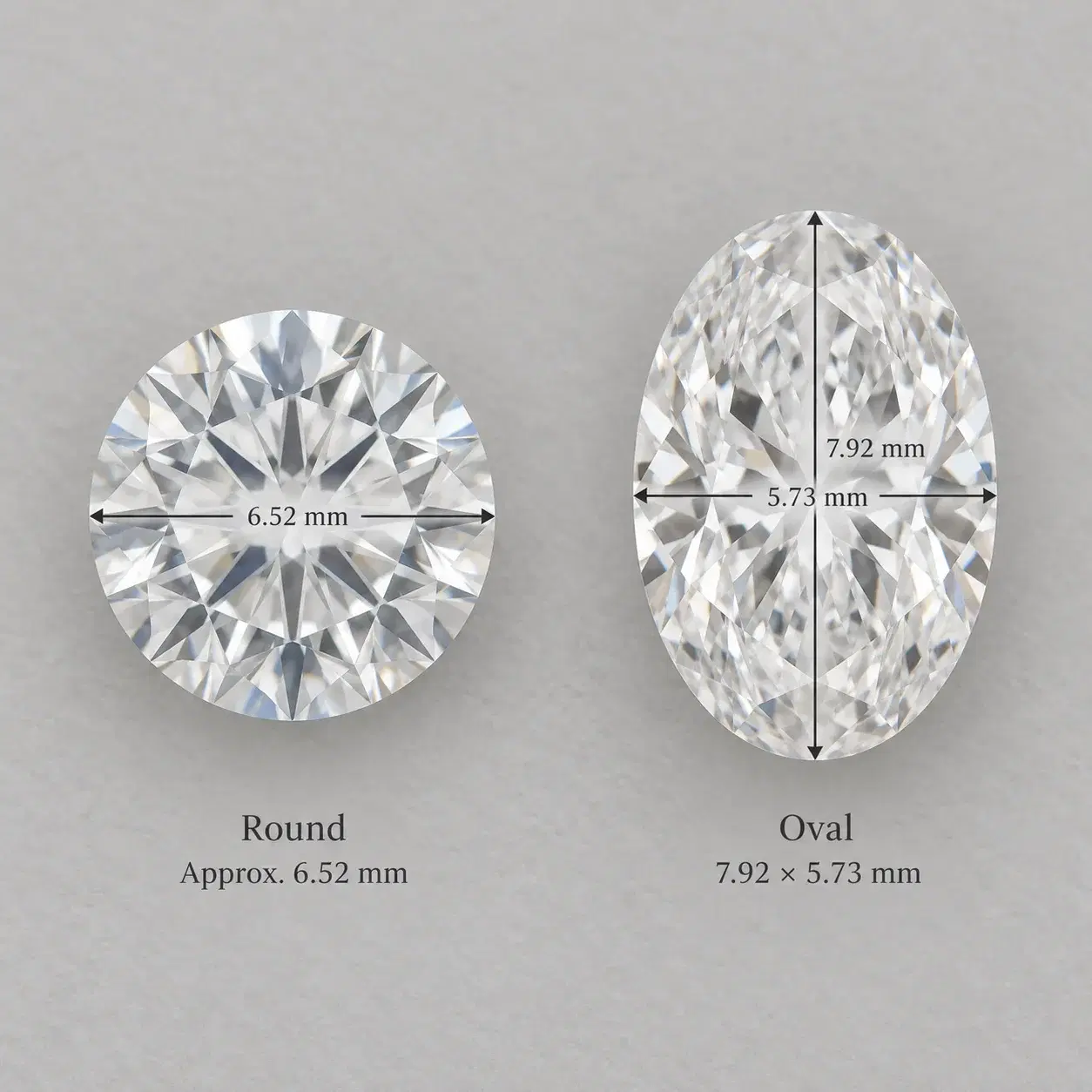
Illustrative comparison. Specifications and prices shown are not a current quotation.
Why an Oval Can Look Larger Than a Round at the Same Weight
Oval diamonds are often described as appearing larger because their elongated outline extends farther along the finger.
That statement needs context.
At equal weight, an oval can be longer than a round, but it may simultaneously be narrower.
Using the one-carat lab-grown examples above:
Round: approximately 6.52 mm across
Oval: 7.92 × 5.73 mm
The oval therefore extends considerably farther in one direction, while the round occupies more width across the other direction.
This is why “looks bigger” needs to be defined.
A buyer may be referring to:
the longest visible measurement, the width across the finger, the approximate face-up area or simply the subjective impression created by the shape.
Use actual millimetre dimensions alongside carat weight rather than assuming that one shape universally looks larger.
For broader carat-to-millimetre comparisons, see Uniglo’s Diamond Size Chart.
Compare Similar Visible Coverage as Well as Equal Weight
If your main priority is how much space the diamond occupies when viewed from above, comparing only equal carat weights may not answer the whole question.
An oval cannot match both the length and width of a circle simultaneously.
You therefore need to decide whether you want:
similar width across the finger, similar length along the finger or approximately similar face-up coverage.
The next pair illustrates the third approach.
Both are laboratory-grown diamonds, although their weights and listed grades differ.
| Diamond | Colour / clarity | Listed measurements | Approximate outline area | Displayed price |
|---|---|---|---|---|
| 1.00-carat round | G / VVS1 | 6.37 × 6.33 × 3.97 mm | 31.67 mm² | US$274 |
| 0.91-carat oval | E / VS2 | 7.49 × 5.38 × 3.40 mm | 31.65 mm² | US$216 |
Prices were reviewed on 13 September 2026.
The source listings identified IGI references:
LG825631784 for the round
and
LG803660688 for the oval.
The approximate areas above are geometric estimates based on the listed dimensions.
For the round, the estimate uses:
π × average diameter² ÷ 4
For the oval, the estimate uses:
π × length × width ÷ 4
These calculations are useful comparison tools, but actual diamonds are not perfect geometric circles or ellipses.
The figures should therefore not be interpreted as exact measurements of the visible polished surface.
They also do not measure brilliance, fire or scintillation.
In this example, the estimated outline areas are almost identical.
However, the oval is approximately 1.14 mm longer and 0.97 mm narrower than the round’s average diameter.
The oval also weighs less at 0.91 carats while still producing a similar geometric face-up-area estimate.
That does not create a universal conversion between 0.91-carat ovals and one-carat rounds.
The individual proportions matter.
The oval also carried the lower listed price in this pair, but weight, colour, clarity and other characteristics change simultaneously, so the difference cannot be attributed entirely to shape.
For more dimension comparisons across other shapes and weights, use Uniglo’s Diamond Size Chart.
Oval vs Round Diamond Sparkle
Round brilliant diamonds use a facet arrangement built around a circular outline.
Their visual appearance can include reflected white light, coloured fire and changing patterns of light and dark as the diamond or viewer moves.
Cutting and proportions strongly influence how those effects appear.
GIA’s guidance on selecting round diamonds provides further context.
Oval diamonds are also commonly cut using brilliant-style faceting, but their elongated shape changes the arrangement and distribution of reflections.
That does not mean every round will automatically look more attractive than every oval.
The individual cutting and the buyer’s visual preference still matter.
GIA discusses these characteristics in its oval diamond guide.
When comparing oval and round diamonds, examine both under similar lighting conditions.
Look at:
the centre, edges, pattern of reflections and how the stone responds as it moves.
A still photograph shows only one viewing angle.
Strong showroom spotlights can make many diamonds appear unusually bright and fiery, so include softer lighting in the comparison where possible.
The measurement and price examples in this article document size and asking price.
They do not provide an independent side-by-side laboratory assessment of the individual stones’ sparkle.
Does a Round Diamond Sparkle More Than an Oval?
A round brilliant is designed around a highly symmetrical circular faceting structure, while an oval has an elongated brilliant-style pattern.
That difference can influence the appearance of the reflections.
However, it is too simplistic to say that every round diamond will automatically look better than every oval.
The individual stone’s cutting, proportions and contrast pattern need to be assessed.
A well-selected oval can appear highly lively and bright, while an individual round still needs to be assessed for its own cutting characteristics.
GIA’s diamond cut guidance explains why proportions and cutting relationships matter to light performance.
When deciding between the shapes, compare the actual diamonds rather than choosing from shape reputation alone.
The Oval Bow-Tie Effect
One important feature to check in an oval diamond is the bow-tie effect.
An oval can display a darker bow-tie-shaped pattern across its centre.
GIA explains that this visual effect is associated with contrast and the way light is blocked or returned through parts of the stone.
Its prominence can vary according to the individual diamond and viewing conditions.
Read GIA’s oval diamond guide for the laboratory’s discussion of oval appearance.
A bow tie should therefore be assessed on the actual diamond rather than from shape name alone.
Review the stone in motion and from a normal viewing distance.
Ask whether the central dark area:
remains strongly dominant from many angles or changes as the stone moves.
Subtle contrast can form part of the diamond’s visual pattern, while a strongly persistent dark region may be less attractive to some buyers.
For a more detailed explanation, read Uniglo’s oval lab-grown diamond guide.
Oval Proportions and Length-to-Width Ratio
An oval’s length-to-width ratio describes how elongated its outline is.
Calculate it by dividing length by width.
For the one-carat lab-grown oval in the first table:
7.92 ÷ 5.73 ≈ 1.38
The diamond therefore has an approximate length-to-width ratio of 1.38.
GIA discusses oval proportions and outline considerations in its oval diamond guide.
A higher ratio generally produces a more elongated outline, while a lower ratio produces a broader oval.
However, the ratio does not establish the diamond’s overall size or cutting quality.
For example:
7.92 × 5.73 mm = approximately 1.38
and a much smaller oval could also have a ratio of approximately 1.38.
The shapes would have similar proportions while differing in physical size.
Use length-to-width ratio together with the actual millimetre dimensions and a view of the individual diamond.
Is There an Ideal Oval Diamond Ratio?
There is no single ratio that automatically makes every oval diamond the best choice for every wearer.
Length-to-width ratio primarily describes the shape of the outline.
Some buyers prefer a broader oval, while others prefer a more elongated appearance.
The intended setting can influence that choice as well.
A solitaire may emphasise the diamond’s outline differently from a halo, three-stone or side-stone design.
Rather than choosing from the ratio alone, compare several actual ovals and decide which proportion looks most balanced for the jewellery design you want.
Uniglo’s Diamond Shapes guide provides additional context for comparing outlines.
Cut Labels Need to Be Checked Against the Report
The retailer examples in the first comparison carried different cut descriptions.
The lab-grown round was listed as:
Ideal
while the lab-grown oval was listed as:
Very Good.
Both natural examples were listed as Very Good.
Those product-page labels should not automatically be interpreted as equivalent laboratory cut grades.
GIA's overall cut grading system applies to standard round brilliant diamonds within its specified grading framework.
Natural ovals do not receive the same overall GIA cut grade used for standard round brilliants, although other characteristics such as polish and symmetry can still be recorded.
For more detail, see GIA’s diamond cut guidance and GIA’s oval diamond guide.
IGI uses its own reporting and assessment framework for laboratory-grown diamonds.
You can review IGI’s laboratory-grown diamond report guidance.
The practical rule is straightforward:
do not assume a seller’s cut label means the same thing across every shape or grading laboratory.
Connect the description to the supporting report and examine the actual stone.
For the wider grading framework, see Uniglo’s Diamond 4Cs guide.
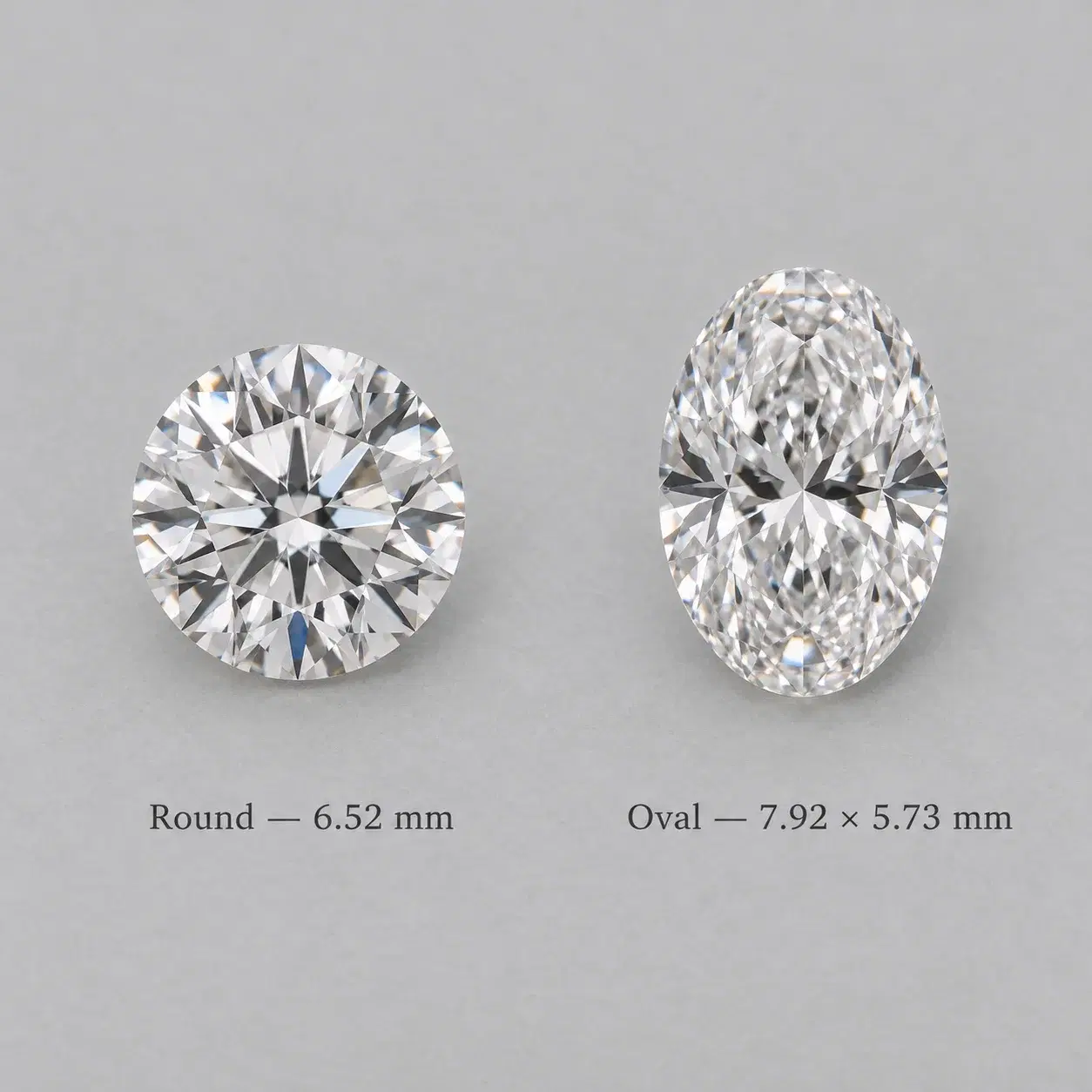
Illustrative comparison. Specifications and prices shown are not a current quotation.
Are Oval Diamonds Cheaper Than Round Diamonds?
Not always.
The dated examples in this article show both outcomes.
For the natural one-carat pair:
Natural round: US$1,200
Natural oval: US$1,071
The oval was therefore US$129 less.
For the laboratory-grown one-carat pair:
Lab-grown round: US$248
Lab-grown oval: US$264
The oval was US$16 more.
These examples demonstrate why a fixed statement such as “oval diamonds are always cheaper than round diamonds” is unreliable.
Even where weight, colour and clarity match, other characteristics can differ.
Price can also vary according to:
proportions, finish, availability, seller pricing and other characteristics of the individual diamond.
Keep natural and laboratory-grown comparisons separate when evaluating price.
The natural examples above are K/SI2, while the laboratory-grown examples are E/SI1.
Comparing those prices directly would combine an origin difference with substantial changes in colour and clarity.
For current laboratory-grown price context across multiple weights, read Uniglo’s Lab Grown Diamond Prices guide.
How to Compare Oval and Round Diamond Prices Properly
A useful price comparison changes as few variables as possible.
For example, rather than comparing:
1.00 ct round, E/SI1
against
1.50 ct oval, D/VVS1
request options that are much closer in specification.
A better comparison could be:
1.00 ct round, E/VS1
and
1.00 ct oval, E/VS1
within a similar quality range.
Then compare:
the millimetre dimensions, grading-report information, appearance and whole-stone price.
For a finished engagement ring, use comparable settings as well.
A loose-diamond price does not include the selected ring unless explicitly stated.
Metal, setting style, side stones, ring size, manufacturing, delivery and applicable taxes can all influence the final amount.
This makes the total purchase price more useful than comparing isolated loose-stone prices alone.
Natural Oval vs Natural Round Diamonds
The same measurement principles apply when comparing natural diamonds.
The natural one-carat examples reviewed for this article were:
Round: 6.38 × 6.32 × 3.98 mm
and
Oval: 7.63 × 5.57 × 3.55 mm.
Again, the oval is longer while the round is wider across its circular outline.
Both weigh one carat.
This reinforces the central distinction between:
carat weight
and
physical dimensions.
For natural diamonds, grading documentation should also be checked carefully.
If a report reference is not clearly supplied in a listing or quotation, request it before relying on the stone’s stated grading information.
Lab-Grown Oval vs Lab-Grown Round Diamonds
The same process applies to laboratory-grown diamonds.
The one-carat examples in this article were both E/SI1:
Lab-grown round: 6.55 × 6.49 × 3.86 mm
Lab-grown oval: 7.92 × 5.73 × 3.47 mm
Again, the shapes distribute the same weight differently.
For laboratory-grown diamonds, check the report information associated with the individual stone.
IGI provides information on its laboratory-grown diamond reports in its official report guidance.
Uniglo’s IGI Certified Lab-Grown Diamonds guide can also help you understand how to read the document.
For current laboratory-grown options, explore Uniglo’s Lab-Grown Diamonds.
Which Shape Works Better in an Engagement Ring?
Start with the outline you prefer on the hand.
A round diamond creates a balanced circular footprint.
An oval introduces elongation and can be oriented along the finger in the conventional north-south direction or, in some designs, placed east-west across it.
The setting can significantly change the final appearance.
A halo can increase the visual width around the centre stone.
A narrow solitaire band can make the centre diamond more visually dominant.
Side stones can change the overall horizontal coverage.
For that reason, compare oval and round diamonds in similar settings where possible.
If you already own a setting, do not assume that two stones of equal carat weight will fit interchangeably.
Provide the jeweller with the complete measurements of the proposed diamond.
Oval vs Round Diamonds on the Finger
An oval's elongated shape tends to draw the eye along the finger.
A round creates a more symmetrical visual centre.
Neither effect is inherently better.
The preferred appearance depends on:
hand proportions, band width, setting design, diamond dimensions and personal taste.
Do not judge the comparison from online product photographs alone.
Retailers may resize each diamond image to fill the same display area, making stones with noticeably different real-world dimensions appear almost identical on screen.
Use the stated millimetre measurements.
Where possible, request images or video showing multiple diamonds at the same scale.
Uniglo’s Oval Diamond Ring guide provides additional guidance on how the shape works in jewellery designs.
Which Shape Is Better: Oval or Round?
There is no universal winner.
Choose round if you prefer:
a circular outline and the classic visual pattern associated with a round brilliant.
Choose oval if you prefer:
a more elongated outline and additional flexibility in length-to-width proportion.
But shape should only be the beginning of the decision.
For either option, compare:
carat weight, actual measurements, documentation, appearance, proportions and complete purchase price.
The better diamond is the one that satisfies the characteristics you actually value within your budget.
Frequently Asked Questions
Does an oval diamond look bigger than a round diamond?
It can look longer at the same carat weight, but check the width as well.
In the documented one-carat lab-grown comparison, the oval measures 7.92 × 5.73 mm, while the round averages approximately 6.52 mm in diameter.
The oval is therefore longer but narrower.
Can a smaller oval give similar visible coverage to a round?
Yes, in some individual comparisons.
The 0.91-carat oval and one-carat round examined above produced almost identical geometric face-up-area estimates.
However, their proportions and other characteristics differ, so this should not be used as a universal carat conversion.
Do round diamonds always sparkle more than oval diamonds?
Not automatically.
Shape influences the faceting pattern, but the individual diamond’s cutting and proportions also matter.
Compare the actual diamonds in similar lighting and movement.
Do oval diamonds have a bow tie?
Many ovals show some degree of bow-tie contrast.
Its visibility and prominence vary between individual stones and viewing conditions.
Evaluate the actual diamond rather than assuming all bow ties look the same.
Is there one ideal oval length-to-width ratio?
No single ratio is ideal for every buyer.
The ratio describes how elongated the oval is.
Choose the outline you prefer while also reviewing the actual diamond’s dimensions and appearance.
Are oval diamonds always cheaper than round diamonds?
No.
The examples in this article show both a cheaper oval and a more expensive oval depending on the individual pair.
Compare current stones with similar specifications rather than assuming a universal shape discount.
Can I use the same comparison for natural and lab-grown diamonds?
Yes.
Carat weight and millimetre measurements work the same way for both origins.
When comparing prices, keep natural and laboratory-grown examples separate and use reasonably similar specifications.
Which looks bigger: a 1 carat oval or 1 carat round?
The oval may look longer, while the round is likely to provide more width relative to its length.
Use the actual millimetre measurements because individual stones can vary.
Is an oval or round diamond better for an engagement ring?
That depends on the appearance you prefer, the setting and the specific stones available.
Compare both shapes at a similar weight and specification, then look at their actual measurements and appearance.
Compare Oval and Round Diamonds With Uniglo
To compare oval and round diamonds, contact Uniglo Diamonds with your preferred origin, carat range, budget and intended jewellery piece.
Ask to compare options at the same carat weight as well as diamonds that meet your preferred millimetre dimensions.
Request the individual stones’ grading information, measurements and current quotations so you can compare the complete purchase rather than choosing from shape name or carat weight alone.
You can also explore Uniglo’s Natural Diamonds, Lab-Grown Diamonds, Diamond Shapes guide and Diamond Size Chart before requesting suitable options.




