
Old Mine Cut vs Old European Cut Diamonds
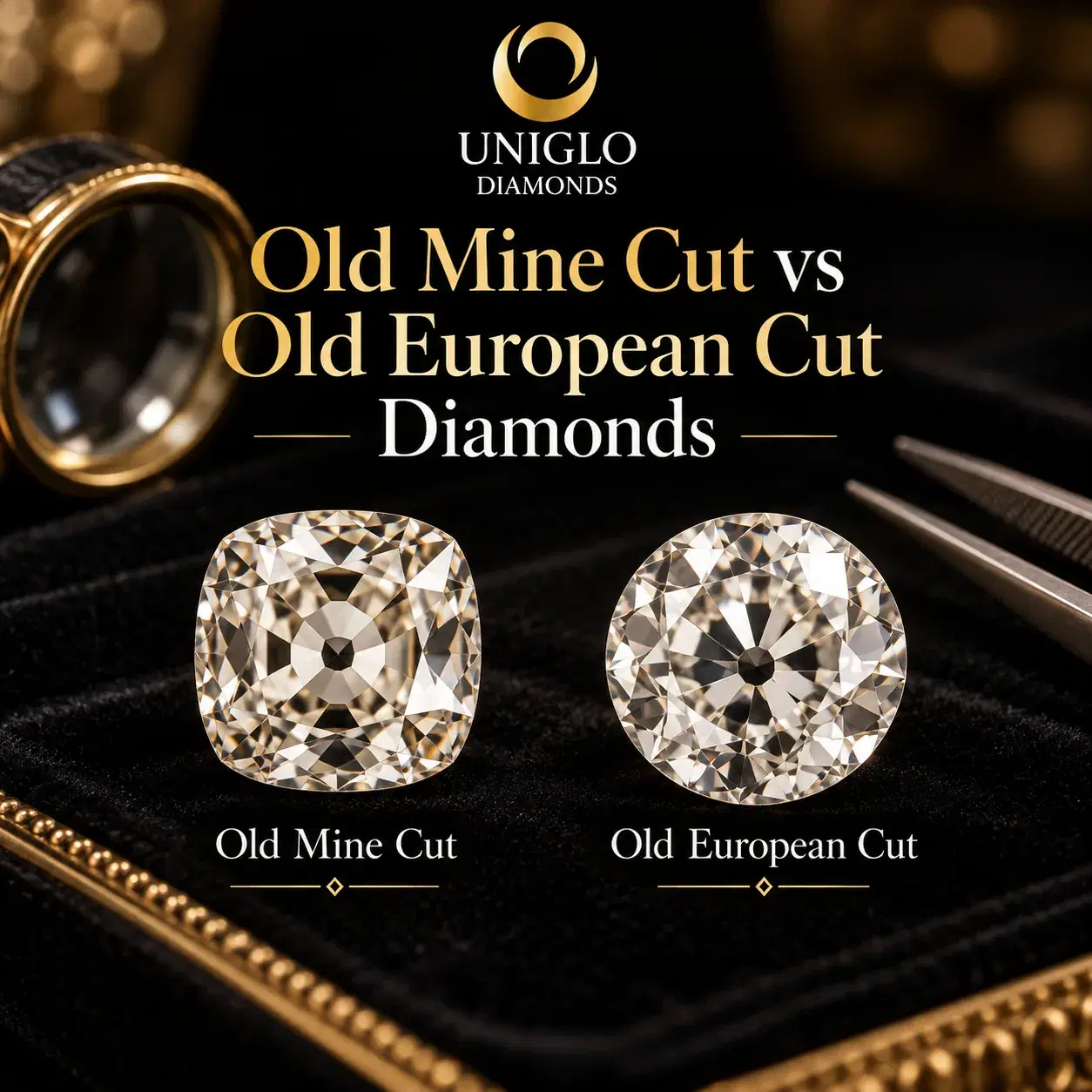
The main difference between an old mine cut and an old European cut diamond is the outline: an old mine cut usually has a cushion-like shape, while an old European cut is round. Both commonly have a high crown, small table and visible culet. Their cutting style alone does not establish when the diamond was cut.
For buyers, that last distinction matters as much as the shape. You may want a genuinely antique diamond, a newly cut diamond with an antique appearance, or simply a ring with a period-inspired design. Those are different requests, and the description, documents and price comparison should reflect the one you actually mean.
Old mine cut vs old European cut: comparison table
| Feature | Old mine cut | Old European cut |
|---|---|---|
| Typical outline | Soft square or rectangular cushion | Round |
| Crown and table | Usually a high crown and small table | Usually a high crown and small table |
| Culet | Often large and visible | Often visible; size varies |
| Facet appearance | Broad flashes with an individual pattern | Broad flashes in a round arrangement |
| Outline to inspect | Corners, length and width, balance | Roundness and consistency around the edge |
| Modern shape to compare | Cushion | Round brilliant |
| What the style proves about age | No cutting date by itself | No cutting date by itself |
These are typical characteristics, rather than a pass-or-fail visual test. Two diamonds carrying the same trade description can look quite different. Use the table to shortlist a style, then compare the actual stones.
What is an old mine cut diamond?
An old mine cut diamond is a historic brilliant cutting style associated with Georgian and Victorian jewellery. Its familiar cushion-like outline has rounded corners rather than the circular perimeter of an old European cut.
GIA describes the classic style as having 58 facets, a relatively small table, a high crown, a large culet and short lower-half facets. Historical hand cutting and the shape of the original rough contributed to variation between stones. The girdle can also be particularly thin in places. See GIA’s old mine cut diamond guide.
When comparing examples, decide how much individuality you enjoy. A slightly uneven outline may appeal to someone seeking historic character, while another buyer may prefer a more balanced silhouette. Ask for a straight-on photograph before deciding: an angled image can make even a balanced stone look uneven.
The name should not be treated as documentary proof that a particular diamond came from a particular mine. If geographic origin or ownership history is part of the selling claim, ask for evidence supporting that separate claim.
What is an old European cut diamond?
An old European cut diamond is a round historic brilliant style that preceded the modern round brilliant. It is especially associated with late Victorian, Edwardian and Art Deco jewellery, although its development began earlier.
Its round outline offers a different starting point for a ring design from the old mine cut’s cushion shape. Before considering grades, look at which outline you prefer on the hand or within the proposed setting.
GIA’s guide to antique diamond cuts explains the relationship between these historic styles. It also distinguishes original antique pieces from newly made pieces with an antique appearance.
For a broader introduction to outlines, use Uniglo’s diamond shapes guide. Then return to the individual stone’s photographs and report: a shape name cannot describe every detail of its appearance.
Why do these diamonds have a visible culet?
The culet is the small facet at the bottom of a diamond’s pavilion. In some old cuts, it is sufficiently large to be noticeable through the top of the stone. IGI’s glossary explains the culet and other diamond terminology.
A visible culet may look like a little opening in a face-up image, but it is not a literal hole drilled into the diamond. Equally, do not assume that every central dark or pale mark in a photograph is the culet. Ask the supplier to identify the feature and provide a clear magnified view when needed.
Compare it at normal viewing size as well as under magnification. A culet that dominates an enlarged screen image may be less noticeable on the hand. Conversely, if it distracts you in ordinary viewing, the explanation that it is characteristic of the style does not make it the right choice for you.
Which has better sparkle?
Neither cutting name guarantees better sparkle. Your useful comparison is between two specific diamonds, viewed under matching conditions.
Separate three things when watching a video: overall brightness, coloured flashes and the pattern of bright and dark areas as the diamond moves. Ask yourself whether the pattern remains attractive through a gentle tilt, rather than judging one especially flattering frame.
Some buyers enjoy a slower, broader flash pattern; others prefer more frequent smaller flashes. Describe what you see instead of accepting a general claim that one historic cut is always more fiery, more brilliant or more beautiful.
Do not base the decision on a candlelight video alone. A ring will also be worn in ordinary rooms and daylight. The most helpful evidence shows the diamond in the environments where you expect to see it.
A practical video comparison
Ask for both diamonds to be clean and filmed using the same camera, background, distance and lighting. Request a stationary face-up view, a slow tilt and a side view. This is a suggested buying procedure, rather than a laboratory grading method.
Include diffuse daylight or ordinary room light alongside a separate spotlight clip. Keep the videos at a similar displayed size. A stone shown larger on screen can appear more impressive even when its actual dimensions are smaller.
If the seller supplies only different videos, write down the differences before comparing. One stone under strong spotlights and another under flat lighting is an incomplete comparison. Request matching footage before making a final choice.
Old mine cut vs cushion cut: are they the same?
Old mine cuts and modern cushion cuts share a family resemblance, but “cushion” describes a wider range of diamonds. A cushion-shaped outline alone does not establish old mine faceting, antique age or a particular light pattern.
Modern cushions can have different facet arrangements, including modified patterns. GIA’s cushion cut guide explains how the shape has developed from earlier cutting styles.
If your priority is the soft outline rather than historical provenance, compare Uniglo’s cushion-cut lab-grown diamonds as modern alternatives. Inspect each listing’s actual images and specifications; this collection link does not establish that any stone is an old mine cut or an antique.
Old European cut vs modern round brilliant
A round outline is the shared starting point, rather than proof of an identical cut. Look closely at the table, central pattern and culet when comparing an old European cut with a modern round brilliant.
Uniglo’s round lab-grown diamonds offer a modern round comparison. If you want an old European appearance specifically, communicate that requirement before treating a round listing as a suitable substitute.
Keep the design decision separate from the historical decision. A modern round diamond in a vintage-inspired setting can satisfy a design preference without satisfying a request for an original antique stone.
How GIA describes old European cuts
GIA’s published explanation gives four characteristics used to identify classic old European cuts:
| Characteristic | Published GIA threshold |
|---|---|
| Table size | 53% or less |
| Crown angle | 40° or more |
| Lower-half facet length | 60% or less |
| Culet size | Slightly large or larger |
GIA explains that a diamond meeting three of the four criteria can receive the old European designation. These are classification criteria, rather than recommended “ideal” proportions or evidence of age.
The same explanation says that GIA does not assign an overall cut grade to diamonds in the old European style. It also describes a “circular brilliant” designation for certain round diamonds between classic old European and modern round brilliant styles. See GIA’s explanation of 58-facet round diamond descriptions.
A seller’s use of “transitional” therefore needs to be read alongside the actual report description. Ask for clarification if the terminology differs. Do not try to replace a laboratory designation with measurements estimated from a photograph.
Uniglo’s diamond certificates guide provides background on reading diamond documents. Match the report to the offered stone and ask what each document actually establishes.
Antique age, cutting style and diamond origin are separate
1. Cutting style: what does the diamond look like?
This is the question answered by descriptions such as old mine cut, old European cut or modern round brilliant. Modern reproductions of old mine cuts exist, as GIA’s old mine guide explains. A newly fashioned stone can therefore have an old cutting style.
Ask whether the description refers to an original historic cut, a modern reproduction or simply a vintage-inspired appearance. Get that answer in writing if it affects your purchase.
2. Historical age: when was it cut or set?
GIA states that its diamond grading report does not determine a diamond’s age or when it was cut. An age claim needs evidence beyond the cutting-style description.
Ask which item the seller is dating: the loose diamond, the mounting or the assembled piece. An old setting may have a replacement stone, and an older diamond may be placed in a new setting. Request the available provenance records and the basis of any specialist attribution.
If the history is uncertain, keep that uncertainty in the product description. “Period-inspired design” and “documented antique diamond” should not be used interchangeably.
3. Origin: natural or lab-grown?
An antique-looking shape is not an origin test. GIA explains that reliable identification of laboratory-grown diamonds requires appropriate testing; visual resemblance alone is insufficient. See GIA’s guidance on identifying lab-grown diamonds.
Read Uniglo’s lab-grown vs natural diamonds guide if you are also deciding between origins. Require accurate disclosure for the specific stone offered, including any treatments stated in its documentation.
Size, colour and clarity: compare the actual stone
Face-up size and setting height
Carat weight measures mass rather than visible dimensions. Compare the recorded length and width, or diameter measurements for a round stone, alongside total depth. IGI’s glossary covers these measurement terms.
Avoid predicting which diamond will look larger from the cutting name alone. Request images at the same scale and a side view of the proposed setting. Ask your jeweller whether the depth requires a taller mounting and whether that height suits the wearer’s daily routine.
For an old mine cut, check whether you prefer a near-square or more elongated outline. For an old European cut, inspect the round silhouette straight on. Record your preferred appearance before comparing carat weights.
Colour and clarity in the finished design
Choose a colour appearance you enjoy instead of assuming an antique-style diamond must look warm. Review the report information and ask to see the stone against a neutral background before viewing it in the proposed metal colour.
For clarity, ask whether visible features can be seen at ordinary viewing distance and whether any require a condition assessment. A dramatic close-up is useful for locating a feature, but it does not show how noticeable that feature will be in everyday wear.
Keep the report, appearance and condition assessment together. None of those should be replaced by a romantic description of the diamond’s character.
Inspect condition before choosing a setting
Diamond hardness does not make a stone immune to chipping. GIA identifies thin girdles and existing damage among the factors that deserve attention. Its diamond chipping guide explains why protection and condition checks matter.
Ask a qualified jeweller or gemologist to inspect the girdle, corners, culet and any surface-reaching features. Request clear documentation of existing chips or wear rather than accepting “normal for its age” as a complete assessment.
If buying a mounted stone, ask which areas cannot be examined because the setting covers them. For resetting, have the jeweller assess the stone and proposed mounting before work begins. The design should accommodate the diamond’s actual outline and condition.
Ask about known repolishing or recutting. Keep any available before-and-after records, especially if historical appearance is central to the purchase. Do not agree to alteration simply because the stone differs from a modern cutting preference.
What to request before buying
| Request | What it helps establish |
|---|---|
| Written cutting-style description | Exactly what the seller means by old mine, old European or transitional |
| Laboratory report and identification details | The documented identity and characteristics of the offered stone |
| Dimensions and matching videos | Visible size, outline and appearance |
| Condition assessment | Existing damage, wear and setting considerations |
| Basis for antique claims | Which object is dated and what supports that date |
| Known alteration history | Whether previous work is documented |
| Written quotation and purchase terms | What is included and how inspection or returns work |
Compare quotations using the same requirements. A documented antique, an undocumented older-looking diamond and a modern reproduction should not be treated as equivalent offers merely because their photographs resemble one another.
If you want help comparing options, contact Uniglo Diamonds with your preferred outline, dimensions, budget and origin. Specify whether genuine antique provenance is essential or whether your priority is the visual style. Ask what suitable options are currently available and request documentation for any stone offered.
Frequently asked questions
More Topics




