
Melee Diamond Size Chart: Sieve Sizes, Millimetres and Points
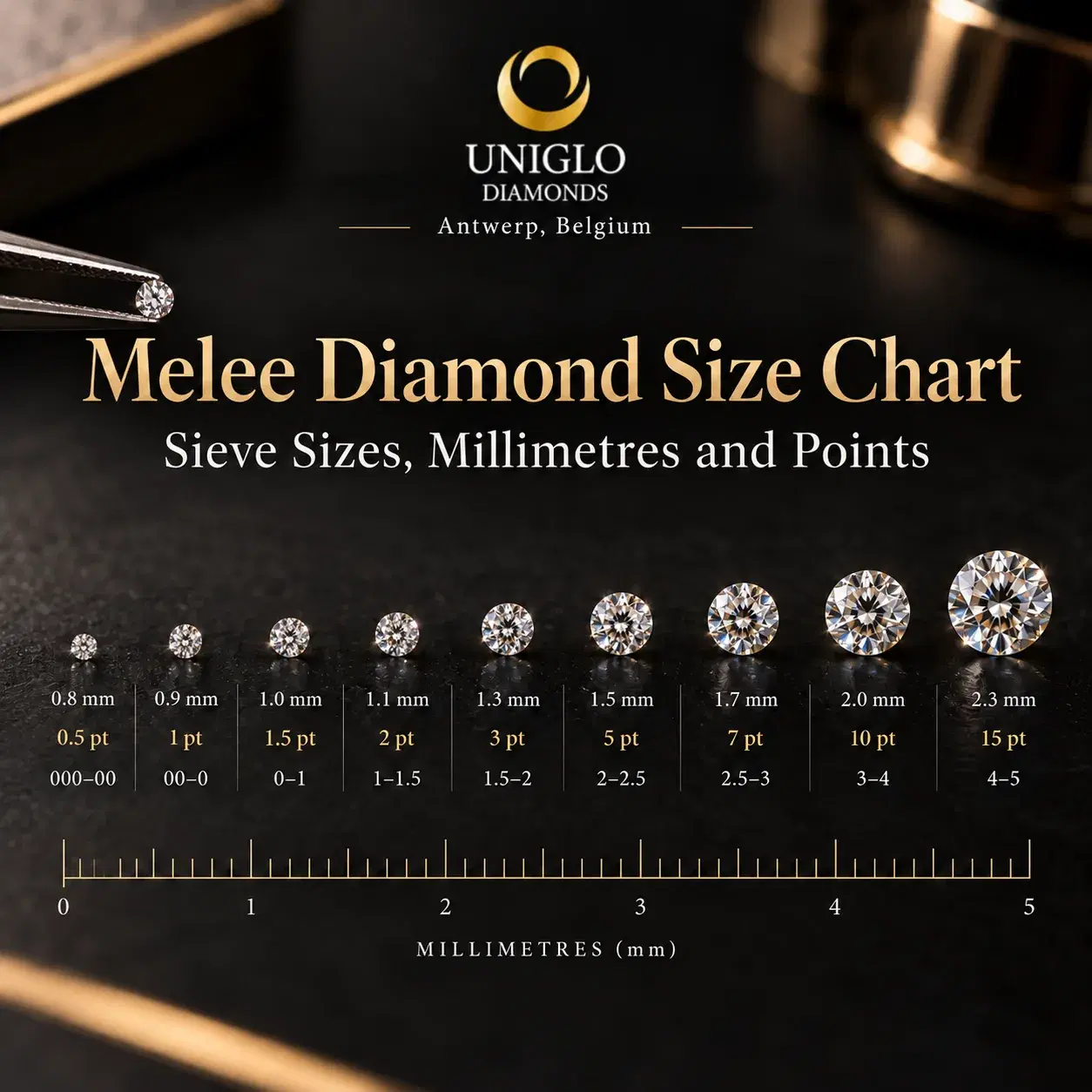
A melee diamond size chart connects a stone’s dimensions in millimetres with its estimated weight in carats and points. One point equals 0.01 carat. Sieve labels identify sorting categories; confirm the millimetre range attached to a label before ordering. For setting fit, specify dimensions. For parcel weight, specify carats and the required number of stones.
These distinctions matter when buying small diamonds for pavé, halos, wedding bands or replacement work. Two stones with similar weights can have different diameters, while diamonds in one diameter band can vary in weight because of their depth and proportions. Use the reference chart below for planning, then confirm the actual parcel specification with your supplier or jeweller.
What size is a melee diamond?
GIA defines melee as small diamonds and gemstones weighing less than one-fifth of a carat, or 0.20 ct, while noting that size ranges vary between countries and trade segments. In diamond jewellery, the term usually describes small accent stones rather than the principal centre stone.
Round diamonds are common, but melee also comes in fancy shapes. This guide’s millimetre-to-weight estimates apply to round brilliants only. For broader comparisons between shapes and larger stones, use Uniglo’s diamond size chart in millimetres and carats.
Round melee diamond size chart: millimetres, carats and points
The following chart gives calculated weight estimates, not measured parcel averages. It uses the round-brilliant weight-estimation formula published in GIA’s Gems & Gemology:
Estimated carats = diameter² × depth × 0.0061, with diameter and depth measured in millimetres.
For this illustration, depth is assumed to be 61% of diameter throughout. That assumption makes the calculation consistent; it is not a cut-quality recommendation. Actual weight depends on the stone’s proportions, including depth and girdle thickness. These are Uniglo’s calculations using the published formula, rather than a GIA-issued sizing chart.
| Round diameter | Estimated weight per stone | Estimated points per stone |
|---|---|---|
| 0.80 mm | 0.0019 ct | 0.19 points |
| 1.00 mm | 0.0037 ct | 0.37 points |
| 1.20 mm | 0.0064 ct | 0.64 points |
| 1.30 mm | 0.0082 ct | 0.82 points |
| 1.50 mm | 0.0126 ct | 1.26 points |
| 1.70 mm | 0.0183 ct | 1.83 points |
| 1.80 mm | 0.0217 ct | 2.17 points |
| 2.00 mm | 0.0298 ct | 2.98 points |
| 2.20 mm | 0.0396 ct | 3.96 points |
| 2.40 mm | 0.0514 ct | 5.14 points |
| 2.50 mm | 0.0581 ct | 5.81 points |
| 2.80 mm | 0.0817 ct | 8.17 points |
| 3.00 mm | 0.1005 ct | 10.05 points |
| 3.20 mm | 0.1219 ct | 12.19 points |
| 3.50 mm | 0.1595 ct | 15.95 points |
Weights and points are rounded independently from the calculation. The decimal places show the model’s output, not a guarantee of weighing accuracy or a supplier’s calibration tolerance.
For example, a 2.00 mm round diamond is estimated at approximately 0.03 ct, or three points, under these assumptions. A 2.50 mm stone is estimated at about 0.058 ct. Neither measurement establishes the actual weight of a particular stone; weighing determines that figure.
When comparing this chart with a supplier’s chart, check whether its weights are calculated estimates or measured averages from stock. Differences do not automatically mean either chart is wrong. Different depth assumptions and parcel proportions can produce different weights for the same nominal diameter.
Diamond sieve sizes: how to read the labels
Diamond sieves help sort small loose stones by size. The label on a sieve category is separate from the measurement in millimetres. An entry such as “16–16.5” must therefore be read alongside its specified diameter band; it does not describe a diamond measuring 16 mm across.
Here are examples from Uniglo’s round-diamond catalogue, checked on 5 October 2026:
| Sieve label shown in the catalogue | Listed millimetre range |
|---|---|
| 15.5–16 | 3.60–3.69 mm |
| 16–16.5 | 3.70–3.79 mm |
| 19–19.5 | 4.30–4.39 mm |
| 19.5–20 | 4.40–4.49 mm |
These are specific catalogue examples, not a universal sieve-number conversion table. Some catalogue categories include small accent diamonds above GIA’s less-than-0.20 ct definition. For a purchase, rely on the stated measurements and actual weight rather than the category name alone.
You can see the labels alongside dimensions in Uniglo’s 3.60–3.69 mm round parcel listing and 3.70–3.79 mm round parcel listing.
A useful order records the sieve label, its corresponding millimetre band and the acceptable size tolerance. If a drawing calls for a particular diameter, confirm that the proposed parcel meets that requirement. A sieve description alone does not establish every stone’s measured dimensions, depth or suitability for an existing setting.
What are diamond points?
GIA explains carat weight as a measure of mass: one carat equals 200 milligrams and is divided into 100 points. Points are especially convenient when describing small diamonds.
Points = carats × 100. Carats = points ÷ 100. These conversions are exact; converting millimetres into weight requires an estimate or an actual measurement of weight.
| Weight per stone | Points per stone | Calculated stones per carat* |
|---|---|---|
| 0.0025 ct | 0.25 points | 400 |
| 0.005 ct | 0.5 points | 200 |
| 0.01 ct | 1 point | 100 |
| 0.015 ct | 1.5 points | About 66.7 |
| 0.02 ct | 2 points | 50 |
| 0.03 ct | 3 points | About 33.3 |
| 0.05 ct | 5 points | 20 |
| 0.10 ct | 10 points | 10 |
Calculated from the stated individual weight, assuming every stone has that weight. Fractional values express a weight ratio, not a deliverable piece count.
The decimal place matters: a diamond weighing 0.085 ct is an 8.5-point diamond. It is not a 0.085-point diamond. Read a parcel’s “average points” field alongside its average carat weight and ask for clarification if those values do not agree.
How many melee diamonds are in one carat?
Calculated stones per carat = 1 ÷ average individual carat weight. A parcel averaging 0.02 ct per stone has approximately 50 stones per carat. If the average is 0.01 ct, the corresponding figure is approximately 100.
This calculation helps estimate purchasing quantities, but an actual parcel contains whole stones with varying individual weights. Ask for the piece count when your design requires a fixed number of diamonds. Ordering a weight without specifying the count may leave you with a different number of stones than expected.
Consider a band requiring 60 diamonds averaging 0.015 ct each. The estimated diamond requirement is 60 × 0.015 ct = 0.90 ct. If a jeweller needs additional stones for matching or replacements, add that allowance separately and agree it before ordering. There is no single extra percentage that suits every design.
For an existing parcel, divide its total weight by its piece count to find the average. A 2.40 ct parcel containing 120 stones averages 0.02 ct per stone. That average helps describe the lot, but it does not establish that all 120 diamonds have identical weights or diameters.
Why millimetres matter when matching melee
Millimetres describe dimensions, which help determine whether a stone fits its seat and matches neighbouring diamonds. Points describe weight. When replacing a missing accent stone or completing a uniform row, establish the required dimensions before using weight as a secondary comparison.
GIA’s guidance on designing with melee notes that a size difference of 0.20 mm can be noticeable. This does not make 0.20 mm an acceptable tolerance for every setting. The appropriate range depends on the design and the jeweller’s requirements.
For a replacement, have the jeweller assess the remaining stones and the setting. A nominal two-point description may narrow the search, but the replacement also needs compatible dimensions, cut appearance and colour. A photograph can help discuss the appearance; it cannot establish an exact diameter without a reliable scale.
For new jewellery, agree the stone specification with the setter or manufacturer before selecting a parcel. A CAD design’s nominal diameter and a supplier’s diameter band need to be reconciled before production. This is particularly useful when several matching rows or a continuous halo must look consistent.
Round, single-cut and fancy-shape melee measurements
A round chart should not be used as a weight chart for baguettes, princess cuts, marquise diamonds or other fancy shapes. For these stones, record length and width and confirm depth where it matters to the setting. Matching one dimension does not establish that two differently shaped diamonds have the same weight or fit.
For round parcels, confirm whether the stones are single-cut or full-cut. GIA’s melee guide describes single cuts with 17 or 18 facets and full cuts with 57 or 58. The distinction matters when matching an existing piece, even when the nominal diameter is similar.
Uniglo’s diamond shapes guide can help identify the shape required. For ordering, use the actual dimensions and cut description rather than translating a fancy shape into a round-equivalent diameter.
Does this size chart apply to natural and lab-grown melee?
Millimetres, carats and points use the same measurement units for natural and lab-grown diamonds. The round-brilliant estimate can be used for planning either type when the same dimensional assumptions apply. It does not identify origin, treatment, colour or clarity.
Keep the size specification and the origin declaration separate. A calibrated parcel should have its dimensions described clearly, while natural or laboratory-grown origin should be stated explicitly. If screening documentation is required, ask which service was used and what it establishes.
GIA’s Melee Analysis Service separates qualifying natural diamonds from laboratory-grown diamonds, simulants and potentially HPHT-treated natural diamonds. Screening is a different task from measuring dimensions or obtaining an individual grading report. A sieve-sorted parcel should not be described as individually GIA graded merely because it has been size sorted.
What should you specify when ordering a melee parcel?
Combine the physical specification with the purchasing quantity. State the shape, cut style, required millimetre range, natural or lab-grown origin, colour and clarity requirements, number of stones and target total weight. Include a sieve label when the supplier uses one, together with the diameter band it represents.
An enquiry could read: “Please quote 60 round full-cut natural diamonds for a wedding band. The setter requires a 1.50 mm nominal diameter; please confirm the available diameter range and tolerance, colour and clarity range, actual piece count and total weight.” This gives the supplier a clear starting point without assuming the chart’s estimated weight is a guaranteed parcel average.
For repeat orders, retain the agreed specification and the original parcel reference. Reordering by total carat weight alone may not reproduce the same dimensions or matching appearance. Confirm the new lot’s measurements and quality range even when its trade description looks familiar.
Browse Uniglo’s melee diamond parcels to review available categories, or contact Uniglo Diamonds with your required measurements and quantity for an availability enquiry.
Frequently asked questions
More Topics




