
Matched Diamond Pairs: Specifications for Jewellers
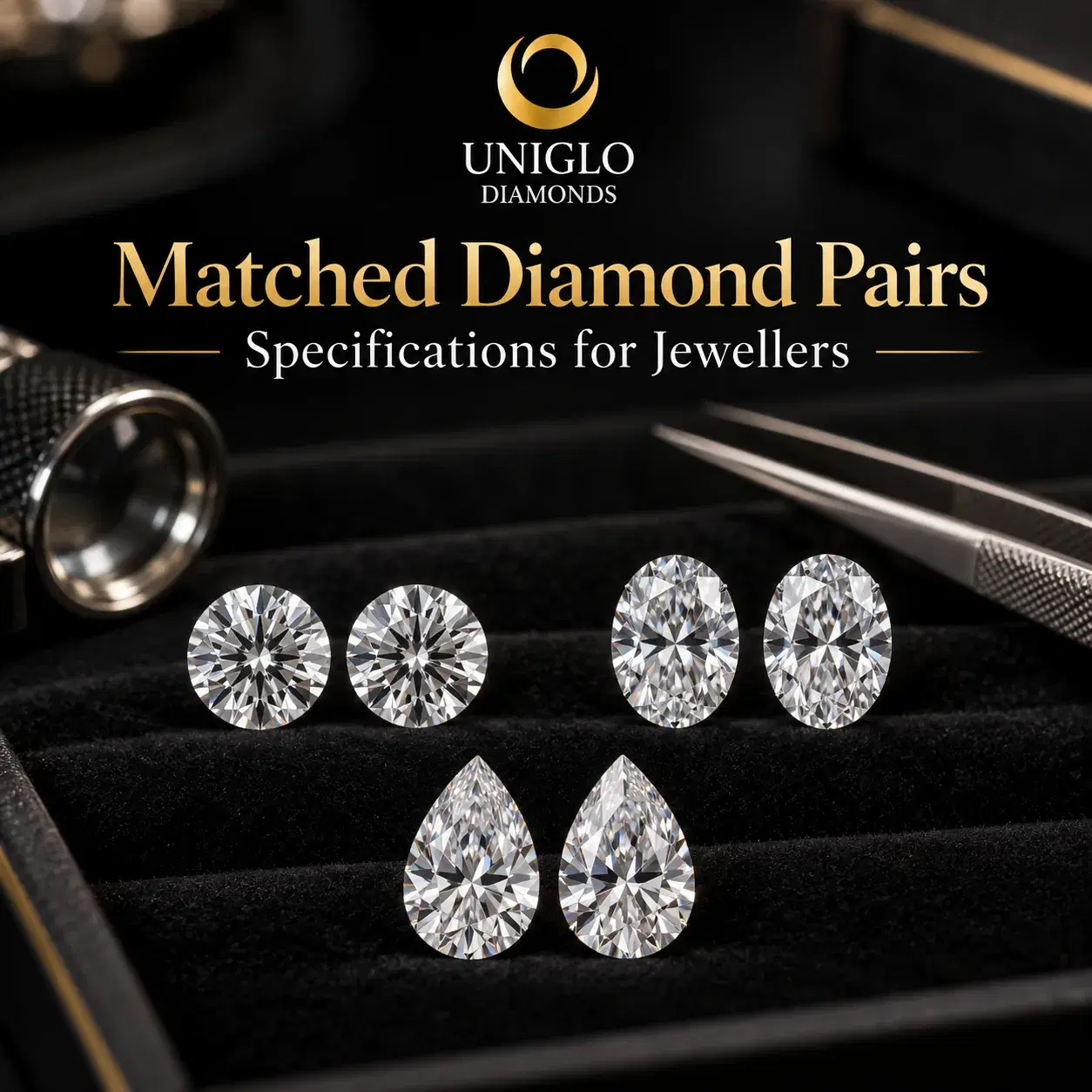
Matched diamond pairs are two diamonds selected to work together in a jewellery design. A useful match considers shape, face-up dimensions, colour appearance, cut pattern and condition, alongside individual grading information. Similar carat weights or identical report grades alone do not establish that the stones will look balanced together.
Jewellers commonly request pairs for stud earrings, drops and side stones in rings. The specification should connect the customer’s appearance expectations with the setter’s physical requirements. It should also identify the two actual stones so the pair approved in a video or inspection is the pair supplied.
This guide explains what to put in a matched-pair enquiry, how to compare proposed stones and what to confirm before accepting them for production.
What does “matched” mean for a diamond pair?
Matching is a relationship between two stones and their intended use. One pair might be selected for symmetrical earrings, while another needs to frame a centre diamond in a three-stone ring. The acceptance criteria can differ because the diamonds will be viewed and set differently.
A supplier’s “matched pair” description is therefore a starting point for discussion. Ask which features have been matched and what differences remain. Establish whether the description refers to similar report data, a visual comparison, dimensional selection or a combination of these checks.
Two individual grading reports describe their respective stones. Unless documentation expressly assesses the pairing, those reports should not be presented as independent proof that the diamonds match each other. Keep the individual descriptions and the jeweller’s pair assessment distinct.
Start with the jewellery design
For earrings, define the shape, desired face-up size and how the diamonds will be oriented. A matched pair for round studs requires a different outline comparison from a pair of pear drops. If the settings already exist, obtain their requirements before searching by weight or grade.
For ring side stones, assess the proposed pair together and alongside the centre stone. GIA’s side-stone guidance recommends considering complementary colour, cut and clarity, as well as appropriate proportions for the ring. Matching the two side stones does not automatically establish that they suit the centre diamond or the mounting.
Record whether the design requires visual uniformity or deliberate contrast. For example, coloured side stones around a colourless centre can be an intentional choice. The order should explain that choice rather than leaving the supplier to infer what “matching” means.
Dimensions matter more than weight alone
GIA explains that carat measures weight rather than size. For pairs, individual weights help describe the purchase, but face-up measurements help establish physical and visual balance. Request both sets of information.
For rounds, compare the minimum and maximum diameters and confirm the depth required by the setting. For fancy shapes, compare length and width, then examine the outline: equal headline measurements do not establish identical shoulders, corners, curvature or point placement.
As a hypothetical example, two ovals could both measure 7.00 mm long but have widths of 4.80 mm and 5.10 mm. Their length-to-width ratios would be approximately 1.46 and 1.37. Whether that difference is acceptable depends on the design, but matching their lengths alone would leave an important distinction unaddressed.
Uniglo’s diamond size chart in millimetres and carats provides broader measurement context. When specifying a pair, use the actual stones’ dimensions and the setter’s requirements rather than treating a weight-to-size estimate as a manufacturing specification.
Agree the tolerances before requesting the final pair
Ask the setter or manufacturer to define the acceptable dimensional ranges. Separate each stone’s permitted measurements from the maximum difference allowed between them. Both diamonds could fall within a broad size range while still sitting at opposite ends of it.
For an existing mounting, the critical requirement may be fit within two particular seats. For a new design, the manufacturer may have more flexibility, but the customer’s visual expectations still need to be considered. Do not adopt one numerical tolerance for all shapes, sizes and settings.
If the supplier proposes stones outside the original specification, obtain approval before treating them as substitutes. Record the revised measurements and any necessary design changes. This is especially useful when a seemingly minor variation affects seating height, orientation or the symmetry of the finished piece.
Colour: compare the grades and the appearance together
State whether the order requires the same colour grade or allows a defined range. If individual reports are supplied, record the grading laboratory and the colour description for each stone. This makes differences explicit rather than hiding them within one pair-level label.
Then view the actual diamonds together under consistent conditions. GIA’s stud-earring guide notes that nearby metal, skin and other surroundings can influence perceived colour. For a useful comparison, keep the lighting, background and orientation consistent and consider the proposed metal separately.
An adjacent colour grade is not automatically unacceptable, and identical grades do not remove the need to inspect the pair. Decide whether the appearance suits the commission and document any accepted grade difference. For side stones, make the same comparison with the centre diamond where available.
Matching fancy-coloured diamond pairs
For coloured diamonds, request each stone’s full colour description and relevant origin information. GIA describes fancy colour using hue, tone and saturation: colour, relative lightness or darkness, and intensity. A broad colour label is insufficient for a close visual match.
Compare the pair face-up for the intended colour balance, including any secondary colour impression. Confirm whether the customer wants close similarity or deliberate variation. Keep natural or laboratory-grown diamond origin and natural or treated colour information clearly recorded where applicable.
If colour is central to the commission, request a direct comparison of the actual stones and agree the final assessment arrangements. Uniglo’s fancy-coloured diamonds page provides an enquiry starting point; a specific pair still needs its own confirmed description.
Clarity and condition: do the grades need to be identical?
Specify the minimum clarity requirement and whether a grade difference is permitted. GIA assesses clarity using factors including the size, number, nature, location and visibility of inclusions and blemishes. Matching the grade labels does not mean the characteristics occupy the same positions or have the same appearance.
Review each stone individually for visible characteristics and condition, then assess their appearance as a pair. If “eye-clean” is part of the order, agree what the supplier means by it, including viewing distance and orientation. It should not silently replace the stated clarity requirement.
Have a qualified person assess chips, damaged girdles or other condition concerns before setting. Consider any inclusion or surface feature that needs the setter’s attention independently of the visual matching decision. A pair can appear balanced face-up while one stone still requires further examination.
Cut appearance: compare how both diamonds behave
Compare the stones together in motion as well as face-up at rest. For round brilliants, review the available cut information and the actual appearance. For fancy shapes, pay particular attention to the pattern of reflections, central contrast and whether one stone has a noticeably different visual character.
GIA’s research on oval, pear and marquise diamonds describes variation in bow-tie and crushed-ice patterns and how those patterns change with movement. When matching two stones, the relevant question is whether their appearances work together for the design, rather than whether their headline proportions are similar.
For step cuts, compare the arrangement and appearance of the larger reflections under the same movement. For a brilliant-cut pair, compare the balance of broad and smaller flashes. These are practical inspection prompts, not a substitute for laboratory grading or a standardized pair score.
Check what any cut description on the quotation actually means. IGI’s fancy-shape methodology combines several assessments, including proportions, craftsmanship and light return. A supplier’s own cut label should not be assumed to represent that laboratory assessment. Review the actual document when one is offered.
Should the fluorescence grades match?
Record each stone’s fluorescence description when available and state any contractual requirement. GIA’s fluorescence guidance recommends viewing relevant diamonds in different lighting conditions rather than treating fluorescence as inherently good or bad.
If the grades differ, assess the proposed pair together in appropriate conditions, including daylight where practical. A difference deserves disclosure and consideration, but the grade alone does not establish a visible mismatch. Conversely, matching fluorescence grades do not establish that every other aspect of appearance matches.
Avoid assuming that fluorescence automatically causes haze or that a “None” description guarantees transparency. Review the actual stones and ask a qualified gemologist to assess any concern that cannot be resolved from the available imagery.
Special requirements for tapered and shaped side stones
Some side-stone shapes need more information than a simple length-by-width entry. Use a dimensioned photograph or drawing to identify the edges and measurements required by the setter. This avoids ambiguity when the supplier and manufacturer use different measurement conventions.
| Pair type | Details to add to the enquiry |
|---|---|
| Tapered baguettes | Length, wide-end width, narrow-end width, depth and intended orientation |
| Trapezoids | Identified edge measurements, spacing between relevant edges, depth and outline comparison |
| Half-moons | Straight-edge length, curved outline, overall dimensions and fit alongside the centre stone |
| Pears or marquises | Length, width, shoulder or wing appearance, point alignment and intended orientation |
| Rounds for studs | Minimum and maximum diameter, depth requirements and face-up appearance comparison |
For a symmetrical ring, show how the left and right stones will be placed around the centre. “Mirror matched” should be clarified with the actual orientation or drawing, rather than treated as a complete dimensional specification. Two stones need to work in the intended arrangement, not just look similar when photographed in an arbitrary position.
Use Uniglo’s diamond shapes guide for shape terminology, then supply the design-specific details needed for the particular pair.
A specification table for matched diamond pairs
Send one shared order specification and ask the supplier to return the individual details for Stone A and Stone B. Keep the permitted differences visible. The following table can be adapted to an enquiry or purchasing worksheet.
| Specification | What to request or record |
|---|---|
| Intended use | Studs, drops, ring side stones or a replacement pair |
| Origin | Natural or laboratory-grown, with relevant treatment declarations |
| Shape and faceting | Required outline and cut style |
| Dimensions | Measurements for each stone and the setter’s acceptable ranges |
| Pair differences | Agreed maximum differences in the measurements that matter to the design |
| Weight | Individual weights and combined pair weight |
| Colour | Required grades or range, permitted differences and visual matching expectations |
| Clarity and condition | Minimum grades, accepted variation and any condition criteria |
| Cut appearance | Available grading information and the visual comparison required |
| Fluorescence | Each stone’s description and any agreed requirement |
| Identification | Two stock references and report numbers where applicable |
| Evidence | Reports, individual images and footage showing the actual pair together |
| Commercial terms | Pair price, currency, additional charges, availability and quote validity |
| Acceptance | Agreed viewing, inspection, substitution and return arrangements |
For example: “Please propose a pair of natural round brilliants for stud earrings. The customer requires matching face-up size and appearance, with colour and clarity limits supplied below. Please provide the individual dimensions, weights, grades, fluorescence descriptions, stock references and reports where available, plus a video of both stones together.” Add the confirmed limits before asking for a final quotation.
How to inspect a proposed pair remotely
Request a side-by-side face-up image with both stones at the same scale, orientation and distance from the camera. Follow it with footage of both diamonds moving under one lighting setup. Individual glamour images made under different conditions are less useful for judging a pair.
As a practical check, ask for the stones to exchange left and right positions in a second view. This can help investigate whether an apparent difference follows the stone or its position within the recording setup. It is an inspection aid, not a laboratory test or proof of equivalence.
Keep Stone A and Stone B identifiable throughout the comparison. Note what remains uncertain and request the missing evidence specifically. If the clips show different magnifications or backgrounds, ask for a consistent comparison before deciding that a difference belongs to the diamonds themselves.
Reports, identity and accepting the supplied pair
Where reports are available, check the details for each stone. GIA Report Check confirms whether report information matches GIA’s archived data. It does not, by itself, physically identify the stones delivered or establish that they form a suitable pair.
Ask how the supplied diamonds will be connected to their documentation, including inscriptions where present and other appropriate identification checks. Uniglo’s diamond certificates guide provides broader report context. Do not assume every small side stone will have an individual report; establish the documentation available for the actual purchase.
On receipt, reconcile both stock references, individual descriptions and the agreed pair specification. Have the setter confirm suitability before production. If a supplier proposes replacing one stone, reassess the new pair rather than assuming the original pair approval still applies.
Pair weight, quotations and replacement orders
Keep individual and combined weights separate. A pair weighing 1.00 ct in total could contain two 0.50 ct stones, or stones of 0.48 ct and 0.52 ct. The same total does not describe the distribution or establish matching dimensions.
Ask whether the quotation covers both diamonds and what additional charges apply. Compare proposals against the same specification and evidence requirements. A lower pair price is difficult to interpret if one proposal allows broader dimensions or provides a different level of selection and documentation.
For a replacement, identify the retained stone as precisely as possible and compare the proposed new stone directly with it. An earlier invoice or grade description can help the search, but the surviving diamond and current setting requirements should guide the final match.
Requesting matched diamond pairs from Uniglo
For trade enquiries, Uniglo’s wholesale natural diamonds and wholesale lab-grown diamonds pages provide starting points according to the required origin. Specify that you need a pair and include the intended use, measurements and acceptable differences.
Contact Uniglo Diamonds with your specification or drawing and required date. Ask which stones can be proposed, what comparison imagery is available and which purchasing terms apply before committing the pair to a production schedule.
Frequently asked questions
More Topics




