
Brown, Blue and Grey Tints in Lab-Grown Diamonds
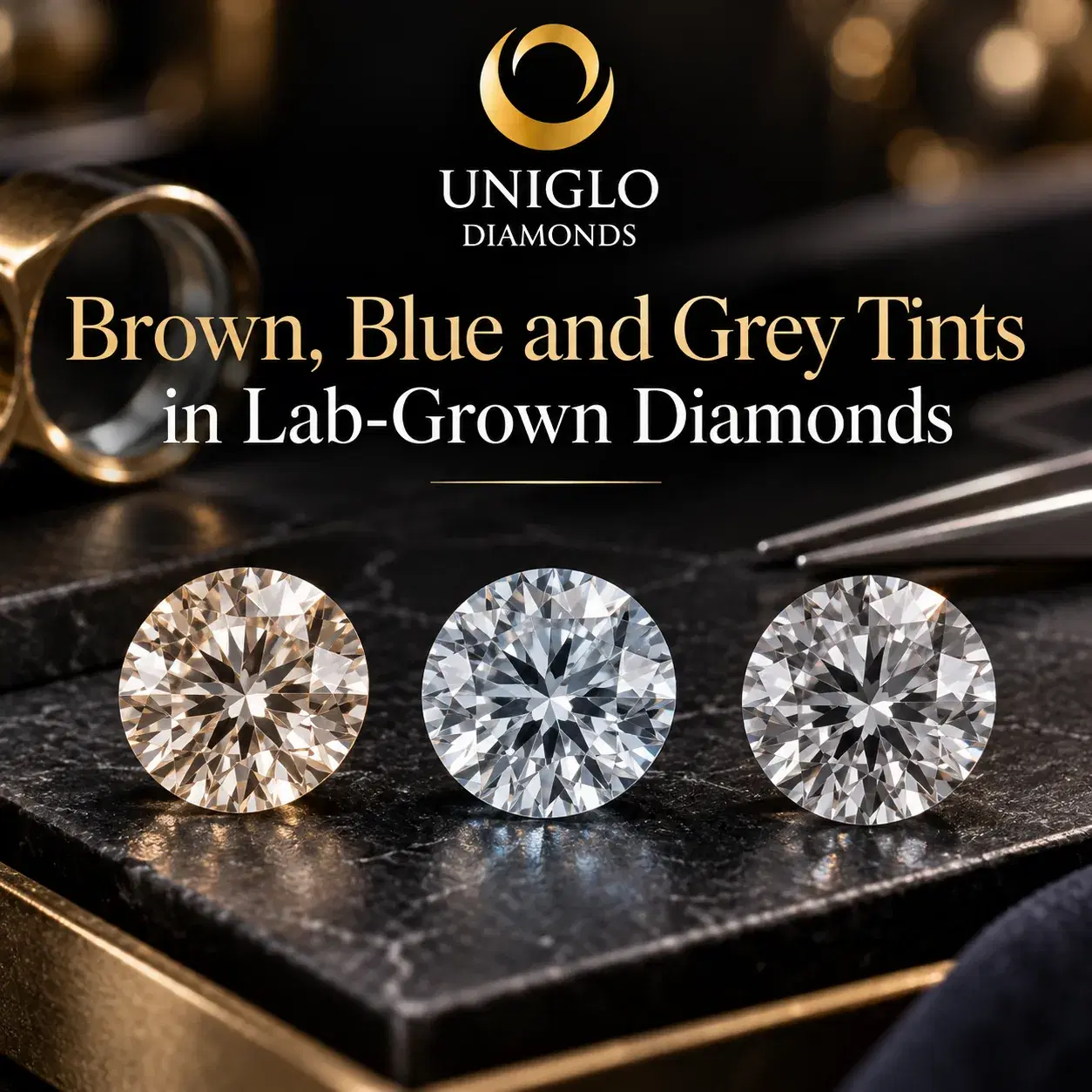
Lab-grown diamonds can show brown, blue or grey coloration associated with growth-related defects, impurities or subsequent processing. Boron can cause blue body colour, while some CVD-grown material has documented brown or grey coloration. A blue flash, UV glow or dark facet in a video is a different observation. Assess the actual stone and its report before deciding that a visible cast is an unwanted tint.
Colour questions do not end with a letter in a listing. A diamond may look slightly cool in one recording and neutral in another, or show a warm cast that is difficult to separate from the background. The useful next step is a controlled comparison and a specific explanation of what you are seeing.
This guide explains lab-grown diamond blue nuance and the buying questions raised by brown and grey tints. For a comparison of individual colour grades, use Uniglo’s D versus F colour guide; here, the focus is the appearance and interpretation of a particular cast.
What does blue nuance mean in a lab-grown diamond listing?
If a listing describes “blue nuance”, ask whether the seller means a subtle blue body colour and under which viewing conditions it was observed. Do not translate the phrase into a specific laboratory grade, fluorescence result or boron concentration. Request the complete report and the seller’s explanation of the actual stone.
For a buyer seeking a neutral-looking diamond, the practical question is whether a blue cast is noticeable in the intended viewing conditions. For someone who likes a cool appearance, the question may instead be how consistent that appearance is. Either preference needs evidence tied to the candidate rather than a general claim about its growth method.
GIA’s study of HPHT-grown diamonds documents boron-related blue colour. It also describes colourless HPHT-grown material with low boron concentrations. Detecting boron is therefore not the same as establishing a noticeable blue tint.
Ask the seller to distinguish the listing’s descriptive language from the laboratory’s exact wording. If the report contains a colour comment, read it as written rather than replacing it with “blue nuance” or “no nuance”. If the comment is absent, request clarification of the assessment rather than assuming a chemical test result.
Why some lab-grown diamonds have a blue tint
Boron incorporated into the diamond’s crystal structure can produce blue colour. The relevant appearance depends on the material being examined, rather than simply whether a growth process can involve boron. A label such as HPHT is production information, not a complete description of hue.
Blue coloration is not restricted to HPHT-grown specimens. In a 2025 laboratory note, GIA documented a blue band in a 1.09 ct, D-colour CVD-grown diamond. The band was visible through pavilion facets and could not be observed through the table; the researchers attributed it to a locally elevated boron concentration.
That example is useful because it connects colour with viewing direction and the documented specimen. It does not prove that every D-colour diamond has a hidden band, or that a seller’s unexplained blue video represents the same phenomenon.
Some unusual CVD-grown specimens also have documented defect-related colour behaviour beyond boron. Identifying the mechanism requires laboratory examination. A buyer should ask what has been established for the particular stone, not try to infer its chemistry from a screenshot.
Why some CVD-grown diamonds have brown coloration
Brown coloration can arise during growth. IGI’s explanation of post-growth processing discusses atomic arrangements and vacancy-related defects, and how subsequent treatment can reduce or alter that coloration.
“Vacancy” means a missing atom at a position in the crystal structure. It is not an open hole that you could locate with a loupe. Keep this defect terminology separate from the visible crystals, feathers and other features considered during clarity assessment.
GIA’s review of CVD-grown material describes more than one contributor to brown appearance in studied specimens, including non-diamond carbon and extended crystal defects. There is no sound reason to identify every brown-looking sales image as the result of one specific mechanism.
For buying purposes, request an observation of the final polished stone. An explanation of how rough material can become brown is not an assessment of the candidate after any processing. Record whether a warm cast persists under reasonably neutral viewing conditions and whether you find it acceptable.
What causes grey tints in lab-grown diamonds?
Grey coloration has also been documented in CVD-grown diamonds. GIA’s 2024 research update discusses an association with non-diamond carbon nanoclusters and changing growth conditions. The findings concern examined material and historical submission trends, not a claim that every current CVD diamond is grey.
A grey-looking recording needs closer interpretation. A hue, a dark reflected area and reduced transparency are different descriptions. Ask the seller which, if any, applies to the actual diamond. A paused frame that happens to look dark cannot settle that question.
If the stone looks consistently grey to you across suitable views, request a professional assessment of its body colour and transparency separately. If the concern appears only in one recording, obtain a fresh comparison before deciding what the cause is. Use “grey appearance in this video” until an examination supports a more precise description.
There is no universal grey-tint discount or a rule that a cooler-looking stone will be less brilliant. Compare the complete candidate and quotation with an alternative that meets your visual brief, rather than making a price judgement from the word “grey”.
Brown, blue and grey: what should buyers check?
| Appearance being investigated | Relevant documented possibility | Useful next step |
|---|---|---|
| Brown or warm cast | Growth-related defects or other contributors in some material | Review the final stone, report and treatment information |
| Persistent blue cast | Boron-related body colour in some diamonds | Request a specific colour assessment and actual-stone comparison |
| Grey appearance | Documented growth-related coloration in some CVD material | Separate body colour, reflections and transparency questions |
| Blue seen during UV exposure | Fluorescence or another UV-related response | Identify the test conditions and read the relevant report information |
| A lingering glow after excitation | Phosphorescence | Ask an examiner to interpret the response separately from body colour |
The table lists possibilities to investigate, not diagnoses you can make at home. Describe what you observe first; let the examiner establish what it means. This keeps a reasonable colour preference from turning into an unsupported claim about origin, treatment or durability.
Blue body colour, fluorescence and phosphorescence are different
Body colour is the diamond’s coloration assessed under relevant viewing conditions. GIA defines fluorescence as visible light emitted by a gemstone when exposed to ultraviolet radiation. A blue fluorescent reaction is therefore not, by itself, evidence of blue body colour.
Phosphorescence is a glow continuing after the excitation source is removed. GIA’s fluorescence research summary explains that it is frequently observed in some lab-grown material, particularly HPHT-grown diamonds, and is an identification clue rather than a complete origin test.
When comparing media, label the conditions. An ordinary-light video, a UV fluorescence photograph and a recording of afterglow answer different questions. Ask for an ordinary-light view if your concern is the colour you will notice when wearing the jewellery.
Do not use a UV glow to assign a body-colour grade or diagnose a growth process. Request the examiner’s interpretation and appropriate report evidence. Your purchasing preference can be based on appearance without turning every unusual optical response into a reason to reject the diamond.
How colour grades and report comments fit together
Read the complete document, including its laboratory, date, service and comments. IGI’s grading-process explanation describes D-to-Z colour assessment in a standardised environment, with the diamond upside down and viewed through the side. The laboratory grade is not assigned by judging a single face-up promotional image.
IGI’s post-growth article discusses hue comments such as Faint Blue, Light Blue, Faint Brown and Faint Gray in particular ranges. That guidance does not justify inventing a missing comment or assuming that every seller uses the same additional wording. Ask for the actual report attached to the diamond you are considering.
GIA’s service needs a separate distinction. Its October 2025 service change moved the revised colourless-to-near-colourless laboratory-grown assessment to overall Premium or Standard categories. Its current laboratory-grown services page describes that service separately from the Laboratory-Grown Colored Diamond Report. Earlier documents and other laboratories can use different formats.
Premium or Standard is not a seller’s “no blue nuance” observation, and a letter-grade listing should not be described as the universal current GIA format. Verify the service actually used, then request the appearance information relevant to your shortlist.
For the broader documentation check, see Uniglo’s diamond certificates guide. Keep the exact laboratory wording alongside your visual notes so the two remain easy to distinguish.
Growth method and post-growth treatment are separate facts
An HPHT-grown diamond and a CVD-grown diamond that subsequently underwent HPHT treatment have different production histories. GIA’s summary of lab-grown technology explains that HPHT processing can reduce brown coloration in CVD-grown material. Treatment is not a second growth process adding more diamond.
Read the growth and treatment entries separately. IGI’s reporting announcement distinguishes wording about no indication of post-growth treatment from wording allowing for such treatment. Preserve that qualification: “may include” does not identify an exact procedure, and “no indication” should not become an invented manufacturing record.
An “as-grown” preference is a purchasing requirement you can specify. It does not replace assessment of the final appearance. Likewise, the presence of disclosed processing does not tell you whether you will enjoy the stone’s colour or reflection pattern.
For a wider comparison of the methods, use Uniglo’s CVD versus HPHT buying guide. Choose the actual candidate using its evidence rather than treating one growth acronym as a universal quality ranking.
Do these tints change or fade during normal wear?
Modern colour-altering HPHT and LPHT processing is described by IGI as permanent under ordinary conditions. Do not assume that a treated stone is a temporary colour effect, or promise that an unwanted cast will disappear after it is worn or cleaned.
There are documented specialist exceptions involving unusual colour behaviour. GIA’s 2024 update describes some CVD-grown specimens whose apparent blue colour changes after UV excitation and returns towards a stable pinkish-brown or grey appearance under white light. This is a laboratory finding about particular defect systems, not a general description of all blue lab-grown diamonds.
If an examiner raises a stability question, ask for the relevant laboratory assessment before buying. Do not carry out heating or irradiation experiments to identify a tint. Ordinary viewing and qualified examination are sufficient ways for a buyer to progress the question.
How to evaluate an unwanted tint before buying
Start with a specific colour brief
Say whether you want a neutral-looking centre stone, a deliberately cool appearance or a documented fancy-colour diamond. “Good colour” is too broad to communicate those differences. Give the seller your intended setting and ask them to state how the candidate was assessed against your brief.
Keep colour alongside the rest of the purchase. If origin is still part of your decision, Uniglo’s lab-grown versus natural diamond guide covers that separate comparison. A tint question should not be used as an improvised test of whether the stone is real or laboratory-grown.
Request a comparison with consistent presentation
Ask for the actual candidate beside a reasonably comparable alternative in the same frame, using consistent lighting and a neutral background. Request face-up and side views with slow movement. Record what persists, what changes with angle and what the seller identifies as a reflection rather than body colour.
For remote evidence, ask how the video was recorded and whether colour adjustments were applied. White balance, surroundings and display differences can change the presentation; a phone screenshot is not a controlled colour-grading setup. If the neutral reference in a frame looks strongly warm or cool too, request a fresh recording before drawing a conclusion about the diamond.
Review the intended setting and any neighbouring stones
After checking the loose stone, ask to see how it appears in the intended setting or a suitable comparison setup. Record that as an appearance preference rather than a change to the laboratory grade. If adjacent diamonds are part of the design, evaluate the group together instead of relying only on each individual specification.
The useful question is whether the combination looks harmonious to you under the relevant conditions. A preference for a warmer setting does not require you to accept an unexplained brown cast, and a cool-looking presentation should not be assumed to establish blue body colour.
Resolve uncertain observations before committing
Keep a short record: report number, colour description, growth and treatment wording, recording conditions, your observation and the unresolved question. Where the supplied media remains ambiguous, request a professional colour assessment or an in-person inspection.
Confirm the inspection arrangements and applicable return terms, including whether mounting or custom work changes them. Do not rely on the possibility of improving an unwanted tint after purchase. Select a candidate that meets the agreed brief before it becomes part of a finished piece.
A concise request to send the supplier
“For diamond [stock reference/report number], please confirm the report’s exact colour assessment and any hue comments. State the documented growth process and post-growth treatment wording. I am looking for [a neutral-looking appearance/a preferred cool cast/documented fancy colour]. Please provide comparable ordinary-light face-up and side videos, explain any persistent brown, blue or grey appearance, and identify whether further colour or transparency assessment is needed.”
Add the intended setting, budget and inspection requirements. Ask the seller to distinguish an observation from a laboratory finding. “Appears cool in this recording; body colour not yet assessed” is more useful than a confident chemical explanation without supporting evidence.
To discuss suitable candidates, contact Uniglo Diamonds with that brief and the relevant reports. Compare actual appearance and complete quotations; a descriptor such as blue nuance should not be turned into a fixed discount or an automatic premium.
Frequently asked questions
More Topics




