
How Jewellers Order Diamonds for a Tennis Bracelet
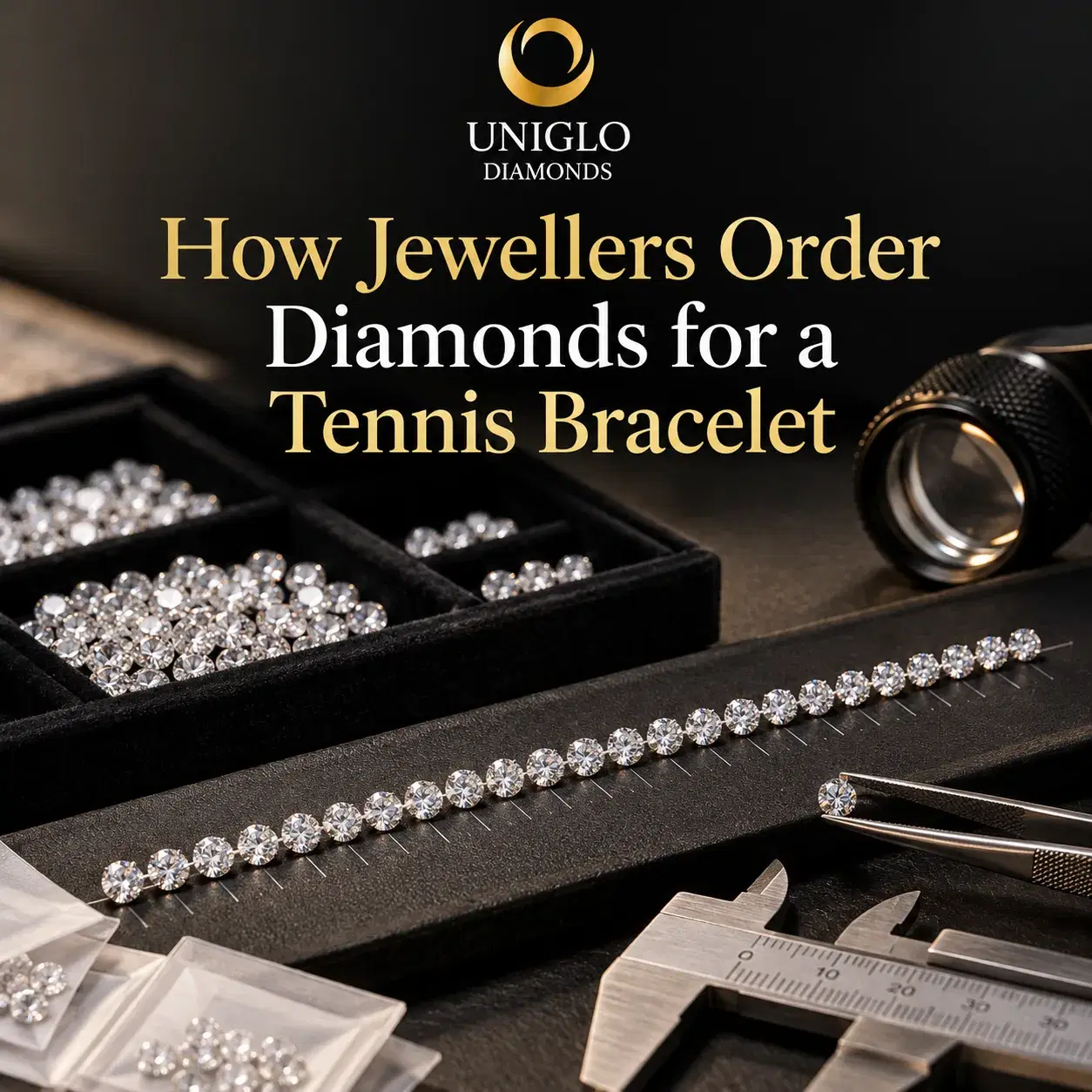
Sourcing diamonds for tennis bracelets starts with the approved mounting specification. Confirm how many stones the design requires, their permitted millimetre dimensions, cutting style, origin and matching criteria. Then request a quotation for an identifiable parcel that can meet those requirements, with count, weight, documentation and inspection terms clearly stated.
Ordering only by total carat weight leaves important production questions unanswered. The parcel must contain enough suitable stones for the approved settings, and those stones need to create the intended appearance along the bracelet. Keep production quantity, dimensional fit and visual matching separate in the brief, then assess them together before releasing the goods for setting.
Start with the approved bracelet design
GIA describes a tennis bracelet as a flexible line of individually set diamonds or gemstones. Its tennis bracelet guide shows why the stone arrangement and jewellery construction belong in the same discussion. For ordering, use your actual design or mounting requirements rather than a generic description of the finished style.
Record the drawing or model revision, finished-length requirement, stone-setting layout, shape and any graduation in size. Have the manufacturer or setter confirm the stone seats and the acceptable candidate dimensions. If a customer changes the length or shape after the brief is prepared, review the requirements before using the original quotation to place the order.
Do not derive an exact count by dividing wrist length by diamond diameter. The finished design also includes setting components, links and the clasp arrangement. Obtain the required stone count from the approved layout, then reconcile it with the manufacturing specification. That is the count the supplier needs to fulfil.
Calculate production stones and spares separately
For a uniform bracelet design, multiply the confirmed stone count per bracelet by the number of bracelets. Add any agreed spare stones separately, with the same relevant requirements. Spares are an inventory decision: identify how they are allocated and avoid treating them as installed bracelet diamonds in a finished-item weight description.
The following is a hypothetical ordering example, not a standard tennis bracelet count or an Uniglo offer.
| Illustrative requirement | Calculation | Stones |
|---|---|---|
| Production for three approved bracelets | 3 bracelets × 52 stones | 156 |
| Separately requested spares | Quantity chosen for this example | 6 |
| Total order requirement | 156 production stones + 6 spares | 162 |
The example establishes a requested count only. It does not establish a parcel weight, diamond size, appropriate spare allowance or finished bracelet specification. Those details must come from the actual design and the goods selected.
For a graduated or mixed-shape bracelet, prepare separate order lines for each size or position group. Multiply each group by the production quantity and identify its spares separately. A total of 162 stones would be insufficient information if the design needs several distinct dimensions and the delivery contains only one size.
For repeat production, distinguish goods needed for current jobs from stock being purchased for future work. Allocate accepted stones to the intended order and record the remaining balance. This makes it easier to resolve shortages without losing track of which parcel supplied a particular production batch.
Specify calibrated measurements in millimetres
For this order, “calibrated” should mean that the stones meet agreed dimensional limits for the mounting. State those limits in measurable terms. GIA’s guidance on designing with melee notes that size differences can be noticeable where uniformity is intended and discusses the connection between stone selection and setting construction.
For round diamonds, ask the setter which diameter and depth requirements must be supplied. For fancy shapes, include length, width and depth together with any relevant outline requirement. Tapered or distinctive shapes may need further dimensions or a drawing. Our diamond shapes guide helps describe the broad shape, while the manufacturing team defines the technical fit.
Use explicit minimum and maximum measurements where the design requires them. Identify the unit and whether the limit applies to every production stone. If a supplier offers a parcel using a sieve code, request the corresponding millimetre range and confirm how it relates to the agreed specification. Do not let the code replace the actual dimensional requirement.
An average measurement does not demonstrate that every stone meets the limits. Ask how the parcel is sorted and how out-of-range stones will be identified and handled. Have the setter approve the tolerances; do not adopt a universal tolerance from a size chart or another bracelet design.
Separate stone count from total carat weight
Stone count answers how many diamonds are present. Total parcel weight answers how much the supplied goods weigh together. Neither proves the other requirement has been met, and neither confirms that all supplied stones are suitable for the bracelet.
If the supplier normally quotes by carat, provide your count requirement and ask how it will be fulfilled. If it quotes by piece, still request the relevant weight information and dimensional specification. An estimated count derived from average weight should retain that qualification until the actual quantity has been established.
For finished jewellery, record the weight of the diamonds actually installed. Unused spares and rejected stones do not belong in that bracelet’s diamond-weight total. Where the purchasing parcel serves several jobs, preserve enough allocation information to distinguish the production pieces from the remaining inventory.
Keep an approximate weight-per-stone figure separate from measured dimensions. It can support planning or a quotation, but it cannot confirm that an individual stone fits the seat. If exact total weight is part of the customer order, discuss how the manufacturing and sourcing teams will meet it alongside the setting requirements.
Define what “matched” means for the bracelet
A matched parcel needs a stated appearance requirement. Specify the desired colour and clarity range, cutting style, relevant finish information and the visual consistency expected along the bracelet. Ask the supplier to explain any trade shorthand rather than assuming both parties interpret it identically.
Consider the stones together under agreed viewing conditions. Describe how obvious colour, brightness or outline differences will be assessed and whether a reference sample is available. A grade range can describe the intended selection, while a layout review helps establish whether the actual goods produce the appearance your production team expects.
Cutting style belongs in the order. GIA distinguishes single-cut and full-cut round melee in its melee diamond guide. For a bracelet intended to have one consistent cutting style, name that requirement rather than ordering only “round diamonds.” Keep any cut or finish description tied to its assessment basis; a supplier’s parcel label should not be presented as an individual laboratory grade for every stone.
Ask the setter to review condition requirements as well as appearance. Specify how chips, damage or features unsuitable for the proposed setting will be handled. A visually consistent parcel still needs to meet the manufacturing acceptance criteria, and dimensional conformity alone does not settle that assessment.
State origin and documentation requirements
Identify whether the order requires natural or laboratory-grown diamonds and keep that designation on the quotation, delivery and stock records. If you are comparing both options, request separate clearly labelled offers for the same production brief. Our natural versus lab-grown guide provides broader background without replacing the parcel specification.
Ask what evidence supports the supplied origin and what goods that evidence covers. For natural melee, GIA offers a melee analysis service designed to separate natural diamonds from laboratory-grown diamonds, simulants and potentially HPHT-treated natural diamonds. Its submission criteria concern that service; they are not Uniglo order minimums or a guarantee that a particular parcel has undergone the service.
IGI’s diamond screening guidance describes natural loose parcels returned with sealed packaging and identifying information, including analysis date, seal number, result, parcel weight and customer reference. If such documentation accompanies your delivery, reconcile its identifiers with the actual parcel before opening or allocating the stones.
Distinguish screening from grading and dimensional sorting. IGI’s sorting services describe parcel-level colour and clarity ranges and additional parameters available through particular services. Read the scope of the supplied evidence rather than assuming that the word “screened” establishes every matching requirement. Our diamond certificates guide explains documentation in more detail.
Put the parcel specification into the quotation request
Use an order brief that the supplier, purchaser and setter can all read without reconstructing the requirements from separate messages. The following template identifies the main fields; complete it from the approved design and actual purchasing needs.
| Specification field | Information to enter |
|---|---|
| Job and design reference | Production order, drawing revision and intended bracelet variant |
| Bracelet quantity | Number of pieces being manufactured |
| Production stone count | Confirmed count per bracelet and total required |
| Spares | Separate quantity and specification for each size group |
| Origin | Natural or laboratory-grown; relevant treatment requirements |
| Shape and cutting style | Required outline, facet arrangement and any orientation detail |
| Dimensional limits | Millimetre requirements approved by the setter, with permitted variation |
| Quality and matching | Colour, clarity, appearance criteria and agreed comparison conditions |
| Condition requirements | Manufacturing acceptance criteria and procedure for unsuitable stones |
| Weight requirements | Quoted or confirmed parcel weight and any finished-job requirement |
| Documentation | Screening, sorting or grading evidence and its required scope |
| Delivery identification | Parcel or lot reference and separate packing by order line |
| Commercial terms | Price basis, currency, charges, payment, validity and inspection arrangements |
| Timing | Required delivery and whether staged supply can be considered |
If the supplier proposes a substitution, request the revised requirements and offer explicitly. A different dimensional range, appearance range or count may affect the manufacturing plan. Obtain the appropriate approval before treating the substitution as accepted goods for the original order.
For larger or repeated laboratory-grown orders, our bulk loose-diamond guide provides purchasing context. The sourcing guide for jewellers also covers preparing a brief and handling discrepancies. This bracelet order should retain its specific count, calibration and matching requirements throughout.
Compare quotations by suitable production quantity
Establish whether the quoted amount is per carat, per stone or for the complete parcel. For a per-carat quotation, the stone amount is the quoted rate multiplied by the quoted or confirmed parcel weight, on the stated basis. Add any excluded charges to understand the complete purchase cost.
Then confirm how many suitable production stones the offer supplies. A lower per-carat rate does not establish a lower cost for completing the bracelets if the goods require extra sorting, contain insufficient acceptable stones or need supplementary purchases. Ask which sorting work is included and how discrepancies will be resolved.
After inspection, landed parcel cost divided by accepted stone count can be a useful internal measure of cost per accepted stone, provided the cost and count cover the same goods. Where the order includes several size groups, calculate them separately or document how costs are allocated. This measure does not replace the specification or make stones of different sizes comparable by itself.
Agree inspection and notification terms before payment. Clarify whether claims concern individual stones, a whole parcel or a specified group, and ask what handling or setting affects return eligibility. Plan the setter’s assessment within the agreed period rather than treating delivery directly to production as acceptance by default.
Check and allocate the parcel before setting
At intake, reconcile the delivery reference, order lines, quantity, weight and accompanying evidence. Preserve packaging and identifiers until the receipt checks are complete. Keep different origins, dimensions and customer jobs separate so stones cannot be allocated from the wrong group.
Follow an agreed inspection plan for dimensional conformity, condition and matching. If only a sample is checked, record that scope and do not describe the result as proof that every stone conforms. Sampling is not automatically suitable for every job; decide its role with the manufacturing team and supplier before accepting the delivery.
Review the bracelet selection in the proposed sequence where practical, then have the setter confirm suitability. Hold discrepant goods aside, identify the issue and contact the supplier within the agreed terms. Keep replacements identifiable and reassess them against the relevant group rather than adding them to production without comparison.
Record the stones allocated to each job, the spares retained and any rejected or returned balance. These records support repeat ordering and later replacement work. For another production run, reuse the approved specification, then verify the new goods; a previous successful delivery does not establish that a later parcel is identical.
Request a trade quotation from Uniglo Diamonds
Contact Uniglo Diamonds with the approved bracelet specification, production quantity, stone counts, separate spare requirements and required delivery date. Include origin, shape, cutting style, dimensional limits, matching criteria, documentation requirements and delivery destination. State which figures are final and which remain subject to the setter’s approval.
You can review our melee diamond parcel inventory for references relevant to the enquiry. Send any selected parcel reference alongside the technical brief and ask whether the required production quantity and specification can be supplied. Confirm current availability and the applicable trade-order conditions.
For example: “Please quote diamonds for the attached approved tennis-bracelet design. Each order line identifies the production count, separate spares, required millimetre limits, cutting style, origin and matching criteria. Please confirm the offered count and weight, assessment basis, documentation, complete payable amount, delivery timing and inspection terms.” This is a request template, not a confirmed Uniglo offer.
Frequently asked questions
More Topics




