
G vs H Diamond Colour: What Changes When You Buy?
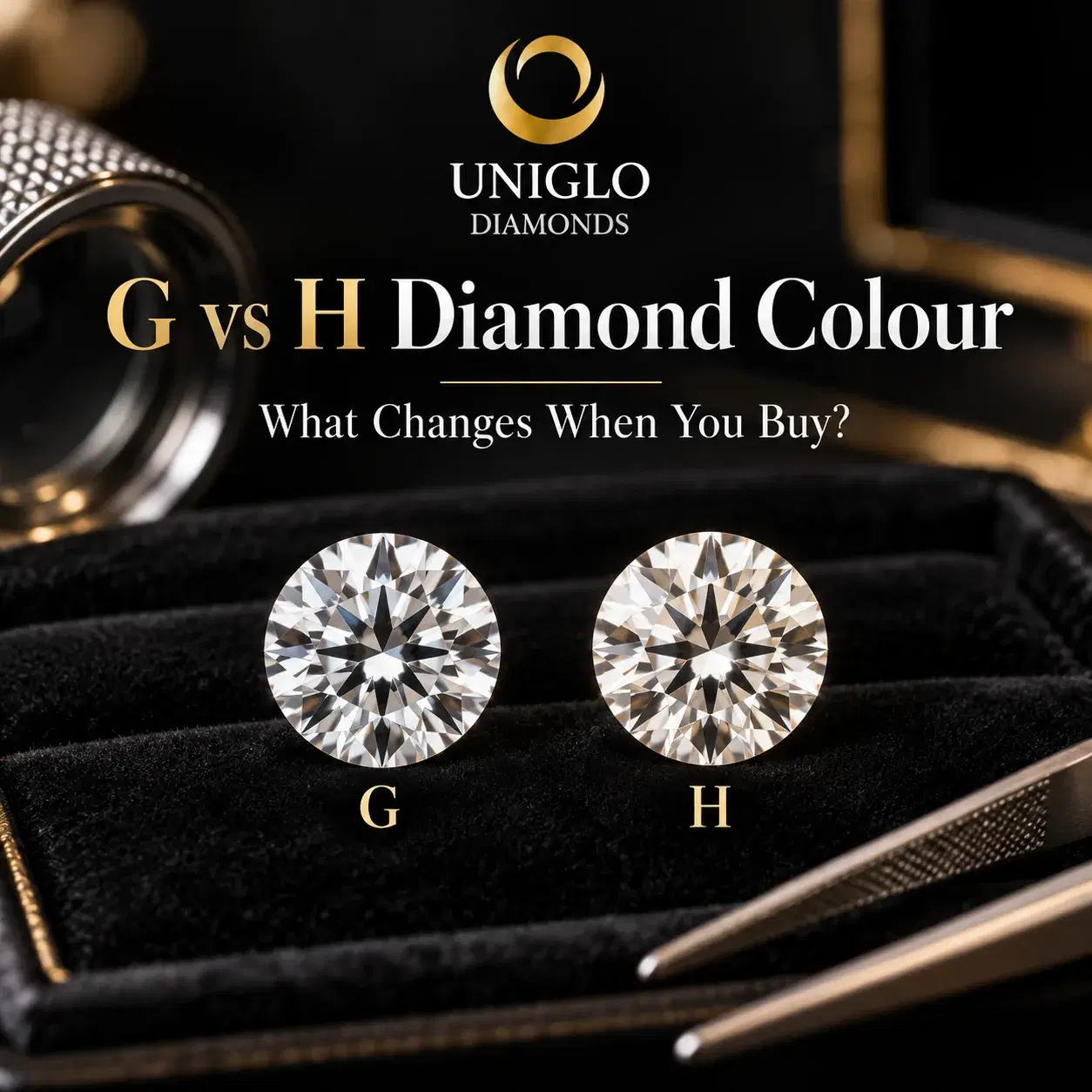
G and H are adjacent diamond colour grades in the near-colourless G–J range. G is the higher grade, indicating less colour under laboratory grading conditions. The face-up difference can be subtle, and both can look white in jewellery. For a G vs H diamond decision, compare the actual stones’ appearance, cut, dimensions, reports and quotations before deciding whether G is worth the extra cost.
The difference between the letters is meaningful in grading, but it does not establish how much difference you will notice on your hand. An H diamond that meets your appearance requirements can be a sensible purchase. A G diamond may suit someone who prefers its particular appearance or needs that grade for an agreed specification.
This guide explains what the one-grade change means, how shape and settings affect the comparison, and how to assess the price difference without assuming every G and H diamond behaves alike.
Where do G and H sit on the diamond colour scale?
GIA’s D-to-Z colour scale measures the degree of colourlessness in diamonds within that range. D is the highest grade, followed by E, F, G, H and the remaining letters towards Z. Each grade represents a defined range rather than one exact shade.
G is the first grade in the near-colourless category; H is the next. Neither belongs to the D–F colourless category. “Near-colourless” does not mean that every observer will see warmth in ordinary wear, or that every stone in the category looks identical.
Keep the colour description separate from other qualities. A G diamond can have a different clarity, cut appearance or face-up size from an H diamond. The higher colour grade alone does not establish that it is the better overall candidate.
G vs H diamonds at a glance
| Buying consideration | G colour | H colour |
|---|---|---|
| Position on the scale | One grade above H | One grade below G |
| Colour category | Near-colourless | Near-colourless |
| Laboratory assessment | Less colour than H within the grading system | Slightly more colour than G within the grading system |
| Face-up appearance | Assess the particular diamond | Assess the particular diamond |
| Sparkle | The colour label does not establish cut performance | The colour label does not establish cut performance |
| Setting suitability | Depends on the intended appearance and design | Depends on the intended appearance and design |
| Price | Compare a current quotation for a comparable stone | Compare a current quotation for a comparable stone |
Use this comparison to understand the labels, then inspect the actual candidates. It does not predict an exact visual difference or a fixed price premium between any two diamonds.
Why laboratory grading and face-up appearance differ
GIA explains its colour-grading process as a comparison with masterstones under controlled lighting and neutral viewing conditions. D-to-Z grading uses a table-down orientation to reduce the complexity of the face-up reflection pattern.
In jewellery, you usually see the diamond from above, moving through different lighting and surroundings. IGI’s colour guidance identifies shape, size, cutting, fluorescence, lighting and mounting as factors that can influence perceived colour in that view.
The distinction is useful: the report provides the laboratory assessment, while your inspection determines whether you like the stone in its intended use. A face-up video that looks white should not be used to assign a colour grade, and the report grade should not be treated as a complete prediction of every view in jewellery.
Can you see the difference between G and H?
Sometimes you can, particularly in a direct comparison with relevant viewing conditions. Sometimes the distinction is not apparent to the buyer. GIA notes that many colour differences are subtle enough to escape an untrained observer; that is different from promising that G and H will always look identical.
Compare loose stones together where possible, then look at each individually in a view representative of the finished jewellery. You may notice a difference side by side that does not remain important when one diamond is worn on its own. Alternatively, a subtle warmth may still matter to you after the comparison ends.
Record your preference without turning it into a universal rule. “I prefer this G in the white-metal setting” and “I do not notice a meaningful difference between these candidates” are both useful observations. Neither establishes how every other G and H diamond will look.
Shape and cut: when should you inspect colour more closely?
Round brilliant diamonds
Round brilliants are a useful starting point for a G–H comparison. GIA’s quality-diamond guide explains that brilliant cutting can reduce the visibility of colour in the face-up view through its reflection pattern and returned light.
Compare the stones’ cut information and actual appearance alongside colour. An attractive H round should not be dismissed solely because another stone is G, and a G round should not be accepted without checking its other characteristics. Ask for consistent footage so lighting does not become the main difference you are judging.
Emerald and Asscher cuts
Step cuts have a different appearance, with broader reflections and views into the stone. Spend time comparing colour both face-up and through relevant side views. Do not transfer your reaction to a round G–H pair directly to two step-cut candidates.
For an emerald or Asscher cut, request imagery of the actual stones in similar orientations. Check whether the observed colour difference remains relevant in the intended mounting. The decision should reflect the candidate and design rather than an automatic rule that H is unsuitable for step cuts.
Ovals, pears, marquises and other fancy shapes
Inspect the whole outline, including the ends or tips where relevant. GIA notes that pointed shapes can concentrate colour at their tips. A face-up view dominated by bright central reflections may leave that part of the comparison unanswered.
Observe colour separately from dark contrast patterns and changes in brightness. A dark area in a moving oval is not, by itself, evidence that the diamond has a lower colour grade. Uniglo’s diamond shapes guide provides shape terminology for your enquiry; the colour assessment still needs the specific stone’s report and viewing evidence.
Does carat weight make the colour difference more noticeable?
Size belongs in the comparison rather than being treated as an afterthought. IGI’s discussion of colour in context explains that visibility can change with carat weight and the way the diamond is viewed. A satisfactory appearance in a smaller stone does not establish the appearance of a larger candidate with the same grade.
For a larger purchase, inspect the actual G and H options in the intended shape. There is no single carat threshold at which H automatically stops being appropriate. Your sensitivity to colour, the stone’s cutting and the mounting remain relevant.
Compare dimensions as well as weights when deciding where to spend the budget. A move from H to G may come with changes in size or other quality factors if the total budget is fixed. Make those changes explicit so you can judge the complete alternatives.
White gold, platinum, yellow gold and rose gold
The surrounding metal can influence perceived diamond colour through reflection and contrast. IGI’s setting guidance discusses the relationship between shape, colour grade and metal choice. The actual result should be assessed for your stone and design.
| Intended setting | What to compare before choosing G or H |
|---|---|
| White gold or platinum | Whether either stone shows warmth you find distracting against the intended metal |
| Yellow gold | How reflected warm colour and the overall colour balance affect your preference |
| Rose gold | Whether you enjoy the combination of the diamond’s appearance and the warm metal |
| Yellow or rose gold with a white-metal head | The stone beside the head and prongs, as well as beside the band |
| Halo or three-stone design | The centre stone with the proposed surrounding diamonds and metal |
H can be suitable in a white-metal setting; G is not a mandatory minimum. Conversely, a warm-metal band does not guarantee that every buyer will be comfortable with every H diamond. Compare the actual combination.
The head and prongs matter alongside the shank. A yellow-gold ring with a platinum head gives the centre diamond different immediate surroundings from an all-yellow-gold design. Ask to see the relevant combination rather than judging solely from the band description.
The setting changes the viewing context, not the laboratory colour grade. Avoid treating a mounting choice as proof that an H diamond has become a G, F or D.
Matching the centre stone to a halo or side stones
For a multi-stone design, inspect the proposed diamonds together. A G centre surrounded by one set of accent stones may produce a different balance from an H centre surrounded by another. Broad labels for the surrounding parcel do not establish the appearance of the complete piece.
State whether you want visual uniformity or intentional contrast and ask the jeweller to assess the combination. Do not assume that all stones must have identical grades, or that a one-grade difference can never matter. Their relative sizes, shapes and viewing arrangement belong in the decision.
For a repair or upgrade, compare the proposed centre stone with the diamonds already in the jewellery. The existing piece supplies useful context that an isolated photograph of the new diamond cannot reproduce.
Fluorescence: will it change the G vs H choice?
GIA’s fluorescence guidance explains that appearance should be assessed under different kinds of lighting, including daylight where appropriate. Fluorescence describes a response to ultraviolet light; its presence is not a blanket reason to accept or reject either colour grade.
Record each candidate’s fluorescence description and compare its actual appearance. Do not assume that an H with blue fluorescence will always look like a higher-grade stone, or that fluorescence automatically makes a G look hazy. Ask for a qualified assessment if transparency or another feature raises concern.
Fluorescence information provides context alongside the colour grade. It should not be used to invent a new grade from a photograph or to skip the comparison of the two actual diamonds.
How to compare G and H in photographs and videos
Confirm that the images show the offered stock references. Ask for both diamonds together at the same scale, with a neutral background, consistent lighting and unchanged camera settings during the comparison. These are practical requests for useful viewing evidence, not a home colour-grading protocol.
Begin with a face-up view and gentle movement. Request side views if the proposed setting exposes the diamond from those directions. Then include a view that better represents the size and distance at which the jewellery will normally be seen.
As an additional comparison aid, ask for the stones to exchange positions within the same setup. If the apparent difference follows the recording position rather than the stone, investigate the setup before drawing a conclusion. That check helps frame questions; it does not establish a laboratory grade.
Screen settings, white balance, exposure and image processing can affect the colours shown online. A video can help you shortlist and discuss preferences, but it cannot guarantee an exact colour impression on every device or in every environment. Confirm what further viewing or inspection arrangements are available when the decision remains uncertain.
How much more should G cost than H?
There is no fixed price gap that applies to every G and H diamond. Higher colour generally carries a premium when relevant factors are otherwise comparable, but current offers also reflect origin, shape, weight, clarity, cutting, documentation and purchasing terms.
Ask for dated quotations and list the other differences between candidates. If the G option is larger or has a different clarity, the total price difference cannot be attributed entirely to colour. Compare otherwise similar alternatives where available before deciding what the upgrade costs.
The quoted G premium relative to the H option is (G price − H price) ÷ H price × 100. This calculates the difference between those offers; it is not a market average, a forecast or proof that either stone represents better value.
Use Uniglo’s natural diamond prices guide for broader pricing context. For this decision, judge the actual premium alongside the appearance you prefer and any specification the purchase must meet.
Is G worth the extra money?
G can be worth choosing when you prefer the actual stone’s appearance, the premium fits your budget or the order requires G or higher. If the colour distinction matters to you, paying for it can be a reasonable personal choice even when another buyer would select H.
H can be a sensible option when the specific stone meets your appearance, condition and documentation requirements and its quotation suits the purchase. A higher-grade letter should not automatically outweigh an H candidate you prefer overall.
Consider two decision examples rather than a universal recommendation. In one, the buyer sees no meaningful colour difference and uses the available budget for another priority. In the other, the buyer consistently prefers the G in the intended setting and accepts the premium. Both decisions follow from the actual comparison.
For a jeweller fulfilling a customer’s order, obtain approval before substituting H for a specified G. Similar appearance in one view does not remove the contractual grade requirement.
Natural and lab-grown diamonds: read the actual document
Confirm origin separately and compare prices within the same origin when investigating a colour premium. A natural G and a laboratory-grown H differ in more than one purchasing factor. Their price gap is not a useful measure of the cost of moving one colour grade.
Check the grading laboratory, document type and date. GIA’s current colourless-to-near-colourless laboratory-grown service provides a Premium or Standard overall quality assessment. “Standard” does not, by itself, identify a precise G or H colour grade.
Earlier reports may use earlier formats, so read the actual document rather than assuming that every GIA laboratory-grown description follows today’s format. If the supplier adds a G or H description, ask what report or assessment supports it. Uniglo’s diamond certificates guide provides broader context for laboratory documents.
For laboratory-grown price comparisons, use Uniglo’s lab-grown diamond prices guide alongside current quotations for the actual candidates.
Requesting a useful G vs H shortlist from Uniglo
For a practical comparison, give the supplier your required origin, shape, approximate size, clarity needs, budget and intended metal. Ask for a G and H shortlist with individual stock references, reports, dimensions, fluorescence descriptions and comparable viewing evidence.
Uniglo’s round lab-grown diamonds page provides a starting point for that shape and origin. For other requirements, contact Uniglo Diamonds with the specification and ask which candidates and viewing options are available.
Keep the final decision attached to a specific stone. You are purchasing that diamond and its documented characteristics, rather than the average appearance of every diamond carrying the same letter.
Frequently asked questions
More Topics




