
Emerald vs Radiant Diamonds
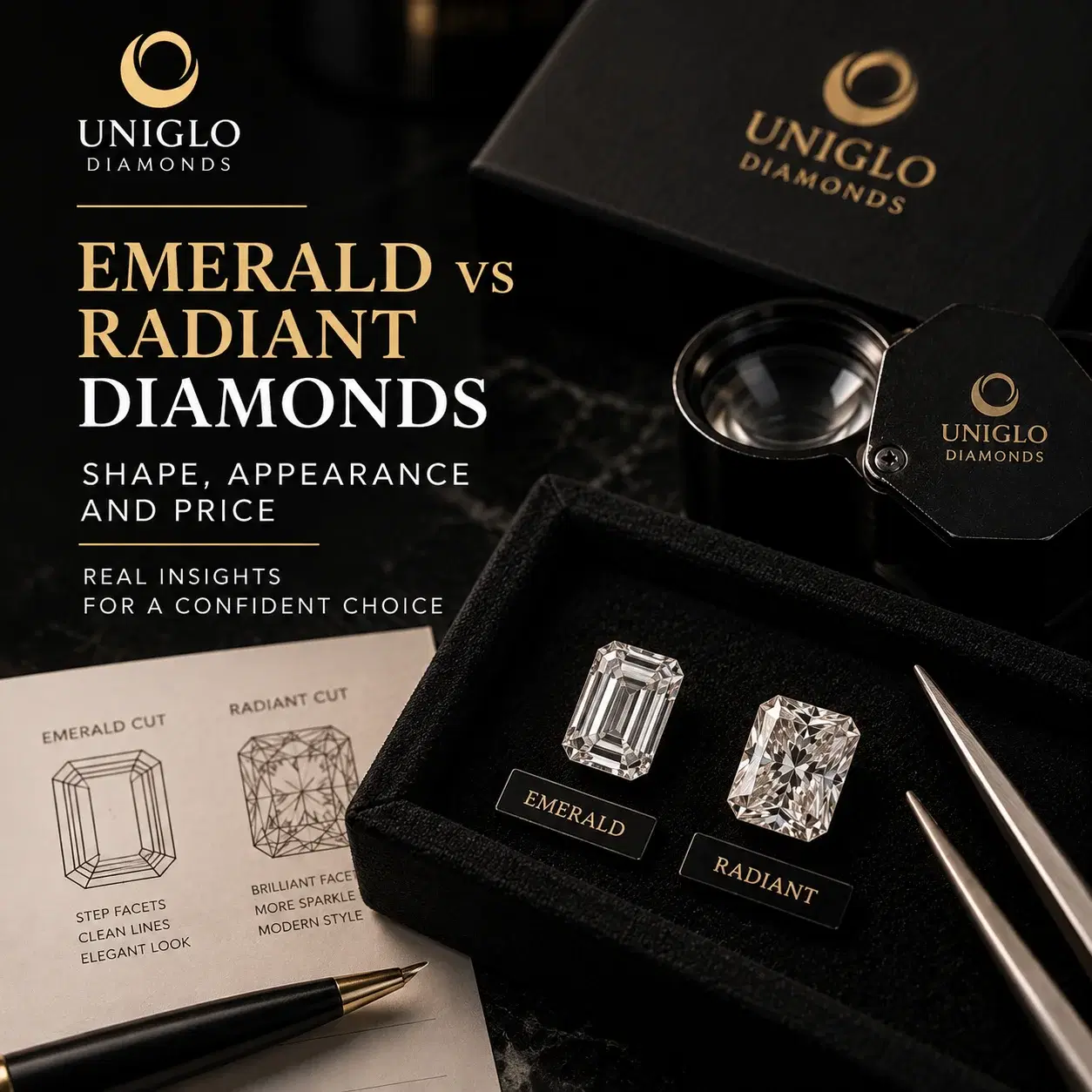
Emerald and radiant diamonds can share a rectangular outline with clipped corners, but their facet styles create distinctly different appearances. An emerald cut uses broad, linear step facets that produce organised flashes and clear reflections. A radiant uses brilliant-style faceting that usually creates a busier pattern of smaller flashes.
The difference becomes especially clear when the diamonds move. An emerald cut tends to alternate between broad areas of light and dark, while a radiant can show more frequent scintillation across the stone. Neither effect is automatically better; the useful question is which visual character you prefer.
Clarity, proportions and the individual stone also matter. The open appearance of an emerald cut can make some inclusions easier to notice, while a radiant’s denser reflection pattern may make certain characteristics less obvious. That general tendency does not guarantee that one clarity grade will suit every diamond.
This comparison applies to both natural and laboratory-grown diamonds. Origin describes how the diamond formed or was produced; emerald and radiant describe its shape and cutting style.
Emerald vs radiant diamonds at a glance
| Comparison | Emerald diamond | Radiant diamond |
|---|---|---|
| Facet style | Step cut, with long facets arranged in parallel rows | Brilliant or modified brilliant-style faceting |
| Appearance | Broad flashes, strong lines and an orderly pattern | More numerous flashes and a busier sparkle pattern |
| Outline | Usually rectangular with straight sides and clipped corners | Square or rectangular, generally with clipped corners |
| Movement | Larger sections often change from light to dark together | Smaller reflections can switch more frequently across the stone |
| Inclusion visibility | Open facets can make some characteristics easier to see | Denser reflections may help obscure some characteristics |
| Proportion priority | Balanced steps, an attractive outline and controlled light and dark areas | Even light return, balanced outline and an attractive reflection pattern |
| Setting consideration | Metalwork should fit the clipped corners without hiding too much of the outline | The setting should match the corner size, depth and chosen square or rectangular profile |
GIA explains that cut concerns a diamond’s facet arrangement, proportions and interaction with light. Those features affect brightness, fire and scintillation, and their combination can differ substantially between individual stones. GIA’s diamond cut guidance.
For a wider introduction to outlines and shape names, visit our diamond shapes guide.
Facet style creates the main visual difference
The emerald cut belongs to the step-cut family. Its crown and pavilion use rows of elongated facets that run broadly parallel to the girdle. Viewed from above, these facets create nested geometric reflections that draw attention towards the centre of the diamond.
This pattern is sometimes described as architectural because the lines are easy to follow. Rather than producing a continuous field of fine sparkle, an emerald cut often displays fewer but broader flashes.
A radiant cut combines a square or rectangular outline with brilliant-style faceting. Its facet arrangement breaks the reflected light into a more detailed pattern. Some radiants show distinct flashes, while others show many small reflections that may be described as a crushed-ice appearance.
Shape names alone cannot describe every facet pattern. Two radiants can have different pavilion arrangements, and two emerald cuts can display different balances of brightness and contrast. Compare the facet information on the reports where it is provided, then examine the actual diamonds.
How emerald and radiant diamonds look in movement
A still photograph can show outline and colour, but it cannot fully demonstrate scintillation. Scintillation includes the flashes and changing pattern of light and dark that appear as a diamond, the light source or the viewer moves.
In an emerald cut, several long facets may brighten or darken together. Slow movement can reveal a deliberate sequence of broad flashes. Check whether the pattern looks balanced across the centre and towards the ends of the diamond.
In a radiant, smaller reflections may switch on and off more rapidly. Look for sparkle across the whole face-up area rather than concentrating only on one bright section. A lively centre does not compensate for ends or corners that remain persistently dark in ordinary viewing conditions.
Compare both diamonds under similar lighting and at the same image scale. Use a neutral room, daylight and controlled jewellery lighting if available. Rotate each stone slowly from side to side and from end to end. A short, highly edited video can exaggerate differences that are less obvious in normal wear.
GIA separates brightness, fire and scintillation when explaining diamond appearance. Keeping those effects distinct helps you describe what you actually prefer instead of treating every reflection as the same kind of sparkle. GIA’s explanation of diamond cut.
Inclusion visibility and clarity
Clarity grading considers internal characteristics called inclusions and surface characteristics called blemishes. Their size, number, position, nature and visibility contribute to the assessment. GIA’s diamond clarity guide.
An emerald cut’s broad table and open step facets can make some inclusions easier to locate. A feature beneath the table or reflected repeatedly by the pavilion may attract more attention than a similar-looking feature near an edge.
A radiant’s more complex reflection pattern may make certain inclusions less noticeable face-up. It can also make detailed inspection more difficult because reflections and inclusions may overlap visually. The facet style does not erase an inclusion or change the laboratory grade.
Avoid choosing a minimum clarity grade from the shape name alone. Instead:
- Read the laboratory report and locate the documented characteristics.
- Inspect the diamond face-up at ordinary viewing distance.
- Review magnified views to understand the position and nature of the features.
- Check the diamond from different angles and under consistent lighting.
- Ask whether any characteristic affects transparency, durability or setting decisions.
IGI states that clarity is assessed at 10× magnification and depends on the visibility, size, number, location and nature of internal and surface characteristics. IGI’s laboratory-grown diamond report guidance.
Our guide to the Diamond 4Cs explains how clarity fits into the wider quality assessment.
Proportions: compare the complete outline
Both shapes can be broad or elongated. The length-to-width ratio helps describe that difference, but it does not establish beauty or cut quality by itself.
Calculate the ratio by dividing the reported length by the width:
Length-to-width ratio = length ÷ width
The following examples are mathematical illustrations rather than recommended proportions:
| Illustrative measurements | Calculated ratio | What the number describes |
|---|---|---|
| 7.50 × 6.00 mm | 1.25 | A moderately rectangular outline |
| 8.40 × 6.00 mm | 1.40 | A more elongated outline |
| 9.00 × 6.00 mm | 1.50 | A distinctly elongated outline |
Two diamonds with the same ratio may still look different. One may have larger clipped corners, a wider table or a different distribution of width through the middle and ends. An emerald and a radiant can therefore share the same length and width while presenting different visible outlines.
Inspect the following proportion features together:
- Length and width: These describe the face-up dimensions recorded on the report.
- Depth: This affects how the diamond occupies space vertically and how much weight lies below the girdle.
- Table: Its size contributes to the visible facet arrangement and overall appearance.
- Corner size: Larger or smaller clipped corners change the outline and the way a setting must hold the stone.
- Girdle: Thickness can vary around a fancy-shaped diamond, so read the complete description where available.
- Symmetry: This records the precision of the shape and facet alignment within the scope of the laboratory assessment.
IGI’s fancy-shape cut process considers polish, symmetry, proportions, shape-specific craftsmanship and light return. IGI also states that proportions alone are insufficient to grade fancy-shape cut quality. IGI’s fancy-shape cut grading methodology.
Carat weight does not tell you the visible size
Carat is a unit of weight. One metric carat equals 200 milligrams, and equal carat weights do not guarantee equal face-up dimensions. GIA’s explanation of carat weight.
When comparing an emerald and a radiant at the same weight, check the millimetre measurements and depth. One stone may be longer, another wider, and a third may carry more of its weight below the girdle.
The enclosing rectangle formed by length and width is also an incomplete measure of visible area. Clipped corners remove part of that rectangle, and different corner sizes change the outline. Use dimensions to narrow the comparison, then judge the actual stones rather than converting carat weight into a guaranteed visual size.
Our diamond size chart explains how carat weight and millimetre dimensions should be used together.
Colour can present differently in the two facet patterns
Facet arrangement, lighting, background and setting metal can influence how colour appears face-up. The open reflections of an emerald cut and the smaller reflections of a radiant do not present colour in exactly the same way.
Compare diamonds against the same neutral background and under the same lighting. If the finished ring will use yellow or rose-coloured metal, ask to see how the proposed setting changes the overall impression. The laboratory colour grade remains an assessment made under controlled conditions; a photograph taken in different surroundings is not an equivalent comparison.
GIA explains that diamond colour is graded under controlled viewing conditions and that subtle colour differences can affect quality and price. GIA’s diamond colour guide.
Read the report before comparing quality labels
Establish who issued the report, which service was used and which assessments appear on the document. Record the exact measurements, carat weight, colour information, clarity information, polish, symmetry, fluorescence and relevant comments.
Do not assume that every seller’s use of “Excellent” refers to the same assessment. It may describe a laboratory cut grade, a finish grade or the seller’s own category. IGI publishes a fancy-shape grading process that can produce an overall cut grade after several assessment stages. Other reports and services may present fancy-shape information differently. IGI’s diamond cut grading guide.
For laboratory-grown diamonds, confirm that the report identifies the origin and review any comments about the growth process or treatment where supplied. IGI describes the origin, measurements and quality information included in its laboratory-grown diamond reporting service. IGI’s laboratory-grown diamond reports.
For help reading specific documents, visit our IGI report guide and GIA report guide.
Setting suitability
Emerald and radiant diamonds both commonly have clipped corners, which gives a jeweller defined places to support the stone. The setting still needs to be made for the individual diamond’s measurements, corner size, depth and girdle profile.
Solitaire and prong settings
A simple prong setting leaves much of the outline visible. Check whether the prongs cover the corners evenly and whether they obscure a significant part of a narrow emerald or radiant.
The basket should support the diamond at the correct height. A deeper stone may require a different structure from a shallower stone with similar face-up dimensions.
Bezel settings
A bezel can trace the outline with a continuous rim of metal. This may suit either shape, but the rim must follow the actual corner angles and side profile. Ask to see the proposed border from above because its thickness changes the visible proportions of the centre stone.
Halos and side stones
A halo can make the overall outline appear wider or more elongated. With an emerald cut, straight or step-cut side stones can reinforce the linear appearance. With a radiant, brilliant-cut side stones can continue a more detailed sparkle pattern. These are design choices rather than rules.
Keep the surrounding stones and ring design similar when comparing centre shapes. Otherwise, the setting may contribute more to the visual difference than the emerald or radiant itself.
Wedding-band fit
Whether a wedding band sits flush depends on the basket, gallery and height of the complete engagement-ring setting. The centre stone’s shape alone cannot answer that question. Review the two rings together before the setting is finalised.
Which shape should you choose?
An emerald cut may suit you if you prefer strong geometry, broad flashes and an orderly pattern of reflections. Give particular attention to clarity visibility, the balance of light and dark areas and the alignment of the steps.
A radiant may suit you if you prefer a square or rectangular outline with more frequent sparkle. Compare how evenly the reflections appear across the centre, ends and corners, and decide whether you prefer larger flashes or a finer crushed-ice pattern.
Use the following order when comparing candidates:
- Choose the square or rectangular outline and degree of elongation you prefer.
- Compare actual millimetre measurements as well as carat weight.
- View both diamonds in motion under similar lighting.
- Check clarity characteristics at normal distance and under magnification.
- Read each report and identify what every quality label represents.
- Confirm that the intended setting fits the individual stone.
- Compare current quotations on the same basis, including the setting and applicable charges.
If you are also considering another rectangular brilliant style, read our cushion vs radiant diamond guide.
Frequently asked questions
What is the main difference between emerald and radiant diamonds?
The main difference is facet style. Emerald cuts use broad step facets that create linear reflections and larger flashes. Radiants use brilliant-style faceting that generally produces a more detailed sparkle pattern.
Does a radiant diamond sparkle more than an emerald cut?
A radiant usually produces more numerous flashes, while an emerald cut tends to show broader flashes and a stronger pattern of light and dark. “More sparkle” does not establish that the radiant is better cut or that every buyer will prefer it.
Do emerald cuts need a higher clarity grade?
Their open step facets can make some inclusions easier to notice, but a fixed minimum grade is not reliable for every stone. Review the location and nature of the characteristics, then inspect the actual diamond at ordinary viewing distance and under magnification.
Which looks larger at the same carat weight?
The shape name and weight do not provide enough information. Compare length, width, depth, corner size and the face-up appearance of the individual diamonds.
What length-to-width ratio is best?
There is no single ratio that suits every buyer. The ratio describes elongation. Choose the outline you prefer, then assess facet pattern, symmetry and light return separately.
Can an emerald diamond fit a radiant setting?
A jeweller must assess the individual stone and setting. Matching length and width do not guarantee matching corner angles, depth or girdle profile.
Are emerald and radiant diamonds available as natural and lab grown stones?
Yes. Both shape and facet styles can be applied to natural or laboratory-grown diamond material. Confirm the diamond’s origin from the description and appropriate documentation.
Compare emerald and radiant diamonds with Uniglo
To compare emerald and radiant diamonds, contact Uniglo Diamonds with your preferred origin, carat range, dimensions, budget and intended setting.
Ask to review individual stones with similar length-to-width ratios and face-up dimensions. Compare their reports and videos under consistent conditions, then request a current quotation showing what the complete purchase includes.




