
Diamond Table and Depth: Reading Round-Diamond Proportions
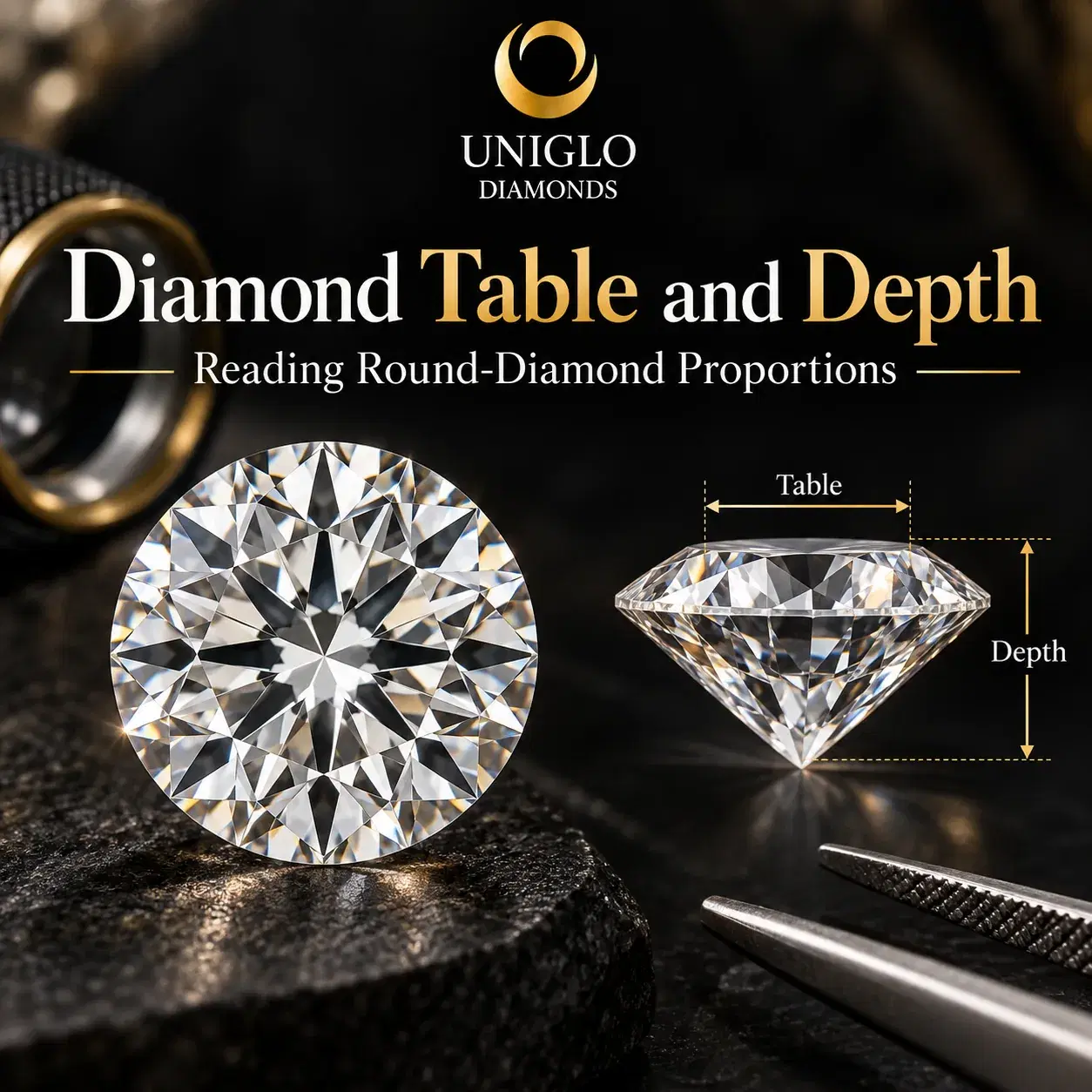
Diamond table percentage compares the width of the top facet with the diamond’s average diameter. Depth percentage compares its total height with that diameter. For round brilliants, read both alongside crown and pavilion angles, the grading report and the actual appearance. A promising table-and-depth pair does not guarantee an Excellent cut or a diamond you will prefer.
When comparing round diamonds online, table and depth are easy numbers to find and filter. They help describe the stone, but they cannot explain its entire appearance. Two listings with similar percentages can still require quite different buying decisions.
This guide covers modern standard round brilliant diamonds. It explains the measurements, gives a worked example and shows how to turn the report’s proportions into useful questions for a supplier. Fancy shapes and antique cutting styles need their own assessment rather than the same numerical rules.
What is diamond table percentage?
The table is the flat facet at the top of the diamond. Its percentage expresses its width relative to the stone’s average girdle diameter. It is a linear measurement, not the percentage of the face-up surface area occupied by the table.
GIA’s round-brilliant anatomy guide describes table percentage using the average of four table measurements divided by the average diameter. GIA reports it to the nearest whole percent.
Table percentage = average table width ÷ average girdle diameter × 100
A reported table of 57% therefore concerns the table’s relative width. It does not mean that 57% of the diamond sparkles, that 57% of incoming light returns to your eye, or that the stone receives a particular cut grade.
For a buyer, the number is most useful when kept with the other report details. Avoid copying it into a shortlist as a stand-alone score where a lower or higher value automatically wins.
What is diamond depth percentage?
Total depth is the diamond’s height from the table to the culet or bottom point. For a round diamond, depth percentage expresses that height relative to its average diameter. IGI’s glossary distinguishes this round-diamond calculation from the width-based calculation used for fancy shapes.
Depth percentage = total depth in millimetres ÷ average girdle diameter × 100
This is different from pavilion depth. Total depth covers the whole diamond; pavilion depth concerns the lower section below the girdle. If a supplier refers simply to “depth”, clarify which measurement they mean.
Also distinguish millimetres from percentages. Two rounds can share a depth percentage while having different physical heights because their diameters differ. The percentage describes proportion, not absolute size.
Worked example: reading table and depth from dimensions
Consider an illustrative round diamond with minimum and maximum diameters of 6.40 mm and 6.50 mm. Its total depth is 3.97 mm, and its average measured table width is 3.68 mm. These are hypothetical measurements for explaining the arithmetic, not an available Uniglo stone or a recommended proportion recipe.
| Measurement | Calculation | Result |
|---|---|---|
| Average diameter | (6.40 + 6.50) ÷ 2 | 6.45 mm |
| Table percentage | 3.68 ÷ 6.45 × 100 | Approximately 57.05%; 57% when rounded to a whole percent |
| Total depth percentage | 3.97 ÷ 6.45 × 100 | Approximately 61.55%; 61.6% when rounded to one decimal place |
The example shows how the percentages relate to dimensions. It does not establish the crown angle, pavilion angle, light performance or final cut grade. Those require additional information.
Use calculations as a sense check when comparing a listing with its report. Small differences can arise because displayed dimensions are rounded. If a discrepancy is substantial or the listing appears to belong to a different stone, ask the supplier to resolve it before continuing.
What are good diamond table and depth percentages?
There is no single table-and-depth combination that guarantees the best round diamond. A useful reference must state what its numbers represent and which other factors are assumed.
GIA’s anatomy explanation gives a table range of 52–62% for its Excellent round-brilliant cut category, while stressing that proportions must work together. Being inside that range does not independently qualify a diamond for Excellent.
For a narrower example, IGI’s discussion of balanced round-brilliant proportions presents a 56–58% table alongside particular crown and pavilion angles, lower-half lengths and girdle descriptions. It is a combined approach, rather than a rule that every attractive round must have that table size.
| Numerical reference | Context | What it does not establish |
|---|---|---|
| Table 52–62% | GIA’s published explanation of the Excellent round-brilliant category | That every stone in this table range is Excellent |
| Table 56–58% | IGI’s example of a balanced proportion combination | That rounds outside this narrower range are unsuitable |
| Crown angle 34.5–35.0° and pavilion angle 40.6–40.8° | Angles used alongside the table in that IGI example | A result from angles alone, without the remaining checks |
For depth, begin with the actual laboratory cut grade and full proportion diagram instead of treating a shop’s depth filter as the grading system. Compare suitable candidates within your budget, then use the depth percentage to investigate how each stone carries its weight.
Why published depth limits need context
GIA’s Facetware help distinguishes measured depth printed on a report from depth calculated using rounded proportion parameters. Its published Excellent depth-limit interval of 57.5–63.0% applies in the calculation context it describes; it is not a universal pass-or-fail filter for the displayed depth number.
GIA gives an example with measured depth of 62.6% and calculated depth of 63.1% that received a Very Good cut grade. It also explains that some Excellent reports can show measured depth above the published calculated limit.
The practical lesson is to trust the verified report’s actual grade over an attempted reclassification from one displayed value. If a supplier’s explanation is unclear, ask them to show the full diagram and explain the difference. Do not assume a report is incorrect merely because a number crosses an online chart’s boundary.
Why crown and pavilion angles matter
Table and depth describe part of the geometry. Crown and pavilion angles help explain how the upper and lower sections are arranged. GIA’s cut education emphasises that the interaction between proportions matters, including cases where individually acceptable values combine unfavourably.
Think of two hypothetical rounds with the same 57% table and 61.6% total depth. Those two figures do not tell you how much height lies in the crown, girdle and pavilion. Requesting the full diagram may reveal differences that the original comparison concealed.
For a practical shortlist, keep crown angle and pavilion angle next to table and depth in the same row. Also retain the remaining diagram information rather than cropping it out of a screenshot. You need not calculate an optical model yourself; you need enough information to avoid selecting from an incomplete description.
Do a larger table or lower depth mean more sparkle?
Neither number is a direct sparkle score. GIA describes brightness as white-light reflections, fire as coloured flashes, and scintillation as the light-and-dark display associated with movement. A diamond’s visual pattern also depends on the arrangement and contrast of reflections.
Ask which effect you actually prefer when reviewing videos. “More sparkle” can otherwise turn into a comparison of whichever clip has stronger studio lighting. Keep both stones at the same apparent scale and ask for similar recording conditions.
Do not assume that a larger table guarantees greater brightness, or that a smaller one guarantees stronger fire. Compare actual candidates under more than one lighting environment, and use the report to support that comparison. The proportions should help explain your observations, rather than replace them.
How depth relates to face-up size and value
Carat weight is not the same as visible size. GIA’s round-diamond buying guide warns that weight can be retained in the pavilion or girdle without making the diamond appear larger. This makes actual diameter an important comparison alongside depth.
If two candidates have similar weights but noticeably different diameters, ask what accounts for the difference. Do not immediately attribute it to depth alone or select the larger one without reviewing its appearance and condition.
Use Uniglo’s diamond size chart for general context, then return to the shortlisted stone’s own measurements. A chart cannot substitute for the dimensions of the diamond you are buying.
For value, compare complete quotations. Keep origin, weight, reported grades, measurements and commercial terms visible together. A proportion number should not become the explanation for a price difference when the stones differ in other substantial ways.
How to read a round-diamond report in order
Confirm the stone and report
Start with the supplier reference and laboratory report number. Check that the dimensions, weight and grades in the listing agree with the report, and confirm that the video shows that candidate. This avoids spending time analysing proportions from one stone while viewing another.
Read the actual cut grade
Identify the laboratory and the grade it assigned. GIA’s standard cut-grade scope covers D–Z standard round brilliants. IGI’s current round-diamond methodology considers polish, symmetry, proportions and light performance. Review the specific document instead of assuming every laboratory’s labels have identical definitions.
Uniglo’s diamond certificates guide can help you identify and understand the paperwork. An overall grade supports selection but does not decide which candidate’s appearance you will personally prefer.
Keep the whole proportion diagram
Record table, total depth, crown angle and pavilion angle, then retain star length, lower-half length, girdle and culet information where provided. GIA’s Facetware overview shows that cut estimation involves multiple inputs and additional limiting factors.
You do not need to turn every proportion into a separate ranking. The aim is to preserve enough context for a supplier or qualified reviewer to explain the diamond rather than approve it from two numbers.
Resolve any missing information
If a listing only supplies table and depth, request the report. If the full document does not provide a detail you need, ask what additional assessment or media is available. Missing information should remain an open question in your shortlist, rather than being filled with an assumption.
What to check in a round-diamond video
Request a slow face-up rocking video, a clear still and a normal-scale view. Where possible, compare shortlisted stones using the same lighting, background, camera distance and exposure. A macro clip is useful for details, while an ordinary-scale view helps with the final aesthetic decision.
Inspect the centre and the surrounding areas as the diamond moves. If an area repeatedly looks disappointing, ask for another recording and an explanation. A dark frame alone does not identify its cause, and a bright frame alone does not establish consistent performance.
Try to compare both diffuse and directional lighting. Record what you like about each candidate instead of relying on a vague “best sparkle” impression. For example, you might prefer the balance of bright and dark reflections in one video but want a clearer normal-scale view before approving it.
If an optical image or report is supplied, ask whether it comes from the actual stone or a model, and what it assesses. IGI notes that its proportion-based light-performance analysis does not account for dense clarity characteristics or reduced transparency. Any transparency concern still deserves its own examination.
Balancing proportions with colour, clarity and budget
Once suitable candidates are shortlisted, compare what the additional money buys. Avoid paying more simply because one stone is a fraction closer to a favourite numerical target. Ask whether the difference produces a visible benefit you value or meets another requirement in the brief.
Uniglo’s guides to diamond cut vs clarity and diamond cut vs colour discuss those wider trade-offs. Keep this page’s proportions checks as one part of the decision rather than using them to ignore an unacceptable inclusion or colour appearance.
For a lab-grown shortlist, explore Uniglo’s round lab-grown diamonds and request reports and media for the available candidates. Establish origin separately; a lab-grown label does not settle the quality of the particular diamond’s cutting.
What to ask before buying
A useful enquiry requests a small, comparable shortlist and the evidence needed to choose between it. You can adapt this wording:
Please propose standard round brilliant diamonds for [jewellery design] within [budget and currency]. My origin requirement is [natural or lab-grown]. Please include the full laboratory report, actual diameter and depth measurements, table and depth percentages, and the complete proportion diagram. I would like comparable face-up videos and an explanation of any significant proportion or visible-size differences before choosing.
Send your brief through Uniglo’s enquiry page. Confirm current availability and agree inspection, reservation and return terms before ordering. If a candidate changes, review the replacement’s own report and media.
Related guides
Frequently asked questions
More Topics




