
Side-Stone Diamonds: Baguettes, Trapezoids and Half-Moons
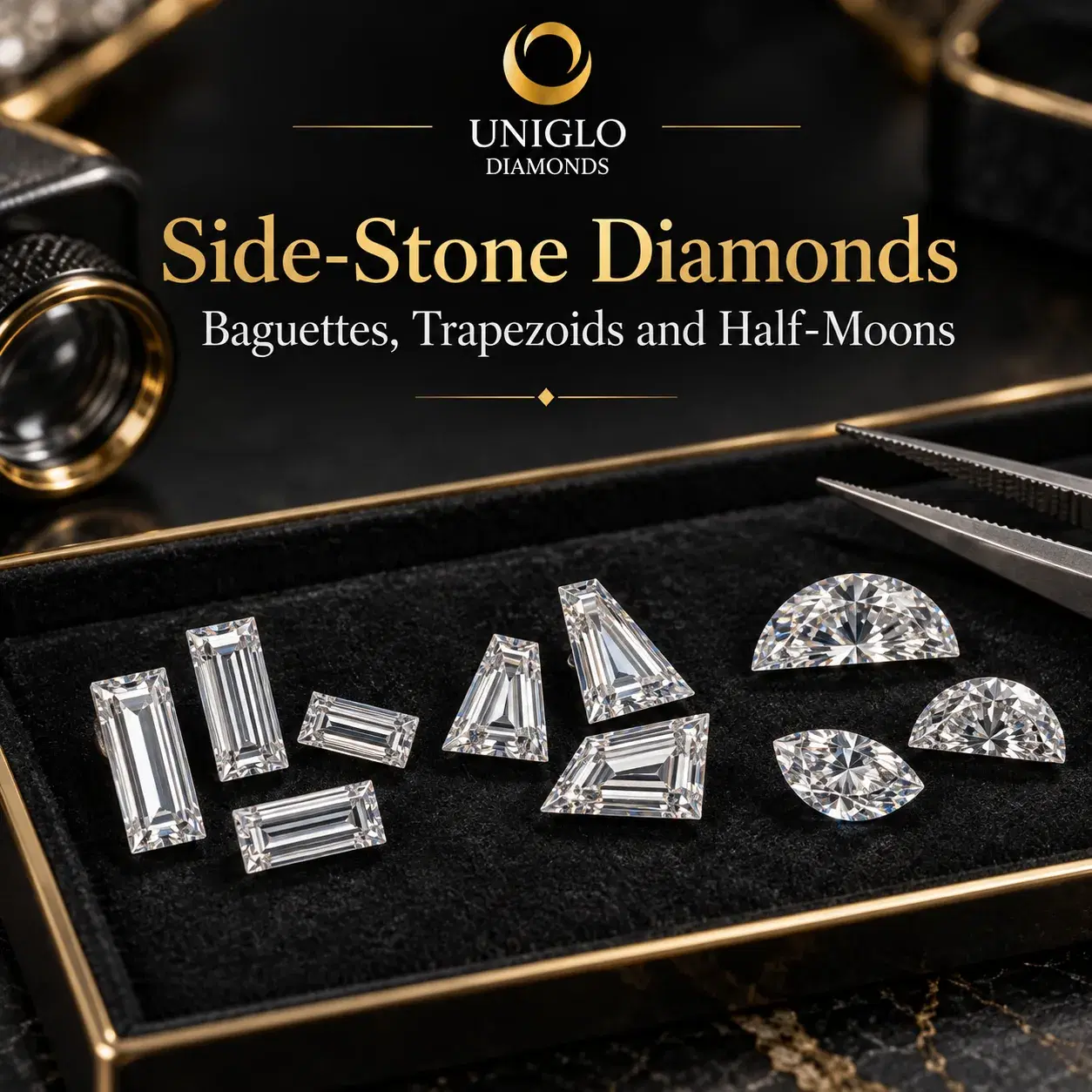
Diamond side stones should suit the centre diamond’s outline, the intended reflection pattern and the width of the finished design. Baguettes offer straight or tapered lines, trapezoids create a broader angular transition, and half-moons add curved outlines. Compare the actual pair beside the centre, then confirm dimensions, visual matching and the setter’s fit requirements before buying.
The best choice is a combination you have seen at the scale and orientation of the finished piece. A beautiful pair viewed alone may create a different balance once it is placed beside your centre diamond.
What are diamond side stones?
Side stones are diamonds positioned beside a principal stone in a jewellery design. A three-stone ring is a familiar example, but a design may include several accents on each side. “Side stone” describes the role of the diamond rather than one shape, size or cutting style.
Side stones can be selected to continue the centre’s appearance or to introduce deliberate contrast. GIA’s three-stone ring guide describes combinations of different shapes, including cushion centres with half-moon accents. Matching shapes is one option; mixing them is another.
Decide which effect you want before requesting a pair. Should the centre dominate, should the three stones read as a balanced group, or should the accents create a transition towards the band? That brief gives the jeweller a useful basis for proposing alternatives.
Compare the three main side-stone options
| Shape | Outline to recognise | Design effect to preview | Important check |
|---|---|---|---|
| Straight baguette | Rectangular outline with parallel long sides | A straight geometric accent | Length, width and consistent pair appearance |
| Tapered baguette | A narrow rectangular-type outline that becomes wider towards one end | A slender change in width beside the centre | Both end widths, taper and intended orientation |
| Trapezoid | Generally a four-sided outline with unequal parallel edges | A broader angular shoulder | Edge lengths, depth of the outline and cutting style |
| Half-moon | A curved outer edge with a straighter inner edge | A rounded shoulder or curved contrast | Curve, outline depth, edge fit and pair balance |
These descriptions are starting points. Modified outlines exist, and measurements can be presented differently between suppliers. Request a labelled photograph or drawing of the actual goods rather than assuming the trade name defines every detail.
Baguette side stones: straight or tapered?
GIA’s baguette guide distinguishes straight and tapered baguettes and notes their use as side stones. Conventional baguettes are step cut, while modified or mixed facet arrangements also occur. Confirm the cutting style when assessing a proposed pair.
Choose straight baguettes for a shortlist when you want a linear accent. Ask to see their long axes in the proposed orientation: changing the orientation changes the composition, even though the stones themselves remain the same.
For tapered baguettes, preview the transition from the centre towards the shoulders. Specify which end is intended to face the centre and request both end widths. Do not accept a single “width” measurement without establishing what it refers to.
The practical question is whether the pair creates the line you want. A taper can look attractive in isolation yet create too abrupt or too slight a transition in the chosen mounting. Ask the designer to show that relationship before deciding.
Trapezoid side stones: outline and cutting style
Trapezoids, also called trapeze diamonds in some descriptions, have an angular outline with a wider and narrower parallel edge. Their exact proportions vary, so the name alone does not establish how broad they will look beside your centre.
Ask whether the proposed stones have step-cut, brilliant-style or modified faceting. GIA’s shape and cut-style guide explains why the outline and facet arrangement are separate considerations. A similar silhouette can contain a different pattern of reflections.
For a shortlist, compare a broader trapezoid shoulder with a slender tapered baguette shoulder. The geometry can overlap in trade descriptions; establish the actual outline and faceting instead of relying on the name to settle the distinction.
Request a drawing showing which edges face the centre and the band. Check the pair in mirrored positions. If the broad edge follows a different angle from the centre’s adjacent edge, ask how the setting will handle the spacing rather than assuming the diamonds will fit together without adjustment.
Half-moon side stones: curved shoulders
Half-moons combine a curved edge with a straighter edge, but they are not necessarily exact semicircles. Compare how elongated or full the proposed outlines are, and confirm their cutting style. Two pairs carrying the same shape name may create different shoulders.
GIA’s oval diamond guide identifies half-moons as an option that echoes an oval’s curved shape, while tapered baguettes can provide geometric contrast. That is a useful distinction to preview, rather than a rule that every oval needs one particular pair.
Do not assume a half-moon has a concave inner edge that precisely hugs your centre. Ask to see the actual edge and the proposed gap. The designer needs to assess the diamonds and supporting metal together.
Compare the pair’s curves in a steady face-up view. Then view the proposed arrangement from the side to understand how the stones will sit. A pleasing top view still needs a feasible mounting with appropriate clearance and support.
Which side stones suit your centre diamond?
Use the following combinations as design options to preview, not universal recommendations or claims about stock availability. The final choice depends on the actual stones and mounting.
| Centre shape | Options to compare | Question the preview should answer |
|---|---|---|
| Emerald cut or Asscher | Baguettes, step-cut trapezoids or smaller emerald cuts | Do you prefer a narrow accent or a broader geometric shoulder? |
| Oval | Half-moons, tapered baguettes or smaller ovals | Should the shoulders continue the curves or introduce angular contrast? |
| Cushion | Half-moons, trapezoids or rounds | Does the pair complement this cushion’s particular outline and reflections? |
| Radiant | Trapezoids, half-moons or baguettes | Do you want a related facet style or a deliberate step-cut contrast? |
| Round | Baguettes, half-moons or smaller rounds | How much visual width and shape contrast should the accents add? |
For an emerald-cut centre, compare the outer edge of each candidate with the centre’s cropped corners. For an oval or cushion, look at the complete outline rather than assuming every curve will continue smoothly. A shape family contains many proportions.
When starting with Uniglo’s emerald-cut, oval or cushion-cut lab-grown diamonds, save the centre’s measurements and available images before discussing a pair. Use the diamond shapes guide to compare broader centre-shape options.
Choose the whole ring’s proportions
GIA’s side-stone selection guide recommends considering the centre, side stones and wearer together. A pair needs to work in the complete ring rather than only in an enlarged photograph.
Ask for a face-up design preview with the intended finger size, band width and stone orientation. Specify whether you want the centre to remain the strongest focal point or a more evenly weighted three-stone composition. Compare at least two layouts if the first does not make that preference clear.
Look at the proposed overall span. Wider shoulders may move the accents towards the sides of the finger, while narrower ones may leave more visible band. Ask to see how the design looks on the wearer’s hand or on an appropriately scaled representation.
There is no single side-stone carat percentage that suits every centre. Equal weight does not establish equal visible width, and a broad trapezoid does not fill space in the same way as a long baguette. Use weight for the purchase description and actual dimensions for the design comparison.
Establish a common measurement orientation
Ask the supplier to mark the measurements on a face-up drawing. For this design discussion, identify the edge next to the centre and the direction towards the band. This avoids confusion when one supplier’s “length” runs in a different direction from another’s.
For tapered shapes, retain the wider and narrower edge measurements. For half-moons, request the span along the straighter edge and the distance out to the curved edge. Confirm total stone depth separately, since a face-up outline does not show how much room the pavilion requires.
The setter should approve the dimensions for the proposed mounting. If buying for an existing setting, have it measured first. A stated total weight or a generic “matched pair” description cannot establish fit in a particular seat.
Match appearance, not just grades
View the two side stones together under the same lighting before including the centre. Compare outline balance, apparent colour, transparency and how their reflections change during movement. Ask the seller to keep the stones clean and similarly positioned in the recording.
Next, view the three-stone combination. Decide whether you want continuity or contrast and whether the result achieves it. A pair can look balanced on its own yet appear noticeably warmer, darker or different in reflection pattern beside the centre.
Grades help describe the stones, but they do not replace that group view. Do not impose a universal D-colour or VVS-clarity requirement on every pair. Ask whether any inclusion or appearance difference is noticeable at the intended viewing scale, and have condition or durability concerns assessed separately.
Deliberate contrast is a valid brief too. If you want coloured side stones, define the intended effect and request suitable identification and colour-origin evidence. A coherent comparison starts with the look you want, rather than assuming all three stones must look identical.
Cutting style and report details
State whether you want similar reflection patterns or a deliberate contrast between centre and accents. Request the actual cutting descriptions and viewing evidence. A brilliant-style centre with step-cut baguettes can be an intentional design choice; a mismatch should be evaluated against the brief rather than the shape name alone.
Read quality fields carefully. IGI’s fancy-shape cut-grading explanation describes assessment of finish, proportions, craftsmanship and light return. Proportions alone do not establish cut quality, and an individual polish grade should not automatically be read as an overall cut grade.
Ask whether the evidence concerns individual diamonds, the pair or a wider parcel. Uniglo’s diamond certificate guide explains the main documentation distinctions. Match any individual report to its offered stone and keep the pair’s identities clear in the images and quotation.
Confirm natural or laboratory-grown origin requirements for both the centre and side stones, along with relevant treatment disclosures. The centre’s report should not be assumed to establish the identity of the accents.
Check the setting, profile and wedding-band fit
A three-stone layout describes the design; it does not specify how each diamond is secured. GIA’s ring-setting guide distinguishes setting styles from mounting methods such as prongs and bezels. Ask the jeweller to explain the proposed support for each stone.
Have the setter check corners, girdles and current condition before mounting. GIA’s chipping guidance explains the relevance of exposed corners and very thin girdle areas. A curved outline does not remove the need to assess its edges and mounting.
Review the side profile as well as the top view. Ask about finished height, clearance beneath the stones and any potential contact between neighbouring diamonds. If a wedding band will be worn alongside the ring, include it in the preview and discuss the gap or contact points.
For future repairs, retain the approved shape and dimension records. Ask how a replacement would be sourced and fitted. This is particularly useful when the pair has an unusual taper, curve or custom outline that cannot be captured by a weight description alone.
A practical buying sequence
Start with the centre’s actual measurements and the design role you want the side stones to play. Ask for two or three feasible shape options at the proposed scale, then shortlist the composition before requesting a final matched pair.
Review the actual pair in still images and slow video, first together and then beside the centre where possible. Request another view if exposure, focus or positioning prevents a fair comparison. Keep the stone references connected to the evidence so that similarly described options cannot be confused.
Have the jeweller approve the fit, support and finished profile. Agree what happens if the supplied stones differ from the approved pair or do not meet the setting requirements. Complete the available inspection within the agreed period and before mounting.
What to send in your enquiry
| Information | What it helps establish |
|---|---|
| Centre shape and measurements | A real starting point for the proposed combination |
| Desired design effect | A dominant centre, balanced trio or transition to the band |
| Preferred side-stone shapes | The alternatives you want to preview |
| Mounting or existing ring details | Fit, support, height and clearance requirements |
| Origin and documentation requirements | The product description and evidence needed |
| Budget and timing | Feasible options, quotation basis and inspection arrangements |
You can send this request:
Please suggest side-stone pairs for the attached centre diamond and design brief. Show feasible baguette, trapezoid or half-moon options at their intended scale and orientation. Confirm each proposed pair’s outline, cutting style, marked dimensions, origin and available documentation. Please show the actual pair together and beside the centre where possible, and explain the mounting requirements, price basis and inspection arrangements before setting.
What affects the cost of diamond side stones?
Compare dated quotations for actual pairs you could use. Establish whether a price is for one stone, the two-stone pair or a larger parcel. Include matching, custom cutting or calibration where quoted, plus the mounting work needed for the chosen design.
Do not assign a universal price ranking to baguettes, trapezoids and half-moons. Different dimensions, origin, quality and sourcing requirements make broad comparisons unreliable. A readily available pair and a specially sourced pair are different proposals even when their total weights are similar.
Choose side stones around the complete design
Approve the composition and actual pair together. A useful decision combines the shape you prefer with visible matching, documented goods and a mounting the setter has assessed.
Explore Uniglo’s melee diamond parcels for available small accent options, or contact Uniglo Diamonds with your centre measurements and preferred side-stone shapes. Ask about current availability and pair-specific evidence; do not assume every shape or custom dimension is held in stock.
Frequently asked questions
More Topics




