
Diamond Polish vs Symmetry: What the Grades Mean
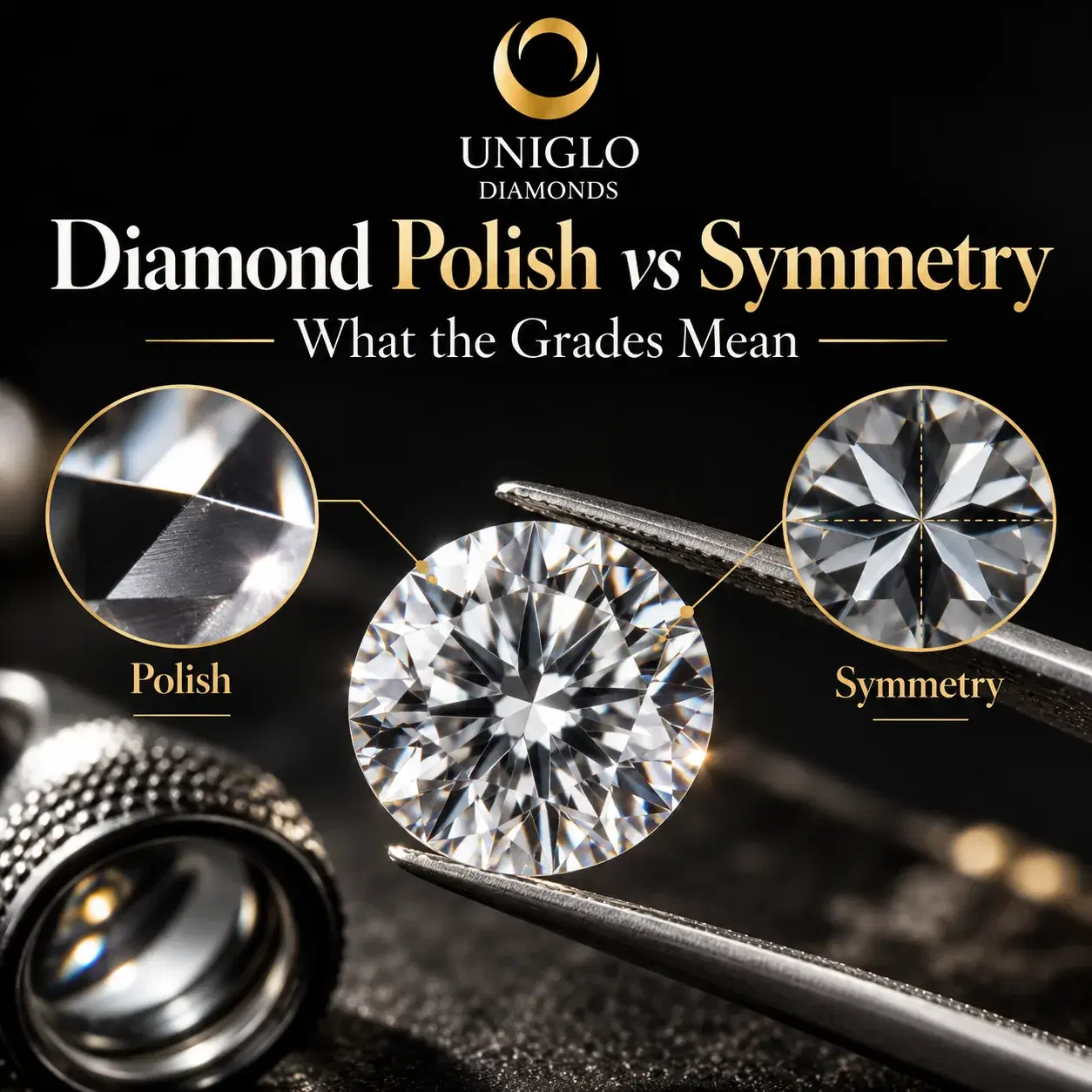
Diamond polish describes the condition and finish of facet surfaces. Symmetry describes the precision of the outline and facet arrangement. They are separate craftsmanship grades, and neither replaces an overall cut assessment. A round diamond can have a GIA Excellent cut grade with Very Good polish or symmetry, so buyers should assess the complete stone before paying more for two Excellent finish grades.
Polish and symmetry often appear beside each other on a diamond report, making them easy to treat as one score. They answer different questions. A surface can be carefully finished while the facet arrangement contains deviations, or the arrangement can be precise while surface features limit the polish grade.
This guide explains diamond polish vs symmetry, the grade scale, what buyers can realistically see and how to compare candidates without confusing finish, cut quality and clarity.
What is diamond polish?
Polish concerns the quality and condition of a diamond’s facet surfaces. GIA’s report guide explains that the assessment includes blemishes from polishing and subsequent wear. The term does not mean cleaning a finished ring with a cloth.
Polish features can include fine lines, scratches, pits and areas of abrasion. A laboratory evaluates them under controlled conditions rather than judging how shiny the diamond looks in a promotional photograph.
For a buyer, the useful question is what limits the particular stone’s grade and whether that feature matters to its appearance or condition. “Very Good polish” alone does not identify the feature, its location or how it will look at ordinary viewing distance.
Ask for a specific explanation when comparing two close candidates. A seller should distinguish a laboratory-observed surface feature from dust, a reflection or something unresolved in the recording.
What is diamond symmetry?
Symmetry concerns the precision of the diamond’s outline and the shape, placement and alignment of its facets. GIA’s terminology guide includes deviations such as an off-centre table, unequal facet shapes and misalignment between crown and pavilion facets.
It is more than asking whether a stone looks balanced in one face-up image. A three-dimensional diamond needs assessment from different views. A photograph may be useful for your aesthetic preference but cannot reproduce the laboratory examination.
Symmetry also does not mean that every facet must have the same shape or size. Different facet types have different roles in the cutting style. The relevant comparison is whether the intended arrangement is executed precisely, rather than whether the entire diamond consists of identical surfaces.
If a feature is described as asymmetrical, ask which part of the stone is affected and how that relates to the report. Do not assume that one unusual reflection proves a lower symmetry grade.
Diamond polish vs symmetry: the difference
| Question | Polish | Symmetry |
|---|---|---|
| What does it assess? | Facet surface condition and finish | Outline precision and facet arrangement |
| What might explain a lower grade? | Surface features such as polish lines | Deviations such as facet misalignment |
| What should a buyer request? | Identification of the relevant surface feature | Identification of the relevant arrangement deviation |
| Does Excellent settle the overall purchase? | No; review the complete diamond | No; review the complete diamond |
| Does it replace an overall cut grade? | No | No |
Record both grades separately when building a shortlist. Avoid a single “finish: Excellent” entry unless the supplier confirms exactly which assessments that label covers.
The polish and symmetry grade scale
GIA’s technical finish booklet assesses features at 10× magnification. This table summarises its categories; it is not an automatic buying rule.
| Grade | General meaning in GIA’s finish assessment |
|---|---|
| Excellent | Absent or minute features, difficult to see at 10× |
| Very Good | Minor features at 10× |
| Good | Noticeable features; appearance may be affected |
| Fair | Obvious features, with visible effects more likely |
| Poor | Prominent features, significantly affecting appearance |
Polish concerns surface lustre; symmetry concerns arrangement deviations. Ask about the individual assessment.
Excellent can allow minute finish features. It does not establish mathematical perfection or Flawless clarity.
Excellent vs Very Good: can buyers see the difference?
Often, the difference needs magnification to appreciate. GIA’s finish research found that Very Good polish or symmetry did not reliably reduce unaided-eye face-up appearance in otherwise Excellent-quality round diamonds under its observation conditions.
That finding is useful when comparing suitable stones, but it should not become “the grades never matter”. It does not establish that every Very Good candidate looks identical to every Excellent candidate, or that other differences between two stones can be ignored.
Request a controlled comparison. Keep origin, shape, dimensions and reported quality reasonably comparable, then examine the actual appearance. Ask whether the finish difference creates a benefit you value or is principally a documented craftsmanship preference.
If you prefer Excellent grades as part of your purchasing brief, state that requirement. If appearance and budget are the priorities, keep a well-assessed Very Good candidate in the comparison rather than removing it solely because the label is one grade lower.
Can a diamond have Excellent cut with Very Good polish or symmetry?
Yes. GIA’s current cut-grade explanation confirms that Very Good polish or symmetry can accompany an Excellent overall cut grade. Finish grades are part of the assessment, alongside appearance and design factors; they are not a requirement for three identical words on the report.
For illustration, consider two hypothetical reports:
| Report entry | Candidate A | Candidate B |
|---|---|---|
| Overall cut | Excellent | Excellent |
| Polish | Excellent | Very Good |
| Symmetry | Excellent | Excellent |
The table shows a possible grading combination, not two actual Uniglo stones or a recommendation to choose B. To decide between real candidates, you would still need the reports, dimensions, condition, appearance and quotations.
Conversely, Excellent polish and Excellent symmetry do not automatically make the overall cut Excellent. Ask for the actual cut grade where one is provided, rather than inferring it from the two finish entries.
What does Triple Excellent mean?
GIA explains Triple X as a trade term for round brilliants with Excellent cut, Excellent polish and Excellent symmetry on their GIA reports. It is shorthand for those three entries, rather than an additional laboratory grade above Excellent.
A Triple Excellent description is useful only when the underlying report supports it. Verify all three entries and identify the laboratory. If the term appears on a fancy-shape listing, ask exactly what the seller intends it to mean.
Do not extend the label into promises it does not contain. It does not specify the diamond’s origin, establish that every inclusion is invisible, or decide whether you prefer its particular appearance. Treat it as a report-based description within a complete purchase assessment.
Is Excellent symmetry the same as hearts and arrows?
No. A symmetry grade and evidence of a particular reflection pattern answer different questions. Do not use an Excellent symmetry entry alone as proof of a hearts-and-arrows claim.
IGI describes hearts-and-arrows diamonds through precise overlapping facet reflections viewed in a reflective scope: hearts appear face-down and arrows face-up. If this characteristic matters to your purchase, ask for the specific supporting assessment and images of the proposed stone.
Check that both views belong to the candidate being offered. An illustration of an ideal pattern or a stock photograph is not evidence for that diamond. Ask which criteria the supplier uses before paying a premium for the description.
The same principle applies to claims such as “perfect optical symmetry”. Request a clear definition and suitable evidence. Ordinary report entries should be read for what they assess, while additional claims need their own support.
Polish and symmetry on fancy-shaped diamonds
An oval, pear, cushion or emerald cut can have Excellent polish and symmetry without carrying a GIA overall cut grade. GIA’s report education distinguishes its standard D–Z round-brilliant cut grading from the finish assessments provided for other shapes.
Read the laboratory name before interpreting the document. IGI’s fancy-shape cut methodology combines finish assessment with proportion qualification, shape-specific craftsmanship and light return. It requires further assessments beyond Very Good or Excellent polish and symmetry for an Excellent overall result.
For a fancy shape, request a slow video and clear face-up image alongside the report. Decide whether you enjoy the outline and reflection pattern. An Excellent symmetry label should not replace that viewing decision or be converted into a claim that the diamond has no undesirable dark areas.
For matching jewellery, approve the stones together. Two diamonds with the same finish grades may still differ in the appearance you want to coordinate. Jewellers sourcing earrings or side stones should request shared comparison media for the actual pair or group.
Is polish or symmetry more important when buying?
Avoid assigning one a universal priority. The relevant question is whether either grade reveals a concern in the particular candidate and whether you can identify a benefit from upgrading it.
For an ordinary modern round-brilliant purchase, start with the overall cut assessment and actual appearance. Then review the finish grades and any feature needing clarification. If you are choosing a specific precision-cut product, documented craftsmanship requirements may carry additional weight in your brief.
Keep clarity separate. Excellent polish does not remove an internal inclusion, and Excellent symmetry does not establish that a diamond is eye-clean. Uniglo’s diamond cut vs clarity guide provides context for comparing those different quality questions.
If a finish grade is Good or lower, ask for a specific explanation and further inspection before committing. Determine whether the feature affects the qualities you want, rather than approving it from a general reassurance that it will be hidden by the setting.
Should you pay more for Excellent polish and symmetry?
Obtain comparable quotations before deciding. A price difference between two unrelated diamonds cannot be attributed to finish grades alone. Origin, weight, measurements, other reported grades, appearance and purchasing terms all belong in the comparison.
Write down what the additional spend buys in the actual shortlist. If you cannot see a worthwhile appearance difference, the decision may be about a documented grade preference rather than a visible upgrade. Either preference is valid when it is understood and fits the budget.
Do not assume a fixed discount for Very Good or a fixed premium for Triple Excellent. Ask for current prices and assess the complete stones. If one candidate meets a firm specification and another does not, make that distinction explicit instead of comparing them as interchangeable.
For lab-grown rounds, explore Uniglo’s round lab-grown diamonds, then request reports and media for the available candidates. Origin should be established separately from finish quality.
What buyers should check before ordering
Confirm the report number, supplier reference and matching images first. Read polish and symmetry as separate entries, alongside the actual cut grade where provided. Uniglo’s diamond certificates guide can help you review the document.
For an unresolved feature, ask the supplier what it is, where it occurs and whether it is visible at ordinary viewing distance. Request a magnified image or an inspection explanation when necessary. If the seller has detailed laboratory feedback, ask whether relevant information can be shared; the consumer report may not list every grade-setting finish feature.
Review a clean stone under comparable viewing conditions. A promotional video cannot reliably distinguish every laboratory-grade boundary. Use it for comparing appearance and use qualified examination for identifying the actual feature.
Check current condition as well as report details, especially for a previously worn diamond. Ask about damage or alterations since grading and agree how any discrepancy will be handled. A report documents an assessment; it should not be used to dismiss a newly observed condition concern.
When reviewing Uniglo’s diamond inventory, keep the report and comparison notes with the specific candidate. Recheck a replacement stone rather than carrying approval over from a different report.
What to include in a supplier enquiry
Use a brief that identifies the jewellery design, budget and any firm grade requirements. You can adapt this wording:
Please propose diamonds for [design] within [budget and currency], with [natural or lab-grown] origin. Please show polish and symmetry separately, include the full grading report and provide comparable face-up videos. If a finish grade is below Excellent, please explain the feature responsible and its practical significance. Any precision-pattern claim should be supported by evidence for the actual candidate.
Send your requirements through Uniglo’s enquiry page. Confirm availability, inspection options and purchasing terms before approving the stone.
Frequently asked questions
More Topics




