
Diamond Girdle Thickness: What Buyers Should Check
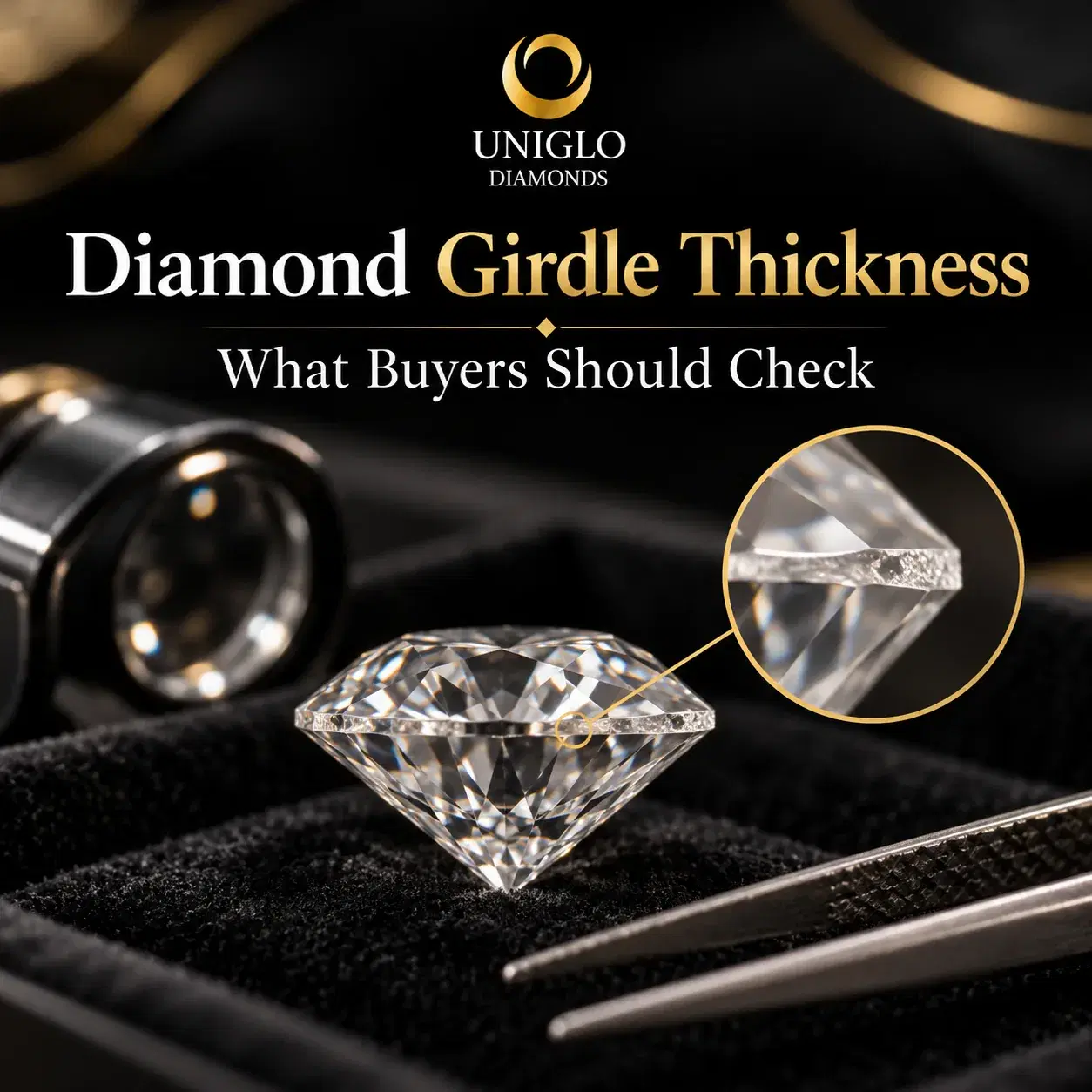
Diamond girdle thickness describes the depth of the edge between the crown and pavilion. Buyers should check the full reported range, the location of thin sections, the diamond’s face-up dimensions and its suitability for the proposed setting. A thicker girdle is not automatically better, and a single percentage cannot establish overall cut quality or durability.
The girdle receives less attention than colour or clarity, but it deserves a place in your buying decision. A diamond may look attractive face-up while an edge detail still needs inspection. Another may reach your desired carat weight without providing the dimensions you expected.
This guide explains the terms on a grading report and the practical questions to ask before buying a loose diamond or approving one for jewellery. It focuses on the girdle; choosing the whole diamond still requires its report, appearance, condition and price to be considered together.
What is the girdle of a diamond?
The girdle is the outer edge separating the crown, above it, from the pavilion, below it. IGI’s glossary identifies it as the area at which a diamond’s diameter or length and width are measured. Girdle thickness is the vertical distance across that edge, rather than the diamond’s overall width.
Imagine viewing a loose diamond from the side. The crown rises towards the table, the pavilion narrows towards the bottom, and the girdle sits between them. The thickness description concerns that connecting edge around the stone.
Do not confuse girdle thickness with total depth or lower-half facet length. These are separate proportion details. When a supplier sends a diagram, ask them to identify the feature you are discussing so that you are comparing like with like.
How to read a diamond girdle thickness range
A report may show one description, such as Medium, or a range, such as Thin to Slightly Thick. A range does not mean the diamond was graded inconsistently: it describes variation around the edge.
GIA’s girdle assessment booklet explains that its verbal descriptions for standard round brilliants generally identify the thinnest and thickest valley positions, assessed visually at 10× magnification. If both fall in the same category, one description can be reported.
Read both ends. “Very Thin to Thick” should not be interpreted as “Medium on average”. The thicker sections do not remove the need to examine the thinner ones. Equally, a maximum description does not tell you how much of the circumference has that thickness.
Ask where each extreme occurs and whether it affects the proposed mounting. A report provides the description; a detailed inspection helps explain what that description means for your particular purchase.
Diamond girdle thickness chart: what the terms mean for buyers
These are recognised descriptive categories, not a ranking from worst to best. The questions below are buying prompts rather than automatic acceptance rules.
| Girdle description | What to ask before choosing |
|---|---|
| Extremely Thin | Where is the section, and what is the durability assessment? |
| Very Thin | Is the thin area exposed or at a vulnerable location? |
| Thin | Has the complete edge been checked for the proposed setting? |
| Medium | Do the dimensions, condition and appearance meet the brief? |
| Slightly Thick | Is the thickness compatible with the mounting and desired dimensions? |
| Thick | How does the face-up size compare with alternative stones? |
| Very Thick | Is the additional weight worthwhile for this purchase? |
| Extremely Thick | Why is this stone preferable to alternatives with comparable specifications? |
Use the chart to organise a discussion with the supplier. It does not establish that every Medium girdle is suitable, that every Thick girdle is poor value, or that a stone can safely be mounted without examination.
What is the best girdle thickness for a diamond?
For a conventional round brilliant, a range within Thin, Medium and Slightly Thick is a useful starting point for a shortlist. IGI includes those descriptions in its discussion of a particular balanced round-brilliant proportion combination. That is guidance for round diamonds, not a universal rule for every shape and design.
The best purchase still needs to meet your overall requirements. A promising girdle description should lead to the next checks: appearance, dimensions, condition, report details and setting approval. It should not end the selection process.
For fancy shapes, discuss the specific outline and edge locations with a jeweller. A round-diamond filter applied indiscriminately to pears, princess cuts, cushions and emerald cuts can conceal the very differences you need to understand. Uniglo’s diamond shapes guide can help you establish the shape before comparing its proportions.
Girdle thickness percentage and verbal description are different
For standard round brilliants, GIA’s anatomy guide describes the girdle percentage as an average measured at eight bezel/main hill positions. Its verbal range is visually assessed at valley positions. The percentage and the range therefore describe different aspects of the same scalloped edge.
This explains why a numerical percentage need not match the value you expected from a general online chart. Do not convert the number directly into a verbal category without knowing the laboratory’s measurement method and reference positions.
To understand the arithmetic, thickness expressed relative to diameter takes this form:
Girdle thickness percentage = measured thickness ÷ reference diameter × 100
For illustration only, 0.24 mm divided by a 6.00 mm reference diameter equals 4.0%. This example is not a laboratory classification boundary or a recommended target. It also does not describe the thinnest section elsewhere around that hypothetical stone.
For a fancy shape or a different laboratory’s report, ask what the displayed percentage represents. Keep the report’s wording with the number when recording a shortlist; copying only “4%” into a comparison sheet removes essential context.
Why very thin girdle sections need attention
GIA’s guide to protecting diamonds from chipping identifies very thin sections, including those at corners and points, as vulnerable locations. Diamond’s resistance to scratching does not make it immune to impact damage.
An Extremely Thin or Very Thin minimum deserves an explicit durability discussion before purchase. Ask the supplier to locate the area, show a magnified view and have a qualified jeweller assess it for the intended setting. A flattering face-up video cannot answer all of those questions.
Also ask about characteristics close to the edge. GIA’s round-diamond buying guide advises considering the type, number and placement of inclusions near the girdle alongside thickness. The concern is the individual feature and its location; do not assume every feather creates the same risk.
For remote purchases, agree how an unresolved edge concern will be handled before placing the order. Obtain clear photographs and an inspection opportunity where available. If the supplier cannot adequately explain a questionable section, compare another candidate rather than deciding from the range alone.
Does a thick girdle make a diamond look smaller?
A thick girdle can retain weight without adding equivalent face-up size. GIA’s round-diamond guide warns that a heavier stone may hide weight in the girdle or pavilion. This is a reason to compare measurements, not a reason to assume every thickness difference has the same visible effect.
Record the actual diameter for rounds, or length and width for fancy shapes, beside the carat weight. Compare stones with similar origin, shape and reported quality before concluding that one offers better value. Uniglo’s diamond size chart provides context, while the candidate’s own measurements should guide the decision.
For example, imagine two proposed round diamonds with similar weights but different diameters. The smaller one deserves a closer proportion review, but the dimensions alone do not prove that its girdle caused the difference. Ask for the full report and inspect the appearance before choosing.
Do not chase maximum spread by ignoring durability or performance. The practical aim is a diamond whose visible size, appearance and condition justify the price and suit the jewellery design.
How shape changes the girdle check
For a round diamond, review the entire circumference. For pointed shapes, ask for clear views of the tips and corners as well as the sides. GIA’s chipping guidance highlights pointed areas as vulnerable, so a general face-up photograph should not be the only evidence considered.
Cushions need their own location-specific discussion. GIA notes that their girdles commonly vary, with thicker corners and thinner sections between them. Normal variation does not remove the need to inspect an extremely thin area.
Ask a supplier to identify the part of the outline that corresponds to the minimum and maximum descriptions. An annotated image is especially helpful for remote buyers. Without it, two stones with the same range can be difficult to compare meaningfully.
Does girdle thickness affect the cut grade?
Girdle thickness is one consideration in assessing a diamond’s cutting. It is not a stand-alone sparkle grade. Do not use a favourable thickness description to overlook the diamond’s appearance or treat one unfavourable detail as a complete explanation of its performance.
GIA currently limits its overall cut grade to standard round brilliants in the D–Z colour range. When reviewing a fancy-shaped diamond, distinguish polish and symmetry grades from an overall cut grade.
IGI’s fancy-shape cut methodology includes shape-specific craftsmanship checks, including girdle considerations, alongside other assessments. Read the actual report and identify which grades it contains. Uniglo’s diamond certificates guide provides a useful route into reviewing the documentation.
Faceted, polished and bruted: finish is separate from thickness
A girdle may be faceted, polished or bruted. Faceted describes small polished surfaces around the edge; a polished girdle has a smooth polished surface; a bruted girdle has the granular surface associated with shaping. These finish descriptions are separate from how thick the edge is.
Do not interpret “faceted” as “sufficiently thick”, or a bruted surface as evidence that the diamond is damaged. If an edge looks irregular in a photograph, ask a qualified examiner to distinguish its finish from any condition concern.
Record finish and thickness separately when comparing stones. This avoids a common enquiry problem: receiving “faceted girdle” as an answer when you actually asked whether a thin section was suitable for the design.
Check the girdle with the proposed setting
Give the setter the specific diamond’s report and dimensions before approving a mounting. Ask how the edge will sit in the design and whether any area needs further examination before work starts. A stock image of a similar ring cannot establish the fit of your chosen stone.
A bezel can help shield the edge, while protective prongs can cover vulnerable points. Neither approach makes a problematic section automatically acceptable. The condition of the diamond, the setting design and the quality of the work still need assessment.
For an existing ring, GIA’s chipping guidance recommends attention to worn or damaged prongs and loose stones. Have the mounting inspected if the diamond moves or a prong is damaged; an acceptable girdle description does not replace ongoing maintenance.
For a replacement stone, obtain the setter’s dimensional requirements first. Do not order by carat weight alone, and ask the setter to approve the actual candidate before it is mounted. Preserve inspection photographs with the order so both parties have a record of the edge condition.
A practical buying checklist
Use this sequence when reviewing a candidate from Uniglo’s diamond inventory or discussing a sourcing brief. Availability and suitability should be confirmed for the actual stone.
| Check | Evidence to request |
|---|---|
| Identify the candidate | Supplier reference, report number and matching media |
| Read the whole girdle description | Minimum, maximum and finish, exactly as reported |
| Locate areas needing attention | Annotated side views or a qualified inspection |
| Compare visible size | Actual measurements beside weight and price |
| Confirm the setting | Setter’s review of the specific diamond and design |
| Resolve uncertainty before ordering | Written answers and agreed inspection or return terms |
Keep the evidence together rather than spreading it across separate messages. If the supplier substitutes a different stone, repeat the relevant checks for that candidate instead of carrying approval over from the original.
What to ask your diamond supplier
An effective enquiry explains the intended jewellery and asks for evidence that can be reviewed. You can adapt this wording:
Please send the report and dimensions for this diamond, together with its complete girdle description. If the range includes Very Thin or Extremely Thin, please identify the location and provide an inspection assessment for the proposed setting. If it includes Very Thick or Extremely Thick, please show how its face-up size compares with suitable alternatives. Please include clear edge views and confirm the inspection and return terms before I approve the stone.
Send your requirements through Uniglo’s enquiry page, with the design or setting details where available. Ask for clarification of any unresolved point before choosing, rather than relying on an overall reassurance that the diamond is “good quality”.
Frequently asked questions
More Topics




