
Diamond Bow-Tie Effect: How to Judge It in Videos
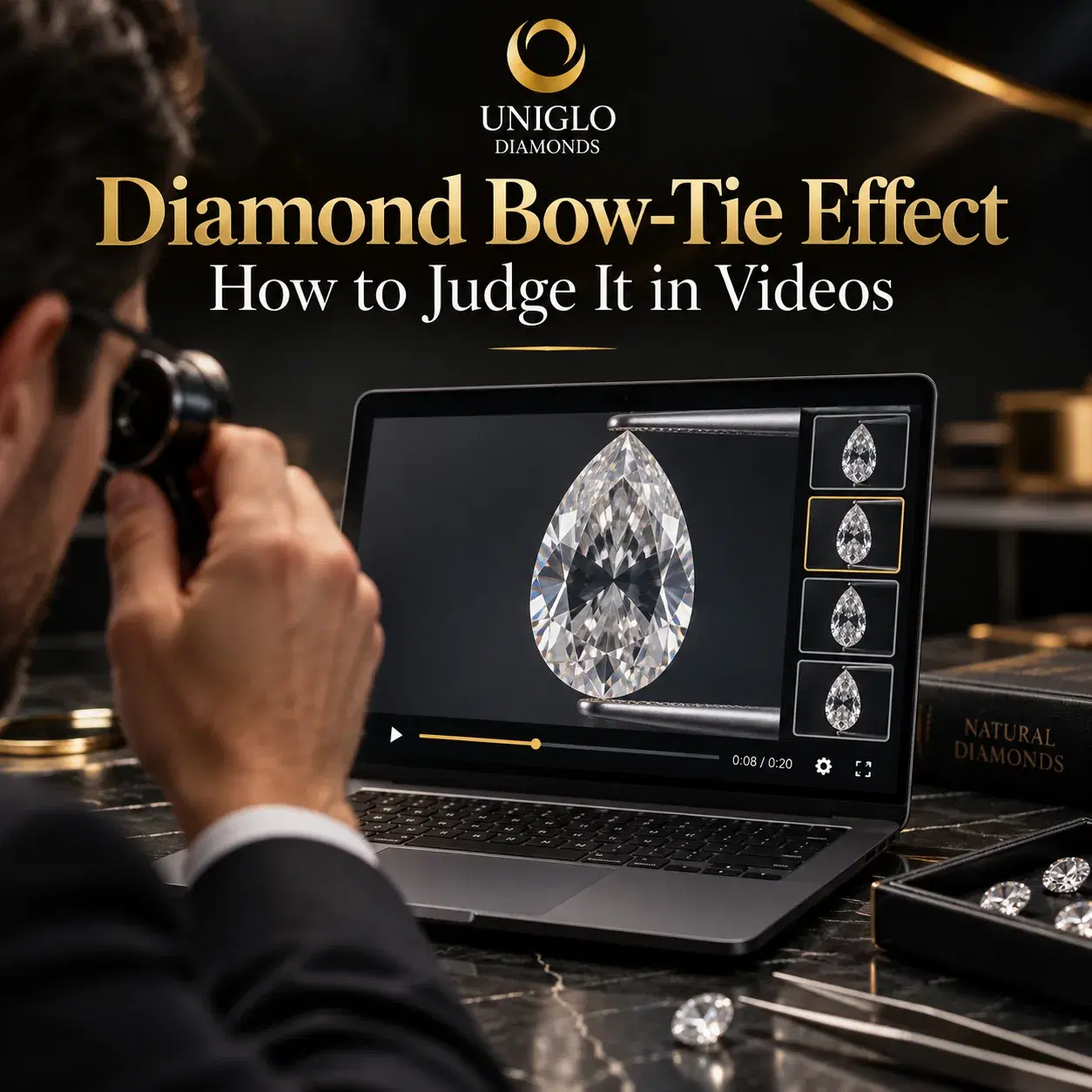
The diamond bow tie effect is a dark, bow-shaped pattern that can appear across the centre of an elongated diamond, especially an oval, pear or marquise. To judge it in a video, watch whether the central area brightens as the diamond moves or remains a distracting dark band. Compare face-up views, gentle tilts and more than one lighting environment before deciding.
A single screenshot cannot establish how a diamond will look in daily wear. The darkest frame may exaggerate a momentary reflection, while the brightest frame may miss a pattern that appears frequently. A useful video shows the diamond’s behaviour through movement, with enough context to understand the lighting and camera position.
The aim is to decide whether you enjoy the stone’s overall appearance and whether its centre stays visually engaging. This guide provides a practical viewing method for that decision, rather than a numerical bow-tie grading scale.
What causes the diamond bow tie effect?
A diamond’s facets gather and redirect light from its surroundings. In some elongated brilliant cuts, the arrangement of those facets creates a characteristic contrast pattern across the middle. The viewer can also block incoming light, contributing to the darkness seen in that area.
GIA’s discussion of diamond cut and appearance explains that observer obstruction interacts with the faceting arrangement to produce the bow-tie pattern. Viewing distance and the lighting environment influence its visibility. A close camera and its surroundings can likewise affect the recorded appearance, so a video is a view under particular conditions, not a complete account of the diamond.
The bow tie is an optical appearance pattern, rather than an inclusion shaped like a bow tie inside the crystal. Changing the camera angle may change its appearance without changing the diamond itself. That is why the question “Does this stone have a bow tie?” is less useful than “How prominent is it under the conditions in which I will see the stone?”
Which diamond shapes commonly show a bow tie?
Oval, pear and marquise brilliant cuts are the main shapes discussed in GIA’s research on rounded fancy diamonds. Their faceting arrangements can produce different central patterns, some persistent and others brightening during movement. Individual stones need to be assessed rather than judged by their outline alone.
For an oval, watch the central band together with both rounded ends. For a pear, examine the middle without letting flashes near the tip or rounded end distract you from it. For a marquise, compare the central area with both wings and points. These are viewing prompts, not shape-specific acceptance grades.
You can use Uniglo’s diamond shapes guide to compare outlines. When assessing a particular bow tie, however, use imagery of that exact diamond rather than a representative photograph of the shape.
Is every visible bow tie a problem?
Some contrast contributes to the pattern you see as a diamond moves. The presence of darkness in one view does not automatically make a diamond unattractive. GIA’s fancy-shape research found that broad, dark or persistent bow ties were generally disliked, while opinions differed for narrower or more transient patterns.
Your own preference still matters. A central pattern may bother one buyer and appeal to another. Consider whether you keep noticing a dark division across the stone or whether you enjoy the changing reflections as part of its overall appearance.
The following descriptions are practical observations for comparing videos. They are not laboratory grades, standardized severity categories or fixed purchasing rules.
| Observation in comparable videos | How to use it |
|---|---|
| The centre darkens briefly, then produces bright reflections | Watch the complete motion cycle before judging a paused frame. |
| A broad central band stays dark through several gentle tilts | Request another lighting environment and viewing distance. |
| The pattern becomes much stronger in a close-up | Compare it with a less magnified view that better represents wearing distance. |
| The centre looks bright only at a steep tilt | Request a clear face-up view and movement close to that position. |
| The whole stone looks dim or the footage lacks detail | Improve the viewing evidence before assigning the effect to the diamond. |
| A video barely shows the stone face-up | Ask for additional footage; the existing clip is insufficient for this comparison. |
How to judge a bow tie in diamond videos
1. Confirm that you are watching the actual diamond
Start with the stock reference and any corresponding grading-report number. Confirm that the video shows the stone offered for purchase. A shape demonstration or a video of a similar diamond can explain the effect, but it cannot establish the appearance of the one you intend to buy.
Save each candidate’s reference with its video. If you are comparing several stones, label the clips clearly so a promising view does not get attributed to the wrong diamond. Reconfirm the reference when requesting follow-up footage.
2. Find a clear face-up view
Face-up means looking towards the diamond’s top, with its outline clearly visible. Pause briefly near that position to identify the central pattern, then resume playback. Note its width, darkness and relationship to the rest of the stone without treating the pause as your final verdict.
A side view can provide useful context, but it does not replace a face-up assessment. If most of the clip shows the pavilion or a sharply tilted stone, request footage that spends more time near the orientation in which you expect to see the diamond set in jewellery.
3. Watch gentle movement around that position
Look for slow rocking forward and backward and from side to side. These movements help you follow what happens to the same central area rather than simply seeing a succession of unrelated angles. This is a practical request for clearer evidence, not a prescribed laboratory testing motion.
Observe whether the centre changes from dark to bright, whether only a small part brightens or whether the band continues to dominate. Compare those changes with the rest of the stone. A bright flash elsewhere does not answer the question of how the middle behaves.
Avoid deciding from the single best or worst moment. Watch the clip at its normal speed first, then use slower playback or pauses to understand the pattern you noticed. Enlarging a low-resolution recording cannot recover detail that was never captured.
4. Request more than one lighting environment
Ask for a view in soft, diffuse light and another in ordinary indoor light. Describe the conditions you want rather than requesting only “a better video”. If a clip is made under concentrated jewellery spotlights, use it as one view alongside footage in less dramatic lighting.
GIA’s pear-shaped diamond guidance recommends examining the stone from different angles under lighting conditions in which the jewellery will be worn. Apply that principle to the video request: choose conditions relevant to your use, rather than assuming that one lighting setup is universally decisive.
The backgrounds and surroundings should also be disclosed or visible where practical. A dark background is not proof of a poor diamond, and a bright background is not proof of an attractive one. What matters is having enough consistent information to interpret the comparison.
5. Include a view at an ordinary viewing distance
Macro footage helps reveal the pattern, but it magnifies details far beyond the view of a ring on a hand. Ask for a second clip at a less magnified scale, with the diamond still in focus and clearly identifiable. Assess whether the central darkness remains your first impression.
GIA’s marquise buying guide recommends face-up viewing without magnification under normal lighting and at a normal viewing distance. An on-hand or temporary-holder view can help put the size and appearance in context, although the holder and recording conditions still need to be considered.
Do not expect the macro and ordinary-distance views to look identical. Use them to answer different questions: what pattern is present in detail, and how noticeable is that pattern in a more familiar view?
6. Compare candidates under similar conditions
Ask for shortlisted stones to be filmed using the same lighting, background, camera distance and movement where possible. Otherwise, the recording conditions can become part of what you are comparing. Side-by-side footage or separate clips made with one setup are useful ways to reduce that uncertainty.
Record simple observations rather than invented scores. For example: “The centre brightens during gentle rocking in both clips” or “The central band remains the feature I notice first in the indoor view.” Keep those notes attached to the stock references and use them to narrow your shortlist.
Why a screenshot or 360-degree video may be insufficient
A screenshot records one combination of angle, illumination and camera position. It is useful for marking the area you want the supplier to discuss, but it cannot show whether that area brightens with movement. Send the image with the video reference and timestamp so the supplier understands your concern.
A 360-degree recording can also be useful, but its value depends on the views it contains. Rotation around one axis may provide little gentle movement close to face-up. A complete spin is therefore not automatically a complete bow-tie assessment.
If the existing footage leaves a question unanswered, request the missing view specifically. For example, ask for slow side-to-side rocking near face-up in diffuse light. A targeted request is more useful than collecting several additional clips that repeat the same angle and lighting.
Can a grading report tell you how strong the bow tie is?
Read the actual report fields and the laboratory’s methodology. Polish and symmetry grades describe aspects of finish and craftsmanship; they should not be treated as a direct description of how distracting the central pattern will look to you in every environment.
GIA’s current grading guidance states that its overall cut grade applies to D-to-Z standard round brilliants. An oval, pear or marquise with Excellent polish and Excellent symmetry should not therefore be assumed to carry a GIA Excellent overall cut grade.
IGI offers a fancy-shape cut-grading process that includes polish, symmetry, qualifying proportions, additional craftsmanship requirements and light-return assessment. Check whether the particular report includes that assessment. A cut grade provides useful context, but it does not replace viewing the stone or establish a universal “zero bow tie” promise.
Uniglo’s diamond certificates guide explains broader report terminology. For this buying decision, combine the relevant document with imagery of the matching stock item and a clear understanding of the purchase terms.
Can table, depth or length-to-width ratio predict a bow tie?
These measurements help describe a diamond, but they are not a complete model of its appearance. Fancy shapes have different facet arrangements and outline variations. Two stones with similar headline proportions can therefore require separate visual assessments.
Do not use a preferred length-to-width ratio as a guarantee against a bow tie. Choose an outline you like, then examine the actual centre pattern in comparable footage. Similarly, a table or depth range may help organize a shortlist without establishing how every shortlisted stone behaves in movement.
If a seller uses “bow-tie-free” or a similar description, ask what it means and under which viewing conditions the stone was assessed. Request supporting footage rather than treating the phrase as a standardized laboratory grade.
Bow tie, light leakage and inclusions: avoid confusing them
A bow tie describes a characteristic central appearance pattern. Light leakage concerns light that does not return towards the viewer, while windowing can create an area through which the background becomes visible. An inclusion is a physical characteristic within or reaching the surface of the diamond. These terms describe different things.
A dark area in a compressed video is not enough to diagnose its precise cause. When you are uncertain, ask a qualified gemologist to interpret the stone and any supporting imagery. For a buyer’s initial shortlist, record what you can actually see without assigning an unsupported technical explanation.
What video should you request before buying?
A useful request identifies the stone and specifies the missing evidence. You can send the following wording to the supplier:
“Please send a video of stock reference [reference] showing the diamond face-up, followed by slow rocking forward and backward and from side to side. Please include soft diffuse light and ordinary indoor light, plus a less magnified view. I would like to see whether the central bow-tie area brightens with movement. If possible, film my shortlisted stones under the same conditions.”
Before purchasing, confirm any available inspection, return or in-person viewing arrangements. A remote shortlist is more useful when you also understand how the final decision can be made. Do not assume a particular supplier offers those arrangements without confirmation.
Shortlisting an oval, pear or marquise at Uniglo
Browse Uniglo’s oval lab-grown diamonds, pear-shaped lab-grown diamonds or marquise lab-grown diamonds to identify relevant shapes and stock references. Judge each stone’s optical appearance individually and keep its stated origin with your shortlist.
Contact Uniglo Diamonds with the references you are considering and the video views you need. Ask what additional imagery or viewing options are available, then compare the evidence before making your selection.
Frequently asked questions
More Topics




