
D vs F Colour Lab Grown Diamonds
Choosing between a D vs F lab grown diamond is not a decision between a colourless diamond and a visibly yellow diamond. D and F sit within the same colourless category on the D-to-Z diamond colour scale, with D representing the highest colour grade and F representing the lower end of the colourless range. The technical distinction is real, but the practical buying question is whether that distinction produces enough visible difference in the individual diamonds you are comparing to justify any difference in price.
GIA groups D, E and F diamonds together as colourless, while IGI also places D–F within its colourless grading category. That does not make D and F identical grades. A D diamond is graded as having less detectable body colour than an F diamond under controlled grading conditions, but both sit at the top end of the conventional D-to-Z range. You can review GIA’s official diamond colour scale and IGI’s laboratory-grown diamond report guidance for the underlying grading framework.
For many buyers, the best decision is therefore not simply to ask whether D is “better” than F. It is to compare two individual diamonds with similar carat weight, shape, clarity and cutting characteristics, look at them under controlled and ordinary viewing conditions, verify their grading reports and then determine whether the additional cost of the higher colour grade provides a visible benefit that matters to you.
What Is the Actual Difference Between D and F Colour?
D is the highest grade on the conventional D-to-Z colour scale. F is two grading steps below D because E sits between them, but both remain within the colourless range. The grading system measures progressively increasing traces of colour as you move from D toward Z, so the technical difference between D and F is a difference in the amount of detectable body colour under laboratory grading conditions.
This distinction is considerably more precise than simply looking at two face-up product photographs. GIA determines diamond colour under carefully controlled lighting and viewing conditions using master comparison stones. The diamond is evaluated in a position designed to make body colour easier to assess rather than judging only the face-up sparkle that a customer normally sees in jewellery. IGI similarly states that colour grading is carried out in a standardised viewing environment and that multiple graders independently assess colour before the final grade is established.
That distinction matters because a jewellery buyer normally sees the diamond face up, surrounded by reflections, facets, metal and changing light. The laboratory is deliberately trying to detect subtle body-colour differences that may be much harder to isolate during normal wear. A D grade is therefore genuinely higher than an F grade, but the grading difference should not automatically be interpreted as an equally obvious visual difference when the stones are being worn.
For broader context on how colour works alongside carat, clarity and cut, see Uniglo’s Diamond 4Cs guide.
Can You See the Difference Between a D and F Lab Grown Diamond?
Sometimes, but the comparison needs to be controlled. Looking at a D diamond under one light and an F diamond under another, or comparing separate product photographs taken using different exposure, white balance or magnification, is not a reliable way to judge the colour difference.
The strongest comparison uses diamonds of the same shape and approximately the same weight, displayed at the same scale and under the same lighting. Ideally, the stones should first be compared face up as they would normally be seen in jewellery and then inspected under a neutral comparison environment if you want to investigate the colour distinction more closely.
GIA notes that many differences between neighbouring high colour grades are subtle enough to be difficult for an untrained observer to detect. This is especially relevant when discussing two stones that are not merely close on the scale but are both already inside the D–F colourless category.
That does not mean nobody can distinguish D from F. A trained grader using controlled conditions is performing a different type of assessment from a consumer looking at a finished ring. Some buyers may also be more colour-sensitive than others. The sensible approach is therefore to avoid claims such as “D and F always look identical” or “everyone can clearly see the difference”. The answer depends on the stones, comparison conditions, shape, size and observer.
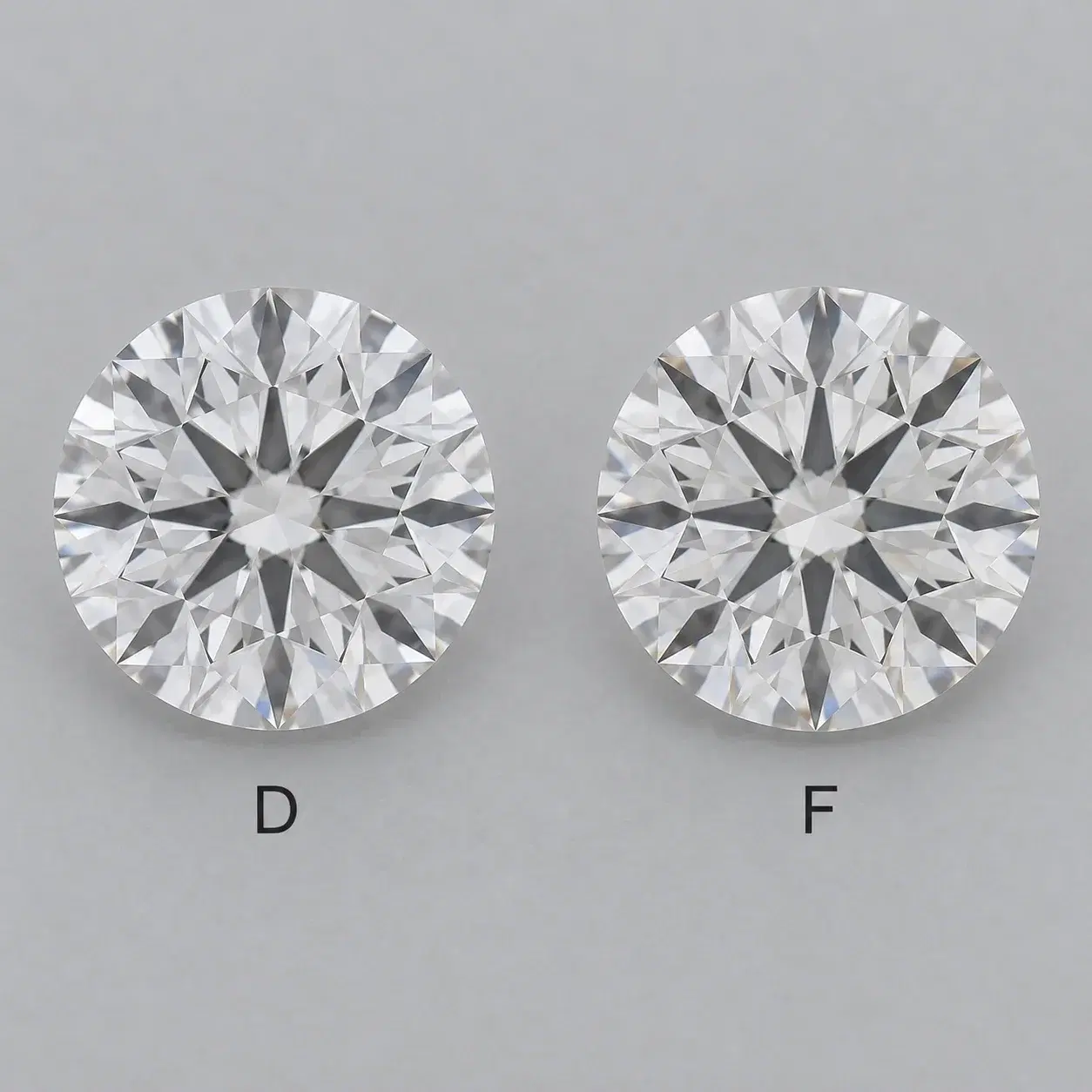
Illustrative comparison. Specifications and prices shown are not a current quotation.
D vs F Colour in a One-Carat Lab Grown Diamond
A useful comparison comes from looking at actual diamonds where most of the headline specifications remain similar. Public retail listings checked for this article included two 1.00-carat round laboratory-grown diamonds graded VS1 and described by the seller as Ideal cut. The D-colour example carried IGI report reference LG807638649, measured approximately 6.39 × 6.34 × 3.95 mm and was displayed at US$275. The F-colour example carried IGI report reference LG813672660, measured approximately 6.41 × 6.38 × 3.96 mm and was displayed at US$269.
The six-dollar difference is useful precisely because it demonstrates why buyers should not assume that moving from F to D automatically creates a dramatic price jump in every individual listing. In this pair, the D diamond was approximately 2.2% more expensive than the F diamond, but even this small difference cannot be attributed solely to colour. The diamonds are individual stones with slightly different measurements and potentially other report-level characteristics.
The more important lesson is that a one-carat buyer should compare the complete diamonds rather than deciding that the D label must automatically justify a substantial premium. If the two stones look effectively equivalent to you when viewed under the same conditions and the F diamond satisfies the rest of your requirements, F may allow you to allocate more of the budget elsewhere. If you specifically value obtaining the highest colour grade and the price difference is small, D may be a reasonable choice.
This is also why dated examples should remain dated. Laboratory-grown diamond inventory and asking prices change, so these figures are comparison evidence from the review date rather than a permanent D-versus-F pricing formula. For wider pricing methodology, read Uniglo’s Lab Grown Diamond Prices guide.
D vs F Colour in a Two-Carat Lab Grown Diamond
The same approach becomes even more important as carat weight increases. A second public comparison reviewed for this article involved two 2.00-carat round laboratory-grown diamonds, both VS1 and both described as Ideal cut. The D-colour stone, IGI report LG813610715, measured approximately 8.21 × 8.16 × 4.93 mm and was displayed at US$477. The F-colour stone, IGI report LG822630923, measured approximately 8.13 × 8.04 × 4.94 mm and was displayed at US$463.
Here, the D stone was US$14 more expensive, a difference of roughly 3% against the F example. Once again, however, it would be incorrect to conclude that the D colour grade itself was worth exactly US$14. The D example also had somewhat larger face-up dimensions, and individual stones can differ in proportions, report details and seller inventory economics.
This is why dated quotations need to be treated as evidence about real buying choices rather than as an attempt to calculate a universal “D colour premium”. If you receive a current quotation for a D diamond and an F diamond, compare the exact reports and measurements before concluding how much of the price difference is genuinely attributable to the colour grade.
For understanding the relationship between carat weight and actual millimetre dimensions, use Uniglo’s Diamond Size Chart.
Does D Colour Automatically Mean a Better Lab Grown Diamond?
D is a higher colour grade than F, but that does not make every D-colour diamond a better overall purchase than every F-colour diamond. Colour is only one characteristic of an individual stone.
Consider a D diamond with proportions or light performance you do not prefer and an F diamond with an appearance you find substantially more attractive. Choosing the D diamond purely because the letter sits higher on the colour scale would give one grading characteristic more importance than the complete appearance of the stone.
The same applies to clarity. A D/SI1 diamond and an F/VS1 diamond change both colour and clarity simultaneously. If the prices differ, it becomes difficult to determine which characteristic is responsible for the difference. A more useful D-versus-F comparison keeps shape, weight and clarity as similar as possible before assessing whether the higher colour grade produces a benefit you value.
When reviewing an IGI-graded laboratory-grown diamond, the report can help establish the diamond’s colour, clarity, measurements and other recorded characteristics. Uniglo’s IGI Certified Lab-Grown Diamonds guide explains how to use the document in the buying process.
Why D and F Should Be Compared Using the Individual Reports
A colour comparison becomes far more useful when the report numbers remain attached to the diamonds being discussed. A statement such as “D costs US$500 and F costs US$450” has limited value if you do not know whether the stones share the same carat weight, shape, clarity or dimensions.
The grading report allows the comparison to remain connected to specific stones. When asking for D and F options from a supplier, request the exact carat weight, millimetre measurements, clarity grade, report number, polish, symmetry and relevant cut information rather than asking only for the colour and price.
For laboratory-grown diamonds, the documentation should also establish the laboratory-grown origin of the stone. IGI explains that its laboratory-grown diamond reports record origin and quality information, while colour assessment itself takes place under standardised grading conditions. The report is therefore useful for identifying what is being sold, but it should not be treated as a price appraisal. Whether the price represents good value still needs to be determined by comparing the diamond and the complete commercial offer.
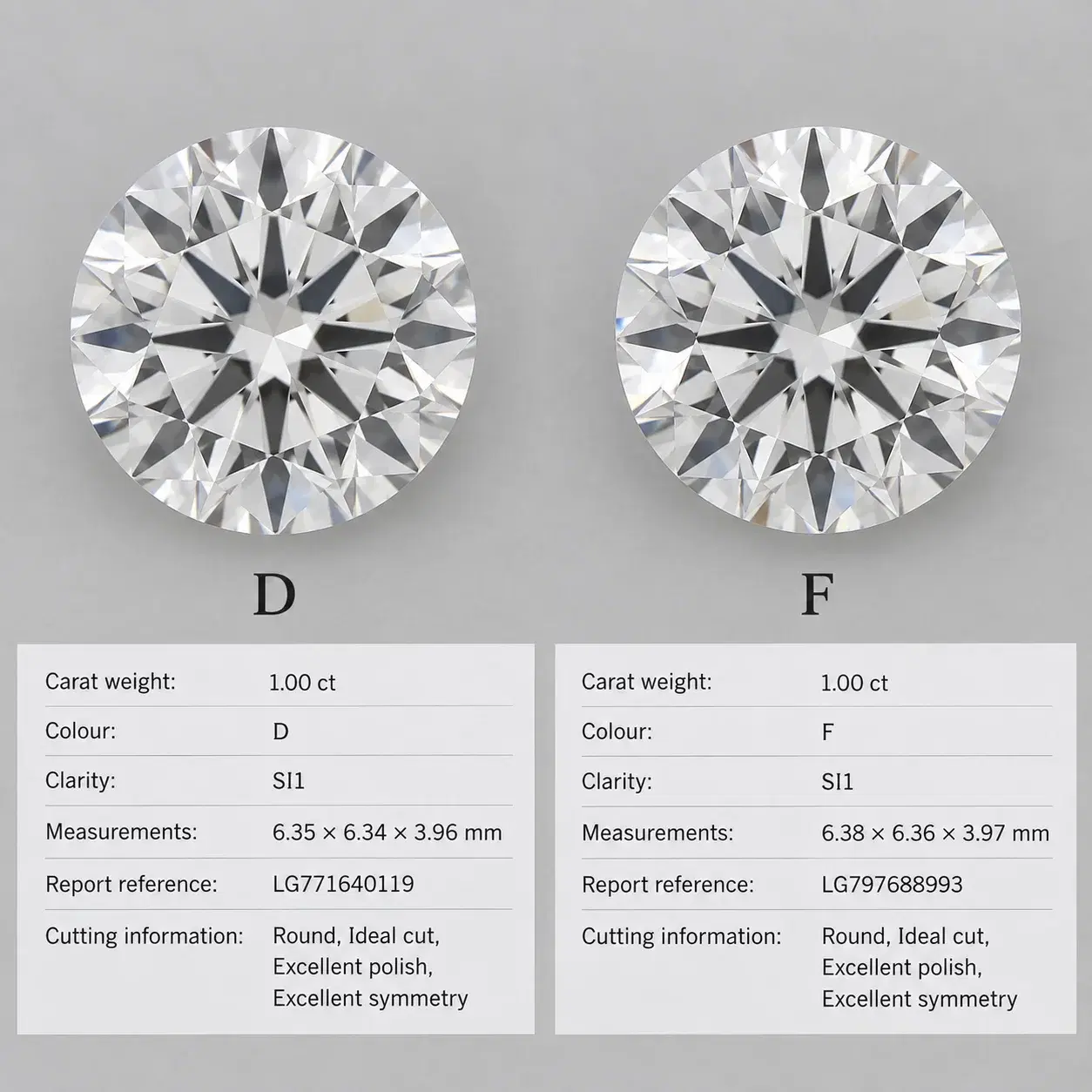
Illustrative comparison. Specifications and prices shown are not a current quotation.
Does F Colour Look Yellow Compared With D?
An F-colour diamond should not be described as a yellow diamond merely because it is two grades below D. F remains inside the colourless category used by both GIA and IGI.
The distinction between D and F concerns increasingly detectable traces of body colour under controlled grading conditions. By contrast, the word “yellow” in normal consumer language can suggest an obviously warm appearance that does not accurately describe why F belongs within the colourless category.
That is particularly important for website images. If an F diamond appears obviously yellow beside a D diamond in a comparison photograph, first investigate the photography. Different colour temperature, exposure, background, reflection or post-processing can create a much larger apparent difference than the diamonds themselves.
For the page’s supporting imagery, the D and F stones should therefore never be photographed separately and later placed side by side unless the capture conditions have been carefully matched. A controlled same-frame comparison is much more defensible.
Does Diamond Shape Affect How Easily You Notice D vs F?
Shape can affect the way colour is perceived because different facet arrangements distribute light and reflections differently. GIA notes, for example, that the brilliance of a round brilliant can help mask some yellow or brown colour more effectively than certain step-cut diamonds.
That means a D-versus-F decision should ideally be made within the shape you actually intend to purchase. Comparing a D round against an F emerald cut does not isolate colour. It simultaneously changes the facet architecture, proportions and outline.
If you want a round diamond, compare D and F rounds. If you want an emerald cut, compare D and F emerald cuts. The same principle applies to oval, radiant, cushion, pear and other shapes.
This is particularly useful for buyers who are highly sensitive to subtle colour. A comparison between individual stones of the intended shape gives you far more relevant information than trying to generalise from photographs of completely different cuts.
Uniglo’s Diamond Shapes guide can help you understand the structural differences between the major shapes before you begin the colour comparison.
Does the Ring Metal Change the D vs F Decision?
The surrounding metal can influence how the diamond is perceived because diamonds reflect light and colour from their environment. GIA notes that metal colour can influence the apparent colour of a diamond in a finished ring.
This means a loose-diamond comparison and a finished-jewellery comparison are not necessarily visually identical. If you intend to use platinum or white gold, compare the candidate diamonds with that final presentation in mind. If the ring will use yellow or rose gold, the warm surrounding metal becomes another source of reflected colour.
The practical implication is not that one metal universally requires D or F. It is that the complete ring should be considered rather than treating the loose stone as if it will always be viewed in a neutral white environment.
If the difference between D and F is already difficult for you to distinguish loose under controlled conditions, decide whether paying more for D provides enough benefit once the stone is placed into the actual ring design.
Should You Pay More for D Colour?
Paying more for D can make sense when the highest possible colour grade is specifically important to you, when you can see and prefer the difference in the individual stones, or when the additional cost is small enough that it does not force an unwanted compromise elsewhere in the purchase.
What does not make sense is assuming that D must always be chosen because it sits at the top of the scale. If moving from F to D requires you to accept a less attractive cut, poorer proportions, a smaller stone than you wanted or a substantially higher overall purchase price, the trade-off deserves closer examination.
The public one-carat and two-carat examples reviewed for this article also show why the premium should be established from current stones rather than assumed. The D examples were more expensive in those particular matched comparisons, but the differences were small and the stones were not perfectly identical in every other characteristic.
A useful buying question is therefore: “What exactly am I receiving for the additional amount between these two specific diamonds?” The answer should come from their reports, dimensions, appearance and current quotations rather than from the D and F letters alone.
When F Colour Can Be the More Efficient Choice
F can be a strong choice for a buyer who wants to remain within the colourless category but does not place special importance on owning the highest letter grade.
Because F is still colourless within the established grading framework, choosing it is not equivalent to accepting an obviously coloured diamond. If you compare a D and F stone under relevant viewing conditions and cannot identify a meaningful appearance advantage in the D diamond, the lower-priced F option may allow you to preserve budget for something more noticeable to you.
That could mean maintaining your preferred carat weight, selecting the setting you actually want or choosing the individual diamond whose cutting and appearance you prefer.
The important point is not that F is always the “better value”. Value depends on the actual options and the buyer’s priorities. F simply deserves to be judged as an individual colourless diamond rather than being treated as inferior merely because D exists above it.
When D Colour Can Be Worth Choosing
D is the appropriate choice when having the highest colour grade is itself part of your specification. Some buyers want the top available D-to-Z colour grade regardless of whether the difference is immediately visible in ordinary wear, and that is a legitimate purchasing preference.
D may also be attractive when two otherwise suitable diamonds are close in price. If you prefer the D stone, its report is strong, its proportions suit your requirements and the premium is modest, there may be little reason to move down to F simply for the sake of doing so.
The decision becomes less attractive when D colour carries a substantial premium that forces compromises you care about more. This is why the price should be evaluated against actual F alternatives rather than against a generic statement that D is more valuable because it is more colourless.
How to Compare D and F Lab Grown Diamonds Properly
The strongest comparison begins by narrowing the options to diamonds of the same origin and shape, with similar carat weight and clarity. Once those variables are reasonably controlled, compare the reports and millimetre dimensions before looking at the stones at the same scale.
The visual comparison should use identical lighting rather than two independently edited product images. Look at the diamonds face up under ordinary viewing conditions because that is how they will normally be seen, but remember that laboratory colour grading is intentionally performed under conditions designed to detect subtle body colour.
After the appearance comparison, review the price difference. A D diamond being more expensive does not prove that the additional amount is caused entirely by colour, because no two individual diamonds are identical. Measurements, proportions, finish and inventory conditions can also affect a quotation.
The final question is whether the D stone gives you a benefit you can identify and value. If it does, choose it. If the F diamond gives you effectively the same appearance you want at a more suitable total price, F can be the more efficient buying decision.
D vs F Lab Grown Diamond Price
There is no fixed percentage by which a D-colour laboratory-grown diamond must cost more than an F-colour diamond. General grading principles support D as the higher colour grade, but actual retail prices are attached to individual stones and inventories rather than to colour in isolation.
In the one-carat round VS1 examples reviewed for this article, the D stone was displayed at US$275 while the F stone was US$269. In the two-carat round VS1 examples, the D stone was US$477 while the F stone was US$463. Both comparisons showed a higher asking price for D, but neither pair was identical in every physical characteristic, so the difference should not be treated as a measured colour premium.
This is why a buyer should request two or more current quotations rather than applying a fixed percentage to an F price. Ask for stones that are genuinely comparable and retain their report references alongside the prices.
For a broader explanation of how weight, specifications and individual inventory affect laboratory-grown diamond pricing, see Uniglo’s Lab Grown Diamond Prices guide.
D vs F Lab Grown Diamond: Which Should You Choose?
If your goal is the highest colour grade available within the conventional D-to-Z scale, D is the clear technical choice. It occupies the top position on the colour scale and represents less detectable body colour than F under laboratory grading conditions.
If your goal is to obtain a colourless-grade diamond while balancing the complete specification and price, F deserves serious consideration. It remains in the same D–F colourless category and the difference from D can be subtle enough that the decision should be made using the individual stones rather than the grade names alone.
For most buyers, the most defensible decision is therefore to compare a D and F diamond of similar weight, shape, clarity and cutting quality side by side. If you can see and prefer the D diamond and the additional cost fits comfortably within the budget, choose D. If you cannot identify a meaningful visual advantage and the F diamond has the appearance and specifications you prefer, paying for the highest grade is not automatically necessary.
Frequently Asked Questions
Is D colour better than F in a lab grown diamond?
D is the higher colour grade. It represents the highest level of colourlessness on the D-to-Z scale, while F is two grades lower. However, both D and F are classified as colourless, so a higher technical grade does not automatically mean that the visual difference will be obvious to every buyer.
Is F colour considered colourless?
Yes. Both GIA and IGI place F within the D–F colourless category. It should therefore not be confused with a visibly yellow diamond simply because D sits higher on the scale.
Can you see D vs F colour with the naked eye?
The difference can be subtle, particularly without controlled side-by-side comparison. Whether you personally notice it depends on the diamonds, shape, size, lighting, setting and your own colour sensitivity. Compare the actual stones rather than relying on differently photographed online images.
Is a D colour lab grown diamond always more expensive than F?
Not necessarily in every individual listing. D is the higher colour grade and, all else being equal, higher colour grades can influence value, but real diamonds are not identical in every other characteristic. Current pricing should therefore be compared using individual reports and dated quotations.
Is D colour worth paying extra for?
It is worth paying extra if the highest colour grade is important to you or if you can see and prefer the difference in the particular diamonds being considered. If the F diamond looks equally suitable to you and allows a more useful allocation of budget elsewhere, F can be a sensible alternative.
Does F colour look yellow beside D?
F is still graded within the colourless range. A carefully controlled side-by-side comparison may reveal a subtle difference, but F should not normally be represented as an obviously yellow diamond. Strong yellow appearance in comparison imagery can also result from inconsistent lighting or image processing.
Should I choose D or F for a two-carat lab grown diamond?
Compare actual two-carat stones rather than making the choice from colour letters alone. Larger diamonds give you more material to observe, but dimensions, shape, cut, setting and lighting all affect appearance. Request comparable D and F stones with individual reports and current quotations.
Is D vs F more noticeable in an emerald cut?
Facet arrangement can influence how readily body colour is perceived. GIA notes that round brilliants can hide some colour more effectively than step-cut diamonds. If you intend to buy an emerald cut, compare D and F emerald cuts directly rather than using round-diamond photographs to make the decision.
Do D and F lab grown diamonds use the same grading scale as natural diamonds?
Laboratory-grown diamonds are assessed for colour using established diamond grading systems, and IGI reports D through F laboratory-grown diamonds within its colourless category. When comparing stones, check the individual report to confirm the assigned colour grade and laboratory-grown origin.
Which offers better value, D or F?
There is no universal answer. D offers the higher colour grade, while F may offer a lower purchase price while remaining within the colourless category. Better value depends on the actual stones, visible appearance, reports and current quotations being compared.
Compare D and F Lab Grown Diamonds With Uniglo
If you are deciding between D and F colour lab grown diamonds, contact Uniglo Diamonds with your preferred shape, carat range, clarity requirement, budget and intended jewellery design. Ask for comparable individual stones rather than generic grade-based pricing so that you can review their reports, measurements, appearance and current quotations together.
For the most useful comparison, request D and F options with similar weight, clarity and shape and ask for images or video captured under matching conditions. You can then decide whether the higher D colour grade provides a visual or specification advantage that is worth the difference in price for your particular purchase.
You can also explore Uniglo’s Lab-Grown Diamonds, Lab Grown Diamond Prices guide, Diamond 4Cs guide and IGI Certified Lab-Grown Diamonds guide before comparing individual D and F options.




