
Cushion vs Radiant Diamonds
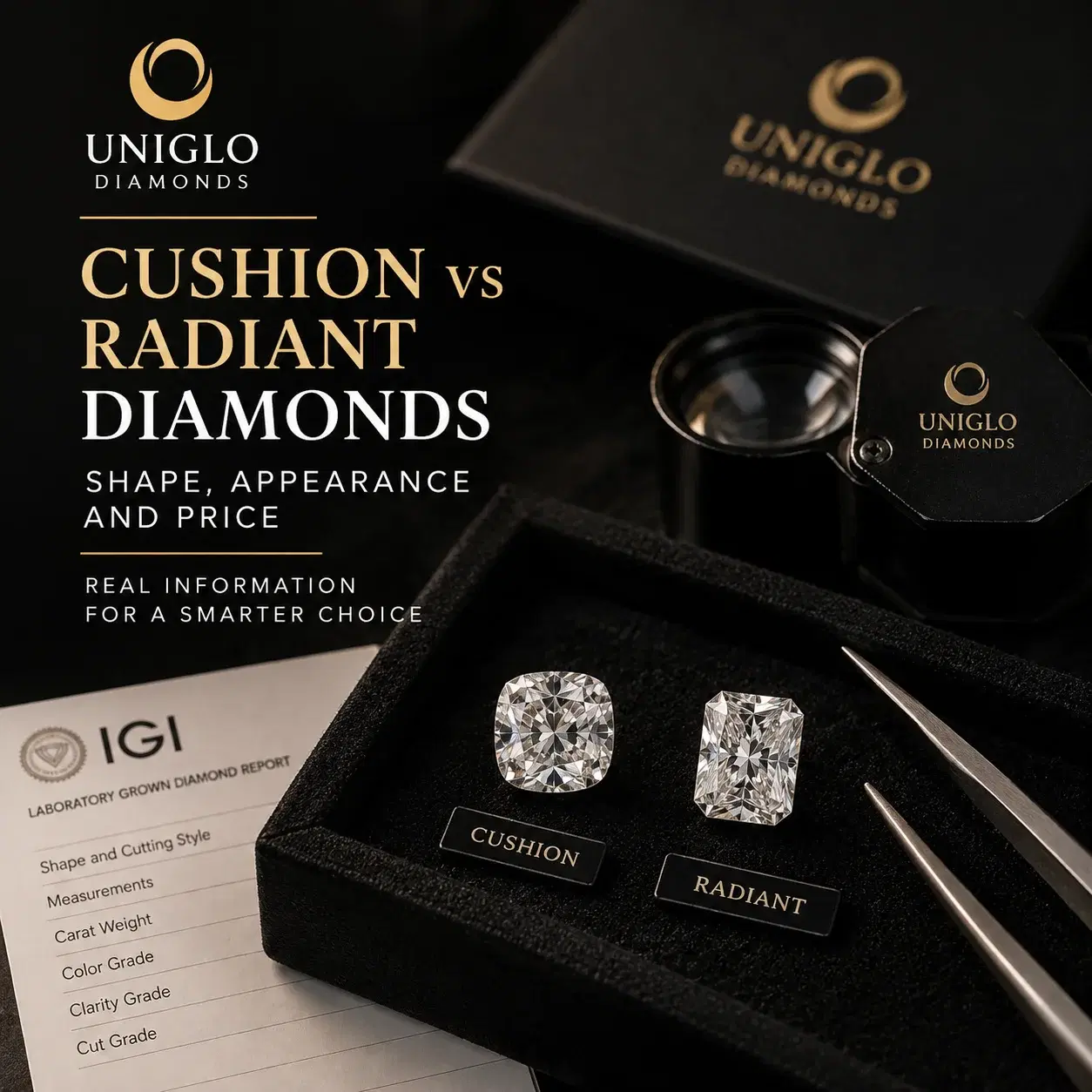
Cushion diamonds typically have curved sides and rounded corners, while radiant diamonds usually have straighter sides and clipped corners, creating a more angular outline. Both shapes can be square or rectangular, and both can show strong brilliance and lively reflections.
GIA explains that cushion and radiant diamonds can use different brilliant-style facet arrangements, so shape alone does not tell you exactly how an individual stone will look. You can review GIA’s broader diamond shape guidance for additional context.
An elongated cushion belongs directly within this comparison because its external dimensions can become very similar to those of a rectangular radiant.
At that point, the buying decision becomes less about simple length and width and more about:
the curve of the sides, corner shape, facet pattern, contrast and how the diamond works in the intended setting.
The same comparison framework applies to both natural and laboratory-grown diamonds.
For a wider overview of the major diamond outlines, see Uniglo’s Diamond Shapes guide.
Cushion vs Radiant: The Main Differences
| Feature | Cushion diamond | Radiant diamond |
|---|---|---|
| Typical outline | Curved sides with rounded corners | Straighter sides with clipped corners |
| Shape proportions | Near-square or elongated | Near-square or elongated |
| Facet appearance | Can vary between brilliant and modified brilliant arrangements | Brilliant or modified brilliant appearance with variations between stones |
| Main outline check | Balance of the curves and corners | Alignment of the sides and consistency of clipped corners |
| Setting consideration | Setting must follow the curved outline and support vulnerable girdle areas | Setting must accommodate the angular outline and individual clipped corners |
GIA discusses the variety of cushion facet arrangements and recommends looking at the balance of the outline rather than assuming that every cushion is visually identical.
Its radiant guidance similarly draws attention to the relationship between the straight sides, clipped corners and overall outline.
For more detail, see GIA’s cushion-cut diamond guide and radiant-cut diamond guide.
A useful first comparison is simply to view both diamonds directly from above.
Ask yourself whether you prefer:
the softer curves of the cushion
or
the cleaner, more angular geometry of the radiant.
Then assess the facet pattern and light performance separately.
Elongated Cushion vs Radiant Diamonds
An elongated cushion remains a cushion even when its proportions become distinctly rectangular.
Increasing its length does not turn it into a radiant.
This is important when comparing rings online.
A near-square cushion photographed beside a long rectangular radiant combines two separate differences:
corner and side shape
and
degree of elongation.
That does not necessarily show the choice a buyer is actually trying to make.
If you like rectangular centre stones, compare:
an elongated cushion
and
a radiant
with similar length and width measurements.
That creates a more meaningful comparison because the overall footprint becomes similar and the remaining differences are easier to see.
Those differences can include:
rounded versus clipped corners, curved versus straighter sides and different patterns of reflections.
Length-to-Width Ratio in Cushion and Radiant Diamonds
Length-to-width ratio is calculated by dividing the diamond’s length by its width.
For example:
8.80 mm ÷ 6.40 mm = 1.38
The ratio is useful for describing how elongated the diamond is.
A ratio closer to 1.00 generally indicates a squarer outline, while a higher ratio indicates more elongation.
However, the ratio does not describe the whole diamond.
Two stones with the same ratio can still differ in:
actual size, side curvature, corner shape, facet arrangement and visual appearance.
Use length-to-width ratio together with the individual diamond’s millimetre dimensions and photographs or video.
Actual Measurements: Three Diamonds at the Same Weight
Carat measures weight, while millimetres describe physical dimensions.
One carat equals 200 milligrams, so a 2.01-carat diamond weighs slightly more than 400 milligrams.
GIA’s explanation of carat weight provides further detail on the distinction between weight and size.
The following three retail examples were reviewed on 13 September 2026.
All were described as:
2.01 carats
E colour
SI1 clarity
and
laboratory grown.
| Stone | Length × width × depth | Calculated length-to-width ratio | Listed IGI reference |
|---|---|---|---|
| Broader cushion | 7.47 × 7.03 × 4.34 mm | 1.06 | LG826674050 |
| Elongated cushion | 8.81 × 6.44 × 4.12 mm | 1.37 | LG803635234 |
| Rectangular radiant | 8.74 × 6.24 × 4.18 mm | 1.40 | LG529259243 |
“Broader” and “elongated” are descriptive terms used here to explain the listed measurements. They are not additional laboratory grades.
The specifications above were taken from dated public retail listings and should still be checked against the individual grading reports before a purchase.
The comparison demonstrates why identical carat weight does not create identical size.
Compared with the broader cushion, the radiant is approximately:
1.27 mm longer
and
0.79 mm narrower.
Calling the radiant simply “larger” would therefore be incomplete.
It is longer, but it is also narrower.
The elongated cushion and radiant are much closer:
Elongated cushion: 8.81 × 6.44 mm
Radiant: 8.74 × 6.24 mm
The elongated cushion is only:
0.07 mm longer
and
0.20 mm wider.
For someone trying to compare similar rectangular footprints, these two stones therefore create a much more useful cushion-versus-radiant comparison.
Their similar dimensions do not make the shapes identical.
Rounded cushion corners occupy the enclosing rectangle differently from clipped radiant corners.
For this reason, multiplying length by width only gives the area of an enclosing rectangle; it does not give the exact visible area of the polished diamond.
The table also says nothing by itself about light performance.
It provides a dimensional starting point.
For broader carat and millimetre comparisons, see Uniglo’s Diamond Size Chart.
Which Looks Bigger: Cushion or Radiant?
There is no universal answer.
At the same carat weight, one diamond may be longer while another is wider.
The three 2.01-carat examples above illustrate this clearly.
The broader cushion has a squarer footprint.
The elongated cushion stretches much farther in one direction.
The radiant is similarly elongated but slightly narrower than the elongated cushion.
Which one appears larger depends partly on what you mean by “larger”.
You may be referring to:
the longest dimension, width across the finger, approximate face-up coverage or subjective visual presence in the setting.
Use actual millimetre measurements rather than choosing from carat weight alone.
Facet Appearance: Broad Flashes and the Crushed-Ice Look
Cushion diamonds do not all produce the same pattern of reflections.
GIA explains that cushion diamonds can use brilliant and modified brilliant facet arrangements, with variations in the crown and pavilion.
See GIA’s cushion-cut diamond guide for additional explanation.
Some cushion diamonds show broader, more distinct flashes of light.
Others display many smaller reflections, producing an appearance often described informally as crushed ice.
Radiants can also show denser patterns of small reflections depending on their facet arrangement.
GIA discusses the variety of fancy-shape facet styles in its diamond shape and faceting guidance.
These labels should be used as viewing descriptions rather than quality grades.
One buyer may prefer broad flashes.
Another may prefer a finer, busier pattern.
The useful question is not:
“Is crushed ice good or bad?”
It is:
“Do I like how this particular diamond looks as it moves?”
Review the centre and edges of each stone from multiple angles.
Notice how the contrast pattern changes rather than making a decision from a single still photograph.
Does a Radiant Sparkle More Than a Cushion?
Shape name alone cannot answer this question.
A diamond’s proportions, facet arrangement and cutting influence how it handles light.
GIA explains that brightness, fire and scintillation are related to the diamond’s interaction with light and the relationships within its cut.
You can review GIA’s diamond cut guidance for more information.
A radiant may show a busier pattern of small reflections than some cushions.
A cushion may show broader flashes than some radiants.
But neither statement applies universally to every individual stone.
For a fair comparison, view both diamonds:
under similar lighting, at a similar image scale and while they move.
Include softer ambient lighting rather than relying only on strong jewellery-store spotlights.
The most practical question remains:
Which actual diamond produces the reflection pattern you prefer?
For further radiant-specific guidance, read Uniglo’s Radiant Cut Diamond Guide.
Cushion vs Radiant Outline From Above
The simplest visual distinction is usually the outer shape.
A cushion generally appears softer because its corners and sides curve.
A radiant has a more geometric appearance because its sides are straighter and its corners are clipped.
That difference can become especially noticeable in solitaire settings where very little metal surrounds the stone.
With an elongated cushion and radiant of similar dimensions, the corners often become one of the fastest ways to distinguish the shapes.
However, even within each category there can be variation.
Some cushions are visibly pillow-like.
Others have more subtle curvature.
Radiants can also differ in the size and angle of their clipped corners.
Assess the actual outline rather than relying only on the shape label.
Which Settings Suit Cushion and Radiant Diamonds?
The setting should be designed around the individual stone’s outline and depth.
Similar carat weights or matching length-to-width ratios do not establish that a cushion and radiant will fit the same setting.
The jeweller needs the actual dimensions.
Prong Settings and Solitaires
Prong settings can leave much of the diamond’s outline visible.
That makes them useful for highlighting the contrast between:
the cushion’s softer curves
and
the radiant’s clipped corners.
GIA discusses prong and solitaire settings among the options commonly used with radiant diamonds in its radiant-cut diamond guidance.
The important issue is how the prongs interact with the particular stone.
Ask where each prong will contact the diamond and how much of the corners or curved outline will remain visible.
When comparing shapes, keep the setting design reasonably similar.
A heavy halo around one stone and a very fine solitaire around another can make it difficult to judge the centre shapes fairly.
Bezel Settings
A bezel surrounds the diamond with metal.
Because the metal follows the outline of the stone, a cushion and radiant require different contour treatment even when their length and width are nearly identical.
The cushion needs a bezel that follows its curved sides and corners.
The radiant requires a frame that accommodates its straighter sides and clipped corners.
GIA notes that very thin girdle areas can be more vulnerable and discusses protective setting considerations in its cushion-cut diamond guide.
The final bezel also becomes part of the visible outline.
Review how much metal will be visible and how it changes the apparent shape of the stone.
Halos and Side Stones
A halo can emphasise or alter the visual character of the centre diamond.
For a cushion, the halo may follow the rounded corners.
For a radiant, it may create a more angular rectangular border.
Side stones also change the overall visual width of the ring.
For this reason, compare the complete ring composition rather than looking only at the centre diamond.
Wedding-Band Fit
The centre-stone shape alone does not determine whether a wedding band will sit flush beside the engagement ring.
Band fit depends on the complete setting architecture, including:
the basket, prongs, height and how far the setting projects from the band.
Two rings using similarly sized cushion and radiant diamonds can therefore interact with wedding bands very differently.
If flush fit matters, review the engagement ring together with the intended wedding band.
Elongated Cushion vs Radiant in an Engagement Ring
Elongated cushions and rectangular radiants can produce similar overall proportions on the finger.
That is why they are often direct alternatives for buyers who want a rectangular centre stone.
The elongated cushion generally gives the design a softer outline.
The radiant creates a more architectural look.
The setting can either reinforce or soften those differences.
For example, a delicate solitaire leaves the outline exposed, making the contrast between rounded and clipped corners more obvious.
A heavy halo may reduce that distinction because much of the centre stone is surrounded by additional diamonds or metal.
Compare both shapes in settings similar to the one you intend to buy.
Durability Depends on the Stone and Its Setting
Diamond is highly resistant to scratching, but it is not impossible to chip.
A sufficiently strong impact can damage a diamond, especially around vulnerable edges or existing weaknesses.
GIA discusses diamond durability and care in its diamond care guidance.
Rounded cushion corners and clipped radiant corners do not make either shape immune to damage.
Have the jeweller assess:
the girdle, any very thin areas, clarity characteristics near the edge and the way the stone will be supported.
For jewellery intended for regular wear, also consider setting height.
A very high centre stone may be more exposed to knocks than one held closer to the finger.
Arrange inspection if the stone begins moving or the surrounding metal becomes damaged.
Reports and Seller Cut Descriptions
Retail product pages may use terms such as:
Excellent
Very Good
or
Ideal.
Do not assume those labels have exactly the same meaning across all shapes, sellers and grading organisations.
GIA’s overall cut grading system for standard natural round brilliant diamonds does not operate in exactly the same way for natural cushions and radiants.
See GIA’s diamond cut guidance for more information about its grading framework.
IGI uses its own reporting and assessment approach for laboratory-grown and fancy-shaped diamonds.
You can review IGI’s laboratory-grown diamond report guidance.
For any stone, connect the seller’s terminology to the actual grading report.
Uniglo’s IGI Certified Lab-Grown Diamonds guide can also help when reading laboratory-grown diamond documentation.
Colour and Clarity Still Matter
Matching carat weight and shape does not make two diamonds equivalent.
Colour and clarity can also differ.
GIA explains that clarity grading considers characteristics including their size, number, nature and position.
You can review GIA’s diamond clarity guidance for further detail.
When comparing cushion and radiant diamonds, try to keep colour and clarity reasonably similar if you want to isolate the visual effect of shape.
For example, comparing:
2.00 ct cushion, E/VS1
with
2.00 ct radiant, E/VS1
is more useful for a shape decision than comparing:
1.50 ct cushion, G/SI1
with
2.50 ct radiant, D/VVS1.
The second comparison changes several variables at once.
For the wider grading framework, see Uniglo’s Diamond 4Cs guide.
Cushion vs Radiant Diamond Price
In the documented 2.01-carat laboratory-grown examples reviewed on 13 September 2026, the displayed retail prices were:
| Stone | Displayed loose-stone price |
|---|---|
| Broader cushion | US$451 |
| Elongated cushion | US$489 |
| Radiant | US$468 |
These were dated public retail asking prices rather than Uniglo Diamonds quotations.
The radiant falls between the two cushion examples.
That does not establish a universal radiant-versus-cushion price rule.
Even though all three examples share the same weight, colour and clarity, they still differ in:
measurements, proportions, finish details and the characteristics of the individual stones.
The appropriate conclusion is therefore not:
“Radiants cost more than cushions”
or
“Cushions cost more than radiants.”
The useful conclusion is:
compare current stones that meet the same buying brief.
How to Compare Cushion and Radiant Prices Properly
Try to change as few variables as possible.
If your goal is to understand whether the shape itself changes your purchasing options, request stones with approximately similar:
carat weight, colour, clarity and overall dimensional scale.
Then compare:
the individual diamond, grading information, measurements and current whole-stone price.
For a finished engagement ring, include the same or comparable setting specifications.
A loose-diamond price does not automatically include:
the setting, metal, side stones, manufacturing, taxes, delivery or other applicable costs.
Compare the complete purchase price where possible.
For broader laboratory-grown pricing guidance, see Uniglo’s Lab Grown Diamond Prices guide.
Natural vs Lab-Grown Cushion and Radiant Diamonds
The same dimensional principles apply to both natural and laboratory-grown diamonds.
Carat remains a measurement of weight.
Millimetres remain measurements of physical dimensions.
Origin does not change those units.
However, price comparisons should generally keep natural and laboratory-grown diamonds separate.
A natural cushion and laboratory-grown radiant with the same carat weight are not a useful pair for establishing a shape-price difference because origin itself changes the comparison.
Within either origin, compare similar specifications.
For laboratory-grown options, explore Uniglo’s Lab-Grown Diamonds.
For natural options, explore Uniglo’s Natural Diamonds.
Which Is Better: Cushion or Radiant?
Neither shape is universally better.
Choose a cushion if you prefer:
softer edges, rounded corners and the range of cushion-style reflection patterns.
Choose a radiant if you prefer:
straighter sides, clipped corners and a more angular rectangular or square appearance.
But the final choice should still depend on the individual stone.
Compare:
outline, millimetre measurements, facet appearance, documentation, setting compatibility and complete price.
The shape name is only the starting point.
Frequently Asked Questions
What is the main difference between cushion and radiant diamonds?
The clearest difference is the outline.
Cushions typically have curved sides and rounded corners.
Radiants usually have straighter sides and clipped corners.
Facet patterns can also differ substantially between individual stones.
Is an elongated cushion the same as a radiant?
No.
An elongated cushion remains a cushion because it retains cushion-style side and corner contours.
It can have almost identical length and width to a rectangular radiant while still looking different.
Which looks bigger at the same carat weight?
It depends on the actual measurements.
In the 2.01-carat examples above, the radiant is longer but narrower than the broader cushion.
The elongated cushion and radiant have much closer external dimensions.
Compare both length and width rather than carat weight alone.
Is an elongated cushion more like a radiant?
It can be more directly comparable because both may have elongated rectangular proportions.
However, the cushion still tends to have softer curved sides and corners, while the radiant has clipped corners and a more angular outline.
Are all cushion diamonds crushed ice?
No.
Cushions use different facet arrangements and can produce different reflection patterns.
Some show broader flashes while others produce a denser pattern often called crushed ice.
Assess the individual diamond.
Do all radiant diamonds have a crushed-ice appearance?
No.
Radiants can also vary in their facet patterns and contrast.
Do not choose from the shape label alone.
Does a radiant sparkle more than a cushion?
Not automatically.
Cutting, proportions and facet arrangement affect the reflection pattern.
Compare the actual stones under similar viewing conditions.
Can a cushion replace a radiant in an existing setting?
Not automatically.
Even when length and width are similar, the corner shape, depth and girdle profile can differ.
A jeweller should assess compatibility before fitting the stone.
Which is better for an engagement ring?
Both can work well.
Choose based on the outline, reflection pattern and overall ring design you prefer.
The individual diamond and setting should satisfy your practical and visual requirements.
Are cushion diamonds cheaper than radiant diamonds?
There is no universal rule.
In the dated three-stone example above, one cushion was cheaper than the radiant and the other cushion was more expensive.
Compare current stones with similar specifications.
Compare Cushion and Radiant Diamonds With Uniglo
To compare cushion, elongated cushion and radiant diamonds, contact Uniglo Diamonds with your preferred origin, weight range, approximate dimensions, budget and intended setting.
Ask to compare individual stones at both:
similar carat weight
and
similar millimetre dimensions.
Request the grading documentation, measurements, clear views of the actual diamonds and a current quotation for the complete purchase.
You can also explore Uniglo’s Diamond Shapes guide, Radiant Cut Diamond Guide, Diamond Size Chart and Diamond 4Cs guide before comparing suitable stones.




