
Crushed-Ice vs Brilliant Cushion Diamonds
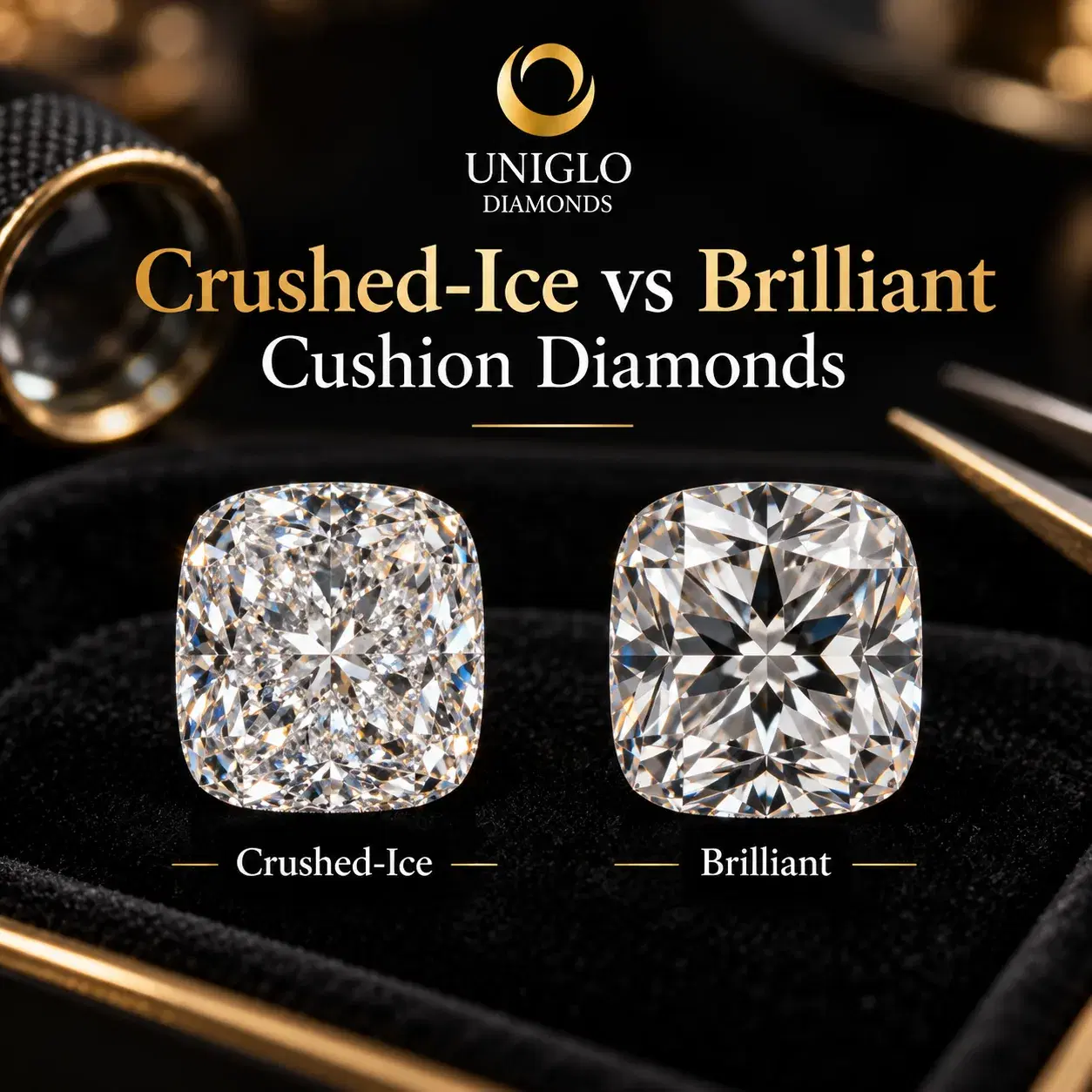
Crushed-ice cushion diamonds show a fine, busy reflection pattern; cushions described as brilliant or chunky in sales listings show more distinct, broader reflections. These are appearance descriptions, not competing quality grades. Choose the pattern you enjoy, then compare the actual diamonds under the same viewing conditions.
Two cushion diamonds can have similar weight and grades yet look noticeably different. A photograph may show one with a recognisable arrangement beneath the table and another with a closely packed mosaic. The difference becomes easier to understand when both stones move slowly in the same light.
This guide explains crushed ice vs brilliant cushion appearance, how those descriptions relate to grading reports, and what buyers and jewellers should request before ordering.
What is a crushed-ice cushion diamond?
“Crushed ice” describes an optical pattern resembling many small, irregular reflections. It does not mean the diamond is crushed, cracked or filled with ice-like inclusions. GIA explains crushed-ice patterns in terms of tiny virtual facets: reflection regions created by light bouncing inside a diamond, rather than additional physical surfaces cut into it.
For buying purposes, ask to see the specific stone behind the description. Compare the centre with the surrounding areas and decide whether the overall look suits you. A seller’s category name should help you start a shortlist, while the individual diamond’s appearance should decide whether it stays there.
Avoid judging from a heavily enlarged still image alone. Request a normal viewing scale as well as a close-up; the close-up helps examine details, while the smaller view helps you decide whether you actually enjoy the overall effect.
What is a brilliant cushion diamond?
In shopping discussions, “brilliant cushion” often means a cushion with a more defined, broader reflection pattern. Buyers may also describe the appearance as chunky. Ask the supplier what their label means, because “brilliant” also has a technical meaning connected with facet arrangement.
GIA’s cushion-cut guide describes cushion brilliant designs and variations with extra crown or pavilion facets. Those modified arrangements receive a modified brilliant description. The report’s cutting-style name and the seller’s visual description answer different questions; use both alongside images of the stone.
A broad-pattern cushion can be a modern diamond. A chunky appearance alone does not establish that it is an antique, an old mine cut, or a diamond with documented historical provenance. If an antique-style appearance is part of your brief, make that requirement explicit when exploring Uniglo’s old-cut diamonds.
Crushed ice vs brilliant cushion: comparison table
The table uses “brilliant-style” in the shopping sense of a broader visual pattern. It does not imply that crushed-ice cushions lack brilliant-style faceting.
| Buying question | Crushed-ice appearance | Broader brilliant-style appearance |
|---|---|---|
| What visual style am I comparing? | Fine, closely packed reflections | More individually recognisable reflections |
| What should I request? | A video showing whether the fine pattern appeals at normal scale | A video showing whether the broader pattern appeals at normal scale |
| Is the label a quality grade? | No | No |
| Does the label tell me the diamond’s origin? | No; establish origin separately | No; establish origin separately |
| Can I choose colour or clarity from this label? | No; assess the individual stone and report | No; assess the individual stone and report |
| Is one automatically better value? | Compare complete specifications and actual quotations | Compare complete specifications and actual quotations |
Treat this comparison as a way to describe your preference. It should not become a rule that eliminates every diamond in the other category before you have seen it.
Does “cushion modified brilliant” always mean crushed ice?
No. A grading-report description of facet arrangement is not a guarantee of one precise face-up appearance. Do not translate “modified” directly into “crushed ice”, or assume that a report carrying “cushion brilliant” must match a particular seller’s chunky example.
When a listing and report appear to use different language, ask the supplier to clarify both. A useful question is: “The report describes the cutting style as cushion modified brilliant. Can you show me the actual face-up pattern and explain what you mean by brilliant-style in this listing?”
Also allow for mixed appearances. Rather than forcing a borderline diamond into one box, describe which areas you like and which you want to compare. A brief such as “a defined centre with less fine texture around it” communicates more than “the best cushion cut”. Keep a reference video with the enquiry so the supplier can see what you mean.
Which cushion style sparkles more?
“More sparkle” can mean several things. GIA distinguishes brightness, fire and scintillation: brightness concerns white light, fire concerns coloured flashes, and scintillation concerns the light-and-dark display associated with movement. These effects should not be reduced to a single sales label.
For your comparison, separate two decisions. First, which pattern do you enjoy? Second, does the particular diamond perform convincingly in the lighting you expect to encounter? A lively studio clip can answer the first question incompletely and leave the second unresolved.
Ask to view the candidates under both diffuse light and directional light. Then compare them at the same scale and pace. Do not award one style a universal advantage in fire or brightness from one stone filmed under one lamp.
GIA’s research on oval, pear and marquise diamonds found varied observer preferences for crushed-ice patterns. That study was not a controlled cushion comparison, so it cannot establish a winning cushion style. It does support being cautious about treating one person’s pattern preference as an objective buying rule.
How to compare cushion diamonds in videos
Start with comparable stones and filming conditions
Keep origin, budget and outline reasonably comparable when building the shortlist. Compare a square cushion with another square cushion first; otherwise, you may be reacting to elongation instead of the reflection pattern. Record face-up length and width alongside carat weight so differences in dimensions are visible in your comparison.
Request the same background, lighting, exposure and camera distance for each candidate wherever possible. A diamond occupying twice as much screen space receives an unfair visual advantage. For videos from different sources, acknowledge the limits and ask for another recording before making a close decision.
Watch a slow face-up rocking motion
Begin with the diamond facing the camera, then watch gentle tilts in more than one direction. A full rotation is useful for identifying the stone, but a slow face-up clip is more helpful for comparing the appearance you will see when wearing it.
Make a short note for each candidate: preferred pattern, areas needing another view, and whether the clip is clear enough to judge. Resist selecting a diamond from its most flattering single frame.
Check the centre and surrounding areas separately
Compare the middle, sides and corners rather than concentrating only on the brightest flash. GIA’s optical glossary distinguishes small reflection patterns from leakage, windowing and viewer-related dark reflections. A dark patch in one image is not enough to identify its cause.
Ask for another angle or lighting environment if an area concerns you. Repeatedly disappointing areas deserve an in-person assessment or further examination by a qualified jeweller. Screen footage is a comparison aid, not a substitute for inspecting transparency, condition and optical behaviour directly.
Finish at normal viewing scale
After the close-up, view the diamond at a scale approximating how you will see it on a hand. Ask whether the difference remains meaningful to you. You may prefer one pattern strongly in a macro video but feel much less strongly about it at ordinary viewing distance.
For an engagement ring, a temporary setting or a suitable hand-view recording can help. Ask which parts of the image come from the proposed diamond and which are illustrations or stock footage. The final shortlist should be based on identifiable stones, with report numbers matched to the supplied media.
Are crushed-ice cushions cloudy?
Crushed ice is a pattern description, not a diagnosis of cloudiness. Do not reject a diamond simply because its reflections look fine or busy, and do not excuse an unresolved transparency concern by calling it crushed ice.
If a video appears hazy, ask for the stone to be cleaned and recorded again with sharp focus. Have the supplier address transparency explicitly rather than responding only with a clarity grade. If uncertainty remains, arrange an examination before committing to the stone.
Choosing a higher clarity grade alone does not resolve every question about a disappointing video. The recording may be inadequate, or a different aspect of the diamond may need assessment. Uniglo’s guide to diamond cut vs clarity provides broader context for treating those buying decisions separately.
How should you compare colour and inclusions?
Avoid rules such as “crushed ice always hides inclusions” or “brilliant cushions always look whiter”. Neither description establishes whether a particular inclusion is acceptable or whether the diamond’s face-up colour meets your preference.
For a colour comparison, request candidates recorded together under neutral, consistent conditions. Discuss the intended metal colour and any adjacent diamonds, then inspect a shortlist with that design in mind. Do not attempt to assign a laboratory colour grade from a phone screen.
For clarity, ask which characteristics are visible without magnification and under what viewing conditions. Review magnified media alongside the report, but decide whether the stone meets your agreed appearance requirements at normal viewing distance. A supplier’s “eye-clean” statement needs a shared definition, especially for a remote purchase.
Write colour acceptance, visible-inclusion acceptance and pattern preference as separate parts of the enquiry. This prevents a supplier from treating one desirable attribute as permission to compromise another.
What can a grading report tell you about cushion cut quality?
Check which laboratory issued the report and which assessments it actually contains. GIA currently states that its overall cut grade applies to standard round brilliant diamonds in the D–Z colour range. A cushion’s Excellent polish and Excellent symmetry should therefore not be presented as a GIA Excellent overall cut grade.
IGI describes a fancy-shape cut-grading process covering polish, symmetry, proportion qualification, craftsmanship and light return. IGI also specifies that its fancy-shape light-return assessment is not an assessment of fire or scintillation. Read the actual report; a cut grade does not specify which reflection style you will prefer.
Use the report to establish documented characteristics, then use identifiable media and inspection to assess appearance. Uniglo’s diamond certificates guide is a useful next step when reviewing the paperwork behind a shortlisted stone.
Are crushed-ice cushion diamonds cheaper?
Do not apply a fixed discount or premium based on the pattern name. A meaningful value comparison needs actual quotations for stones with comparable specifications. Otherwise, differences in origin, weight, grading or dimensions can be mistaken for a price difference caused by appearance alone.
Create a shortlist sheet with the supplier reference, report number, origin, weight, measurements, reported grades, quoted price and your viewing notes. Keep the quotation date and commercial terms with it. If one diamond costs more, ask which specific attributes account for the difference rather than accepting “better cushion” as the explanation.
Consider the whole purchase. A lower-priced stone may be unattractive value if you dislike its appearance or it does not suit the setting. Equally, a premium pattern description is not sufficient reason to exceed the budget when another inspected stone meets your requirements.
For a lab-grown shortlist, start with Uniglo’s cushion-cut lab-grown diamonds, then request media and reports for the actual candidates. Confirm current availability and terms rather than relying on a category description as a stock promise.
Which style should you choose for your jewellery?
Choose a broader-pattern cushion if that is the visual character you consistently prefer across the shortlisted stones. Choose a crushed-ice appearance if you prefer the finer texture after seeing it at ordinary scale. A mixed pattern is also a reasonable choice; your brief does not need to fit a rigid category.
For a solitaire, assess the centre stone in the proposed setting. For a halo or a design with side stones, request a comparison with the surrounding diamonds as well. The question is whether you like the combination, rather than whether every stone shares the same pattern description.
Jewellers sourcing two cushions for earrings should approve them as a pair. Even matching report specifications do not establish that the two stones look coordinated. Ask for a shared face-up video and assess the pair together before approving it.
If your decision concerns the outline rather than the reflection texture, read cushion vs radiant diamonds. That is a separate comparison from choosing between visual styles within the cushion family.
What to include in a cushion diamond enquiry
An effective enquiry identifies the design, budget, origin requirement, preferred outline and a visual reference. It also states which requirements are firm and where you are open to alternatives. This gives the supplier a practical brief instead of asking them to interpret “maximum sparkle”.
You can adapt this enquiry:
I am sourcing a cushion diamond for [jewellery design], with a budget of [amount and currency]. Please propose [natural or lab-grown] stones with [square or elongated] outlines. My preferred face-up pattern is [fine crushed ice, broader reflections, or a mixed pattern], as shown in the attached reference. Please include dimensions, the grading report, current price and a slow face-up video. I would like comparable lighting across candidates and a normal-scale view before choosing.
Send the brief through Uniglo’s enquiry page and ask which candidates can be provided for review. Agree inspection, reservation and return terms before placing an order.
Frequently asked questions
More Topics




