
Choosing Two Diamonds for a Toi Et Moi Ring
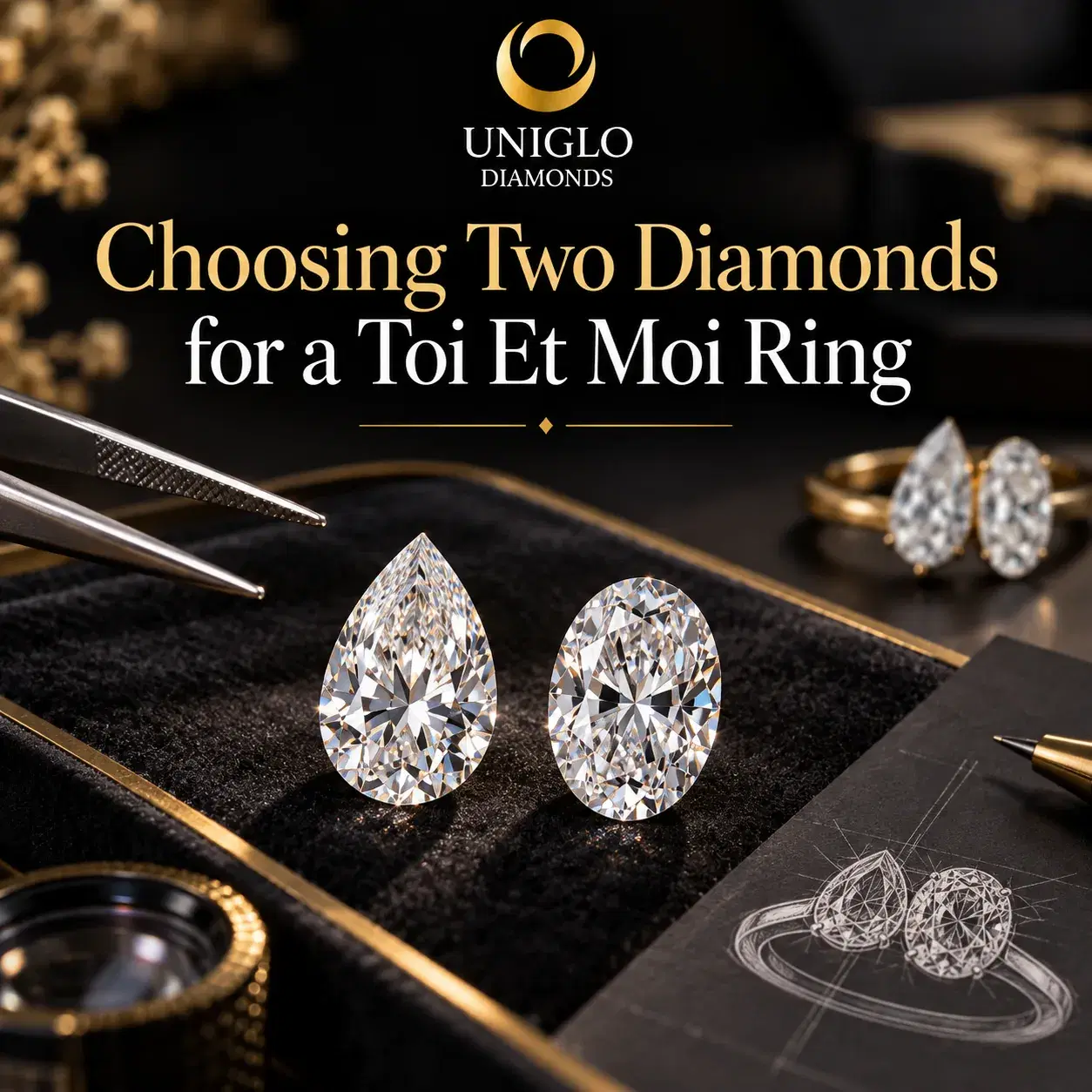
Choosing diamonds for a Toi Et Moi ring means assessing two stones together, in the arrangement you intend to wear. Start with their shapes and actual millimetre measurements, then compare appearance, relative size and the proposed setting. Equal carat weights or matching colour and clarity grades do not automatically produce a balanced two-stone design.
A useful shortlist should let you see how the diamonds work as a pair, rather than asking you to choose two attractive stones independently. Decide whether you want a close visual match or deliberate contrast, involve the setting jeweller before purchase and keep the complete ring budget in view. The right combination is one you enjoy together and that your jeweller can set appropriately.
What is a Toi Et Moi ring?
Toi Et Moi means “you and me” in French. GIA describes the style as two gemstones placed side by side, commonly associated with two people coming together. The stones can match or contrast in shape, size or colour, and the style can use diamonds, coloured gemstones or both. GIA’s guide to ring settings and styles.
For a ring with two diamonds, you have several decisions to make: whether both share the same shape, how large each should appear, how they sit relative to one another and whether their colour and cutting styles should be similar. These choices form the brief for sourcing the stones and designing the mounting.
Think of the diamonds as two focal stones. You do not have to make one subordinate to the other, and you do not have to make them identical. Explain the relationship you want in plain language: two equally prominent stones, a larger stone beside a smaller companion, or two contrasting outlines that still look coherent together.
Two genuine diamond combinations documented by GIA
The examples below are real rings described and pictured by GIA. They show two different approaches to combining diamonds. They are design references, rather than Uniglo stock selections, current offers or specifications to copy without a new setting assessment.
| Genuine combination | What the source documents | What to consider for your own pair |
|---|---|---|
| Pear-shaped diamond with an emerald-cut diamond | GIA’s settings guide pictures a Toi Et Moi ring using these two shapes with claw prongs | Compare the actual outlines in the intended orientation and ask the setter how each will be supported |
| Two old European-cut diamonds | GIA’s antique-ring guide describes an 1880s ring with stones of approximately 1.10 ct and 0.90 ct | Discuss unequal weights as a design choice, then assess your candidates’ dimensions and appearance together |
View the first example under “Toi et Moi Setting Style” in GIA’s settings guide. Its full stone reports and measurements are not supplied. Request that information for your own candidates before purchasing.
See the two old European-cut diamonds in GIA’s antique engagement ring guide under “Toi et Moi Rings.” The reported weights are approximate and describe that ring. They do not establish an ideal weight split or the visible size ratio for a different design.
Use these references to identify what appeals to you, then request actual candidates. If you like the contrast of the first example, ask to view a pear and emerald cut together. If you like the second approach, explain that you are open to two similar cutting styles with unequal weights. The supplier still needs your preferences, budget and setting requirements.
Choose a relationship between the shapes
Begin with the outlines you enjoy, then consider the arrangement. Two stones of the same shape offer a different starting point from a pair of contrasting shapes. Use our diamond shapes guide to narrow the options, but make the final comparison using the actual diamonds rather than generic shape illustrations.
For a mixed-shape pair, ask to see each stone separately and then together. Consider whether the outlines remain distinct, whether one obscures the other in the proposed top view and which orientation you prefer. A pear’s direction, for example, belongs in the design discussion; do not leave it to be decided after the stones have been bought.
For two stones of the same shape, decide how closely you want their outlines and dimensions to agree. You may want a near-matched appearance, or prefer a deliberate difference in size. Tell the supplier which result you mean so a request for “two ovals” does not become an assumption that any two available ovals will suit your ring.
If you are undecided, keep the comparison focused. Ask for a same-shape option and a contrasting-shape option at the intended scale, rather than collecting many unrelated diamonds. A small number of clearly presented alternatives makes it easier to understand your preferences and refine the shortlist.
Compare visible dimensions before deciding the carat split
Carat weight measures mass, so it does not by itself describe how large a stone looks from above. IGI explains that shape and proportions affect physical spread and that diamonds of equal weight can have different dimensions. Its carat weight guide explains why length and width belong in the comparison.
Request each candidate’s length, width and depth in millimetres. For rounds, use the reported diameter measurements and depth. Keep the measurements attached to the individual stone references so you can compare both the separate diamonds and the pair proposed for the design.
Avoid choosing a total carat weight first and dividing it automatically into equal halves. Two stones that total a particular weight can distribute that weight differently. If a quotation gives a combined figure, ask for each diamond’s weight and dimensions separately. Those details help you assess what you are actually buying.
Likewise, equal millimetre lengths do not establish equal visual presence across different shapes. Ask to see the real outlines together at a documented, consistent scale. You can describe which stone appears more prominent without treating a simple length comparison or a rectangular area calculation as a complete measure of visual balance.
There is no single carat split or dimensional ratio that produces the right result for every Toi Et Moi ring. Let the appearance you want and the jeweller’s design assessment guide the search, then compare current candidates within that brief.
Assess visual balance in the intended layout
Decide whether balance means equal prominence or a pleasing asymmetry to you. Look at the pair from the top, then review how the setting changes that view. Prongs, bezels and the space between the stones are part of the finished design, so a loose-stone arrangement is useful preparation rather than a finished-ring preview.
Ask for both candidates to be photographed or filmed together under the same lighting and at the same scale. Compare how each responds as the pair moves, and note any colour or brightness difference you find distracting. Separate sales videos can help examine individual stones, but they may use different lighting, magnification or backgrounds that make a pair harder to judge.
Try more than one orientation before committing to the design. Ask the jeweller to show which stone will sit on each side, how they will be angled and how much separation is proposed. Keep a record of the arrangement you prefer, especially when the diamonds have different shapes or weights.
Review the layout on the intended finger size where possible, using a jeweller’s drawing, model or other suitable design aid. Ask how much of the ring’s top will be occupied and whether the proposed height and width suit the wearer. A photograph of a ring on someone else’s hand cannot settle those questions for your own piece.
Decide whether colour and cutting style should match or contrast
State whether you want the two diamonds to look similar in colour or whether contrast is part of the design. When a close match is the goal, compare the actual stones together. Do not assume that matching report grades remove the need for a visual comparison, or that a fixed difference in colour grades is acceptable in every arrangement.
If you prefer different cutting styles, ask to review how both stones look as they move. Describe what you enjoy in the pair rather than requiring the stones to display identical patterns despite the intended difference in style. Have each candidate assessed individually as well as in the proposed arrangement.
Clarity should also be assessed for each diamond. Ask about the location and visibility of inclusions and any condition feature relevant to the proposed setting. A higher clarity label on one stone does not, by itself, demonstrate that the pair will look balanced or that the other candidate meets your expectations.
Use the reports to record the stones’ characteristics, then use actual imagery and any available viewing to judge the combination. IGI’s diamond report-reading guide identifies shape, cutting style, measurements and quality assessments among the information documented. Keep both records available throughout the shortlist process.
Specify natural or laboratory-grown origin for each stone
Tell the supplier whether you want two natural diamonds, two laboratory-grown diamonds or are considering different origins. Make the designation explicit for each candidate rather than leaving it attached only to the overall enquiry. Our natural versus lab-grown diamond guide provides background for that choice.
If you are comparing natural and laboratory-grown alternatives, request clearly labelled pairs within the same purchase brief. Compare the actual specifications and complete quotations rather than assigning a fixed price difference to the origins. Check whether the budget covers the two loose diamonds or the finished ring.
For laboratory-grown candidates, ask for the actual report and relevant comments. IGI explains the documentation of origin and characteristics in its laboratory-grown diamond report guide. The report format and information should be read as supplied, rather than inferred from a generic “certified” description. Our diamond certificates guide gives additional context.
Confirm the setting requirements before buying both diamonds
Involve the setting jeweller while you are shortlisting. Share the two reports, dimensions, imagery and proposed orientation, then ask whether the design can accommodate those candidates. If you have already selected a mounting, obtain its stone requirements before shopping; if the mounting will be made for the pair, have the jeweller confirm what is needed before committing to manufacture.
Ask the jeweller to review the stone profiles as well as their top-view outlines. Discuss their seating, support, separation and any proposed overlap. If the design drawing places one stone above or close to the other, ask how contact between the stones and surrounding metal is addressed. These questions require assessment of the actual candidates and construction, not a universal spacing rule.
Pointed ends and corners deserve attention. GIA discusses their vulnerability and protective setting choices in its diamond chipping guide. Have the setter explain how the relevant areas of each diamond will be protected while retaining the outline you want to see.
Discuss comfort, access for cleaning and how the ring will sit beside a wedding band if you intend to wear one. Bring that band or its requirements into the design discussion. Ask for a side view as well as a top view, and record the agreed orientation before authorising work.
Request a useful two-stone shortlist
A useful shortlist identifies the pair as well as its two components. Ask the supplier to explain why those particular diamonds were selected together and provide enough information for the setter to review them. If the selection is provisional, make clear what still needs confirmation before acceptance.
| Shortlist information | What to request |
|---|---|
| Design brief | Preferred combination, intended layout and equal or unequal visual prominence |
| Diamond A and Diamond B | Separate stock references, origins, weights and report details |
| Physical measurements | Dimensions and relevant profile information for each stone |
| Appearance evidence | Individual imagery plus a joint comparison under consistent conditions |
| Pair explanation | Why the candidates suit the stated matching or contrast preferences |
| Setting assessment | Jeweller review, mounting requirements and remaining inspection conditions |
| Complete quotation | Individual stone amounts, pair total, currency, inclusions and excluded charges |
| Timing and terms | Availability, quote validity, delivery and inspection/return arrangements |
Avoid selecting one diamond and postponing the search for its companion without understanding the consequences. Ask whether both candidates can be reviewed and purchased on a coordinated timetable. If one becomes unavailable, reassess the replacement beside the remaining stone instead of assuming the original pairing decision still applies.
Keep the setting quotation alongside the stone quotation. A pair that fits your loose-diamond budget may leave insufficient funds for the finished design. Before payment, confirm the complete cost and coordinate the supplier’s inspection terms with the jeweller’s availability. Ask how setting either stone affects the applicable return arrangements.
Ask Uniglo for two diamonds for your Toi Et Moi ring
Contact Uniglo Diamonds with your preferred shapes, origin, budget, ring size and any design reference. Explain whether you want equal visual prominence or deliberate asymmetry, and include the setting jeweller’s requirements if they are already available.
For example: “I am choosing two diamonds for a Toi Et Moi ring and would like to compare a pear-and-emerald combination with a same-shape alternative. Please suggest pairs within my stated budget, identify each stone separately and provide actual dimensions, reports, individual imagery and a joint comparison where available. My jeweller will assess the final pair for the setting.” This is a sourcing brief, rather than an offer or confirmed stock selection.
Our natural loose diamonds and lab-grown loose diamonds provide starting points for enquiries. Share references for stones you like, then ask whether they can be considered together or whether another candidate would better meet the brief. Request current availability and quotation terms for the actual proposed pair.
Frequently asked questions
More Topics




