
Carat vs Total Carat Weight: CT, CTW and CTTW
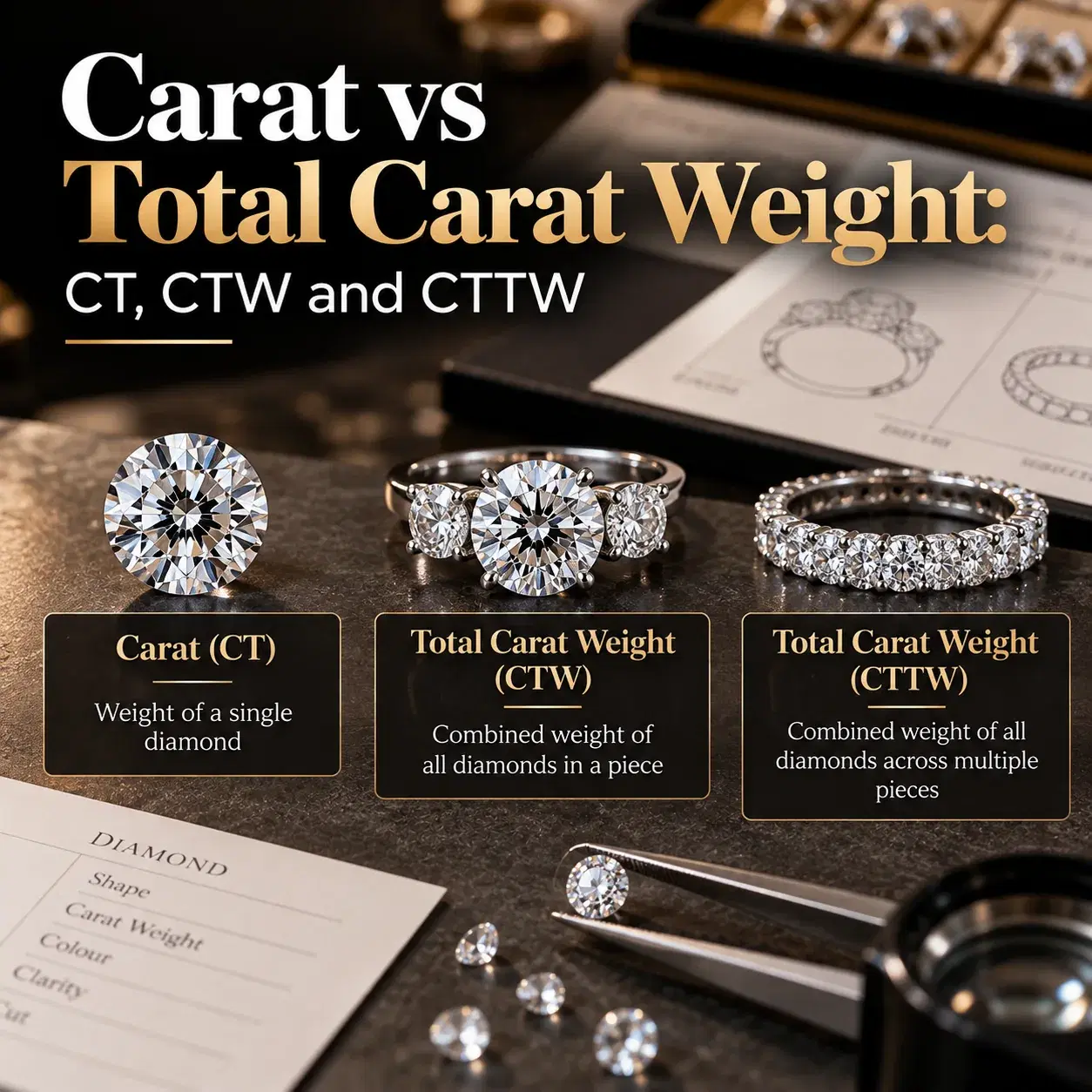
Carat is a unit of gemstone weight. In a single-diamond listing, CT usually describes that stone’s weight; CTW and CTTW describe a combined carat weight. A ring advertised as 1.50 CTW can contain several diamonds adding up to 1.50 carats, with a centre diamond weighing less than 1.50 carats. Always check which stones the stated total includes.
This distinction matters when comparing an engagement ring, a pair of studs or a diamond bracelet. The headline number can look identical while the number of diamonds, their individual weights and the finished appearance differ substantially. A clear weight breakdown makes the comparison much easier.
What do CT, CTW and CTTW mean?
| Term | Usual meaning in diamond descriptions | What to confirm |
|---|---|---|
| CT or ct | Carat, the weight unit; often the weight of an individual diamond | Which stone or group the number describes |
| CTW | Carat total weight | Which diamonds are included in the total |
| CTTW | Carat total weight | The same scope checks as CTW |
| TCW | Total carat weight | Whether it describes the complete piece or a specified group |
| TW | Total weight | Material, unit and scope; the abbreviation alone is incomplete |
| PT or points | Hundredths of a carat | Whether stated per stone or for a group |
CTW, CTTW and TCW generally communicate the same combined-weight concept. Their different lettering does not mean that one describes better diamonds. Capitalisation and punctuation also vary, so “ct. tw.” and “CTTW” may express the same information.
CT is a unit, rather than a guarantee that only one stone is being described. A line reading “accent diamonds: 0.30 ct” may refer to their combined weight if the surrounding text says so. Read the whole specification instead of deciding from the abbreviation alone.
IGI’s glossary defines CT as carat weight and TW as total weight. If a listing uses unfamiliar shorthand, ask the supplier to write the meaning and included stones in full.
What is one carat?
One metric carat equals 200 milligrams, or 0.20 grams. One carat is divided into 100 points, so a 25-point diamond weighs 0.25 ct and a 50-point diamond weighs 0.50 ct. GIA’s carat-weight guide explains the measurement.
Carat measures weight rather than physical size. For visible size, use the stone’s recorded dimensions in millimetres and actual images. A weight number alone cannot show how much finger coverage a ring provides or how large a stud appears on the ear.
Keep gemstone carat weight separate from gold purity. “18K gold” describes the metal’s purity, while “0.75 ct diamond” describes gemstone weight. In the UK, “carat” is also used for gold purity, making the surrounding wording especially important.
If a description contains a diamond weight, gold purity and item weight, read each as a separate field. The weight of the entire ring in grams is not its total diamond carat weight.
How to calculate total carat weight
Add the weights of every diamond included in the stated scope. For a complete diamond ring, that may mean the centre diamond, side stones, halo and any diamonds along the band. For a setting-only offer, the scope may cover just the accent diamonds.
The calculation is: total diamond carat weight = the sum of the included diamond weights. If several stones have the same weight, multiply that individual weight by the number of stones before adding the other groups.
The following are hypothetical examples using exact assumed weights. They illustrate arithmetic, rather than describe Uniglo inventory, measured jewellery or current product offers.
| Example | Diamond weights included | Calculated total |
|---|---|---|
| Ring with accents | 0.90 ct centre + 0.20 ct side stones + 0.10 ct halo | 1.20 CTW |
| Two single-stone studs | 0.50 ct left + 0.50 ct right | 1.00 CTTW for the pair |
| Bracelet with equal-weight stones | 40 diamonds × 0.05 ct each | 2.00 CTW |
| Setting without its centre stone | 24 accent diamonds × 0.01 ct each | 0.24 CTW for the setting |
Real specifications may use rounded, approximate or estimated figures. Read those qualifications before treating a displayed total as an exact sum of displayed per-stone numbers. If the breakdown seems inconsistent, request an explanation of the weight basis and included groups.
A 1.00 CT diamond and 1.00 CTW ring are different descriptions
A single diamond weighing 1.00 ct places the entire stated weight in one stone. A ring with 1.00 CTW may divide that weight among a centre and accents, or among several smaller diamonds without a single large centre.
For example, a hypothetical ring with a 0.70 ct centre and 0.30 ct of accents has 1.00 CTW. Its centre stone is still 0.70 ct. A halo or pavé band can contribute to the overall design, but it does not change that centre diamond’s weight.
GIA explains the individual-versus-combined distinction in its diamond carat-weight buying guide. When comparing rings, ask for the centre weight and accent total as separate figures.
Start with the feature you want to compare. If your priority is the centre diamond, compare its weight, dimensions and documented characteristics. If your priority is the whole design, compare the ring’s appearance alongside its stone breakdown. Both are useful comparisons, but they answer different questions.
Does total carat weight include the centre diamond?
It should include the centre diamond when the figure is explicitly the total diamond weight of the complete ring. A figure for a mounting, halo or accent group can exclude the centre. The listing’s scope therefore matters as much as the letters CTW.
Consider a hypothetical setting containing 0.24 ct of accents. If you add a 1.00 ct centre diamond, the completed ring contains 1.24 ct of diamonds. The setting’s original 0.24 CTW specification and the completed ring’s 1.24 CTW specification describe different scopes.
Before approving a ring quotation, ask whether the centre diamond is included in both the quoted price and stated weight. This is particularly useful when the centre and setting are selected separately. Request the completed specification after the selections are final.
For an existing ring, ask for a breakdown by stone group rather than trying to identify weights from the photograph. An image can show the arrangement, but it cannot establish each diamond’s measured weight.
Total carat weight for diamond earrings
For a pair of earrings, a total may describe both earrings together. Confirm this explicitly. A 1.00 CTTW pair containing two equal-weight single diamonds has 0.50 ct in each earring, rather than 1.00 ct per earring.
Dividing the pair’s total by two gives the average weight per earring. It does not prove that the two individual diamonds weigh exactly the same. For example, hypothetical stones of 0.49 ct and 0.51 ct also add up to 1.00 ct.
For halo studs, hoops or drops, each earring may contain several diamonds. A pair’s total then says even less about the largest individual stone. Ask for the weight of each principal diamond and the combined accent weight where those details affect your choice.
Uniglo’s natural diamond stud earrings guide discusses the broader buying decision. Use this article for the terminology, then review the actual pair’s dimensions, appearance and matching details before purchasing.
Total carat weight for bracelets and necklaces
For a diamond line bracelet or necklace, total weight adds together the included diamonds along the piece. It does not tell you the weight of one diamond, the stone count or the finished length.
Two hypothetical bracelets could each contain 2.00 CTW: one with 40 diamonds of 0.05 ct and another with 50 diamonds of 0.04 ct. These calculations describe different stone arrangements. They do not establish that the pieces have the same length, setting construction or visible width.
Confirm the specification for the size you intend to order. Ask whether changing the length changes the stone count, individual sizes or total weight. Use the dimensions and photographs of that version when deciding how it will fit.
Uniglo’s natural diamond tennis bracelet guide covers bracelet selection in more detail. When comparing two offers, record total weight, stone count, length and width together.
Does total carat weight include coloured gemstones or metal?
“Total diamond carat weight” describes diamonds, not the gold or platinum mounting. In jewellery containing diamonds and coloured gemstones, request separate totals for each material. A combined gemstone total should be labelled clearly.
For illustration, a ring containing a 0.80 ct sapphire and 0.20 ct of diamonds has 1.00 ct of gemstones altogether, but only 0.20 ct of diamonds. Calling that figure “1.00 ct of diamonds” would not describe the example accurately.
Avoid treating “TW” as a complete explanation on its own. Ask what is being weighed and whether the number uses carats or grams. A report or invoice can include total item weight as well as gemstone weight; those are separate measurements.
If different gemstone species or diamond origins appear in the same piece, ask for the groups to be identified individually. A single headline total can be convenient, but the detailed description should still make clear what the piece contains.
Why the same total weight does not mean the same price
Diamond weight distribution matters. GIA explains that a collection of small diamonds can cost considerably less than a single natural diamond of the same combined weight and comparable quality. See its guide to melee diamonds.
CTW therefore does not provide a complete price comparison. Review individual stone sizes, origin, documented characteristics and the mounting. A finished jewellery price also needs to be understood in terms of what the quotation includes.
For a loose diamond, price per carat can help compare suitably similar stones. For finished jewellery, dividing the complete price by CTW creates a blended figure containing the mounting and other included work. It is not automatically the price per carat of the diamonds themselves.
Request dated quotations and compare the same scope. Record whether taxes, setting work, reports and delivery are included. A lower headline price is only useful once you understand the complete specification and purchase terms.
CTW does not describe diamond quality or origin
Total carat weight is a weight statement. It does not provide a colour grade, clarity grade, cut assessment or declaration of natural versus lab-grown origin.
For a multi-stone piece, ask whether the stated quality applies to the centre, the accents or all diamonds. If accents are described by a range, read that range separately from the centre diamond’s individual report. Do not assume one report grades every stone in the jewellery.
Uniglo’s lab-grown vs natural diamonds guide explains the origin distinction. If a piece combines different origins, request separate disclosure and a clear specification for each group rather than assuming the total implies uniform origin.
For visible size, compare recorded dimensions and the arrangement. Uniglo’s diamond shapes guide can help with outline choices. Keep that design comparison separate from the arithmetic of total weight.
Measured, estimated and nominal weights
A loose diamond report may record the weight of the individual stone. A mounted jewellery assessment can involve estimates and limitations created by the setting. Read the wording rather than assuming every number was obtained in the same way.
GIA’s jewellery report services include estimated diamond weights and assessments performed to the extent the mounting permits. These services have defined eligibility; ask which report is appropriate for the item being offered.
IGI also explains assessment limits in its jewellery reports guidance. For a centre diamond graded before mounting, ask whether its original loose-stone report is available. Then check what any separate jewellery report says about the remaining stones.
Terms such as “approximately,” “estimated” or a nominal product size need to remain visible in the specification. Ask whether there is an applicable weight range and what figure will be confirmed for the exact item supplied. Do not silently convert a qualified description into an exact promise.
Uniglo’s diamond certificates guide provides report-reading background. Match the document’s scope to the purchase: one centre-stone report and a complete multi-stone jewellery assessment serve different purposes.
A note for jewellers buying diamond parcels
A parcel’s total weight and piece count are separate specifications. Dividing total carats by the number of stones gives an average weight; it does not prove that every stone has that weight or fits the same setting.
For a hypothetical parcel of 250 stones weighing 5.00 ct altogether, the average is 0.02 ct per stone. Request the actual size range, calibration requirements and quality specification when selecting stones for a design. Do not use the average as a substitute for that information.
Uniglo’s bulk loose lab-grown diamonds guide covers parcel-order requirements. Keep the detailed parcel sourcing discussion there; the calculation here explains the difference between a combined total and individual weights.
What to ask before buying
| Question | Information to request |
|---|---|
| What does the headline weight cover? | Complete item, pair, setting or named stone group |
| What is the centre weight? | Individual principal-stone weight, if applicable |
| How are the accents described? | Stone count and combined weight, with any ranges |
| Is the weight exact or qualified? | Measured, estimated, approximate or nominal basis |
| What does the report cover? | Centre stone, specified groups or whole item |
| What am I comparing visually? | Actual dimensions, finished size and matching-scale images |
Request those details in the quotation or item specification. If any statement is unclear, have it clarified before paying. A short written breakdown is easier to compare than several listings using different headline conventions.
To discuss diamond requirements, contact Uniglo Diamonds with the intended use, origin, individual size requirements and required total weight. Specify whether you need one diamond, matched stones or a parcel. Ask for current options and the relevant documentation for the exact offer.
Frequently asked questions
More Topics




