
Baguette vs Emerald-Cut Diamonds: Centre and Side-Stone Choices
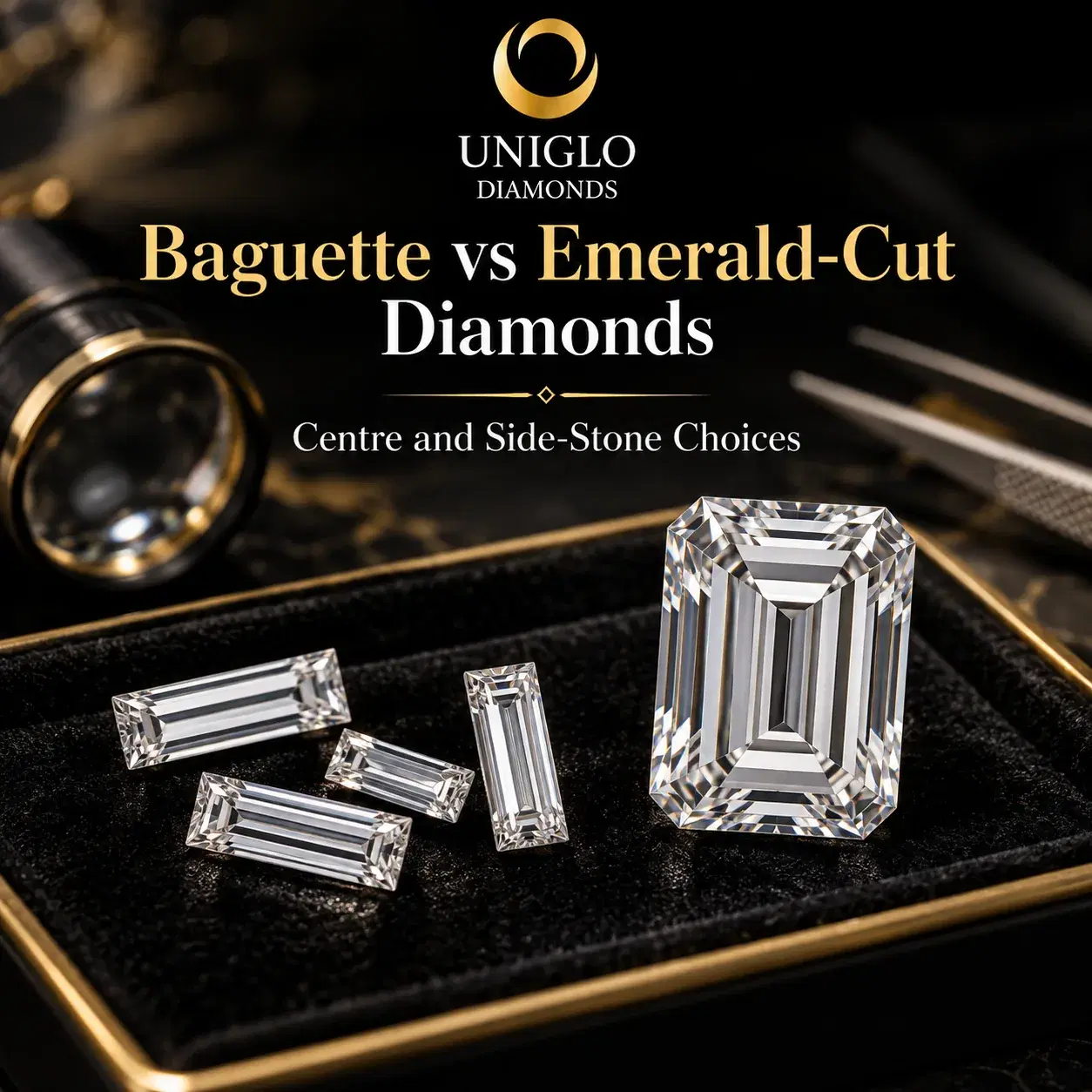
The main difference between a baguette and an emerald-cut diamond is the outline: a straight baguette has square corners, a tapered baguette narrows towards one end, and an emerald cut has cropped corners. Both commonly use step-cut facets. Choose by the stone’s role, actual dimensions and appearance, then check how it fits and matches the complete design.
A baguette is not simply a smaller emerald cut. Nor does “emerald cut” mean that the gemstone is an emerald. These names describe diamond shapes and cutting styles, and they lead to different decisions when choosing a centre, a side-stone pair or a row of accents.
Baguette vs emerald diamond: the useful differences
| Feature | Baguette diamond | Emerald-cut diamond |
|---|---|---|
| Outline | Straight rectangular or tapered; some are closer to square | Rectangular or square outline with cropped corners |
| Common cutting style | Step cut; modified and mixed-cut versions also exist | Step cut with rows of facets around the table |
| Design role | Often an accent, side stone or part of a repeated pattern | Can be a centre stone, side stone or repeated accent |
| Dimensions to request | Length and width; both end widths for tapered stones | Length, width and depth, plus corner and outline consistency |
| Matching priority | Pair or row consistency, taper and fit | Pair consistency, outline and reflection pattern |
| Buying decision | Does the shape create the intended line or transition? | Does the cropped-corner outline suit the intended composition? |
Use the table to prepare a shortlist. Neither shape name establishes a quality level, a particular price or a guaranteed visual result.
What makes a baguette different?
GIA’s baguette guide describes small, usually rectangular step-cut diamonds with straight or tapered edges. Straight baguettes have parallel long sides; tapered baguettes have sides that converge. The taper is an important design feature, rather than an alternative name for an emerald cut.
Confirm the cutting style as well as the shape. GIA also describes “brilliant baguettes” with a mixed facet arrangement. If a quotation uses that term, request a face-up view and an explanation of the actual arrangement instead of assuming a conventional step cut.
For an enquiry, state “straight baguette” or “tapered baguette” and include the dimensions. A request for “small rectangular diamonds” leaves too much uncertainty about the goods you want.
What makes an emerald cut different?
An emerald-cut diamond has cropped corners and a step-cut arrangement. IGI’s glossary describes rectangular or square emerald cuts with parallel rows of facets. GIA’s diamond shape guide explains the broad reflections often described as a “hall of mirrors” effect.
Those cropped corners remain relevant at side-stone sizes. Compare the outline in a design drawing and in a photograph of the actual diamond. A label alone does not show how broad the corner cuts are or whether two stones have matching outlines.
If you are considering an emerald-cut centre, browse Uniglo’s emerald-cut lab-grown diamonds and compare individual measurements and available reports. For other outlines, use the diamond shapes guide.
Which works better as a centre stone?
Choose the centre against the complete ring design
Start with the impression you want from the whole ring: a broader rectangular focal point, a slender line, a horizontal arrangement or a centre framed by smaller stones. Ask the jeweller to show both candidates at their actual scale in the proposed design.
An emerald cut is a useful candidate when you want the cropped-corner outline and its step-cut appearance to carry the design. GIA’s emerald-cut engagement ring guide shows how the shape can be used vertically or horizontally in an east–west setting. Preview the orientation before choosing the stone and mounting.
A baguette can also be the focal stone in a design built around its outline. Confirm availability in the dimensions you want and review how the jeweller proposes to secure it. Its use as a centre does not depend on relabelling it an emerald cut.
Try to compare the complete design rather than a close-up diamond against a finished-ring photograph. Ask for the centre’s visible width, the ring’s overall span and the proposed height. These details make the choice more concrete than a general description such as “large-looking.”
Which works better as side stones?
Straight baguettes
Consider straight baguettes when you want a rectangular element beside the centre or within a repeated pattern. Request a view of the proposed pair in position, with the intended orientation and spacing. Decide whether you want the accents to read as separate stones or as a continuous geometric arrangement.
Check the pair’s length, width and appearance together. Two stones described by the same total weight may still need different settings. If they are intended for symmetrical shoulders, make that requirement explicit before the jeweller finalises the mount.
Tapered baguettes
A tapered pair gives the designer a change in width from one end of each stone to the other. Ask which end will sit nearer the centre and preview the resulting transition towards the band. That choice belongs to the composition; there is no single taper that suits every centre shape or ring width.
Specify length, wide-end width and narrow-end width for each stone. Ask for the pair to be shown side by side and in mirrored positions around the centre. The end widths and visual taper both matter when assessing whether the pair is balanced.
Emerald-cut side stones
Consider small emerald cuts when you want cropped-corner accents that read as individual elements. Compare the side-stone widths with the centre width and ask whether the proposed layout leaves the emphasis where you want it.
For an emerald-cut centre flanked by smaller emerald cuts, check all three outlines in the intended arrangement. The shapes can share a name yet differ in elongation, corner cuts or apparent colour. Request a group view before accepting the pair.
Compare millimetres before carat weight
Carat weight measures mass. Length and width answer different questions about a stone’s visible outline and its fit in a design. GIA’s overview of diamond shapes notes the use of dimensions when buying baguette side stones. Depth is also relevant to the mounting. Compare the measurements individually rather than using total carat weight as a substitute.
For straight rectangular outlines, calculate length-to-width ratio = length ÷ width. For example, a hypothetical 7.00 × 5.00 mm stone has a ratio of 1.40, while a 7.00 × 3.50 mm stone has a ratio of 2.00. They share the same length but have different widths. These examples demonstrate the calculation; they are not recommended proportions or inventory quotations.
A ratio cannot capture every outline detail. It does not describe an emerald cut’s cropped corners or a tapered baguette’s two end widths. Keep the original measurements beside any ratio so the setter can assess the actual shape.
For an existing setting, ask the setter to measure the available seats and assess what can be fitted safely. A replacement should be chosen against that assessment, including depth and condition, rather than ordered solely because it has the same carat weight as the missing stone.
Which shape sparkles more?
Both conventional shapes use step-cut facets, but two individual diamonds can produce different reflection patterns. Watch the actual stones move under comparable lighting. The shape name does not tell you whether a particular candidate has the appearance you prefer.
Avoid choosing by facet count alone. GIA’s diamond buyer’s guide explains that facet count changes the pattern of reflections rather than determining overall brightness; proportions, polish and symmetry matter. A fixed claim that every baguette or emerald cut has one facet count also overlooks modified cutting styles.
Ask for a steady face-up view followed by slow movement. Describe what you see: crisp changing reflections, a persistent dark area, a pale centre or a recording that loses detail. Request another view if the video is out of focus or the highlights are washed out. A single bright frame is a limited basis for a purchase.
If you are deciding between step-cut reflections and a different facet style, read Uniglo’s emerald versus radiant diamond comparison. Keep that decision separate from choosing between two step-cut outlines.
Check clarity and colour in the actual stones
GIA’s emerald-cut buying guide notes that the long, open facets can make inclusions and colour more apparent than in some other cutting styles. This makes direct viewing useful, especially when a centre will be prominent in the design.
That observation does not create a universal VVS or D-colour requirement. Ask whether the features you care about are noticeable at the intended viewing distance. Use magnified images to locate inclusions, then return to a normal-scale view to assess their visual effect. Have a qualified reviewer address any condition or durability concern separately.
GIA’s side-stone selection guide recommends considering matching and proportions in relation to the centre and the wearer. For a pair, compare both stones at once rather than approving them from unrelated photographs. Use clean stones, the same background and the same lighting. Then include the centre in the view where possible. Decide whether any difference is acceptable for your design before the stones are mounted.
Keep grades and appearance distinct in the discussion. A report describes the assessed characteristics of that stone; a group view helps you assess the combination. If a grade range is provided for small accents, ask what it covers and who assigned it rather than assuming every stone carries an individual report.
What should a report or quality description establish?
Match any individual report to the offered stone and check the shape/cutting description, measurements, colour, clarity and finish information provided. For small side stones supplied together, ask whether the documentation concerns individual diamonds or a pair or parcel assessment.
Do not treat “Excellent polish” as though it were necessarily an overall cut grade. Read the field label and the issuing laboratory’s method. IGI’s cut-grading explanation describes fancy-shape assessment using finish, proportions, craftsmanship and light return; proportions alone do not establish cut quality.
Even where a cut assessment is available, retain the actual-stone viewing evidence and confirm what the document covers. Uniglo’s diamond certificate guide explains the main documentation distinctions.
State your natural or laboratory-grown origin requirement for the centre and accents. Ask for relevant evidence and any treatment disclosures. Origin, quality and matching are separate purchasing requirements, and a centre-stone report should not be assumed to describe every accompanying stone.
Setting choices and everyday wear
Ask how the proposed mount supports the diamond and protects exposed areas. GIA’s chipping guidance explains that diamonds can chip despite their scratch resistance, and that vulnerable corners and very thin girdle areas require attention. Cropped corners do not make an emerald cut immune to damage.
For either shape, have the setter check the stone’s current condition and the suitability of the mounting. Discuss visible metal coverage, seat fit, clearance and the finished height. A protective design still needs to fit the actual diamond; the setting name alone does not establish security.
If the ring will sit beside another band, preview the combination. Ask whether stones or settings could contact each other and whether the design needs clearance. For repeated baguette or emerald-cut accents, also agree how an individual stone could be replaced later and retain the specifications needed for matching.
Is a baguette diamond cheaper than an emerald cut?
There is no fixed discount that applies to every comparison. A small baguette accent and a larger emerald-cut centre are different purchases. Their prices cannot isolate a shape effect when size, origin, quality, documentation and sourcing requirements also differ.
Request dated quotations for the actual alternatives you could use. For side stones, establish whether the price covers one diamond, a matched pair or a parcel, and whether matching or custom calibration adds cost. Include the proposed setting work when comparing complete designs.
Agree replacement or return arrangements before mounting. A lower stone price is useful only if the goods meet the design and inspection requirements. Avoid approving a poorly matched pair on the assumption that setting will remove the visible difference.
What to send your supplier or jeweller
Use a brief that names the shape and its role, rather than relying on “rectangular diamond.”
| Requirement | Details to provide or request |
|---|---|
| Design role | Centre, matched side-stone pair, repeated accents or replacement |
| Shape and style | Straight baguette, tapered baguette or emerald cut; specify any modified cutting style |
| Dimensions | Length, width and depth; both end widths for tapered baguettes |
| Fit | Existing setting measurements or dimensions approved by the setter |
| Pair matching | Dimensions, taper or corner consistency, colour and group appearance |
| Quality evidence | Reports or assessment scope, current condition and viewing images |
| Origin | Natural or laboratory-grown requirement and relevant disclosures |
| Commercial terms | Dated quote, price basis, inspection period and replacement arrangements |
For a pair, you can send this request:
Please propose a matched pair for the supplied centre-stone measurements and design. Confirm the exact shape and cutting style, each stone’s dimensions, and both end widths if tapered. Show the two stones together under the same light and, where possible, beside the centre. Please provide available quality and origin documentation, disclose any treatments, and confirm inspection and return arrangements before setting.
Choose the combination, then confirm the stones
Decide what the centre and accents should contribute to the finished piece, then approve the dimensions, matching and setting plan. Keep the actual-stone images and documentation with the agreed design so that substitutions can be assessed against the same requirements.
Explore Uniglo’s melee diamond parcels for available accent options, or contact Uniglo Diamonds with your centre measurements and side-stone brief. Ask which current options meet your specified shape, origin and fit requirements.
Related guides
Frequently asked questions
More Topics




