
3 Carat Lab-Grown Diamond Price in 2026: Stone and Ring Costs
A 3 carat lab-grown diamond should not be priced from carat weight alone. Shape, exact weight, dimensions, colour, clarity, cut, certification and current availability all influence the quotation for an individual stone.
That is particularly important at approximately three carats because small differences in specifications can become more noticeable in a larger diamond. Two stones may both be described as three-carat lab-grown diamonds while differing considerably in proportions, face-up dimensions, colour, clarity and overall appearance.
For that reason, this guide does not assign one fixed Uniglo selling price to every 3 carat diamond. Current Uniglo pricing should be checked against the actual available stone through the diamond inventory or a current quotation.
For comparisons across other carat weights, see our lab-grown diamond prices guide.
How much does a 3 carat lab-grown diamond cost?
There is no single useful price that applies to every 3 carat lab-grown diamond.
A current quotation needs to be connected to the stone's complete specification. A 3.00 ct round F/VS1 diamond, for example, should not automatically be priced or evaluated in the same way as a 3.00 ct oval G/VS2 diamond. Both weigh approximately three carats, but they represent different purchases.
Uniglo's diamond inventory allows buyers to filter available stones by characteristics including shape, carat, colour, clarity, cut, symmetry, polish, fluorescence, grading laboratory and measurements. Current price and price-per-carat information can then be reviewed through inventory access.
| 3 carat buying factor | What should be checked |
|---|---|
| Exact carat weight | Confirm whether the stone is exactly 3.00 ct, slightly below it or above it |
| Shape | Round, oval, emerald, cushion, radiant, pear and other shapes require their own comparisons |
| Colour | Compare the actual colour grade and whether an upgrade is visually important to you |
| Clarity | Review the grade together with the location and visibility of clarity characteristics |
| Cut and finish | Review applicable cut information, proportions, polish and symmetry |
| Measurements | Compare face-up length and width rather than relying on weight alone |
| Certification | Confirm the laboratory report and match it to the individual stone |
| Current price | Use the active Uniglo inventory price or request a current quotation |
This is a stronger basis for comparing a three-carat diamond than borrowing an advertised price from another seller and treating it as representative of Uniglo's stock.
A buyer who wants an exact current amount should therefore identify suitable diamonds in the Uniglo inventory or contact Uniglo Diamonds with the required specifications.
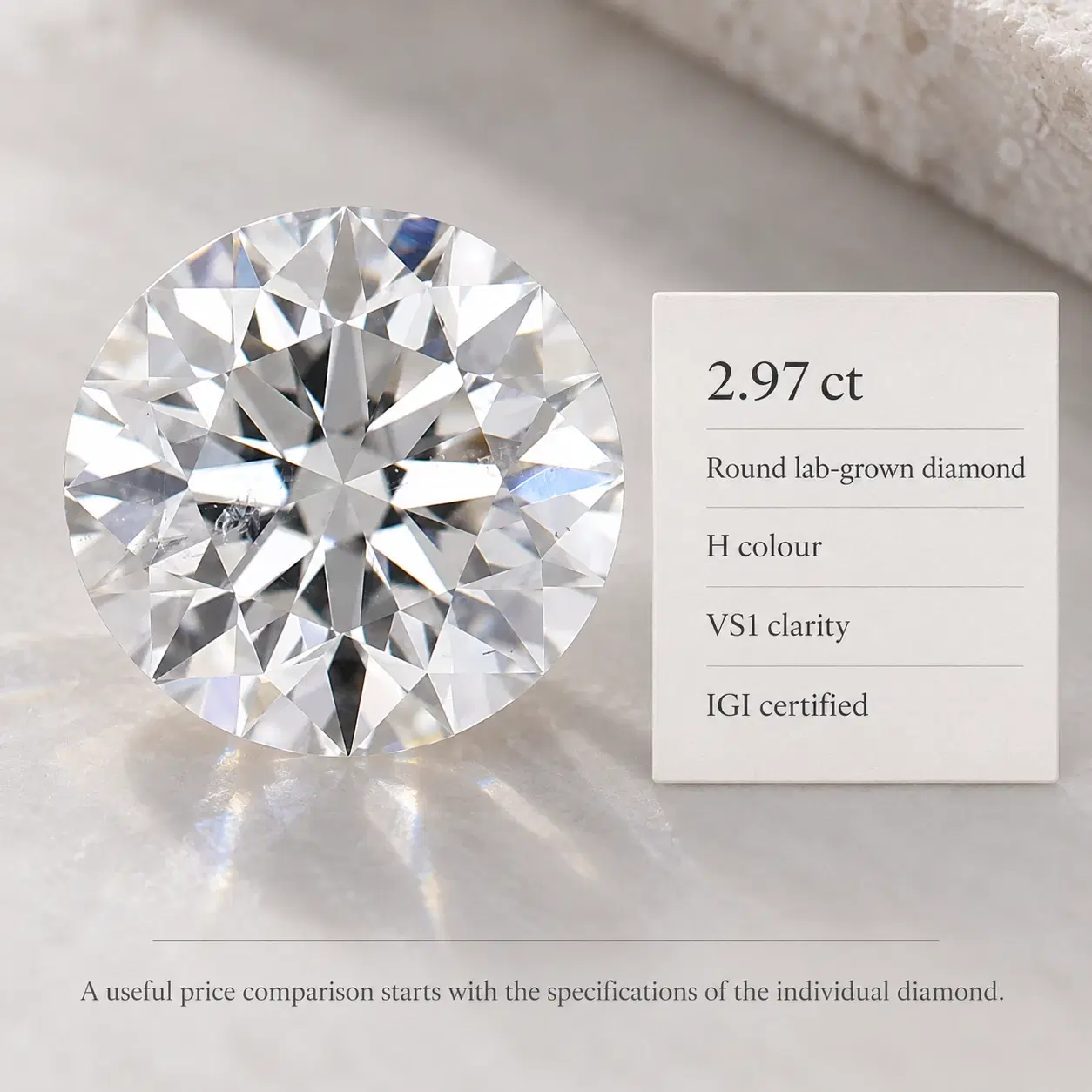
Illustrative example. Specifications and prices shown are not a current quotation.
Why a single 3 carat diamond price can be misleading
Searches for “3 carat lab-grown diamond price” often suggest that carat weight should produce one standard figure. Diamond buying does not work that way.
The three-carat category can contain diamonds with different shapes, exact weights, grades, proportions and certifications. Current availability can also change which combinations are available at a particular time.
A price without those details therefore tells you relatively little.
A more useful comparison might begin with a requirement such as:
Round lab-grown diamond → approximately 3.00 ct → F–G colour → VS1–VS2 clarity → recognised laboratory report → specified cut requirements.
Once that buying specification has been defined, current Uniglo stones can be compared much more meaningfully.
This prevents a cheaper stone with materially different characteristics from being mistaken for a direct equivalent.
How to judge a three-carat diamond quotation
Begin by comparing diamonds that are sufficiently similar.
If you want a round 3 carat stone, compare other rounds within a close weight range rather than immediately comparing the quotation with an oval, emerald or cushion diamond.
Keep the desired colour and clarity ranges reasonably consistent as well. Then investigate the differences that remain, such as exact dimensions, proportions, finish, visual appearance and certification.
A quotation should identify the individual stone being offered. Before comparing prices, confirm its exact weight, measurements, colour, clarity, relevant cut information and grading report.
If one Uniglo option costs more than another, identify what changed.
The more expensive diamond may have a different colour or clarity grade, stronger cut characteristics, different dimensions or simply represent a different available specification. Price alone does not explain the difference.
The objective is not merely to identify the lowest amount. It is to understand what the quoted amount purchases.
What does price per carat tell you?
Price per carat is calculated using:
Price per carat = current loose-diamond price ÷ exact carat weight
If a shortlisted Uniglo diamond weighs 3.04 ct, use 3.04 in the calculation rather than rounding the weight to 3.00.
Price per carat can help organise a shortlist of similar stones, particularly when their weights differ slightly. It does not measure brilliance, beauty, cut performance or suitability for a particular ring.
It should also not be used to manufacture an estimate for another diamond.
For example, the price per carat of one 3.01 ct diamond should not simply be multiplied by 3.20 to predict what another 3.20 ct stone should cost. The second diamond may have different colour, clarity, proportions, certification and availability.
Use price per carat as a comparison metric after the important specifications have already been aligned.
How big is a 3 carat lab-grown diamond?
Carat measures weight rather than visible diameter. One carat equals 200 milligrams, meaning a diamond weighing exactly 3.00 carats has a mass of 0.6 grams.
IGI's carat-weight guidance also distinguishes diamond weight from its visible dimensions:https://www.igi.org/consumer-education/diamond-4cs/carat-weight/
This distinction is important when buying a larger centre stone.
Two diamonds can weigh approximately three carats while distributing that weight differently between face-up width, length and depth. A deeper stone can carry additional weight without producing a proportionate increase in visible surface area.
For a round diamond, compare its diameter.
For an oval, pear or marquise, compare both length and width. For emerald, radiant, cushion and other shapes, examine the complete outline and proportions rather than looking at a single measurement.
Uniglo's inventory includes length, width, height, depth percentage and table percentage filters, allowing those measurements to be considered alongside carat weight.
For a ring purchase, the actual stone should ultimately be considered in relation to the intended mounting. Magnified photographs are useful for inspection but should not replace millimetre measurements when judging physical size.
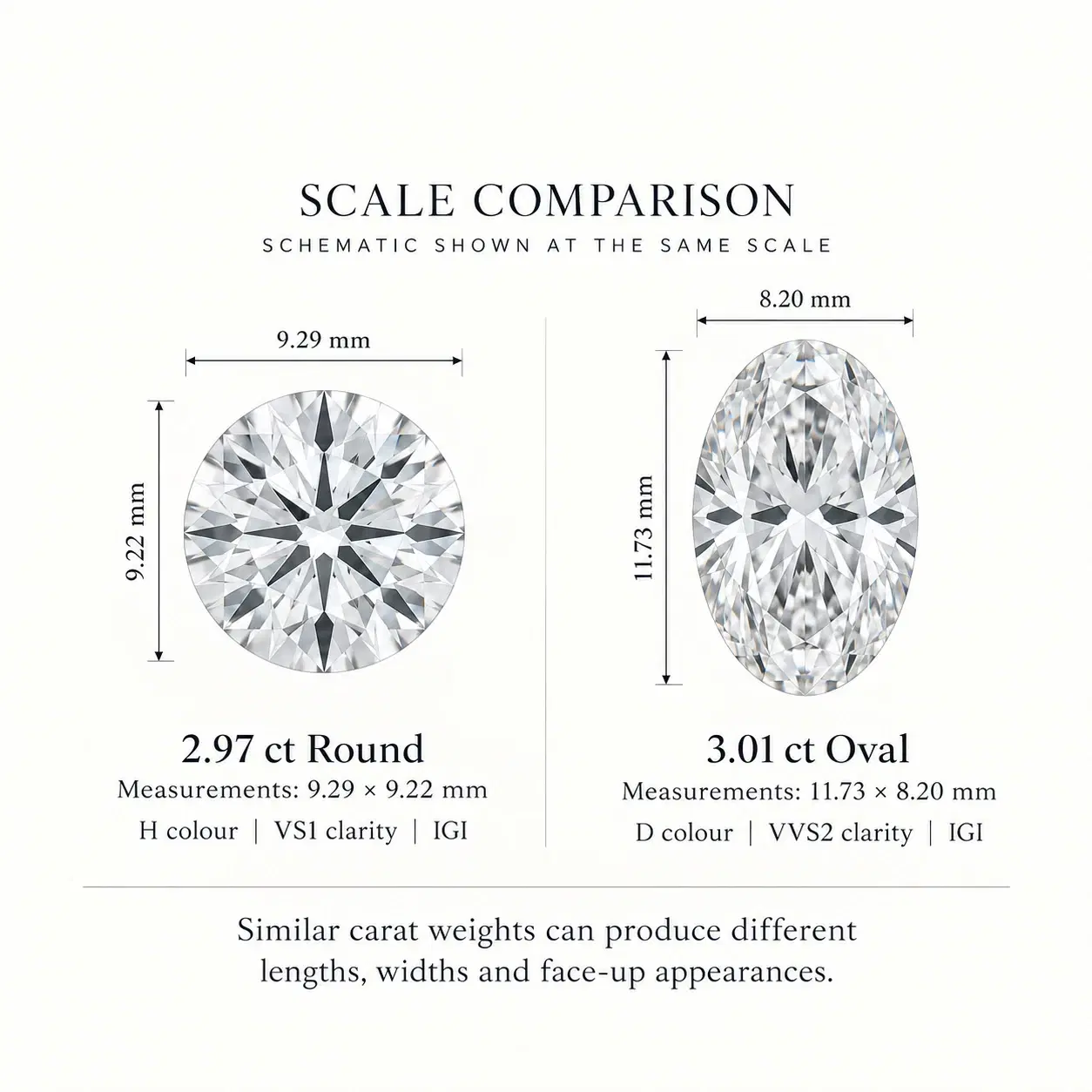
Illustrative example. Specifications and prices shown are not a current quotation.
Which specifications are worth paying for at 3 carats?
At approximately three carats, the size of the diamond can make differences in appearance easier to notice. That does not mean every buyer needs the highest available colour or clarity grade.
A better approach is to determine which specifications visibly improve the particular diamond and which upgrades matter to the buyer.
Cut: assess how the diamond handles light
Cut plays a major role in how a diamond interacts with light.
For a round diamond, review the applicable overall cut assessment together with proportions, polish and symmetry. Actual imagery or video can then help evaluate the individual stone beyond the report data.
IGI explains that cut grading considers multiple elements and that fancy-shape assessment cannot be reduced to proportions alone:
https://www.igi.org/diamond-grading-process/cut-grading/
This is particularly important when comparing three-carat diamonds with similar headline grades.
A higher quoted price should not itself be treated as proof of stronger visual performance. Likewise, choosing the least expensive stone without considering cut can produce a diamond that does not deliver the appearance the buyer expected.
Review the grading information and the individual diamond together.
Colour: decide whether the difference matters visually
Colour grades provide a standardised way of describing the presence or absence of colour within the grading scale.
D, E and F fall within the colourless range, while G through J fall within the near-colourless range.
IGI's colour guidance explains the grading system in more detail:
https://www.igi.org/consumer-education/diamond-4cs/diamond-color/
At approximately three carats, colour can be easier to evaluate than in a much smaller diamond because there is more visible material.
That still does not mean every three-carat diamond needs D colour.
Compare the grade you initially prefer with neighbouring grades where suitable Uniglo inventory is available. Consider whether you can see a meaningful difference in the actual stones and whether that difference justifies the change in quotation for your priorities.
The jewellery metal can also influence how the diamond is visually perceived once mounted, so the final design should be considered alongside the loose stone.
Clarity: look beyond the grade abbreviation
Clarity grading examines internal and external characteristics under controlled conditions and magnification.
IGI explains clarity and the grading scale here:
https://www.igi.org/consumer-education/diamond-4cs/diamond-clarity/
For a three-carat diamond, examine not only whether the report says VVS1, VVS2, VS1 or VS2 but also what the individual diamond actually shows.
The position, size, nature and visibility of clarity characteristics matter.
A higher clarity grade can command a different quotation, but the practical question is whether the upgrade provides a benefit that matters to the buyer.
A VS-grade diamond can therefore be worth comparing with higher clarity options rather than assuming the most expensive clarity grade is automatically required.
If a seller describes a diamond as “eye-clean”, ask what viewing conditions are being used for that description. The laboratory clarity grade and the seller's visual description should not be treated as interchangeable terms.
Certification: verify the individual stone
A recognised grading report is especially useful for a purchase at this size because it records the characteristics of the individual diamond.
Uniglo inventory supports filtering by recognised laboratories including IGI, GIA and HRD.
The report should be used to verify the stone's recorded weight, measurements, colour, clarity and other applicable characteristics.
For an IGI-reported lab-grown diamond, report information can be checked through IGI's official systems:
https://www.igi.org/reports/lab-grown-diamond-report/
You can also read our dedicated IGI lab-grown diamond guide and GIA lab-grown diamond guide.
Certification should help buyers compare diamonds more accurately. It should not be used to imply that every diamond carrying a report from the same laboratory has identical quality or value.
What affects a 3 carat oval lab-grown diamond price?
A 3 carat oval needs to be evaluated somewhat differently from a round because oval proportions can vary considerably between stones of similar weight.
Two approximately three-carat ovals can differ in their length, width and length-to-width ratio. One may present a longer and narrower outline while another appears broader.
That difference matters visually even before colour, clarity and other specifications are considered.
For this reason, compare oval diamonds within your preferred outline rather than treating every three-carat oval as interchangeable.
When requesting a current Uniglo quotation, consider the exact weight, length, width, colour, clarity, certification and other relevant specifications together.
Moving video can also be particularly useful for evaluating an oval. Look at brightness across the stone and the appearance of the central area rather than relying solely on one still photograph.
A bow-tie effect can be present to varying degrees in elongated brilliant shapes. Its visibility should be assessed on the individual diamond rather than inferred from carat weight or length-to-width ratio alone.
The correct question is therefore not:
“What does a 3 carat oval cost?”
It is:
“What does this particular 3 carat oval with these specifications currently cost from Uniglo?”
3 carat oval versus 3 carat round pricing
A round and an oval of similar weight should not be treated as identical products for price-comparison purposes.
Their cutting styles, face-up dimensions and appearance differ.
If the buyer is still deciding between the two shapes, first compare their visual characteristics and how each works with the intended ring. Then request current quotations for suitable Uniglo diamonds within each category.
Avoid applying a fixed percentage discount or premium between round and oval diamonds. Current inventory and the individual specifications determine the actual comparison.
This keeps the decision tied to diamonds Uniglo can supply rather than to a theoretical price relationship between the shapes.
Does slightly more than 3.00 carats automatically mean a better diamond?
No.
A 3.05 ct diamond is heavier than a 3.00 ct diamond, but that does not establish that it looks larger, performs better or represents a stronger purchase.
The additional weight may be distributed across its diameter, length, width or depth.
Compare the measurements and proportions alongside the exact carat weight.
If the main objective is visible size, face-up dimensions deserve particular attention.
If the main objective is brilliance and visual performance, cut quality and the appearance of the actual stone require more attention than the difference between a few hundredths of a carat.
Carat should therefore be considered together with the rest of the specification.
How much does a 3 carat lab-grown diamond ring cost?
The price of the loose diamond is only one component of a finished ring.
The complete quotation may need to cover the centre diamond, the setting, precious metal, additional diamonds, workmanship, customisation and any applicable transaction or delivery costs.
| Cost component | What to confirm |
|---|---|
| Centre diamond | Exact stone, carat weight, measurements, grades, report and current price |
| Setting | Design, metal, purity, ring size and compatibility with the selected stone |
| Additional diamonds | Quantity, total weight and stated quality where applicable |
| Manufacturing | Setting, finishing and any customised work |
| Additional charges | Applicable taxes, shipping or other charges not already included |
| Aftercare | Any resizing, inspection or other services included with the purchase |
A simple solitaire setting and an elaborate diamond-set design obviously require different amounts of metal, additional stones and labour even when the centre diamond is identical.
The setting should also be designed around the measurements of the specific centre stone.
“Suitable for approximately a three-carat diamond” is less precise than confirming compatibility with the selected stone's actual length, width and depth.
A practical way to set the total ring budget
Instead of beginning with an invented example price for the three-carat diamond, start with the buyer's actual total budget.
For example, if a customer has a defined amount available for the complete ring, divide that budget conceptually between the centre stone and the finished setting.
The calculation is:
Maximum amount available for centre stone = total ring budget − confirmed setting and remaining costs
The actual numbers should be inserted only once current quotations are available.
This avoids building the purchase around an outdated or third-party diamond price.
If the centre stone consumes too much of the available budget, the buyer can then compare different colour, clarity, shape or exact carat options while maintaining the overall design objective.
Likewise, if the setting is particularly important, reserving the required amount for the design before selecting the diamond can prevent an unexpected shortfall.
Three-carat centre stone versus three carats total weight
Always establish what the carat description refers to.
A ring containing a 3.00 ct centre diamond has approximately three carats concentrated in its principal stone.
A ring described as 3.00 carats total weight can distribute that combined weight across the centre diamond and additional diamonds.
These are materially different jewellery configurations.
For example, a ring could combine a centre stone with multiple side diamonds to reach approximately three carats total. That should not be compared directly with a ring containing one three-carat centre stone.
When requesting a quotation, ask for the centre-diamond weight and any additional diamond weight separately.
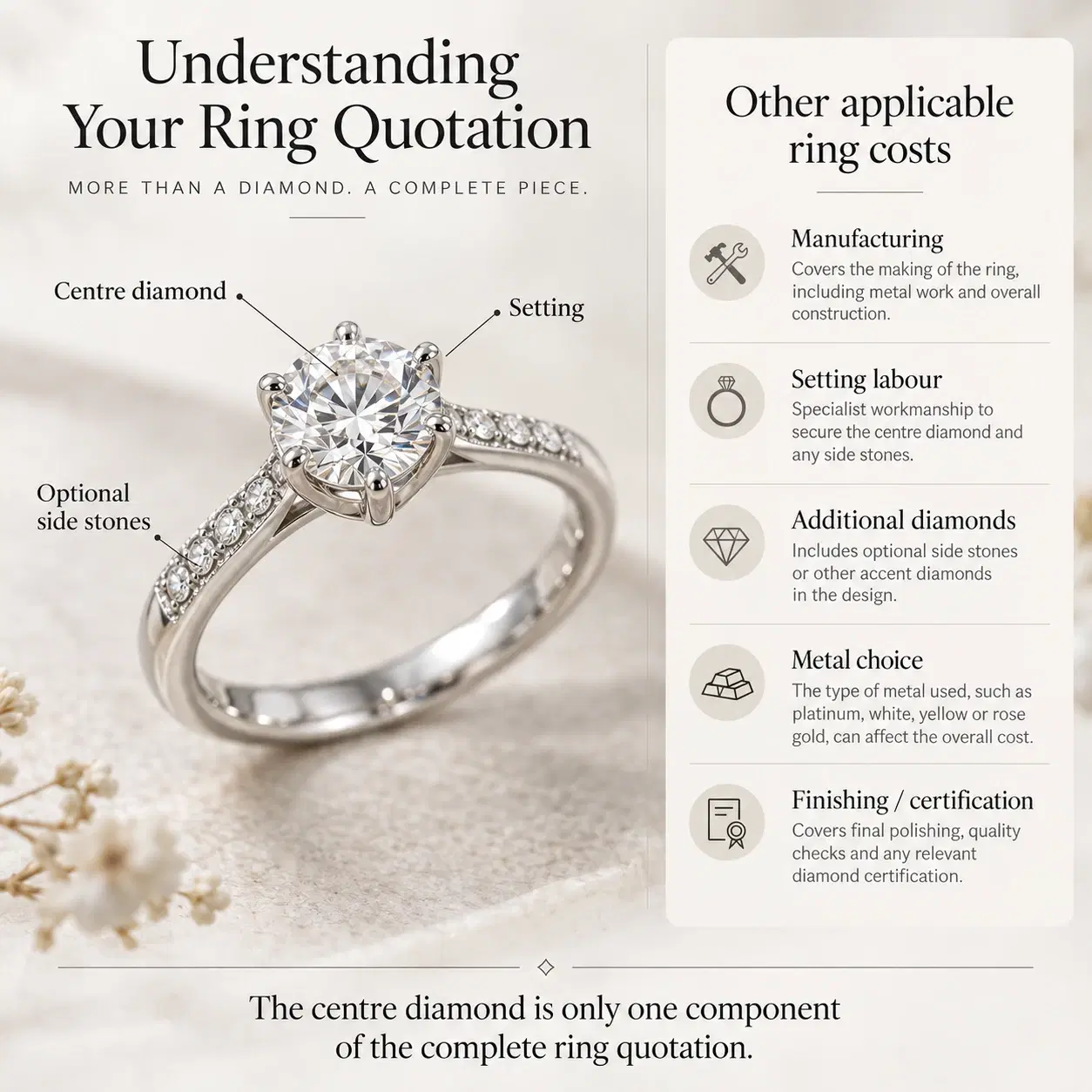
Illustrative example. Specifications and prices shown are not a current quotation.
Loose 3 carat diamond price versus finished-ring price
These two figures answer different questions.
A loose-diamond quotation tells you the price of the individual stone under the stated terms.
A finished-ring quotation includes the jewellery required to mount and present that stone.
When comparing quotations, make sure one supplier's loose-diamond figure is not being compared directly against another complete-ring total.
The written quotation should make the distinction clear.
For buyers working within a strict budget, request both figures where appropriate:
Loose diamond priceandComplete finished-ring price
This provides a transparent basis for deciding whether a particular centre stone works within the overall purchase.
Currency, taxes and delivery
A current price also needs a defined currency and clear purchasing terms.
When requesting a Uniglo quotation, state the delivery country and ask what is included in the amount provided.
International purchases may involve charges that depend on destination and transaction structure. These should be confirmed rather than estimated within a general educational article.
Currency conversion should also be treated carefully.
A converted figure displayed for comparison may not equal the final amount charged by a bank, card provider or payment service.
Keep the original quoted currency visible and compare final payable amounts when evaluating alternative options.
Are 3 carat lab-grown diamond prices changing?
Lab-grown diamond pricing can change over time because production, availability, demand and the mix of available specifications change.
However, historical market movement does not tell a buyer what a particular Uniglo stone costs today.
This page therefore does not use an outside market report or third-party retailer to predict the next price of a three-carat diamond.
The relevant buying reference is current Uniglo availability and the current quotation for the individual stone.
If timing matters, ask how long the quotation remains valid.
That is more useful for a purchase decision than assuming that a historical percentage decline or increase will continue at the same rate across every three-carat diamond.
Wholesale 3 carat lab-grown diamond pricing
A wholesale quotation needs to be interpreted according to the actual commercial requirement.
A jewellery business looking for one certified three-carat centre stone has a different sourcing requirement from a buyer requesting multiple stones, matched pairs, repeated supply or a broader assortment.
Trade enquiries should therefore state the required shape, carat range, colour, clarity, certification preference, quantity and delivery requirements.
If consistency across multiple stones is important, include acceptable dimensions and other matching criteria as well.
A wholesale label by itself does not tell you whether two offers are equivalent.
For trade sourcing, use Uniglo's wholesale lab-grown diamond page and request a quotation for the actual requirement.
What should you check before accepting a quotation?
Before accepting an offer for a three-carat lab-grown diamond, match the quotation with the individual stone.
The report details, exact carat weight, measurements, colour, clarity and other relevant grades should correspond with what is being offered.
Where an IGI report is supplied, verification can be performed using IGI's official report resources:
https://www.igi.org/reports/lab-grown-diamond-report/
A report-number inscription, where present and applicable, can also help connect the physical diamond with its documentation when properly examined.
Our IGI lab-grown diamond reports guide explains the report in greater detail.
Before payment, establish which specific diamond is being supplied, what the quotation includes, its currency, its validity period and the expected delivery timeline.
Also review the applicable purchase, inspection and return conditions before committing to the order.
How to request an accurate 3 carat quotation from Uniglo
A good enquiry gives Uniglo enough information to narrow the available inventory without unnecessarily restricting the shortlist.
Start with the preferred shape and an approximate weight requirement.
For example:
Round → approximately 3.00 ct → F–G colour → VS1–VS2 clarity → certified lab-grown diamond
or:
Oval → at least 3.00 ct → preferred elongated outline → F–G colour → VS clarity → certified lab-grown diamond
Then state the budget and delivery country.
If the budget applies to the complete ring rather than only the loose stone, make that clear because it changes how much can be allocated to the centre diamond.
Also explain where you are flexible.
A buyer may be willing to compare F with G colour while keeping the same shape and clarity range. Another may prioritise visible dimensions and accept several clarity options.
That information helps create a shortlist around the buyer's actual priorities rather than automatically pushing every specification upward.
Contact Uniglo Diamonds for current three-carat options.
You can also review the Uniglo diamond inventory.
Frequently asked questions
How much does a 3 carat lab-grown diamond cost at Uniglo?
There is no single fixed price for every Uniglo three-carat lab-grown diamond. The current price depends on the actual stone's shape, exact weight, colour, clarity, cut characteristics, dimensions, certification and availability. Review current Uniglo inventory or request a quotation for the specification you require.
Why does this guide not give one exact 3 carat price?
An exact price without identifying the diamond can quickly become misleading. Current prices should be connected to specific available Uniglo stones rather than borrowed from another retailer or presented as a universal market figure.
Is a 3.01 carat diamond much more valuable than a 3.00 carat diamond?
The extra 0.01 carat alone does not establish value. Compare the complete specifications, measurements, cut characteristics, appearance and current quotation of both stones.
Does a three-carat diamond need D colour?
No universal colour grade is required for a three-carat diamond. D colour may suit a buyer who prioritises the highest colourless grade, while another buyer may prefer to compare E, F, G or other grades depending on appearance and budget.
Does a three-carat diamond need VVS clarity?
Not necessarily. VVS clarity may be desirable to some buyers, but suitable VS-grade diamonds can also be considered after reviewing the report and the actual stone. The decision should reflect the individual diamond rather than carat weight alone.
Does a three-carat diamond look much larger than a two-carat diamond?
Usually there will be a difference in physical dimensions, but carat is a measurement of weight rather than visible size. Compare the actual millimetre dimensions of the two stones to understand the difference in face-up appearance.
Will a slightly heavier diamond always look bigger?
No. The additional weight may be distributed in depth rather than entirely across the visible face of the diamond. Compare length, width, depth and proportions together.
Is a three-carat oval always cheaper than a three-carat round?
There is no fixed pricing rule that applies to every round-versus-oval comparison. Compare current Uniglo stones with reasonably similar colour, clarity and certification requirements and assess the individual quotations.
What affects the price of a 3 carat oval lab-grown diamond?
Exact weight, length and width, outline, colour, clarity, cut characteristics, certification and current availability can all affect the quotation. The visual character of the individual oval should also be assessed.
Is price per carat useful for a three-carat diamond?
Yes, when comparing reasonably similar stones. Divide the current loose-diamond price by the exact carat weight. Do not use price per carat as a substitute for assessing cut, appearance or the full diamond specification.
Is the price of a 3 carat lab-grown diamond the same as the price of a 3 carat ring?
No. A loose-diamond quotation covers the centre stone. A finished ring can additionally include the setting, metal, side diamonds, manufacturing, custom work and other applicable charges.
What does three carats total weight mean?
Total weight can include the centre diamond and any additional diamonds in the jewellery. It should not automatically be interpreted as a single three-carat centre stone.
Can I use an old 3 carat price guide as today's quotation?
No. Older prices can provide historical context, but the buying decision should use current Uniglo inventory or a current quotation for the individual diamond.
Can I buy a certified 3 carat lab-grown diamond from Uniglo?
Uniglo's inventory includes laboratory filters for IGI, GIA and HRD, allowing certification to be incorporated into the diamond search. Confirm the report belonging to the individual stone before purchase.
Where can I check the current price of a 3 carat Uniglo diamond?
Use the Uniglo diamond inventory or contact Uniglo Diamonds with your preferred shape, weight, colour, clarity and other requirements.
Final takeaway
A useful answer to “How much does a 3 carat lab-grown diamond cost?” requires more information than the number three.
Shape, exact weight, colour, clarity, cut, measurements, certification and current availability all affect the individual diamond and its quotation.
For that reason, the correct reference for a Uniglo customer is Uniglo's current inventory or a current Uniglo quotation, not an advertised price from another diamond retailer.
Use independent laboratories such as IGI, GIA and HRD to understand and verify grading information, while keeping the commercial price comparison centred on the diamonds Uniglo can actually supply.




