
2 Carat Lab Grown Diamond Price
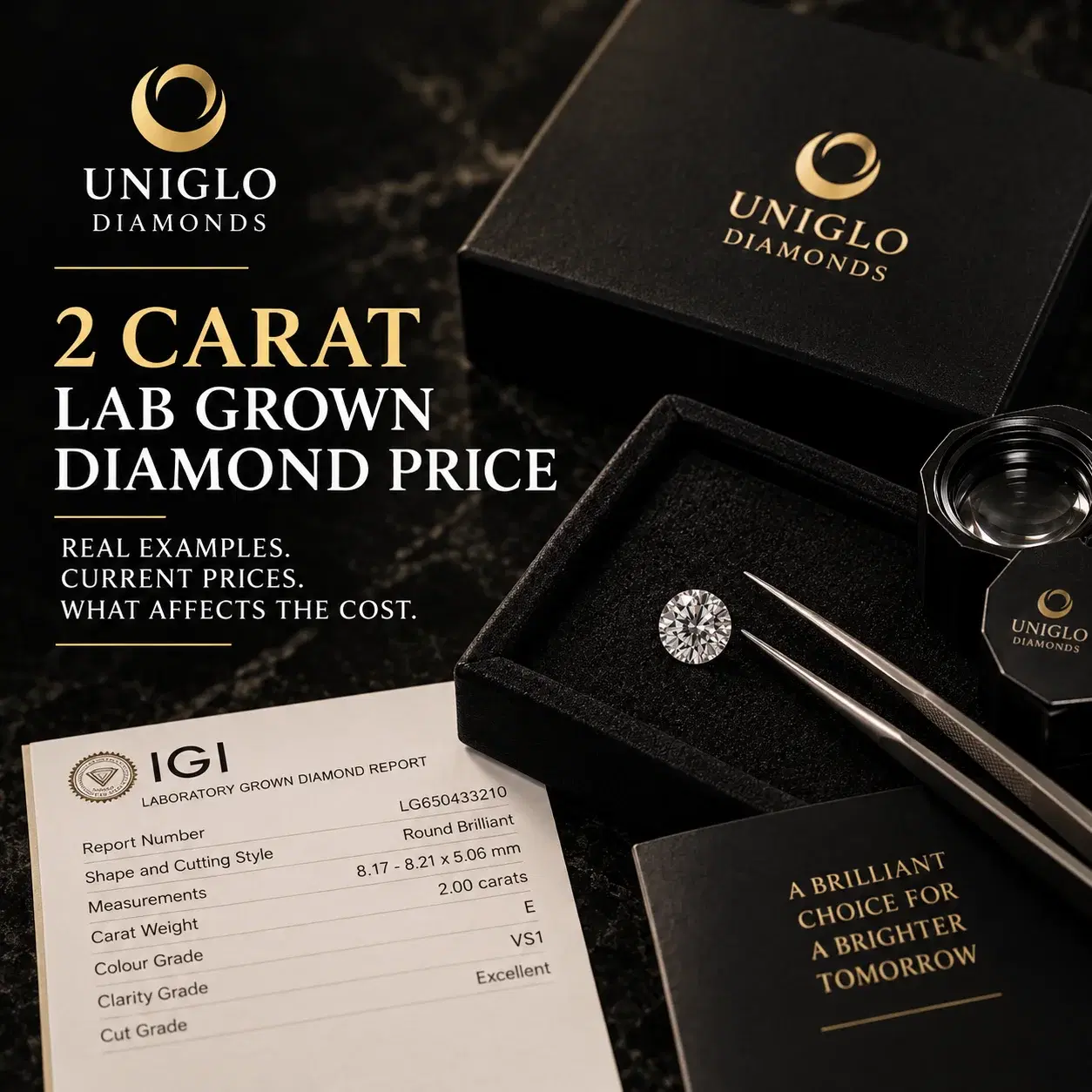
A useful 2 carat lab grown diamond price comparison starts with an individual stone and its complete specifications rather than a headline price alone. There is no single fixed price that applies to every 2.00-carat laboratory-grown diamond because shape, colour, clarity, cut characteristics, measurements, certification and current availability can all influence the quotation.
For this reason, current pricing should be connected to the actual diamond being offered rather than using advertised prices from unrelated external sellers as a benchmark. Availability, final payable amount, taxes, shipping conditions and individual diamond specifications should always be confirmed before purchasing. For a broader explanation of how pricing works across different weights and specifications, see Uniglo’s Lab Grown Diamond Prices guide.
Comparing Prices for 2 Carat Loose Lab-Grown Diamonds
A meaningful two-carat price comparison should begin with diamonds that are sufficiently similar. If you are looking for one loose laboratory-grown diamond weighing approximately 2.00 carats, first keep the shape, colour range, clarity range and certification requirements reasonably consistent. Then compare the exact weight, measurements, cut information, polish, symmetry and other characteristics of the individual stones.
For example, comparing two approximately 2.00-carat round diamonds within a similar colour and clarity range gives you a much better basis for interpreting the price difference than comparing a round E/SI1 diamond with an oval D/VVS1 diamond. In the second example, several important variables have changed simultaneously, making it difficult to understand what is actually influencing the quotation.
The exact carat weight also matters. A 2.00-carat diamond and a 2.08-carat diamond both sit within the general two-carat category, but they are not identical stones. Their measurements and proportions may also differ even when the other headline grades appear similar.
This is why a general two-carat price should not be treated as a universal market range. A lower quotation is better used as the starting point for investigating the specific diamond rather than as proof that it represents the best option. Likewise, a higher quotation should not automatically be interpreted as evidence that the diamond will look better.
Compare the current Uniglo quotation with the actual specifications and visual information of the individual stone.
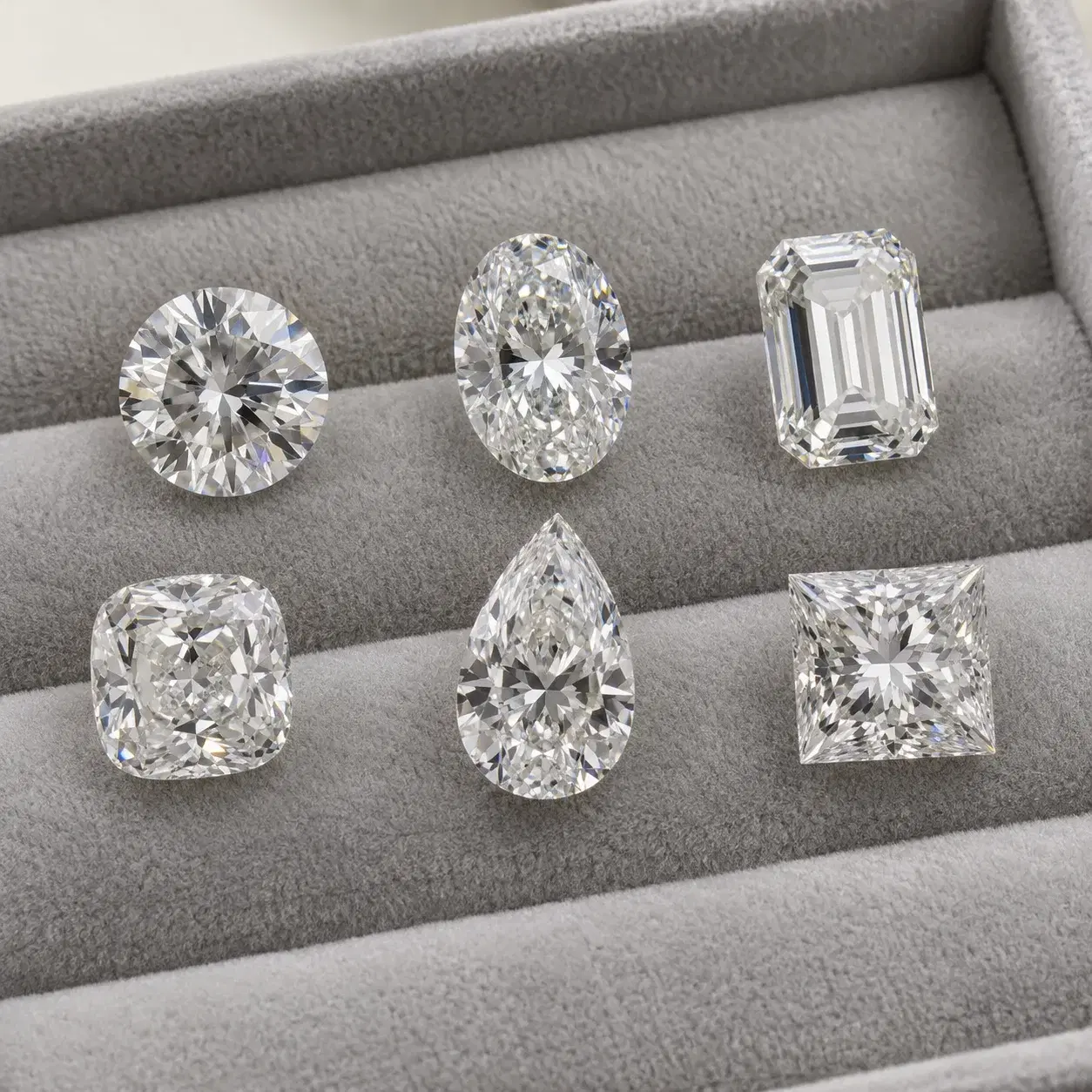
Illustrative comparison. Specifications and prices shown are not a current quotation.
What Should a 2 Carat Lab Grown Diamond Price Include?
A displayed stone price should always be read alongside the diamond’s documentation and the commercial terms attached to the purchase. The headline diamond price alone does not necessarily tell you the complete amount that will ultimately be payable.
Depending on the transaction, the final cost can also involve delivery, insurance while the parcel is in transit, VAT, import duties, local taxes, payment-related charges and the cost of a setting when the diamond is being purchased for a finished piece of jewellery. A loose-diamond quotation should therefore not be treated as the price of a completed engagement ring unless the setting and associated jewellery costs are specifically included.
When requesting a current quotation, ask Uniglo to make clear what the amount covers and whether any significant costs remain outside it. Ideally, the quotation should allow you to distinguish the loose diamond from the setting, delivery and any other applicable charges so that you can compare different options on the same basis.
Shipping insurance and jewellery insurance should also be kept separate. Insurance associated with the shipment generally concerns the parcel while it is being transported. Insurance for the diamond or completed jewellery after delivery is a separate consideration.
Why Certification Matters When Comparing Prices
Two diamonds can both be described as two-carat laboratory-grown diamonds while differing materially in colour, clarity, dimensions, proportions and other documented characteristics. A laboratory report helps identify exactly which diamond is being offered and provides a much stronger basis for comparison than a short product title.
IGI explains that its laboratory-grown diamond reports record the stone’s laboratory-grown origin and relevant quality characteristics. You can review IGI’s laboratory-grown diamond report information or use Uniglo’s IGI Certified Lab-Grown Diamonds guide when reading a report.
A grading report should not, however, be confused with a price appraisal. It documents characteristics of the diamond; it does not determine whether the amount being charged represents good value. Price still needs to be assessed separately against the individual stone, current availability and the complete purchase terms.
Two Round Diamonds at 2.00 Carats Can Have Different Dimensions
Carat measures weight rather than visible diameter. One carat equals 200 milligrams, so a 2.00-carat diamond weighs 400 milligrams. GIA’s explanation of diamond carat weight provides additional information about how carat weight is measured.
This distinction matters because two round diamonds can both weigh approximately 2.00 carats while presenting different face-up dimensions. One stone may distribute more of its weight through its depth, while another may have a somewhat broader diameter. Equal carat weight therefore does not guarantee equal visible size.
When comparing two Uniglo round diamonds around two carats, look at the minimum and maximum diameter together with the total depth and relevant percentage measurements. These figures help explain how the weight has been distributed through the stone and provide more useful information about physical size than carat weight alone.
The important lesson is that carat weight does not tell you exactly how large a diamond will appear from above. Use the actual measurements recorded for the specific diamond when comparing visible size.
A larger diameter should also not automatically be treated as evidence of better cutting. A diamond’s proportions and other cutting characteristics influence how it interacts with light. GIA’s diamond cut guidance explains the relationship between cutting and visual performance in more detail.
For broader millimetre comparisons across weights and shapes, see Uniglo’s Diamond Size Chart.
How Does Shape Affect a 2 Carat Lab Grown Diamond Price?
Shape should be considered alongside weight when comparing quotations. A 2.00-carat round diamond and a 2.00-carat emerald-cut diamond do not represent identical purchases even when their colour and clarity grades are similar. Their cutting style, proportions, dimensions and face-up appearance can all differ.
If you are considering several shapes such as round, oval, radiant or emerald, request separate quotations using broadly comparable requirements. For example, compare two-carat options within a similar colour and clarity range rather than comparing an E/SI1 emerald with a D/VVS1 oval and assuming that any price difference has been caused entirely by shape.
For elongated diamonds, compare length and width together rather than relying solely on the carat weight. The length-to-width ratio can also help describe the outline. Two diamonds can therefore carry the same weight while presenting very different appearances when viewed from above.
Uniglo’s Diamond Shapes guide explains the major diamond shapes in more detail, while the Diamond Size Chart provides useful millimetre references.
Choosing Colour, Clarity and Cut Within Your Budget
The most useful price comparison begins with the appearance and specification range you actually want. If a higher-priced colour or clarity grade is proposed, compare the relevant stones rather than assuming that the higher grade will necessarily deliver a visible improvement that matters to you.
A buyer considering an SI1 diamond should examine the location, nature and visibility of the individual clarity characteristics. A buyer considering VS1 or VVS1 should still inspect the particular stone instead of making the decision solely from the clarity abbreviation. The same principle applies to colour: the grade provides useful information, but the actual diamond and the intended jewellery should remain part of the decision.
When comparing prices, try to change as few specifications as possible. Comparing two round diamonds around 2.00 carats with similar colour and proportions but different clarity grades may help you understand what the clarity change means for the quotation. Comparing a round E/SI1 diamond with an oval D/VVS1 changes shape, colour and clarity at the same time, making the price difference much harder to interpret.
The grading report should support the characteristics and identity of the diamond being offered. For help understanding IGI documentation, use Uniglo’s IGI Certified Lab-Grown Diamonds guide or review IGI’s laboratory-grown diamond report guidance.
Whole-Stone Price vs Price Per Carat
One of the most important details in a diamond quotation is the unit attached to the price. A whole-stone price and a price per carat are not the same thing.
For example, if a hypothetical diamond is quoted at US$500 per carat and weighs exactly 2.00 carats, the arithmetic would produce a whole-stone amount of US$1,000. If the diamond instead weighs 2.08 carats at the same hypothetical US$500-per-carat rate, the calculated stone price would be US$1,040.
These figures are only examples demonstrating the calculation. They are not current Uniglo prices or market-price estimates.
The exact carat weight therefore matters whenever the quotation is expressed on a per-carat basis. If you receive a per-carat quotation, ask for the whole-stone price to be stated clearly as well. For additional explanation of pricing terminology, see Uniglo’s Lab Grown Diamond Prices guide.
2 Carat Loose Diamond Price vs 2 Carat Ring Price
A 2 carat lab grown diamond price does not automatically represent the price of a completed ring. If the quotation covers only the loose diamond, the setting and other jewellery components still need to be considered separately.
A finished ring quotation can involve the centre diamond, precious metal, setting design, side stones or accent diamonds, manufacturing requirements and other services associated with creating the finished piece. Two rings containing similar centre diamonds can therefore have very different final prices depending on the design and materials used.
Another important distinction is centre-stone carat weight versus total carat weight. A ring described simply as “2 carats” could refer to the combined weight of several diamonds rather than one individual 2.00-carat centre stone.
If your requirement is specifically for one two-carat centre diamond, the quotation should make that clear by identifying a centre diamond weight of 2.00 ct or above, together with the individual diamond’s grading-report information.
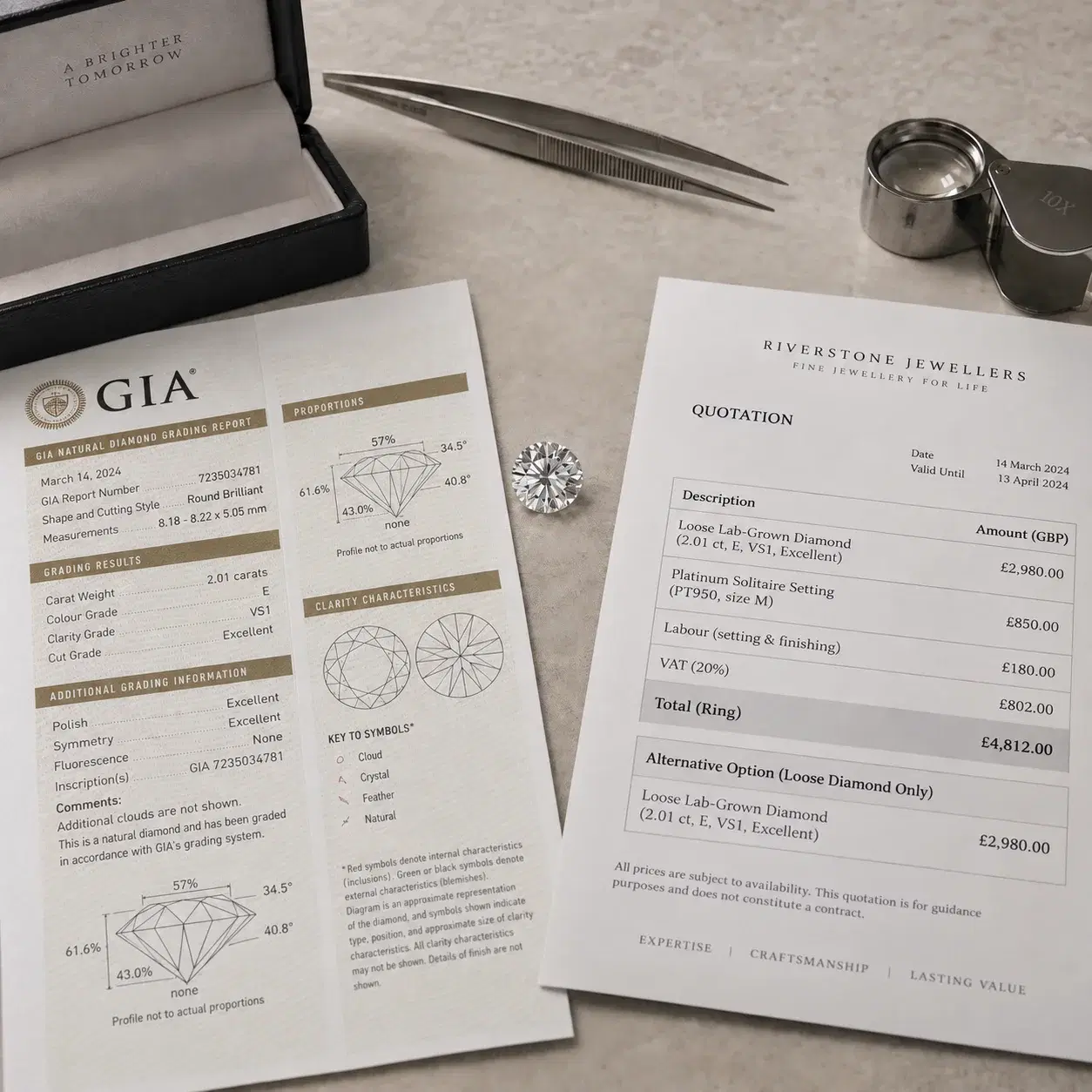
Illustrative comparison. Specifications and prices shown are not a current quotation.
What to Request in a Current 2 Carat Diamond Quotation
When requesting a quotation, give Uniglo enough information to provide genuinely comparable options. Start with your preferred shape, approximate budget and intended use. If two carats is a firm minimum rather than an approximate target, state clearly that you require a centre diamond weighing at least 2.00 carats.
The quotation should ideally identify an individual available stone rather than providing only a generic specification. Ask for the exact carat weight, measurements, colour grade, clarity grade, report issuer, report number and relevant cutting or proportion information.
The quotation date and validity period are also useful because lab-grown diamond inventories can change. Before payment, confirm that the quotation still refers to the same available stone and that its specifications have not changed.
For an international purchase, also establish whether the quoted amount includes or excludes destination-specific taxes, duties, delivery or other charges. This helps prevent a seemingly lower stone price from becoming a higher final payable amount once additional costs are added.
Why a Cheap 2 Carat Lab Grown Diamond Is Not Automatically the Best Option
The lowest number in a comparison is naturally easy to notice, but it should not be evaluated separately from the diamond itself. A lower-priced diamond may differ in clarity, colour, measurements, proportions, cutting characteristics, certification information or commercial terms.
This does not mean that the lowest-priced diamond is necessarily unsuitable. It means that the buyer needs enough information to understand what is actually being purchased at that price.
The reverse is also true. A higher price should not automatically be interpreted as proof that a diamond will look better or perform better. Price is not a quality grade. Compare the documented specifications, actual measurements, grading information and visual appearance of the stone before deciding which option best suits the requirement.
Does a 2 Carat Diamond Look Twice as Large as a 1 Carat Diamond?
No. A two-carat diamond weighs twice as much as a one-carat diamond, but that does not mean it has twice the visible width because the additional mass is distributed through three dimensions.
Approximate round-diamond reference measurements can place a one-carat round at around 6.5 mm across and a two-carat round at around 8.2 mm. The visual increase is substantial, but the diameter does not double.
This is why comparing millimetre measurements alongside carat weight is valuable when choosing a diamond. For a deeper comparison of weight and dimensions, use Uniglo’s Diamond Size Chart.
Natural vs Lab-Grown Diamond Size at Two Carats
The measurement system does not change according to diamond origin. A 2.00-carat natural diamond and a 2.00-carat laboratory-grown diamond both weigh 400 milligrams, and millimetres describe physical dimensions in exactly the same way for each.
Individual natural and laboratory-grown diamonds can still have different dimensions because their shapes and proportions differ. Origin therefore does not create a separate size system; the actual measurements of the individual stone remain what matters.
GIA provides additional information about the relationship between natural diamonds, laboratory-grown diamonds and simulants in its diamond education guidance. If you are specifically shopping for laboratory-grown options, you can also explore Uniglo’s Lab-Grown Diamonds.
Frequently Asked Questions
How much does a 2 carat lab grown diamond cost?
There is no single fixed price for every two-carat laboratory-grown diamond. The current quotation depends on the individual stone, including its shape, exact weight, colour, clarity, measurements, cutting characteristics, grading documentation and availability. For an accurate current amount, review suitable Uniglo options or request a dated quotation for the specification you require.
Is a 2 carat lab grown diamond price quoted per carat?
It can be, so check the quotation carefully. If the amount is explicitly described as per carat, multiply that rate by the diamond’s exact weight to calculate the whole-stone amount. It is useful to ask for the final whole-stone price to be stated clearly before making a purchasing decision.
Can I compare a 1.90-carat diamond with a 2.00-carat diamond?
Yes, if both weights meet your requirements. Compare their actual dimensions, grading characteristics, appearance and prices. If the requirement is specifically for a centre diamond weighing at least 2.00 carats, however, a 1.90-carat stone does not meet that requirement.
Is a two-carat lab-grown diamond ring the same price as the loose diamond?
No. A loose-diamond quotation concerns the stone itself, while a finished ring can also include the metal, setting, additional diamonds, manufacturing and other services. Ask for the centre-diamond price and completed-jewellery price separately when you need to understand how the total budget is being allocated.
Which 2 carat diamond shape is cheapest?
There is no reliable universal rule stating that one shape will always be the cheapest. Compare current Uniglo stones meeting similar specifications. Shape, colour, clarity, cut characteristics, dimensions and availability can all influence the quotation.
Does a higher-priced 2 carat diamond look bigger?
Not necessarily. Price does not measure physical size. Compare the diamond’s millimetre measurements to understand its face-up dimensions. GIA’s carat weight guidance explains why carat should be understood as weight rather than visible diameter.
Does an IGI report confirm that the price is fair?
No. An IGI report documents characteristics of the diamond and its laboratory-grown origin, but it does not determine whether a particular quotation represents good value. Use the report to understand which diamond you are comparing, then assess the price and purchase terms separately. Read IGI’s explanation of laboratory-grown diamond reports or Uniglo’s IGI Certified Lab-Grown Diamonds guide.
Is 2 carats a good size for a lab-grown diamond?
That depends on the appearance, jewellery design, budget and proportions you prefer. Instead of selecting weight alone, compare two-carat diamonds using their actual millimetre dimensions and how they appear in the intended setting. Uniglo’s Diamond Size Chart provides approximate dimensional references.
Is 2.00 carats exactly the same size for every diamond?
No. Two diamonds can both weigh exactly 2.00 carats while having different lengths, widths and depths. Shape and proportions influence how the weight is distributed, which is why both carat weight and millimetre measurements should be considered in a meaningful comparison.
Request a 2 Carat Lab Grown Diamond Quotation
To discuss a two-carat laboratory-grown diamond, contact Uniglo Diamonds with your preferred shape, budget, specification requirements and delivery destination. Ask for the individual diamond’s grading-report information, exact measurements and a dated quotation explaining the whole-stone price and what the quoted amount includes.
If you are selecting a finished ring rather than a loose stone, include your preferred metal, setting style and other design requirements so the quotation can address the complete purchase. You can also explore Uniglo’s Lab-Grown Diamonds or read the broader Lab Grown Diamond Prices guide before requesting suitable options.




