
1 Carat Lab Grown Diamond Price
Price examples checked: 13 September 2026. All displayed amounts are in US dollars.
The 1 carat lab grown diamond price depends on the individual stone, its grading characteristics and the complete purchase being quoted.
Four exact 1.00-carat loose laboratory-grown diamonds reviewed in public retail listings were advertised between US$231 and US$274, with differences in colour, clarity, finish, shape and measurements.
These are selected dated examples from one retailer. They do not establish a market-wide price range and they are not Uniglo Diamonds quotations.
They also represent loose diamonds rather than completed jewellery, so a buyer considering a ring, pendant or other piece should also account for the setting, metal, manufacturing and applicable delivery costs.
For broader pricing context across other weights and specifications, see Uniglo’s Lab Grown Diamond Prices guide.
Documented Prices for 1 Carat Loose Lab-Grown Diamonds
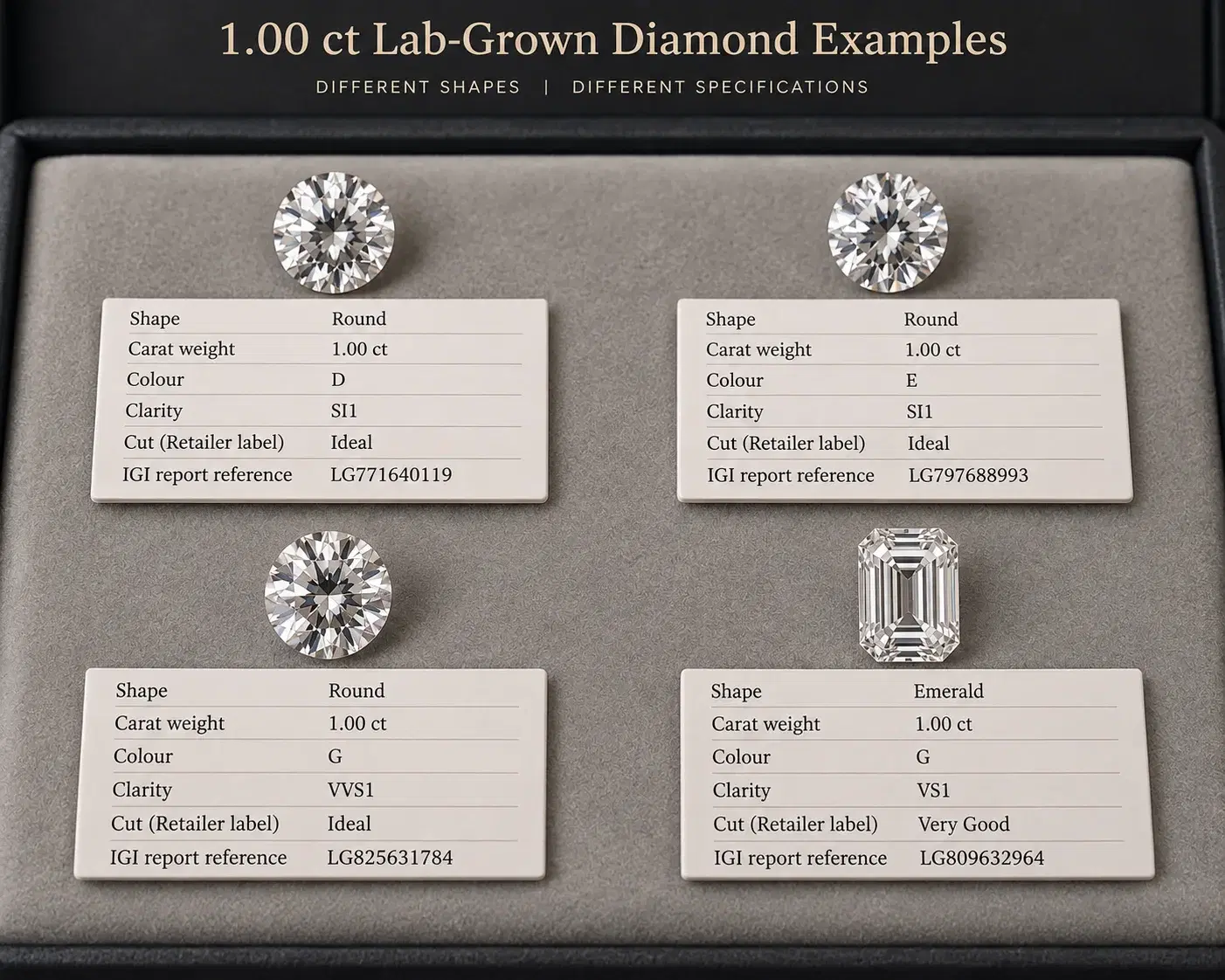
Each row below represents a separate laboratory-grown diamond listed at exactly 1.00 carat.
The figures are whole-stone advertised prices.
| Shape and example | Colour / clarity | Retailer’s cut label | Listed IGI report reference | Displayed price |
|---|---|---|---|---|
| Round — D / SI1 | D / SI1 | Ideal | LG771640119 | US$234 |
| Round — E / SI1 | E / SI1 | Ideal | LG797688993 | US$248 |
| Round — G / VVS1 | G / VVS1 | Ideal | LG825631784 | US$274 |
| Emerald — G / VS1 | G / VS1 | Very Good | LG809632964 | US$231 |
The specifications and cut descriptions above reflect the retailer’s listed information.
When assessing any individual diamond, check the laboratory documentation associated with that stone rather than relying only on the retail listing.
This sample helps illustrate the relationship between price and specifications, but it does not represent every colour, clarity grade, cutting standard, shape or seller available at one carat.
A quotation outside this small sample should therefore be evaluated against its own stone, report and purchase conditions.
Illustrative comparison. Specifications and prices shown are not a current quotation.
What the One-Carat Examples Reveal About Quality and Price
The examples above show why one carat alone is not enough information to compare prices properly.
The D/SI1 round was listed below the E/SI1 round, although both were described using the retailer’s Ideal cut label.
Their finish information also differed. The D/SI1 example had Very Good polish and symmetry, while the E/SI1 example had Excellent assessments for both.
This prevents the comparison from being treated as a controlled test of D colour versus E colour.
Several characteristics change at the same time.
That is an important principle when evaluating diamond pricing.
A price table based only on statements such as:
“1 carat, D colour”
or
“1 carat, VVS clarity”
still leaves several potentially relevant factors unresolved.
The G/VVS1 round presents another example. It combines a different colour grade with substantially higher clarity.
IGI’s laboratory-grown diamond reporting framework documents colour and clarity characteristics separately. You can review IGI’s laboratory-grown diamond report information for more detail.
When paying more for one option, ask what actually changes in the individual diamond.
A meaningful comparison should consider the grading report, measurements, finish information, appearance and total payable amount together.
Is VVS Clarity Necessary for a One-Carat Diamond?
VVS clarity is not automatically required simply because a diamond weighs one carat.
Clarity describes characteristics within or on the diamond and how they are assessed under standard grading conditions.
GIA explains that clarity grading considers factors including the number, size, relief, nature and position of clarity characteristics.
Read GIA’s diamond clarity guidance for more detail.
Many clarity characteristics are difficult or impossible to see without magnification.
This means that a clarity grade alone cannot tell you exactly how noticeable an individual inclusion will be during ordinary wear.
For an SI1 diamond, review the actual stone and ask about the location and visibility of its clarity characteristics.
For a VS1 or VVS1 option, consider whether the extra expenditure provides an appearance difference that matters to you in that particular comparison.
A higher clarity grade is a grading distinction. It should not automatically be interpreted as an equally large visible improvement.
For broader context on how clarity interacts with the other grading factors, see Uniglo’s Diamond 4Cs guide.
How Colour Can Affect a One-Carat Diamond Comparison
Colour and clarity describe different characteristics.
GIA’s colour grading system assesses the absence of colour in diamonds within the D-to-Z range.
You can read GIA’s diamond colour guidance for more information.
Professional colour assessment is performed under controlled conditions.
For buyers, this means that photographs taken under different lighting, backgrounds, camera settings or post-processing conditions should not be treated as equivalent to a controlled laboratory comparison.
If you are deciding between D, E, F or G colour in a one-carat laboratory-grown diamond, compare similar stones where possible.
For example, it is more useful to compare two round diamonds of similar weight, measurements and clarity than to compare:
a D/SI1 round
with
a G/VVS1 emerald
and assume the price difference is caused entirely by colour.
Change as few variables as possible when trying to understand what you are paying for.
Check the Millimetre Measurements Before Comparing Value
One carat equals 200 milligrams.
That is a measurement of weight rather than visible size.
GIA’s explanation of diamond carat weight explains the distinction in more detail.
In the examples reviewed above, the E/SI1 round listed diameters of approximately:
6.49–6.55 mm
while the G/VVS1 round listed:
6.33–6.37 mm.
Both were advertised as exactly 1.00 carat.
That illustrates why millimetre measurements provide useful information that the shared carat weight does not.
A buyer comparing visible size should therefore look at the actual dimensions rather than assuming every one-carat round diamond will present identically.
However, a larger diameter should not automatically be interpreted as evidence of better cutting.
Proportions influence how a diamond handles light, and size is only one part of the assessment.
GIA’s diamond cut guidance explains why multiple proportions and characteristics influence cut performance.
For broader dimensional comparisons across different carat weights and shapes, see Uniglo’s Diamond Size Chart.
One-Carat Round vs Emerald-Cut Pricing
The example table also contains both round and emerald-cut diamonds.
The emerald example was listed at:
1.00 ct, G colour, VS1 clarity — US$231
while the round examples ranged from US$234 to US$274.
This does not prove that emerald-cut laboratory-grown diamonds are always cheaper than round diamonds.
The diamonds differ in clarity, cut description, proportions and other characteristics, so shape cannot be isolated as the only explanation for the price difference.
A more reliable buying comparison would involve requesting quotations for several shapes using similar specifications.
For example:
1.00 ct round, E colour, VS1
1.00 ct oval, E colour, VS1
1.00 ct emerald, E colour, VS1
1.00 ct radiant, E colour, VS1
Comparing options this way makes it easier to understand what shape availability and pricing mean for your actual buying brief.
For more information on shape differences, see Uniglo’s Diamond Shapes guide.
From the Loose-Diamond Price to a Ring Budget
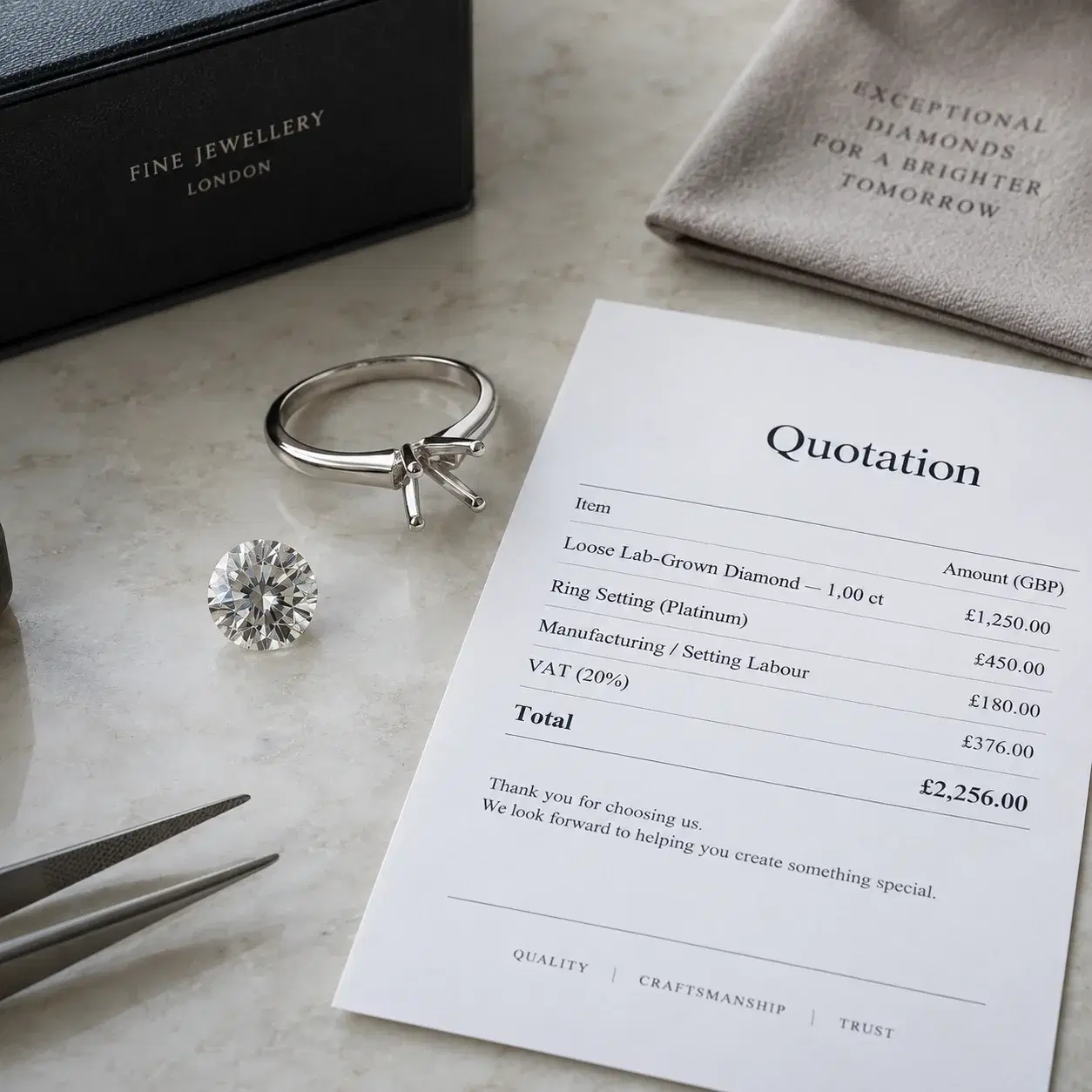
A loose-diamond price represents only one component of a completed ring.
The ring setting can account for a substantial part of the overall budget, particularly when the design uses premium metal, additional stones or more complex manufacturing.
For budgeting purposes, imagine a one-carat loose diamond priced at:
US$248
and a ring setting priced separately at:
US$880.
The arithmetic would be:
| Component | Example amount |
|---|---|
| Loose 1.00-carat centre diamond | US$248 |
| Ring setting | US$880 |
| Component subtotal | US$1,128 |
| Taxes, delivery, sizing and other applicable charges | Confirm separately |
This is a budgeting example only, not a current Uniglo Diamonds quotation and not a configured ring price.
The purpose is to show why a low loose-diamond price should not be treated as the total cost of a finished engagement ring.
A buyer should establish separately:
the centre-diamond price, metal specification, setting cost, additional diamonds, ring size requirements and total delivered price.
The same principle applies to pendants.
A loose diamond does not by itself include the pendant setting, chain or manufacturing.
What Should Be Included in the Total Purchase Cost?
A useful quotation should connect the price directly to the individual diamond being offered.
The document or quotation should make clear whether the amount covers:
a loose diamond, a finished piece of jewellery or a combination of components.
For a laboratory-grown diamond, request the relevant grading-report information so the quoted price can be associated with a specific stone.
Possible additional costs can include:
delivery, import duties, VAT or other taxes, setting costs, ring sizing, payment-related charges and optional services.
These factors vary according to seller and destination.
For that reason, a US-dollar loose-stone price should not automatically be converted into another currency and treated as the amount a buyer in another country will ultimately pay.
If you are purchasing in euros, pounds or rupees, ask for a quotation that clearly states:
the transaction currency, destination, applicable charges and total payable amount.
The laboratory report plays a different role.
It documents characteristics of the diamond rather than determining its monetary value.
IGI explains its laboratory-grown diamond reporting process in its lab-grown diamond report guidance.
For help understanding the document, use Uniglo’s IGI Certified Lab-Grown Diamonds guide.
Illustrative comparison. Specifications and prices shown are not a current quotation.
Exact Weight and Price Per Carat
When browsing diamonds described as “one carat”, check the exact weight.
There is a difference between:
exactly 1.00 carat
at least 1.00 carat
and
approximately one carat.
That distinction becomes important when prices are quoted on a per-carat basis.
For example:
US$300 per carat × 1.00 ct = US$300
but:
US$300 per carat × 1.05 ct = US$315.
These are arithmetic examples rather than current price quotations.
If a seller quotes a per-carat rate, ask for the calculated whole-stone price as well.
That removes ambiguity and makes it easier to compare different diamonds.
Uniglo’s broader Lab Grown Diamond Prices guide explains pricing terminology across other carat weights.
Centre-Stone Weight vs Total Carat Weight
“One carat” can mean different things depending on the jewellery product being discussed.
A loose diamond described as one carat usually refers to that individual stone.
In finished jewellery, however, a one-carat description may refer to:
one 1.00-carat centre diamond
or
1.00 carat total weight spread across several diamonds.
For example, a pair of earrings could have a combined total carat weight distributed across two centre stones.
A multi-stone ring may distribute the total across several diamonds.
If your requirement is specifically for one diamond weighing at least 1.00 carat, make sure the quotation states the individual centre-stone weight.
Is a 0.90-Carat Diamond Worth Comparing With 1.00 Carat?
It can be.
If your carat requirement is flexible, comparing a diamond slightly below one carat with an exact 1.00-carat diamond can help you evaluate differences in measurements, specifications and price.
However, the comparison should still use the actual stones.
A 0.90-carat diamond is not automatically a better value simply because it is below the one-carat threshold.
Likewise, the 1.00-carat diamond is not automatically preferable simply because it crosses that number.
Compare:
actual dimensions, appearance, grading characteristics and price.
If owning a diamond weighing at least 1.00 carat matters to you, keep that minimum in your quotation request rather than compromising it solely because another option is less expensive.
Is a One-Carat Lab-Grown Diamond the Same Size as a Natural Diamond?
Carat and millimetre measurement systems work the same way for both natural and laboratory-grown diamonds.
A 1.00-carat natural diamond and a 1.00-carat laboratory-grown diamond both weigh 200 milligrams.
Their actual measurements can still differ because individual diamonds have different proportions and shapes.
GIA provides additional information about the relationship between natural diamonds, laboratory-grown diamonds and simulants in its diamond education guidance.
For available laboratory-grown options, you can explore Uniglo’s Lab-Grown Diamonds.
What Should You Request in a One-Carat Diamond Quotation?
A useful request should give the supplier enough information to identify suitable diamonds rather than simply asking:
“How much is a one-carat lab-grown diamond?”
Include your:
preferred shape, minimum or exact carat requirement, approximate budget, preferred colour and clarity range, jewellery type and delivery destination.
For the individual stone, request:
exact carat weight, measurements, colour, clarity, report issuer and report reference.
If the diamond is intended for a finished ring or other piece of jewellery, ask for the setting to be quoted separately or clearly itemised within the total.
This produces a much more useful comparison than receiving a single number without knowing exactly what diamond or jewellery configuration it represents.
Frequently Asked Questions
How much does a 1 carat lab grown diamond cost?
The four exact 1.00-carat loose-diamond examples reviewed for this article were advertised between US$231 and US$274 on 13 September 2026.
This is a small dated sample from one retailer and does not establish a universal market range.
Request a current quotation for the specific diamond and purchase terms you want.
Is the cheapest one-carat lab-grown diamond the best value?
Not necessarily.
First establish whether the diamond satisfies your requirements.
Review its grading information, actual measurements, appearance and complete purchase cost before judging whether the lower price represents good value for you.
Should I choose D colour or VVS clarity?
Colour and clarity describe different characteristics.
There is no universal rule saying you should prioritise one over the other.
Compare similar diamonds where possible and decide which differences are meaningful for your own budget and appearance preferences.
Is VVS necessary for a 1 carat lab grown diamond?
No.
VVS is a high clarity grade, but it is not automatically required at one carat.
Assess the individual diamond and decide whether paying for the higher clarity grade provides a benefit that matters to you.
Does the loose-diamond price include a ring?
No, unless the quotation explicitly states that a setting is included.
The examples in this article are loose-diamond prices.
A completed ring requires a setting, metal and potentially additional stones or services.
Can two 1 carat diamonds have different sizes?
Yes.
Carat measures weight rather than external dimensions.
Two diamonds can both weigh exactly 1.00 carat while having different diameters, lengths, widths or depths.
Use Uniglo’s Diamond Size Chart for broader dimensional comparisons.
Can a slightly smaller diamond be worth comparing?
Yes, if your weight requirement is flexible.
Compare its actual measurements, specifications, appearance and price against the one-carat option.
If you specifically require at least 1.00 carat, state that clearly when requesting quotations.
Does an IGI report tell me whether the price is fair?
No.
The grading report documents characteristics of the diamond.
It does not determine whether the seller’s asking price represents good value.
Use the report to understand the diamond, then evaluate pricing separately.
Read IGI’s laboratory-grown diamond report information or Uniglo’s IGI Certified Lab-Grown Diamonds guide.
Can I use these prices as an Uniglo Diamonds quotation?
No.
These figures are dated comparison examples taken from public retail listings.
For current Uniglo pricing, request a quotation for the individual diamond, specification, jewellery requirements and delivery destination being considered.
Request a 1 Carat Lab Grown Diamond Quotation
To discuss a one-carat laboratory-grown diamond, contact Uniglo Diamonds with your preferred shape, exact or minimum weight requirement, budget and delivery destination.
Ask for the individual stone’s specifications, millimetre measurements, grading-report information and a dated quotation explaining what is included.
If you are choosing a finished ring, pendant or another jewellery piece, include your preferred metal and setting requirements so the quotation can cover the complete purchase.
You can also explore Uniglo’s Lab-Grown Diamonds, review the Lab Grown Diamond Prices guide, or compare approximate dimensions using the Diamond Size Chart.




