Why Does Antwerp Celebrate Mother’s Day on 15 August? The Real Story
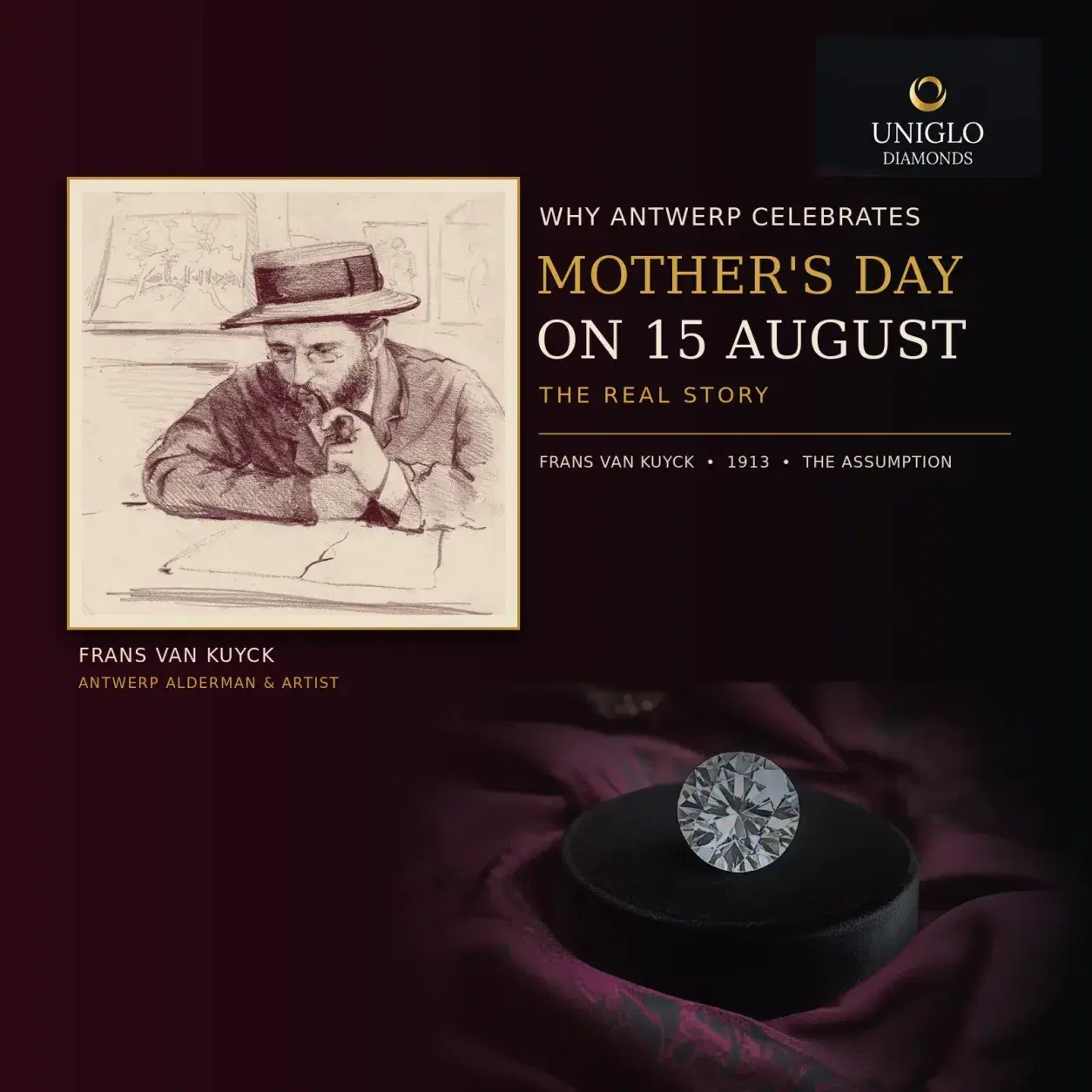
Quick answer: Antwerp celebrates Mother’s Day on 15 August because Antwerp artist and alderman Frans Van Kuyck introduced a local “Day of Mothers” on that date in 1913. He chose a day already associated with the Assumption of Mary, Antwerp’s patroness, and with municipal festivities that brought families home. The local tradition predates Belgium’s widespread May observance.
If you wish a mother in Antwerp a happy Mother’s Day in May, you may hear a characteristically local reply: our Mother’s Day is in August. This is more than a quirky difference in the calendar. Antwerp’s celebration grew from a carefully planned civic initiative with its own founder, symbols, publicity campaign and vision of family life.
In 2026, the contrast is especially easy to see. The second Sunday of May fell on 10 May, while Antwerp Mother’s Day falls on Saturday, 15 August. The two dates represent two different historical routes to the modern celebration.
Antwerp Mother’s Day at a glance
| Historical fact | What the record shows |
|---|---|
| Founder | Frans Van Kuyck (1852–1915), artist and Antwerp alderman for fine arts |
| Proposal published | 6 July 1913 |
| First Antwerp celebration | 15 August 1913 |
| Why that date? | The Assumption of Mary, Antwerp’s Marian tradition and the city’s existing municipal festivities |
| Original name | “Dag der Moeders” — “Day of Mothers” |
| Rest of Belgium | Generally celebrates on the second Sunday of May |
| 2026 anniversary | 113 years since the first Antwerp celebration |
The dates and details above are documented in the Frans Van Kuyck archive held by the Antwerp City Archives and analysed in the University of Antwerp’s historical study, Dag der Moeders: de uitvinding van de ideale moeder.
Who was Frans Van Kuyck?
Frans Van Kuyck was not a priest or a greeting-card manufacturer. Born in 1852, he built a career as an artist, taught at Antwerp’s Royal Academy of Fine Arts and became the city’s alderman for fine arts in 1895. He remained in that office until his death in 1915.
His public work helps explain how he was able to turn an idea into a recognisable city tradition. Van Kuyck had experience with exhibitions, processions, public decoration and civic promotion. He had helped create the popular “Old Antwerp” quarter for the 1894 World Exhibition and was involved in cultural and urban projects ranging from the Flemish Opera to public monuments and festivities. The University of Antwerp’s account of Van Kuyck describes a politician and designer who understood how repeated symbols and shared rituals could give a city a stronger identity.
That background matters. Antwerp Mother’s Day did not emerge spontaneously from an old folk custom. Van Kuyck deliberately designed it to feel familiar, to be easy for households and businesses to repeat, and to connect the modern city with established family and religious symbols.
What happened in Antwerp in 1913?
On 6 July 1913, the organising and propaganda committee for the “Day of Mothers” issued a brochure written by Van Kuyck. It explained why mothers should receive a dedicated annual celebration and set out, in unusually practical detail, how families and businesses should observe it.
Van Kuyck presented the idea as his own and stated that it had developed independently of the Mother’s Day movement in the United States. Just over a month after the brochure appeared, Antwerp held its first large celebration on 15 August 1913. University of Antwerp researchers describe it as the first modern Mother’s Day celebration in Europe, while correctly treating older mother-honouring religious customs as separate traditions.
The timing is important because the now-familiar American calendar had not yet become Belgium’s norm. Anna Jarvis had organised a memorial for her mother in West Virginia in 1908, but US President Woodrow Wilson did not issue the proclamation establishing the second Sunday in May as a national observance until 9 May 1914. The May model spread more widely in Belgium during the 1920s. Antwerp’s August celebration therefore predates both Wilson’s proclamation and the May observance’s broad Belgian adoption. The Library of Congress documents Jarvis’s 1908 service, Wilson’s 1914 proclamation records the later official US date, and The Brussels Times dates the Belgian spread of the May observance to the 1920s.
Why did Van Kuyck choose 15 August?
The strongest historical explanation has three connected parts. Reducing it to only one of them misses how deliberately the date was chosen.
1. It was already the Feast of the Assumption
In the Catholic calendar, 15 August is the Assumption of Mary. For Van Kuyck’s plan, Mary supplied an immediately recognisable image of motherhood. Choosing an established feast also gave the new celebration a sense of continuity; Antwerp households did not have to make space for a completely unfamiliar date.
2. Mary was Antwerp’s patroness
The connection was local as well as religious. Our Lady had been recognised as Antwerp’s patroness since 1124, according to the City of Antwerp’s history of the cathedral parish. The Marian feast was therefore part of the city’s identity long before Van Kuyck proposed Mother’s Day. The City of Antwerp’s historical account explains how Our Lady became the patroness of Antwerp and its people.
3. The date fell during Antwerp’s municipal festivities
Van Kuyck’s own brochure adds a practical reason that is often omitted from popular retellings: 15 August came during Antwerp’s municipal festivities. People who had moved away commonly returned to their parental home for the occasion. A family celebration placed on that date therefore had a ready-made audience and a natural setting.
The most accurate answer is consequently not simply “because of the Virgin Mary.” The Marian association gave the day meaning, while the existing city festivities made it socially workable.
Was Antwerp Mother’s Day a Catholic invention?
No. It had a clear Catholic setting, but the Catholic Church did not create Van Kuyck’s “Day of Mothers.” Van Kuyck was a liberal politician, and his brochure presented the celebration as universal — something that should not belong exclusively to one party, religion, social class or territory.
At the same time, it would also be misleading to call the plan entirely secular. Van Kuyck expected the date’s Marian meaning to appeal to Catholic Antwerp. Catholic newspapers responded positively, although some reports focused more on Saint Mary’s feast than on his new Mother’s Day. University research therefore describes a calculated overlap: a civic and family initiative that borrowed the date, symbolism and emotional force of a major religious observance.
This tension is one reason the Antwerp story is historically interesting. The celebration could be promoted as broadly inclusive while still reinforcing the conventional Christian family ideal influential in early twentieth-century Belgium.
What did the first “Day of Mothers” look like?
Van Kuyck did much more than name a date. His brochure supplied a blueprint for the home, the table and the gift.
Families were encouraged to decorate parts of the house with flowers and ribbons. Bakers were asked to produce bread in a special shape, while a “mother’s cake” would contain a bean in a manner reminiscent of Epiphany traditions. Children could contribute to an “archive of the mother,” a keepsake book preserving family memories and expressions of gratitude.
The proposal even included a piece of jewellery. Fathers were encouraged to give a “mother jewel”: a radiant heart engraved with the children’s names as a symbol of maternal love. Surviving drawings and drafts connected with the jewel are identified in the Van Kuyck holdings of the Antwerp City Archives. The University of Antwerp’s reconstruction of the 1913 programme also notes that Van Kuyck devised an alternative format for orphanages so that children without a mother at home would not simply be excluded.
These details reveal an important point: jewellery, food, flowers, remembrance and family participation were built into the Antwerp tradition from its first edition. They were not all added decades later by modern advertisers.
Was commerce part of the tradition from the beginning?
Yes. Van Kuyck’s plan was emotional and civic, but it was also commercially organised.
He recognised that bakers, goldsmiths, florists and other local shopkeepers would give the new day a repeatable public form. The retailers’ association Antwerpen Vooruit, founded in 1890, helped contact businesses, distribute posters and promote the celebration through its publication Antwerpen Vooruit/Anvers Avant. The University of Antwerp’s study calls this coordination central to the rapid construction of the new tradition. Its analysis of the campaign is based on Van Kuyck’s brochure, merchant correspondence and later historical research.
Contemporary reporting also gives a striking measure of public activity. On the Groenplaats, florists began selling from 5:00 in the morning. After offering thousands of flower arrangements, baskets and pots, they were reportedly completely sold out by around 10:00. Yet the newspaper report described the activity primarily as the feast of Saint Mary, showing that Van Kuyck’s new label had not instantly displaced the older meaning of 15 August. The University of Antwerp cites the 16–17 August 1913 report from Gazet van Antwerpen.
The evidence therefore resists a simple moral. Commerce did not invent the feeling of gratitude that Van Kuyck wanted families to express, but merchants and products were part of his mechanism for turning that feeling into an annual custom.
Popular claims versus the historical record
| Popular claim | What the evidence supports |
|---|---|
| “Antwerp moved Mother’s Day to August because the May version became too commercial.” | The chronology does not support this as the origin. Antwerp’s celebration began in August 1913, before Wilson’s 1914 US proclamation and before the May observance became widespread in Belgium. Van Kuyck’s own plan also involved retailers and gifts. |
| “The Catholic Church created Antwerp Mother’s Day.” | No. The documented initiator was Frans Van Kuyck, a liberal alderman. Catholic tradition strongly influenced his chosen date and symbolism. |
| “15 August was selected only because Mary is the mother of Jesus.” | Incomplete. The Assumption and Antwerp’s patroness were central, but Van Kuyck also chose a date within the municipal festivities, when families commonly reunited. |
| “Jewellery gifts are a modern commercial addition.” | Incorrect. Van Kuyck’s 1913 programme already proposed an engraved heart-shaped “mother jewel.” |
| “Antwerp held the world’s first Mother’s Day.” | Too broad. Anna Jarvis’s US observance predates it, and older religious customs honoured mothers. University researchers describe Antwerp’s 1913 initiative more specifically as the first modern Mother’s Day celebration in Europe. |
| “Everyone in Antwerp rejected the May date.” | Unsupported. The historical record establishes a durable local tradition, not the private practice of every Antwerp resident. Some families may recognise one date, the other or both. |
How is Antwerp Mother’s Day different from the rest of Belgium?
Most of Belgium follows the second-Sunday-in-May calendar associated with the international Mother’s Day movement. Antwerp’s best-known local observance remains fixed on 15 August, regardless of the day of the week.
That creates a practical difference every year:
- The Belgian May date moves because it is tied to a Sunday.
- The Antwerp date does not move because it is tied to 15 August and the Assumption.
- In 2026, the two dates are Sunday, 10 May and Saturday, 15 August.
It is safer to describe this as an Antwerp tradition than to imply a legal boundary or compulsory rule. Mother’s Day itself is a social observance; individual families choose how and when to mark it.
Why has the tradition lasted for more than a century?
Historians sometimes call customs like Antwerp Mother’s Day “invented traditions.” That does not mean they are false. It means their rituals were deliberately created and repeated until they acquired continuity and cultural weight.
Van Kuyck’s design had several advantages. It reused a familiar date, connected the home with the wider city, supplied recognisable symbols and enlisted organisations capable of repeating the message. It also left room for the simplest and most durable element: families could adapt the celebration while keeping 15 August as the local marker.
The tradition’s endurance is measurable. The year 2026 marks 113 years since Antwerp’s first “Day of Mothers.” Its meaning has evolved, and modern families are far more diverse than the household ideal described in 1913. The date survives because Antwerp residents have continued to make it their own, not because every detail of Van Kuyck’s original script remained unchanged.
From Van Kuyck’s “mother jewel” to a personal gift today
There is a direct historical reason jewellery feels at home in this particular story: a symbolic, engraved jewel was part of Van Kuyck’s first programme. That does not make every jewellery campaign historically meaningful. A modern gift should still be chosen around the recipient — her style, the pieces she actually wears and the significance the family wants the gift to carry.
For Antwerp Mother’s Day, Uniglo brings the history back to a practical question: what would she genuinely enjoy wearing beyond 15 August?
Discover selected necklaces, earrings, bracelets and rings, or request a personal shortlist based on her style and your preferred budget: diamond gifts for Antwerp Mother’s Day.
Frequently Asked Questions
More Topics