How to Prepare for a Jewellery Trade Show: A Buyer’s 15-Point Checklist
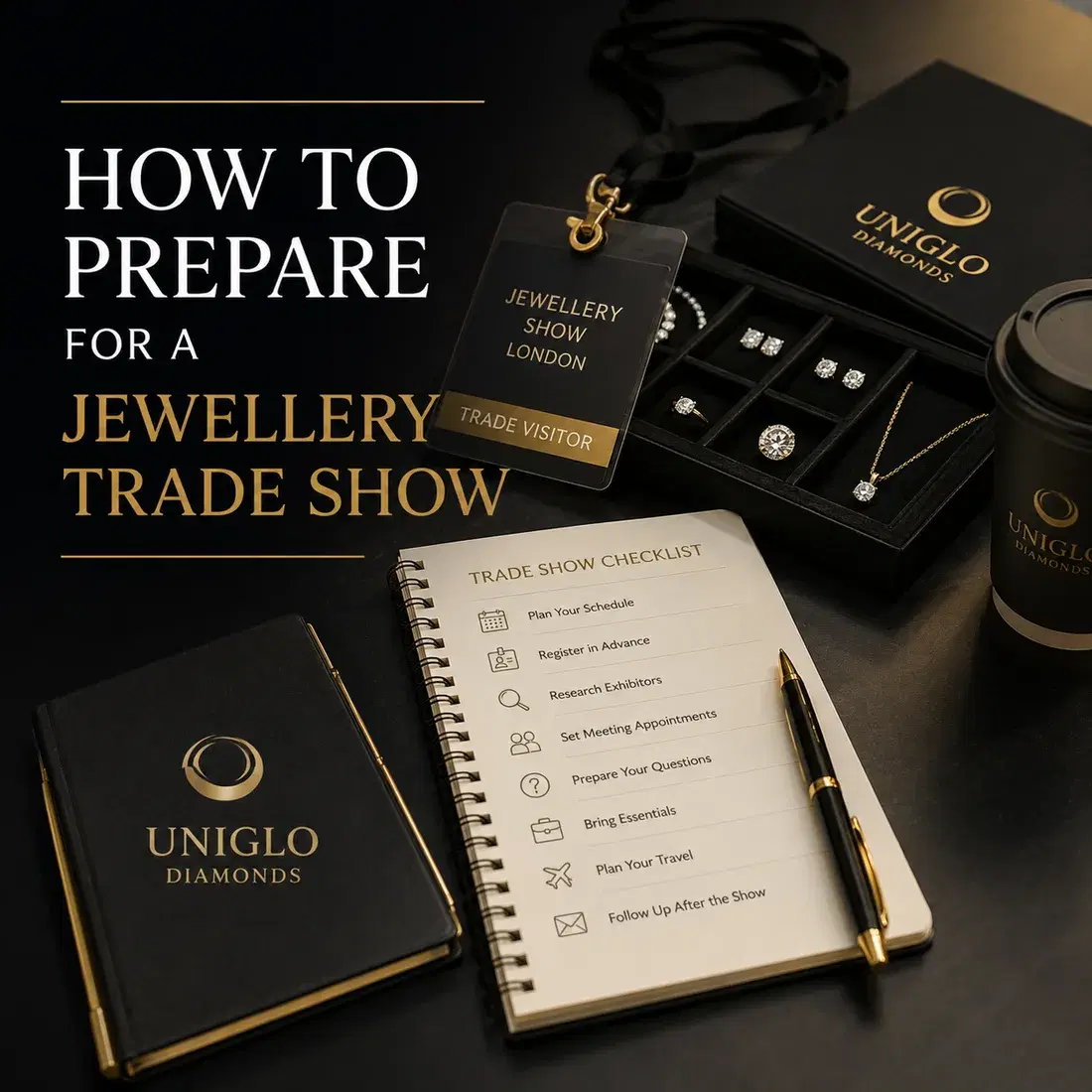
A jewellery trade show can be one of the most efficient buying opportunities of the year, but only if you arrive knowing what you need.
Walking into a hall full of new jewellery, diamonds, gemstones and suppliers without a buying plan is enjoyable, but it is not necessarily productive. Attractive products compete for attention, conversations run longer than expected and by the end of the day it can become surprisingly difficult to remember why one supplier stood out from another.
The best preparation starts before looking at the exhibitor list.
A buyer should know where the current assortment is weak, what customers are asking for, which price points need attention and how much money is realistically available to commit. Supplier meetings can then be built around genuine commercial requirements instead of becoming a sequence of introductions.
Trade-show planning advice across the wider retail sector follows the same principle: clear objectives, planned appointments and disciplined note-taking make follow-up more useful. Current retail guidance also notes that trade-show decisions often continue after the event rather than ending with an immediate order, which makes good records and clear next steps particularly important.
For jewellery buyers, that preparation needs another layer because product quality, stone specifications, precious metals, certification, replenishment and long-term sourcing can all affect whether an attractive product makes commercial sense.
Here is the 15-point checklist we would use.
1. Start With the Problem You Want the Show to Solve
Do not begin with the question, “Which brands should I visit?” Begin with your business.
Perhaps bridal is performing well but there is not enough choice between your entry and premium price points. Maybe customers repeatedly ask for oval diamonds that you struggle to source. Earrings may sell consistently while necklaces sit for too long. You might have a strong core range but very little that creates visual interest in the window.
Those are useful trade-show objectives because they lead to decisions.
“Find new jewellery” is too broad. “Find two suppliers that could strengthen our £1,000–£2,000 bridal offer without duplicating our existing range” gives the buyer something against which every meeting can be judged.
Try to leave the show having solved a small number of important problems rather than having collected information about everything.
2. Review What Is Already Selling
The most useful buying brief begins with your own sales data.
Look at what has actually sold rather than what the team remembers selling. Identify repeat performers, slower categories, popular metal colours, customer-favoured shapes and price bands where conversion appears strongest.
This does not mean buying more of whatever sold last month. The aim is to distinguish between core demand and temporary success. A classic diamond stud that sells throughout the year has a different role from a fashion-led piece that performed exceptionally well for six weeks.
A retailer preparing properly should know which parts of the assortment need depth, which need replacing and which probably need less investment. That makes it much easier to look at a new supplier objectively.
3. Identify the Gaps in the Assortment
Once the current range is understood, write down what is missing.
The gaps may be obvious: no strong anniversary product, too little yellow gold, weak wedding-band choice or not enough designs below a particular retail price.
Others are less visible. Perhaps the business sells plenty of diamond rings but has no reliable solution when a customer asks for a less common loose stone. Maybe the problem is not the range itself but the inability to replenish successful pieces quickly.
This is where a trade show becomes useful as a sourcing exercise rather than simply a product-discovery exercise. Take those gaps with you. A good buying day should gradually turn them into answers.
4. Set a Real Buying Budget Before You Arrive
Trade-show enthusiasm can destroy buying discipline remarkably quickly.
Set the available budget before entering the hall and, where possible, divide it by purpose. A retailer might separate money intended for core replenishment from money available for testing new products or suppliers.
Retail teams often refer to available purchasing capacity as open-to-buy: the amount the business can responsibly commit while considering existing stock, planned purchases and expected sales.
The exact system varies between retailers, but the principle is universal. New jewellery has to compete not only against other products at the show but against stock already sitting in the business. A piece can be beautiful and still be the wrong purchase.
5. Decide What Deserves Depth and What Deserves a Test
Not every new collection should receive the same commitment.
For a proven category from an established supplier, buying enough depth to support expected demand may make sense. For a completely new designer, price point or product type, a smaller test can provide more information with less inventory risk.
Ask yourself what needs to be learned. If you already know customers want a product, availability may be the main concern. If the product is new to your audience, the first order may be better treated as a test of demand.
Separating core buys from test buys before the show prevents excitement around something new from consuming money intended for reliable sellers.
6. Research Suppliers Before Booking Meetings
An appointment should not be used to discover the most basic facts that could have been learned beforehand.
Review the supplier’s website, product range, price positioning and the categories it appears to specialise in. If it is a diamond supplier, understand whether the business appears focused on natural diamonds, lab-grown diamonds, particular sizes or a broader inventory model. If it manufactures finished jewellery, look at design language, metals and likely fit with your existing assortment.
The point is not to make the decision online. The point is to use the face-to-face meeting for questions that actually require a conversation.
At the 2026 Jewellery Show, for example, the official directory provides a searchable exhibitor list before buyers reach the venue, which makes advance shortlisting possible.
Research five promising suppliers properly and you are likely to have better conversations than if you simply write down twenty names.
7. Book the Most Important Appointments First
If a particular supplier could solve an immediate sourcing problem, do not rely on finding them when you happen to walk past the stand. Book the meeting.
The best appointments also have a purpose. Let the supplier know what you want to discuss if possible. “We are looking for a diamond supplier” is less useful than explaining that you regularly need certified ovals between particular carat ranges and want to understand availability and sourcing support.
This gives the supplier an opportunity to prepare relevant information and stops the first half of the meeting being spent narrowing down what you actually came to discuss.
Long-standing jewellery trade-show advice has similarly recommended treating supplier meetings as structured commercial discussions covering products, terms, delivery, stock arrangements and communication rather than informal introductions.
8. Prepare the Specifications That Matter to You
Jewellery buying becomes much easier when subjective taste is supported by objective requirements.
If you are sourcing diamonds, arrive knowing the combinations of shape, carat weight, colour, clarity, grading documentation and budget that matter most frequently to your customers.
For finished jewellery, you may need to know preferred metals, target retail prices, stone requirements, dimensions, packaging expectations or delivery windows.
You do not need a fifty-page specification document. A concise buying brief on your phone or tablet can be enough.
The important point is that when somebody shows you a promising product, you can judge whether it actually fits the business rather than deciding from appearance alone.
9. Know Which Supplier Questions Matter Before the Meeting
The right questions depend on what is being sourced, but several commercial areas deserve attention across most supplier relationships.
Price obviously matters. So do minimum orders, lead times, replenishment, payment terms, consistency and communication.
For finished jewellery, ask what happens when a successful item needs to be reordered. Find out whether core products remain available and how much variation exists between batches.
For diamonds or gemstones, discuss documentation, supply depth and what happens when you need a specification that is not currently available.
Established jewellery trade guidance also highlights issues such as credit, delivery, stock balancing and return or exchange arrangements as useful areas for supplier meetings. A low opening price can become considerably less attractive if everything surrounding the order is difficult.
10. Compare Suppliers Using the Same Criteria
One of the biggest problems with trade-show buying is that every conversation feels different.
One supplier discusses craftsmanship. Another talks about margin. A third focuses on delivery. By late afternoon it becomes easy to compare whichever details happen to be most memorable rather than judging companies consistently.
Create a simple supplier scorecard before the show. It does not have to be complicated. Product fit, quality, price positioning, minimum order, replenishment, lead time, documentation and communication may be enough.
After each important conversation, record the same categories. This does not turn jewellery buying into a spreadsheet exercise. Buyers still need judgement. It simply gives that judgement something consistent to work from.
11. Record Notes Immediately, Not at the End of the Day
Trade-show memory is unreliable.
After six or seven supplier conversations, details begin to merge. The ring you thought came from one company may have been shown by another. A useful comment about lead time is forgotten. A supplier that seemed exciting at 11:00 becomes difficult to distinguish from three similar businesses by 17:00.
Spend two minutes after an important meeting recording what mattered. Note the products that stood out, indicative pricing, commercial terms discussed, follow-up required and any concern you do not want forgotten.
Current retail trade-show guidance recommends capturing contextual notes during meetings specifically because they make post-show follow-up more useful. A photograph of a business card tells you who you met. A good note tells you why the meeting mattered.
12. Look Beyond the Opening Price
A buyer should never ignore price, but the cheapest unit cost does not automatically produce the best commercial outcome.
Imagine two suppliers offering comparable pieces. One is slightly cheaper but requires substantially larger minimum orders and takes much longer to replenish. The other costs more per piece but allows controlled stock depth and can replace successful lines quickly.
The second relationship may ultimately require less cash and create fewer missed sales.
For diamond sourcing, the same principle can apply to inventory. A supplier able to respond reliably to specifications you do not hold may help the retailer avoid owning every possible stone combination. Evaluate total commercial fit, not simply the number written beside the product.
13. Ask What Happens After the First Order
Newness can dominate a trade show. Retail buying is mostly about what happens after newness disappears.
Ask whether the supplier can repeat a successful piece. Ask how long replenishment normally takes. Ask who handles queries after the show. If the supplier manufactures jewellery, understand how much variation to expect between production runs. If the relationship involves diamonds, ask how special sourcing requests are managed once you are no longer standing together in front of the current inventory.
The first order proves you liked the product. The next few orders reveal whether the supplier works for the business.
That distinction is especially important for core, bridal and everyday jewellery where consistency often matters more than novelty.
14. Leave Part of the Day Unplanned
Preparation should not eliminate discovery.
A buyer who books every fifteen minutes of the show only sees the suppliers they already knew existed. That removes one of the major advantages of travelling to a physical trade event.
Protect your important meetings first, then leave genuine time for the floor. Walk through categories adjacent to the ones you planned to buy. Look at new designers. Speak to a supplier whose products caught your attention even though the company never appeared on the original shortlist.
The Jewellery Show itself describes the event as an opportunity to source new collections and materials, gain knowledge and meet other jewellery professionals, while its 2026 directory includes a large mix of UK and international exhibitors.
A good buying plan should create structure without removing serendipity.
15. Turn the Show Into Decisions Within a Few Days
Do not leave the notes sitting untouched for two weeks. By then the urgency has gone and the context surrounding many conversations has faded.
Soon after returning, group suppliers into clear next steps. Some may justify an order. Others need samples, pricing, stock information or a second conversation. A few can be ruled out immediately.
Current retail trade-show guidance suggests following up within a few business days and stresses the importance of carrying meeting context into that follow-up. For a buyer, the principle is equally useful.
If a supplier was promising, say exactly what you want next. “Great meeting you” is polite. “Please send availability and pricing for the oval specifications we discussed” moves the buying decision forward.
What a Good Jewellery Trade Show Should Give You
The value of a trade show should not be measured by the number of catalogues collected, photographs taken or stands visited.
A successful buying trip should leave you with a clearer assortment, a smaller group of genuinely useful suppliers and better information about what the business should buy next.
You may also leave with decisions not to buy. That is useful too.
Discovering that a category looks stronger online than it does in person, that a supplier’s minimum order does not suit your business or that three supposedly different ranges would all duplicate stock you already carry can save significant money.
The buyer’s job is not to come home with as much jewellery as possible. It is to return with better commercial decisions.
Preparing for the Jewellery Show London 2026
This checklist is deliberately evergreen, but it can be applied directly to the Jewellery Show London 2026.
The organisers position the show as a trade event for jewellery businesses to source collections and materials, develop industry knowledge and connect with suppliers.
For buyers who have diamonds on their sourcing brief, Uniglo Diamonds (Antwerp) is confirmed at Stand B41 in the official 2026 exhibitor directory.
Do not arrive at B41 simply asking what diamonds are available. Bring the requirements your business is actually trying to solve — shapes, carat ranges, colour and clarity combinations, certification preferences or recurring specifications that are difficult to source.
That is where preparation turns a trade-show introduction into a useful commercial conversation.
Jewellery Trade Show Preparation FAQs
More Topics