Jewellery Assortment Planning: How to Balance Core, Bridal and Statement Pieces
A jewellery assortment does not become stronger simply because it becomes larger.
A retailer can have hundreds of rings, earrings, necklaces and bracelets and still leave customers feeling that there is surprisingly little to choose from. The opposite can also be true. A smaller collection can feel complete when it covers the occasions, styles, price points and customer needs that matter most to the people who actually shop there.
That is the real purpose of jewellery assortment planning. It is the process of deciding what deserves space in the collection, where the retailer should carry stock depth, where a small test is more appropriate and which customer requirements can be supported through suppliers rather than by owning every possible piece.
Retail assortment planning usually involves balancing dependable core products with seasonal, occasion-led and more experimental inventory. There is no universal percentage that works for every retailer. A bridal specialist, luxury independent, ecommerce jeweller and multi-category high-street store will all need very different ranges.
Jewellery makes this particularly complex because not every product behaves in the same way. A pair of diamond studs may sell repeatedly throughout the year. A distinctive cocktail ring may sell only occasionally but play an important role in the identity of the store. A bridal customer may want to compare several settings while ultimately ordering a diamond or ring specification that the retailer does not physically own.
Good assortment planning recognises those differences.
Start With Why Customers Buy From You
Retailers naturally think in categories. Customers often think in occasions.
The buyer may see rings, earrings, necklaces and bracelets. The customer may be thinking about an engagement, anniversary, birthday, wedding, promotion or simply wanting something new for themselves. Those motivations are often more useful when planning an assortment than the product categories alone.
A store can appear well stocked and still have obvious gaps when viewed through customer intent. It may have plenty of rings but very little suitable for gifting when the buyer does not know someone’s ring size. It may have an excellent engagement-ring offer but almost nothing that encourages those same customers to return for anniversaries or milestones. Another retailer may have a strong accessible jewellery range but no convincing trade-up option when a customer wants to spend substantially more.
The first question in assortment planning should therefore be: what are customers coming to us to buy, and how well does the current range answer those needs? Once that is clear, the product decisions become easier.
Core Jewellery Should Do More of the Commercial Work
Every successful jewellery business normally has a group of products that sell with relatively dependable frequency. What those products are will vary considerably from retailer to retailer.
For one business, diamond studs, simple pendants and tennis bracelets may form the commercial backbone. For another, it could be gold hoops, chains and stacking rings. A bridal-focused retailer may consider solitaire engagement rings and classic wedding bands part of its core.
The important point is that core should be identified from the retailer’s own customer behaviour rather than from a generic list of jewellery-store essentials.
Historic sales information can reveal which styles return consistently, which price points convert well and which products customers repeatedly ask to replace, upgrade or purchase in another variation. Those are the areas where losing availability can be particularly expensive.
Core inventory therefore often deserves more stock depth and more dependable replenishment than experimental products. But core should not mean dull.
A classic diamond pendant still competes with other diamond pendants. A pair of hoops still needs the right size, weight and finish. Customers may understand the product category immediately, but they still need a reason to choose your version. Good core buying is often about controlled variation rather than endless choice.
Bridal Needs Choice Without Requiring the Retailer to Own Everything
Bridal is one of the clearest examples of why jewellery assortment planning cannot be reduced to stocking more products.
An engagement-ring customer can potentially vary the diamond shape, carat weight, colour, clarity, certificate, setting, metal, ring size and budget. Trying to hold every possible combination would tie up enormous amounts of capital.
The better question is what the customer needs to see and what the retailer genuinely needs to own.
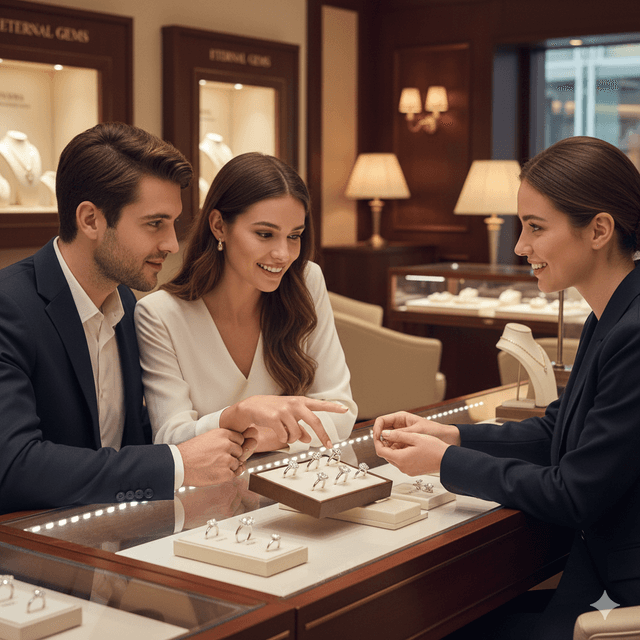
A strong bridal assortment should provide enough physical choice for customers to compare proportions, styles, settings and price levels. It does not necessarily follow that every final diamond specification needs to be sitting in the safe.
This is where supplier access becomes part of assortment planning. If a retailer has reliable access to a broader pool of certified diamonds, the effective range available to the customer can be much larger than the stock physically held in-store. The same principle can apply to ring sizes, metal options and certain made-to-order designs.
That can create a much healthier relationship between customer choice and working capital. The retailer still needs stock. The difference is that it becomes more deliberate stock.
Think About Price Architecture, Not Just Product Count
A collection can have plenty of products and still have poor price coverage.
Imagine a bracelet range with six designs sitting within almost the same price band. To the buyer, that may look like choice. To the customer, it may simply look like six versions of the same decision.
A stronger assortment usually gives the customer somewhere sensible to enter the category and somewhere to trade up. The difference between price levels should also be understandable. The customer might move from a simpler design to greater diamond presence, heavier metal, more craftsmanship, a rarer stone or a more distinctive design.
There is no need to force every category into a rigid “good, better, best” structure, but the principle is useful. Price points should create meaningful progression rather than accidental clustering.
For buyers, looking at inventory by both category and price can reveal problems that are difficult to see when every piece is considered individually. A range may be strong between £500 and £1,000 while having almost nothing convincing for customers who want to spend £2,500. That is an assortment gap even if the showcase looks full.
Bridal Should Lead Somewhere After the Wedding
Bridal can be treated as an isolated department, but commercially it often makes more sense to think of it as the beginning of a customer relationship.
The engagement ring can lead to wedding bands. The wedding can lead to anniversary jewellery. Later may come diamond earrings, eternity rings, milestone gifts or pieces connected with family occasions.
That makes it worth asking whether the bridal assortment creates logical routes into other parts of the store.
A customer who buys an engagement ring should not necessarily need to rediscover the business from scratch when looking for an eternity ring three years later. Where appropriate, design language, metal options and diamond quality can carry through into later purchases.
This is not simply about cross-selling. It is about making the wider assortment feel coherent. A customer may first recognise the business for bridal but gradually come to trust it for jewellery more generally.
Statement Pieces Should Not Be Judged Like Core Stock
Not every product in a jewellery store needs to sell with the same frequency. Some pieces have a different job.
A sculptural bracelet, distinctive diamond ring or unusual necklace may attract attention from across the store. It can give the window character, start conversations and communicate something about the retailer’s taste even when the eventual purchase is a different piece.
That value is real, but it does not justify buying statement jewellery with the same depth as dependable core products. In many cases, statement pieces deserve more variety and less quantity.
One excellent piece may be enough to test whether a design direction resonates with customers. If it sells quickly or produces repeated enquiries, the buyer can respond. If it attracts attention but not purchases, the retailer has learned something without becoming heavily invested.
This is where assortment planning protects a retailer from trend enthusiasm. A trend can deserve representation without deserving a major stock commitment.
Breadth and Depth Need Different Decisions
One of the most useful distinctions in assortment planning is the difference between breadth and depth. Breadth is the amount of different choice available to the customer. Depth is how much inventory sits behind each choice.
A core category may need both. If a particular diamond pendant sells repeatedly, the retailer needs a credible selection and enough stock or replenishment to avoid losing sales.
A statement category may need breadth but very little depth. Customers should see that the retailer has interesting options, but holding several units of each experimental design may make little sense.
Bridal creates another model entirely. Customers require broad choice, but part of that choice can sometimes be delivered through samples, supplier inventory and made-to-order sourcing rather than full ownership.
Thinking in these terms helps retailers build a range that appears extensive without forcing them to finance every possible option.
Use Sales Data, but Understand What the Numbers Mean
Buying instinct is valuable in jewellery. It should work alongside data rather than replacing it.
Look at which products sell repeatedly, which categories produce strong revenue, which price points convert well and which pieces have occupied significant stock value without enough movement.
Inventory turnover can be useful because it shows how often stock is sold and replaced over a period. However, jewellery retailers need to interpret turnover carefully. A £250 pair of earrings and a £15,000 diamond ring should not necessarily be expected to move at the same rate.
The more useful question is whether each product is performing the job assigned to it. A core item that rarely sells is a problem. A hero piece that sells infrequently but creates high-margin transactions and supports the store’s positioning may be doing exactly what was expected.
Data becomes useful when it helps the buyer understand those distinctions.
Decide What You Need to Own and What You Need to Access
This may be one of the most commercially important questions in jewellery assortment planning. Which products must physically be in the business? And which products simply need to be available quickly when a customer asks for them?
Core products that customers regularly expect to purchase immediately often justify stock. Highly specific diamonds can be different.
Imagine a retailer that receives regular demand for round and oval diamonds but only occasional enquiries for certain emerald-cut specifications. Carrying deep inventory across every shape, carat weight, colour and clarity combination may leave large amounts of capital sitting in stones waiting for exactly the right customer.
If the retailer has reliable sourcing support, some of that choice can exist through access rather than ownership. That does not remove inventory risk completely, but it changes how the retailer thinks about range.
A supplier is no longer simply someone who sells stock to the retailer. The supplier can become part of the retailer’s ability to offer a broader assortment.
Too Much Similarity Can Make a Range Weaker
Assortments often become overcrowded gradually.
One supplier introduces a pendant that looks promising, so the buyer adds it. Another collection brings something similar six months later. Then another version appears at an attractive price. Eventually the retailer has several products solving almost exactly the same customer need.
This is particularly easy to miss when products come from different suppliers.
Before adding a new piece, ask what existing item it will compete against. Does it introduce a new price point, design direction, stone, customer occasion or reason to buy? Or is it simply another version of something already well represented?
Newness alone is not enough. Sometimes a good assortment decision is replacing an existing product rather than adding another one.
Leave Some Buying Capacity Uncommitted
Planning should create discipline without making the retailer unable to react.
Open-to-buy is one of the tools retailers use to understand how much purchasing capacity remains after considering existing inventory, planned sales and outstanding orders. Current retail guidance describes it as a way of aligning buying with sales expectations while reducing the risk of excess stock.
For a jewellery retailer, the exact calculation matters less here than the principle. Do not commit every pound of future inventory budget before reaching the buying opportunity.
A retailer may discover a supplier that solves a genuine problem, see a category customers have recently started requesting or encounter a product that is substantially stronger than what was expected.
Having some purchasing flexibility allows the business to respond intelligently rather than either missing the opportunity or overspending.
Review the Range as the Customer Will See It
Supplier appointments naturally encourage buyers to think collection by collection. Customers do not shop that way. They see the store as one assortment.
Three supplier ranges may each look excellent individually while collectively producing too much duplication. The opposite can happen too: each supplier may have been bought cautiously, leaving the overall store without enough depth anywhere.
Before confirming major orders, step away from the supplier view and look at the total range.
Where are the price gaps? Which products perform the same role? Is bridal stronger than gifting? Are there enough trade-up opportunities? Do statement pieces add identity without overwhelming dependable stock?
This is where assortment planning becomes more than purchasing. It becomes merchandising.
There Is No Universal Core-Bridal-Statement Formula
It would be easy to make this article sound more authoritative by saying something like “60% of your range should be core, 25% bridal and 15% statement”. That would also be misleading.
There is no responsible universal allocation that fits every jewellery retailer.
A bridal specialist could justifiably devote the majority of its buying capacity to engagement and wedding jewellery. A fashion-led independent might carry much more expressive inventory. A diamond-focused ecommerce business may operate with comparatively little finished jewellery stock.
The correct balance has to come from the business model, customer demand, margins, sales history and ability to replenish. The useful principle is not a fixed percentage. It is that different parts of the assortment deserve different levels of investment.
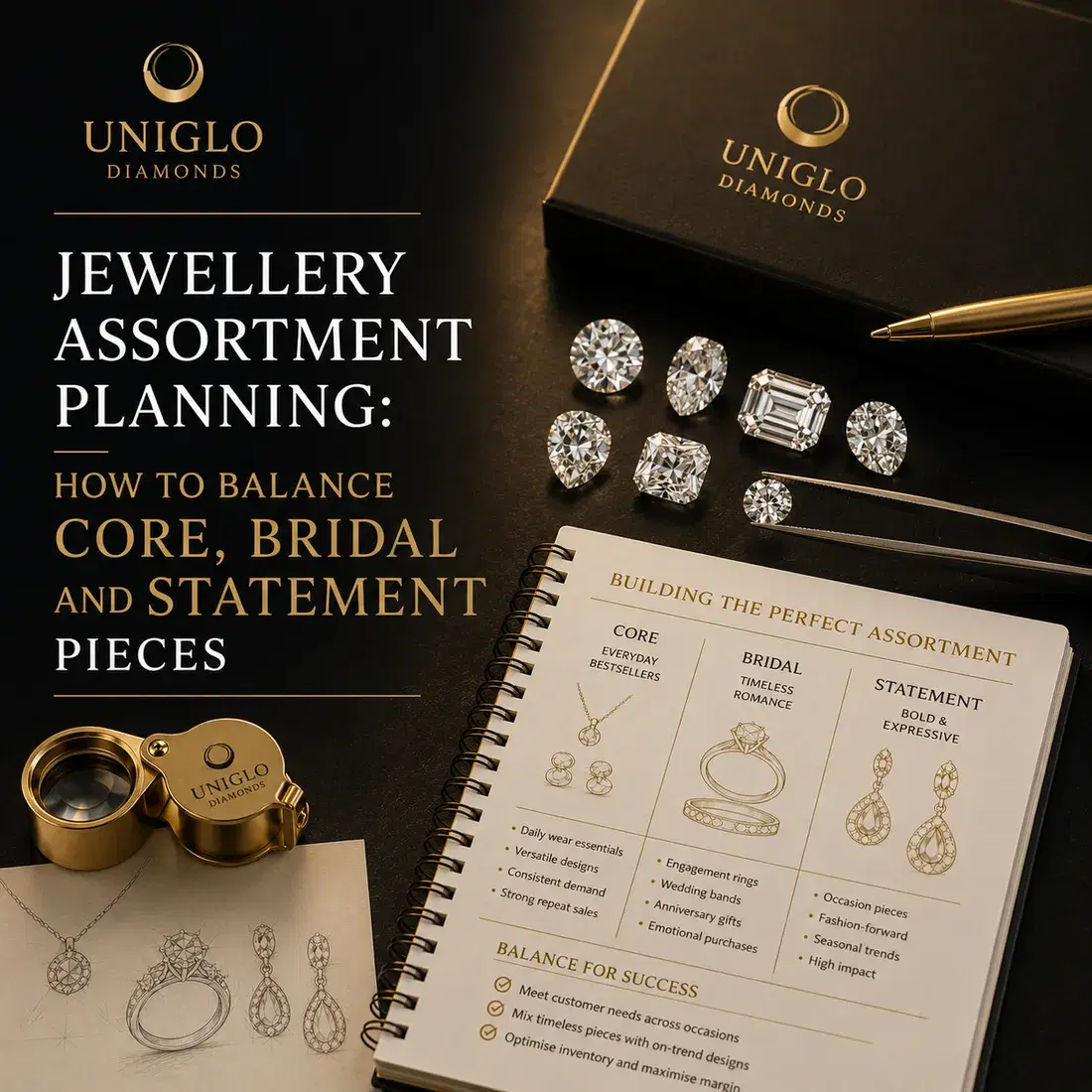
Core typically needs reliability. Bridal requires credible choice and sourcing flexibility. Gifting needs clear price architecture. Statement jewellery can provide differentiation with controlled risk. The proportions come afterwards.
How Assortment Planning Changes Trade-Show Buying
A retailer with a clear assortment strategy walks a trade show differently. They are not looking at every attractive product and asking whether they like it. They already know the collection problems they are trying to solve.
Perhaps bridal needs more choice below a certain price point. Maybe diamond earrings need greater depth. The store may have plenty of delicate jewellery but nothing with enough presence to anchor a window. Or the business may be holding too much capital in diamonds that could be sourced more efficiently when required.
Those objectives turn supplier meetings into much better conversations.
At the Jewellery Show London 2026, where the organisers expect more than 200 exhibitors across jewellery, diamonds, gemstones and related trade categories, the amount of available choice can become overwhelming without that framework.
A clear assortment plan filters the show. It tells the buyer what deserves attention and, just as importantly, what does not. Our 15-point buyer checklist sets out how to prepare.
Using Diamond Supply to Extend the Assortment
Diamond inventory is particularly well suited to this way of thinking because the number of possible combinations is so large.
A retailer may want to give customers access to a broad choice of shapes, carat weights and qualities while knowing that only some combinations justify permanent stock. Supplier flexibility can help bridge that gap.
Uniglo Diamonds (Antwerp) is confirmed at Stand B41 at the Jewellery Show London 2026. The official exhibitor profile describes certified natural and lab-grown diamond supply together with inventory access.
For a retailer, the useful conversation is therefore not simply, “What stones do you have?” Bring the gaps in the assortment.
Which diamond requests are frequent enough to deserve stock? Which specifications are difficult to source? Which stones are tying up capital despite moving infrequently? Where would better supplier access allow the retailer to offer more choice without physically owning every option?
Those questions connect sourcing directly with assortment planning.
Build a Range With a Reason Behind Every Product
The strongest jewellery assortment is rarely the one with the most pieces.
It is the one where customers can find dependable favourites, meaningful choices for important occasions, sensible price progression and enough individuality to make the store feel distinctive.
Core products create reliability. Bridal creates high-intent choice. Gifting and self-purchase give customers reasons to return. Statement pieces create identity.
Those categories do not need equal stock. They need deliberate stock.
The aim is to understand what should be held deeply, what should be tested carefully and what can be supported through a strong supplier relationship rather than permanent ownership. That is the difference between carrying more jewellery and building a better assortment.
If diamond sourcing forms part of the gaps in your current range, bring those requirements to Uniglo Diamonds (Antwerp) at Stand B41 and discuss how greater sourcing flexibility could support the assortment without requiring you to own every stone.
Jewellery Assortment Planning FAQs
More Topics