How to Measure Ring Size at Home: 5 Proven Methods
At Uniglo Diamond, our gemologists help customers find their perfect ring fit every single day. Whether you are choosing a lab-grown diamond engagement ring, a classic wedding band, or an anniversary piece, getting your ring size right from the start saves you time, money, and the frustration of resizing.
This guide gives you 5 proven at-home methods, a complete US/UK/EU ring size chart, and the same expert tips our team uses in our showroom — so you can order with total confidence.
Why Accurate Ring Sizing Matters
A ring that is too tight cuts off circulation. One that is too loose spins, slides off, or falls into a drain. Beyond comfort, precision matters for several important reasons:
- Eternity bands cannot be resized — rings set with diamonds or gemstones all the way around cannot be resized without removing stones. Getting it right the first time is essential.
- Resizing costs money — professional resizing costs $50–$150+ and takes 1–2 weeks. It is an easily avoidable expense with careful at-home measurement.
- Wide bands fit tighter — a 10mm band feels smaller than a 3mm band at the same ring size. Band width directly affects comfort.
- Diamond settings can be damaged — resizing a diamond engagement ring puts stress on prong settings. The less resizing needed, the better for your stone.
The 5 At-Home Ring Sizing Methods
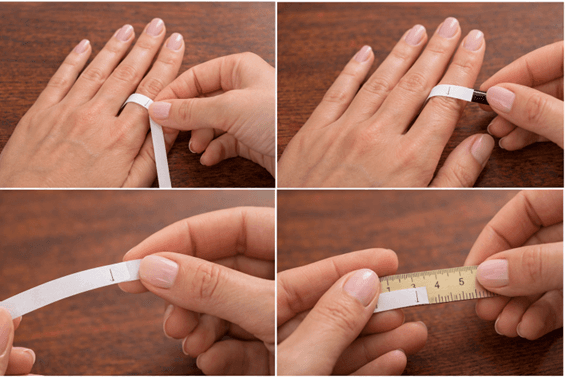
Method 1: The Paper Strip Method (Most Accurate DIY)
- Cut a thin strip of paper roughly 6 inches long and 1/4 inch wide.
- Wrap it snugly around the base of the finger you will wear the ring on — not the knuckle.
- Use a fine pen to mark exactly where the paper overlaps.
- Remove the paper and lay it flat against a ruler. Measure from the end to your mark in millimeters.
- Match your measurement to the ring size chart later in this guide.
Method 2: The String Method
- Cut a piece of non-stretchy string, dental floss, or thin ribbon about 6 inches long.
- Wrap it around the base of your finger where the ring will sit.
- Mark where the string meets with a pen or pinch it with your fingernail.
- Lay the string flat on a ruler and measure the marked length in millimeters.
- Match to the ring size chart in this guide.
Method 3: How to Measure Ring Size in Inches
- Follow the paper or string method above to wrap your finger.
- Measure the length in inches instead of millimeters.
- Multiply your inches measurement by 25.4 to convert to millimeters.
- Match that millimeter number to the circumference column in the ring size chart.
Inches conversion formula: Inches measurement × 25.4 = Circumference in mm → Match to chart. Example: 2.36 inches × 25.4 = 59.9mm = US Ring Size 9
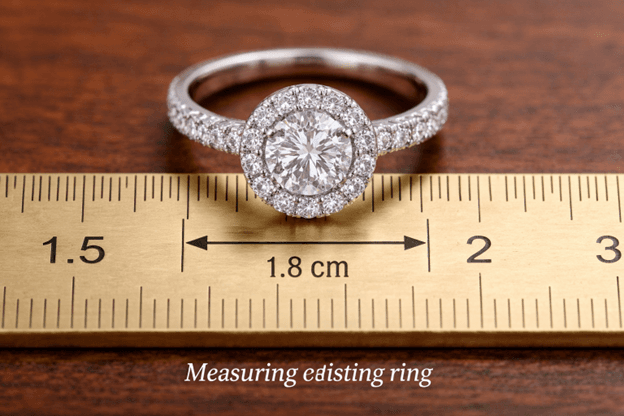
Method 4: Using an Existing Ring
- With a ruler: Place the ring flat on a surface. Measure the inside diameter in millimeters — from the inner edge on one side directly across to the inner edge on the other side.
- Match that diameter measurement to the diameter column in the ring size chart.
- With a printable chart: Print the Uniglo Diamond ring size guide at exactly 100% scale (never 'fit to page' — this distorts the circles).
- Place your ring over the printed circles and find the one where the ring's inner edge lines up exactly.
Method 5: Adjustable Ring Sizer Tool
- Thread the pointed end through the buckle to form a loop.
- Slide the loop onto your finger and tighten it gradually.
- Ensure it passes over your knuckle with slight resistance but sits comfortably at the base.
- Read the number on the sizer where it meets the buckle — that is your ring size.
Free Ring Size Chart: US, UK & EU Conversion (2026)
Use this complete ring size chart to match your millimeter measurement to your US ring size, and to convert between international sizing systems.
| US Size | Circ. (mm) | Diam. (mm) | Circ. (in) | UK Size | EU Size |
|---|---|---|---|---|---|
| 4 | 46.8 | 14.9 | 1.84" | H | 47 |
| 4.5 | 48.0 | 15.3 | 1.89" | I | 48 |
| 5 | 49.3 | 15.7 | 1.94" | J½ | 49 |
| 5.5 | 50.6 | 16.1 | 1.99" | K½ | 51 |
| 6 | 51.9 | 16.5 | 2.04" | L½ | 52 |
| 6.5 | 53.1 | 16.9 | 2.09" | M½ | 53 |
| 7 | 54.4 | 17.3 | 2.14" | N½ | 54 |
| 7.5 | 55.7 | 17.7 | 2.19" | O½ | 56 |
| 8 | 57.0 | 18.1 | 2.24" | P½ | 57 |
| 8.5 | 58.3 | 18.6 | 2.29" | Q½ | 58 |
| 9 | 59.5 | 18.9 | 2.34" | R½ | 60 |
| 9.5 | 60.8 | 19.4 | 2.39" | S½ | 61 |
| 10 | 62.1 | 19.8 | 2.44" | T½ | 62 |
| 10.5 | 63.4 | 20.2 | 2.49" | U½ | 63 |
| 11 | 64.6 | 20.6 | 2.54" | V½ | 65 |
| 11.5 | 65.9 | 21.0 | 2.59" | W½ | 66 |
| 12 | 67.2 | 21.4 | 2.64" | X½ | 67 |
| 13 | 69.7 | 22.2 | 2.74" | Z | 70 |
5 Expert Tips for a Perfect Ring Fit
Our Uniglo Diamond gemologists share the most important advice they give customers before every ring purchase.
- Measure more than once — Finger size changes with temperature, hydration, and time of day. Measure morning, afternoon, and evening — use the middle value.
- Measure at the right time — Fingers are smallest in the morning and slightly larger in the afternoon and evening. Measure mid-to-late day for the most reliable everyday fit.
- Account for band width — Wider bands cover more skin surface and feel tighter. Size up half a size for bands 8–10mm wide, and a full size for bands over 10mm.
- Consider your knuckle — If your knuckle is noticeably wider than your finger base, size to fit over the knuckle. A ring adjuster or sizing bead can stop it spinning at the base.
Sizing for Special Ring Styles
- Engagement Rings (Solitaire): Measure the left ring finger specifically. Most solitaires can be resized ±2 sizes, but precise sizing reduces stress on the prong setting.
- Eternity Bands (CANNOT BE RESIZED): Diamonds set all the way around make resizing impossible. Take at least 5 measurements across 2 days before ordering.
- Men's Wedding Bands: Wide flat bands (8mm+) require sizing up by half to one full size. If your partner normally wears a size 10, order a 10.5 for an 8mm band.
- Stackable Rings: If stacking 3 or more rings, size each ring half a size larger than your normal measurement.
- Halo Engagement Rings: More complex to resize than simple solitaires. Getting the right size from the start is especially important.
- Three-Stone Rings: Can generally be resized 1–2 sizes in either direction. Standard sizing rules apply.
Common Ring Sizing Mistakes to Avoid
- Wrapping the string or paper too tightly — the wrap should feel snug like a ring, not compressed. You should be able to slide it off without effort.
- Measuring when fingers are cold — cold temperatures shrink fingers. A cold-morning measurement can read up to half a size smaller than your true fit.
- Ignoring band width when ordering — a 10mm band at size 6 will fit like a size 5.5. Always size up for wide bands.
- Measuring only once — finger circumference can fluctuate by up to half a size across a single day. Always take at least 3 measurements at different times.
- Printing a size chart at the wrong scale — always print at exactly 100% scale, never 'scale to fit page.' Scaling even 5% distorts the circles.
More Topics